
Lead Nurturing Reduces Customer Acquisition Cost and Increases Conversions
Lead nurturing reduces customer acquisition cost (CAC) by improving conversion rates, building trust with prospects, and maximizing the value of existing leads instead of constantly acquiring new ones. When businesses guide leads through the buyer journey with relevant content and timely follow-ups, they convert more leads into customers—lowering CAC and increasing overall marketing ROI.
Here’s the problem most businesses face:
They invest heavily in ads, generate leads…
but only a small percentage actually convert.
The result?
High CAC, wasted budget, and inconsistent growth.
But the real issue isn’t traffic.
It’s what happens after the lead comes in.
Most leads are not ready to buy immediately.
They need:
- Clarity
- Trust
- Confidence
And that’s exactly what lead nurturing provides.
Instead of pushing for a sale too early,
lead nurturing focuses on:
- Educating prospects
- Addressing objections
- Building relationships over time
Think of it this way:
If 100 leads enter your funnel and only 2 convert, your CAC is high by default.
But if you can convert 5, 10, or even 15 of those same leads…
Your CAC drops—without increasing your ad spend.
Understanding how lead nurturing reduces customer acquisition cost comes down to one principle—converting more of the leads you already paid to acquire.
In this guide, you’ll learn how to use lead nurturing as a system, not just a tactic—so you can reduce CAC, increase conversions, and build a more efficient, scalable growth engine.
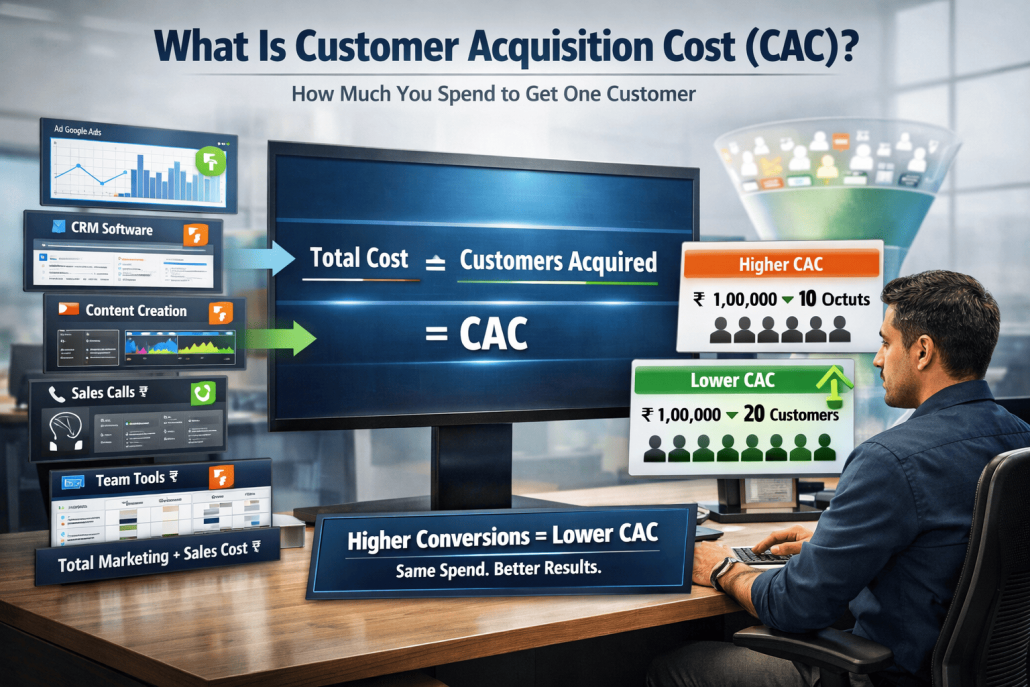
What Is Customer Acquisition Cost (CAC) — And Why It Matters
Let’s simplify this.
Customer Acquisition Cost (CAC) is:
The total cost you spend to acquire one customer.
Simple Formula:
CAC = Total Marketing + Sales Cost ÷ Number of Customers Acquired
What goes into CAC?
Most businesses underestimate this.
It’s not just ad spend.
Your CAC includes:
- Ad spend (Google Ads, Meta Ads, etc.)
- Tools (CRM, email software, analytics tools)
- Team salaries (marketing + sales teams)
- Content creation (blogs, videos, creatives)
- Sales effort (calls, demos, follow-ups)
Why This Matters More Than You Think
Here’s where most businesses go wrong:
They assume:
“High CAC = expensive marketing”
But that’s not always true.
The Real Insight
High CAC often means:
Low conversion efficiency
Let’s look at a simple example:
You spend ₹1,00,000 on marketing.
Case 1:
- You acquire 10 customers
CAC = ₹10,000
Case 2:
- You acquire 20 customers
CAC = ₹5,000
What changed?
Not your budget.
Not your ads.
Your conversion rate improved.
That’s the game changer
You don’t always need to reduce spend to lower CAC.
You need to increase how many leads turn into customers.
Real-World Scenario
A SaaS company runs ads and gets:
- 500 sign-ups for a free trial
But only:
- 10 people convert to paid users
CAC stays high.
Now they introduce:
- Onboarding emails
- Product walkthroughs
- Feature education
Conversions go from:
- 10 → 30 users
Same traffic. Same spend. Lower CAC.
Valuable Tip
Before increasing your marketing budget, ask:
- Are we converting enough of the leads we already have?
- Where are leads dropping off in our funnel?
- Do we have a system to nurture them?
Because:
Optimizing conversion is often cheaper than acquiring new leads.
✅ Key Takeaway
Customer Acquisition Cost is not just about how much you spend.
It’s about how efficiently you turn attention into customers.
And that’s exactly where lead nurturing becomes your biggest advantage.
The Real Problem: Most Leads Don’t Convert (And Why)
Here’s something most businesses don’t realize:
The majority of your leads are not ready to buy when they first interact with you.
But many businesses treat every lead like they’re ready to purchase immediately.
And that’s where things start breaking.
Let’s look at what actually happens:
A potential customer:
- Visits your website
- Downloads a guide
- Signs up for a webinar
What does that mean?
They’re interested.
But not necessarily ready to buy.
So why don’t most leads convert?
Let’s break it down.
1. Leads Are Not Ready to Buy Immediately
Every buyer goes through a journey:
- Awareness
- Consideration
- Decision
Most leads are stuck in the early stages.
Scenario:
A business owner downloads your “SEO checklist.”
That doesn’t mean:
They’re ready to hire you today
It means:
They’re trying to understand the problem
If you immediately pitch your service…
You lose them.
2. Lack of Trust
People don’t buy from brands they don’t trust.
Especially in:
- B2B
- High-ticket services
- SaaS
Scenario:
A lead visits your pricing page.
They’re interested.
But they still wonder:
- “Will this actually work for me?”
- “Can I trust this company?”
Without:
- Case studies
- Testimonials
- Educational content
They hesitate… and leave.
3. No Follow-Up (or Poor Follow-Up)
This is one of the biggest revenue leaks.
Scenario:
A lead fills out your contact form.
You respond after 3 days.
By then:
- They’ve forgotten you
- Or chosen a competitor
Or worse…
You send:
One email
And then nothing
That lead goes cold.
4. Generic Messaging
Not all leads are the same.
But many businesses communicate like they are.
Scenario:
- A first-time visitor gets the same email as a pricing-page visitor
- A curious reader gets the same message as a high-intent buyer
Result?
The message doesn’t resonate
The lead disengages
Important Data Insight
Studies consistently show:
Only a small percentage of leads are sales-ready at the first touchpoint
Which means:
Most of your leads need nurturing before they convert
Common Mistakes That Kill Conversions
- Treating all leads the same
- Pushing for a sale too early
- Not understanding buyer intent
- Ignoring follow-ups
Think of it this way:
If someone just walked into a store…
Would you immediately say:
“Buy this now.”
Or would you:
- Understand their needs
- Answer questions
- Guide them
That’s exactly what your funnel should do.
Key Takeaway
Without nurturing, you’re leaking money at every stage of your funnel.
You paid to acquire the lead.
But without:
- Follow-up
- Education
- Trust-building
That investment goes to waste.
At its core, effective lead nurturing is a form of sales funnel optimization—it ensures that leads don’t just enter your funnel, but actually move through it and convert.
What Is Lead Nurturing (And What It’s Not)
Now that we understand the problem…
Let’s talk about the solution.
What Is Lead Nurturing?
Lead nurturing is a structured process of:
- Educating your leads
- Engaging them over time
- Building trust gradually
So that when they’re ready to buy…
They choose you.
Simple Way to Understand It
Lead nurturing is not about pushing a sale.
It’s about guiding a prospect toward a decision.
Real-World Example
A SaaS company gets a new sign-up.
Instead of immediately selling…
They send:
- Day 1: Welcome email + quick start guide
- Day 3: Feature walkthrough
- Day 5: Case study
- Day 7: Invite to demo
By the time they pitch:
The user already understands the value
Conversion becomes easier.
What Lead Nurturing Looks Like in Practice
- Helpful emails
- Educational content
- Timely follow-ups
- Personalized messaging
- Behavior-based communication
What Lead Nurturing Is NOT
Let’s clear some common misconceptions.
1. Random email blasts
Sending emails without:
- Strategy
- Timing
- Relevance
That’s noise, not nurturing.
2. Hard selling in every message
If every email says:
“Buy now”
Leads will:
Ignore or unsubscribe
3. One-size-fits-all communication
Different leads need different messages.
- New leads → education
- Interested leads → value
- High-intent leads → conversion
Valuable Tip
Before sending any message, ask:
“What does this lead need at this stage?”
Not:
“What do I want to sell?”
Another Practical Insight
Good nurturing feels like:
- Guidance
- Help
- Clarity
Not:
- Pressure
- Spam
- Noise
Core Idea
Lead nurturing = Guiding a prospect toward a decision, not forcing one.
✅ Key Takeaway
When done right, lead nurturing:
- Builds trust
- Reduces hesitation
- Increases conversions
And most importantly…
It turns your existing leads into customers—without increasing your ad spend.
How Lead Nurturing Directly Reduces CAC
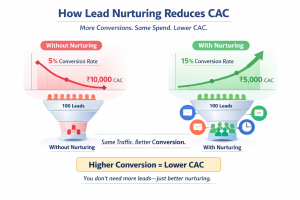
Lead nurturing reduces customer acquisition cost
If you’re wondering how to convert more leads without increasing ad spend, the answer lies in building a structured nurturing process that guides prospects toward a decision.
Now let’s connect the dots.
You’ve seen:
- Leads don’t convert immediately
- Most businesses don’t nurture properly
So what happens when you do nurture?
Your Customer Acquisition Cost starts dropping—without reducing spend.
Let’s break down how.
1. Improves Lead-to-Customer Conversion Rate
This is the biggest lever.
If more leads convert into customers:
Your CAC automatically goes down.
Scenario:
You generate 100 leads.
- Without nurturing → 5 customers
- With nurturing → 15 customers
Same traffic. Same budget.
But your CAC drops by 3X.
Why this works:
Nurturing:
- Builds trust
- Answers objections
- Keeps your brand top-of-mind
So when the lead is ready…
They choose you.
2. Maximizes ROI on Existing Traffic
Every lead you generate already costs you money.
Through:
- Ads
- Content
- SEO
- Social media
Scenario:
A user downloads your guide.
Without nurturing:
They leave and never return
With nurturing:
- You send follow-up emails
- Share relevant content
- Invite them to a webinar
That same lead now converts.
Key Idea:
You don’t need more traffic.
You need to extract more value from the traffic you already have.
3. Reduces Dependency on Paid Ads
Most businesses fall into this trap:
“We need more leads → Increase ad spend”
But here’s the smarter way:
Convert more from what you already have.
Scenario:
- Without nurturing → 2% conversion rate
- With nurturing → 6% conversion rate
Now you get:
3X more customers from the same leads
Which means:
Less pressure to keep increasing ad budgets
Valuable Tip
Before scaling ads, fix your funnel.
Because:
Scaling a broken funnel = scaling your losses
4. Shortens the Sales Cycle
Time is money.
The longer it takes to convert a lead:
- The more follow-ups needed
- The more effort required
- The higher your cost
Scenario:
Two leads:
Lead A (Not nurtured):
- Asks basic questions
- Needs multiple calls
- Takes 30 days to convert
Lead B (Nurtured):
- Already read your content
- Understands your offering
- Takes 10 days to convert
What changed?
Education.
Nurtured leads:
- Come prepared
- Ask better questions
- Decide faster
5. Increases Customer Lifetime Value (LTV)
This is often overlooked.
Lead nurturing doesn’t stop at conversion.
Scenario:
A SaaS company:
- Without onboarding → users drop off
- With onboarding emails + guidance → users stay longer
Result:
- Higher retention
- More repeat purchases
- Higher lifetime value
Why this matters for CAC:
When Customer Life Time Value increases:
You can afford higher CAC
Or maintain the same CAC with better profitability
Key Insight
Here’s the truth most businesses miss:
CAC doesn’t drop because you spend less
It drops because you convert more efficiently
This is where conversion rate optimization plays a critical role—because even small improvements in how leads move through your funnel can significantly reduce your overall CAC.
✅ Key Takeaway
Lead nurturing is not a cost-cutting tactic.
It’s a revenue efficiency system
That:
- Converts more leads
- Faster
- With less effort
How Lead Nurturing Increases Conversions (Stage-by-Stage)
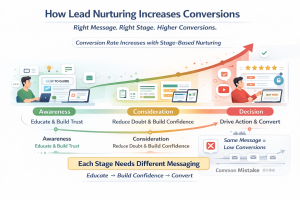
The most effective lead nurturing strategies to increase conversions focus on delivering the right message at the right stage of the buyer journey.
Now let’s make this practical.
Not all leads are the same.
And more importantly:
Not all leads are at the same stage.
Big Mistake Most Businesses Make
They send the same message to everyone.
Result?
- Low engagement
- Low conversions
The Smarter Approach
Align your messaging with the buyer’s journey
Stage 1: Awareness → Interest
This is where the journey begins.
The lead is:
- Exploring
- Learning
- Trying to understand the problem
Goal: Build Trust
Not sell.
What to Share:
- Educational emails
- Blog content
- Guides and checklists
- Industry insights
Scenario:
A business owner searches:
“How to improve website traffic”
They land on your content.
If you immediately pitch:
You lose them
But if you:
- Educate
- Provide value
- Simplify their problem
You earn attention and trust
Tip
Focus on:
Helping, not selling
At this stage:
Trust > Transaction
Stage 2: Interest → Consideration
Now the lead is thinking:
“This looks interesting… but is it right for me?”
Goal: Reduce Doubt
What to Share:
- Case studies
- Product benefits
- Comparisons
- Use-case examples
Scenario:
A SaaS user is evaluating tools.
They’re comparing:
- Features
- Pricing
- Results
If you provide:
- Real results
- Customer success stories
You move from “option” to “preferred choice”
Tip
Answer questions like:
- “Will this work for me?”
- “Is it worth it?”
Stage 3: Consideration → Decision
This is where conversion happens.
But even here…
Leads hesitate.
Goal: Drive Action
What to Share:
- Testimonials
- Product demos
- Free trials
- Limited-time offers
Scenario:
A lead:
- Visited your pricing page
- Opened multiple emails
They’re close.
Now is the time to:
Nudge them forward
Tip
Use:
- Urgency
- Clarity
- Strong CTA
But keep it:
Helpful, not pushy
Big Insight (This Changes Everything)
Each stage needs different messaging.
If you:
- Sell too early → you lose trust
- Educate too late → you lose momentum
Simple Way to Remember
- Awareness → Educate
- Consideration → Build confidence
- Decision → Convert
✅ Key Takeaway
Lead nurturing works because it aligns:
- The right message
- With the right person
- At the right time
And when that happens:
Conversions increase naturally.
Lead nurturing is a key part of customer journey optimization, ensuring that each interaction moves the prospect closer to a confident buying decision.
Types of Lead Nurturing That Drive Real Results
Now that we understand why nurturing matters…
Let’s talk about how to actually do it.
Because here’s the truth:
🔸Lead nurturing is not one tactic.
🔸It’s a system of touchpoints working together.
1. Email Drip Campaigns
This is the foundation of most nurturing systems.
A drip email campaign is a sequence of emails sent over time based on:
- User action
- Signup
- Behavior
Scenario:
A user downloads your guide.
Instead of sending just one email, you send:
- Day 1 → Welcome + resource
- Day 3 → Educational content
- Day 5 → Case study
- Day 7 → Offer/demo
Why it works:
- Keeps your brand top-of-mind
- Builds trust gradually
- Moves the lead step-by-step
Tip:
Each email should have one clear goal
Don’t try to educate, sell, and survey all in one email.
2. Retargeting Ads
Not every lead converts the first time.
But that doesn’t mean they’re lost.
Scenario:
A visitor:
- Visits your pricing page
- Leaves without taking action
You run retargeting ads showing:
- Testimonials
- Benefits
- Limited-time offers
They come back and convert.
Why it works:
- Reinforces your message
- Reminds users of their interest
- Targets high-intent audiences
Tip:
Don’t show generic ads
Show stage-specific ads based on user behavior
3. WhatsApp / SMS Follow-Ups
This is where speed and visibility matter.
Emails can be ignored.
But messages?
They get opened.
Scenario:
A lead signs up for a demo.
You send:
“Hey, just confirming your demo for tomorrow. Let us know if you have any questions.”
Simple. Human. Effective.
Why it works:
- High open rates
- Feels personal
- Faster response
Tip:
Use this for:
- Reminders
- Quick nudges
- Important updates
Avoid overuse—it can feel intrusive.
4. Webinar Sequences
Webinars are powerful for:
- Education
- Trust-building
- High-intent engagement
Scenario:
You host a webinar on:
“How to Reduce CAC for SMEs”
Your nurturing flow:
- Before → Reminder emails
- During → Value-packed session
- After → Replay + offer
Why it works:
- Builds authority
- Engages leads deeply
- Warms up cold audiences
Tip:
Don’t stop at the webinar
The post-webinar follow-up is where conversions happen
5. Personalized Content Journeys
This is where nurturing becomes powerful.
Instead of sending the same content to everyone…
You tailor it based on behavior.
Scenario:
- Lead A → Reads beginner blogs → gets educational emails
- Lead B → Visits pricing page → gets case studies + demo invites
Why it works:
- Feels relevant
- Matches intent
- Increases engagement
Tip:
Even simple segmentation (beginner vs high-intent) can make a big difference
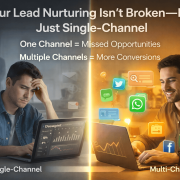
Big Insight
Multi-channel nurturing performs better than single-channel
Because your audience is not in one place.
They:
- Check emails
- Scroll social media
- Use WhatsApp
- Watch videos
Simple Rule
Be present across channels…
But stay consistent in your message
✅ Key Takeaway
The best nurturing systems are:
- Timely
- Relevant
- Multi-channel
- Behavior-driven
Real-World Scenarios
Let’s bring everything together with real examples.
Because this is where theory becomes clear.
Scenario 1: SaaS Business
Problem:
Free trial users sign up… but don’t convert.
What’s really happening?
Users:
- Don’t understand features
- Don’t see value quickly
- Get overwhelmed
Solution:
- Onboarding email sequence
- Feature walkthroughs
- Use-case-based education
Result:
- Higher activation
- More users experience value
- More conversions
CAC drops because more users convert from the same pool
Scenario 2: Service-Based Business
Problem:
Leads inquire… then go silent.
What’s happening?
- Lack of follow-up
- No trust built
- No differentiation
Solution:
- Follow-up emails
- Case studies
- Testimonials
- Educational insights
Result:
- Builds credibility
- Keeps conversation alive
- Increases conversion chances
Scenario 3: E-commerce Business
Problem:
Customers add to cart… but don’t purchase.
What’s happening?
- Price hesitation
- Distraction
- Second thoughts
Solution:
- Cart reminder emails
- Limited-time offers
- Customer reviews
Result:
- Recovered revenue
- Increased conversions
Scenario 4: SME (Small & Medium Business)
Problem:
Leads come in through ads or website… but conversion is low.
What’s happening?
- Leads are not ready
- No structured follow-up
- Sales team engages too early
Solution:
- Lead nurturing email sequence
- Educational content
- Lead scoring to identify high-intent leads
Scenario:
An SME offering digital services:
- Starts sending weekly insights + case studies
- Tracks engagement
Result:
- Warmer leads
- Better sales conversations
- Higher conversion rates
Same leads → better outcomes → lower CAC
Scenario 5: D2C Brand (Direct-to-Consumer)
Problem:
High traffic but low repeat purchases.
What’s happening?
- No post-purchase engagement
- Weak brand connection
- No retention strategy
Solution:
- Post-purchase email flow
- Product usage tips
- Loyalty offers
- Re-engagement campaigns
Scenario:
A skincare brand:
- Sends tips on product usage
- Recommends complementary products
- Offers repeat purchase discounts
Result:
- Higher repeat purchases
- Increased LTV
- Better ROI on acquisition
Key Insight
In all these scenarios, the pattern is the same:
The problem is not lack of leads
The problem is lack of nurturing
Final Takeaway
Lead nurturing turns:
- Interest → trust
- Trust → action
- Action → revenue
And when that happens:
- Your CAC drops
- Your conversions rise
- Your growth becomes sustainable
Common Lead Nurturing Mistakes That Increase CAC (And How to Fix Them)
Here’s the uncomfortable truth:
Most businesses don’t have a lead problem.
They have a lead handling problem.
And every mistake here?
Quietly increases your CAC.
Let’s break down 8 high-impact mistakes—with fixes and real-world scenarios.
1. No Segmentation
What Happens:
All leads get the same emails, same offers, same messaging.
Why It Hurts:
A first-time visitor and a pricing-page visitor are not the same.
Fix:
Segment based on:
- Behavior (visited pricing page, downloaded guide)
- Source (ads, organic, referral)
- Stage (cold, warm, hot)
Scenario:
SaaS:
A CRM tool sends the same onboarding emails to:
- Trial users
- Blog subscribers
Result: Low engagement.
Fix:
- Trial users → product tutorials
- Subscribers → educational content
Engagement improves → more conversions → lower CAC
2. Over-Selling Too Early
What Happens:
You push demos, pricing, or calls too soon.
Why It Hurts:
Trust isn’t built yet.
Fix:
Follow the rule:
Educate → Build trust → Then sell
Scenario:
Service Business:
A marketing agency sends:
“Book a paid consultation” immediately after signup.
Low response.
Fix:
- First: Share insights/case studies
- Then: Invite for consultation
Leads warm up → conversion increases
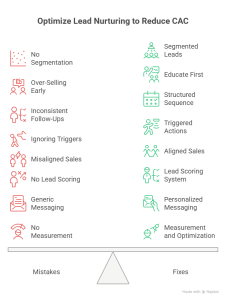
3. Inconsistent Follow-Ups
What Happens:
You follow up once… then disappear.
Why It Hurts:
Leads forget you.
Fix:
Create a structured follow-up sequence
- Day 1
- Day 3
- Day 7
- Day 14
Scenario:
SME (B2B):
A manufacturing supplier responds to inquiry once.
No reply → lead lost.
Fix:
- Follow-up with:
- Product comparison
- Case study
- Reminder
Lead re-engages → closes later
4. Ignoring Behavioral Triggers
What Happens:
You don’t act when leads show intent.
Why It Hurts:
High-intent signals go wasted.
Fix:
Trigger actions based on behavior:
- Visited pricing page → send pricing breakdown
- Abandoned cart → send reminder
Scenario:
D2C Brand:
User adds product to cart → leaves.
No follow-up.
Fix:
- Send:
- Reminder email
- Offer
- Review/testimonial
Recovery increases → CAC drops
5. Not Aligning with Sales
What Happens:
Marketing sends leads.
Sales says: “These aren’t good.”
Why It Hurts:
Wasted effort + poor conversions.
Fix:
Define together:
What is a “sales-ready” lead?
Scenario:
SaaS:
Marketing sends webinar attendees to sales.
Sales says:
“They’re not ready.”
Fix:
Only send leads who:
- Attended webinar
- Visited pricing page
Sales closes faster
6. No Lead Scoring System
What Happens:
You don’t prioritize leads.
Why It Hurts:
Hot leads don’t get immediate attention.
Fix:
Assign points:
- Pricing page → +10
- Webinar → +7
- Email click → +3
Scenario:
Service Business:
A high-intent lead waits 3 days for response.
Lost to competitor.
Fix:
Lead scoring triggers instant sales call.
Faster response → higher close rate
7. Generic, Non-Personalized Messaging
What Happens:
Same email to everyone.
Why It Hurts:
Feels irrelevant → ignored.
Fix:
Personalize using:
- Name
- Industry
- Behavior
- Pain points
Scenario:
SME:
Sends generic “Our services” email.
Low CTR.
Fix:
- “For manufacturing businesses struggling with X…”
Relevance increases → engagement improves
8. No Measurement or Optimization
What Happens:
You run campaigns without tracking performance.
Why It Hurts:
You don’t know what’s working.
Fix:
Track:
- Open rates
- CTR
- Conversion rate
- CAC
Scenario:
D2C:
Runs email campaigns blindly.
No improvement.
Fix:
- Identify top-performing emails
- Double down
Better ROI → lower CAC
Actionable Tip
Fixing just 2–3 of these mistakes can:
- Increase conversions by 20–40%
- Reduce CAC significantly without increasing ad spend
Key Takeaway
- You don’t reduce CAC by spending less
- You reduce CAC by wasting fewer leads
How to Build a Simple Lead Nurturing System (Step-by-Step)
A simple lead nurturing system for small businesses doesn’t need to be complex—it just needs to be consistent, targeted, and aligned with how customers actually make decisions.
Let’s simplify this.
You don’t need complex tools.
You need a structured system.
Step 1: Segment Your Leads
Group leads into:
- Cold (just discovered you)
- Warm (engaged)
- Hot (ready to buy)
Tip:
Start simple. You can refine later.
Step 2: Map Your Customer Journey
Understand:
- Where leads enter
- What they need at each stage
Example:
SaaS Journey:
Ad → Signup → Trial → Upgrade
Step 3: Define Key Touchpoints
Identify:
- Retargeting ads
- Calls
Insight:
More touchpoints = higher conversion probability
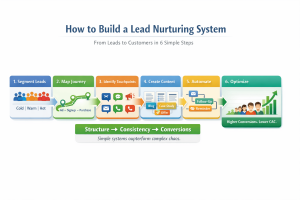
Step 4: Create Targeted Content
Match content to stage:
- Awareness → Educational
- Consideration → Case studies
- Decision → Offers/demo
Scenario:
Service Business:
- Blog → Awareness
- Case study → Consideration
- Consultation → Decision
Step 5: Set Up Automation
Use tools to automate:
- Email sequences
- Follow-ups
- Alerts
Tools:
- CRM: HubSpot, Zoho
- Email: Mailchimp, ActiveCampaign
With the right marketing automation in place, businesses can nurture leads consistently at scale without relying on manual follow-ups.
Step 6: Track and Optimize
Measure:
- Conversion rates
- Engagement
- Drop-offs
Tip:
Improve one step at a time.
Real-World System Examples
1. SME Example
Problem:
Leads come from website but don’t convert.
System:
- Day 1: Welcome email
- Day 3: Case study
- Day 7: Offer/free consultation
Result: Higher conversions without more ads
2. SaaS Example
Problem:
Free trials don’t convert.
System:
- Day 1: Setup guide
- Day 2: Feature tutorial
- Day 5: Case study
- Day 7: Upgrade offer
Result: Better activation → lower CAC
3. Service Business Example
Problem:
Leads go cold.
System:
- Follow-up email sequence
- Testimonials
- Problem-solving content
Result: Trust builds → more deals closed
4. D2C Example
Problem:
Cart abandonment.
System:
- 1 hour: Reminder
- 24 hours: Offer
- 48 hours: Social proof
Result: Recovered revenue
Final Insight
- You don’t need more leads
- You need a better system
Key Takeaway
Lead nurturing is not about sending emails.
It’s about guiding decisions
And when done right:
✔ More conversions
✔ Lower CAC
✔ Higher ROI
Metrics That Prove Your CAC Is Decreasing
Let’s be honest.
You can feel things are improving…
But unless you measure it, you can’t prove it.
And in business:
What you can’t prove, you can’t scale.
So instead of tracking everything, focus on a few high-impact metrics that directly show whether your lead nurturing is working.
1. Conversion Rate (Your #1 Signal)
This is the most important metric.
Formula:
Leads → Customers
Why It Matters:
If more leads convert into customers…
Your CAC automatically drops
Scenario:
You generate 100 leads.
- Earlier → 5 customers → 5% conversion
- Now → 10 customers → 10% conversion
Same leads. Same spend.
But CAC is cut in half.
Tip:
Track conversion at each stage:
- Visitor → Lead
- Lead → Qualified
- Qualified → Customer
This shows where you’re improving.
2. Cost per Lead vs Cost per Customer
This is where many businesses get confused.
They focus only on cost per lead (CPL).
But what really matters is:
Cost per customer (CAC)
Scenario:
You spend ₹50,000 on ads.
Case A:
- 500 leads → ₹100 per lead
- 5 customers → CAC = ₹10,000
Case B:
- Same 500 leads
- 10 customers → CAC = ₹5,000
Lead cost didn’t change
Conversion improved
Insight:
Low CPL ≠ success
High conversion = success
3. Email Engagement (Early Indicator)
Before conversions improve…
Engagement improves first.
Track:
- Open rate
- Click-through rate (CTR)
- Reply rate
Scenario:
SaaS Business:
- Old emails → 12% open rate
- New nurturing sequence → 28% open rate
More engagement → more educated leads → higher conversions
Tip:
If engagement is low:
1.Your messaging is off
2. Not your product
4. Sales Cycle Length
How long does it take to convert a lead?
Scenario:
Service Business:
- Earlier: 30 days to close
- After nurturing: 18 days
Why?
Because leads:
- Already understand the value
- Already trust you
Insight:
Shorter sales cycle = lower cost per deal
Less time → less effort → lower CAC
5. Customer Lifetime Value (LTV)
CAC is only half the story.
The real game is:
CAC vs LTV
Scenario:
D2C Brand:
- Without nurturing → one-time buyers
- With nurturing → repeat purchases
LTV increases
Insight:
Better nurturing doesn’t just convert…
It creates better customers
Putting It All Together
Here’s the pattern you want:
✔ Conversion rate → Up
✔ Email engagement → Up
✔ Sales cycle → Down
✔ LTV → Up
✔ CAC → Down
Core Insight
- If conversions increase while spend stays the same
- CAC will drop automatically
No hacks. No tricks.
Just better funnel efficiency.
Advanced Insight: The CAC vs Conversion Flywheel
Most businesses think like this:
“We need more leads to grow”
But high-growth businesses think differently:
“We need to convert better”
That’s where the CAC vs Conversion Flywheel comes in.
The Flywheel Explained
Here’s the loop:
Better Nurturing
→ Higher Conversion Rate
→ Lower CAC
→ More Budget Efficiency
→ More Leads / Better Investment
→ More Growth
→ Back to Better Nurturing
Why This Changes Everything
This is not a one-time improvement.
It’s a compounding system.
Scenario:
Month 1:
- Conversion rate = 5%
- CAC = ₹10,000
You improve nurturing.
Month 3:
- Conversion rate = 8%
- CAC = ₹6,250
Now you reinvest savings into better campaigns.
Month 6:
- More leads
- Better conversion
- Even lower CAC
Growth accelerates
The Real Power
Most businesses try to scale like this:
Spend more → hope for growth
But this is risky.
Smart businesses scale like this:
Improve system → then scale
Strategic Insight
Lead nurturing is not just a marketing tactic.
It’s a growth lever
Because it impacts:
- Conversions
- Costs
- Revenue
- Retention
Actionable Tip
Start small:
- Improve one nurture sequence
- Track conversion impact
- Reinvest gains into better campaigns
Repeat.
Final Takeaway
- CAC doesn’t drop randomly
- It drops when your system improves
And when you build this flywheel:
✔ Growth becomes predictable
✔ Marketing becomes efficient
✔ Sales becomes easier
Conclusion: Stop Chasing Leads—Start Converting Them
Let’s bring this home.
Most businesses believe their biggest problem is:
“We need more leads”
So they spend more on ads.
Try new channels.
Push harder for traffic.
But here’s the reality:
CAC is not just a cost problem. It’s a conversion problem.
If your funnel converts poorly,
even cheap leads become expensive.
If your funnel converts well,
even expensive leads become profitable.
The Real Shift
Lead nurturing is the missing link most businesses ignore.
It’s the bridge between:
Interest → Trust → Purchase
Without it:
- Leads stay cold
- Sales feels forced
- CAC keeps rising
With it:
- Leads get educated
- Trust builds naturally
- Conversions happen faster
Final Thought
“The businesses that win are not the ones that generate the most leads—
but the ones that convert the most from what they already have.”
That’s the difference between:
- Constantly chasing growth
vs - Building a system that creates it
Actionable Next Steps (Start Here)
Don’t overcomplicate this.
Start simple. Start practical.
1. Audit Your Current Funnel
Ask yourself:
- Where are leads coming from?
- What happens after they enter?
Most businesses don’t even have clarity here.
2. Identify Where Leads Drop Off
Look for leaks:
- After signup?
- After first visit?
- Before purchase?
That’s where your CAC is increasing.
3. Set Up One Simple Nurturing Sequence
Start with just one:
Example:
- Day 1: Welcome + value
- Day 3: Insight or case study
- Day 5: Problem-solving content
- Day 7: Offer or CTA
Keep it simple. Consistency beats complexity.
4. Track Conversion Improvements
Watch:
- Conversion rate
- Engagement
- Sales cycle
Even small improvements = big CAC reduction
Key Takeaway
Lead nurturing is not just another marketing tactic.
It’s a revenue optimization system
Because when you get it right:
✔ You convert more without spending more
✔ You reduce CAC naturally
✔ You build predictable growth






Leave a Reply
Want to join the discussion?Feel free to contribute!