Lead Nurturing Reduces Customer Acquisition Cost and Increases Conversions

Lead nurturing reduces customer acquisition cost (CAC) by improving conversion rates, building trust with prospects, and maximizing the value of existing leads instead of constantly acquiring new ones. When businesses guide leads through the buyer journey with relevant content and timely follow-ups, they convert more leads into customers—lowering CAC and increasing overall marketing ROI.

Here’s the problem most businesses face:

They invest heavily in ads, generate leads…
but only a small percentage actually convert.

The result?
High CAC, wasted budget, and inconsistent growth.

But the real issue isn’t traffic.

It’s what happens after the lead comes in.

Most leads are not ready to buy immediately.
They need:

  • Clarity
  • Trust
  • Confidence

And that’s exactly what lead nurturing provides.

Instead of pushing for a sale too early,
lead nurturing focuses on:

  • Educating prospects
  • Addressing objections
  • Building relationships over time

Think of it this way:

If 100 leads enter your funnel and only 2 convert, your CAC is high by default.
But if you can convert 5, 10, or even 15 of those same leads…

Your CAC drops—without increasing your ad spend.

Understanding how lead nurturing reduces customer acquisition cost comes down to one principle—converting more of the leads you already paid to acquire.

In this guide, you’ll learn how to use lead nurturing as a system, not just a tactic—so you can reduce CAC, increase conversions, and build a more efficient, scalable growth engine.

What Is Customer Acquisition Cost (CAC) — And Why It Matters

Let’s simplify this.

Customer Acquisition Cost (CAC) is:

The total cost you spend to acquire one customer.

Simple Formula:

CAC = Total Marketing + Sales Cost ÷ Number of Customers Acquired

What goes into CAC?

Most businesses underestimate this.

It’s not just ad spend.

Your CAC includes:

  • Ad spend (Google Ads, Meta Ads, etc.)
  • Tools (CRM, email software, analytics tools)
  • Team salaries (marketing + sales teams)
  • Content creation (blogs, videos, creatives)
  • Sales effort (calls, demos, follow-ups)

Why This Matters More Than You Think

Here’s where most businesses go wrong:

They assume:

“High CAC = expensive marketing”

But that’s not always true.

The Real Insight

High CAC often means:

Low conversion efficiency

Let’s look at a simple example:

You spend ₹1,00,000 on marketing.

Case 1:

  • You acquire 10 customers
    CAC = ₹10,000

Case 2:

  • You acquire 20 customers
    CAC = ₹5,000

What changed?

Not your budget.
Not your ads.

Your conversion rate improved.

That’s the game changer

You don’t always need to reduce spend to lower CAC.

You need to increase how many leads turn into customers.
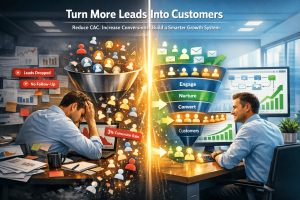
Reduce Customer Acquisition Cost and increase conversion

Real-World Scenario

A SaaS company runs ads and gets:

  • 500 sign-ups for a free trial

But only:

  • 10 people convert to paid users

CAC stays high.

Now they introduce:

  • Onboarding emails
  • Product walkthroughs
  • Feature education

Conversions go from:

  • 10 → 30 users

Same traffic. Same spend. Lower CAC.

Valuable Tip

Before increasing your marketing budget, ask:

  • Are we converting enough of the leads we already have?
  • Where are leads dropping off in our funnel?
  • Do we have a system to nurture them?

Because:

Optimizing conversion is often cheaper than acquiring new leads.

✅ Key Takeaway

Customer Acquisition Cost is not just about how much you spend.

It’s about how efficiently you turn attention into customers.

And that’s exactly where lead nurturing becomes your biggest advantage.

The Real Problem: Most Leads Don’t Convert (And Why)

Here’s something most businesses don’t realize:

The majority of your leads are not ready to buy when they first interact with you.

But many businesses treat every lead like they’re ready to purchase immediately.

And that’s where things start breaking.

Let’s look at what actually happens:

A potential customer:

  • Visits your website
  • Downloads a guide
  • Signs up for a webinar

What does that mean?

They’re interested.
But not necessarily ready to buy.

So why don’t most leads convert?

Let’s break it down.

1. Leads Are Not Ready to Buy Immediately

Every buyer goes through a journey:

  • Awareness
  • Consideration
  • Decision

Most leads are stuck in the early stages.

Scenario:

A business owner downloads your “SEO checklist.”

That doesn’t mean:
They’re ready to hire you today

It means:
They’re trying to understand the problem

If you immediately pitch your service…

You lose them.

2. Lack of Trust

People don’t buy from brands they don’t trust.

Especially in:

  • B2B
  • High-ticket services
  • SaaS

Scenario:

A lead visits your pricing page.

They’re interested.

But they still wonder:

  • “Will this actually work for me?”
  • “Can I trust this company?”

Without:

  • Case studies
  • Testimonials
  • Educational content

They hesitate… and leave.

3. No Follow-Up (or Poor Follow-Up)

This is one of the biggest revenue leaks.

Scenario:

A lead fills out your contact form.

You respond after 3 days.

By then:

  • They’ve forgotten you
  • Or chosen a competitor

Or worse…

You send:
One email
And then nothing

That lead goes cold.

4. Generic Messaging

Not all leads are the same.

But many businesses communicate like they are.

Scenario:

  • A first-time visitor gets the same email as a pricing-page visitor
  • A curious reader gets the same message as a high-intent buyer

Result?

The message doesn’t resonate
The lead disengages

Important Data Insight

Studies consistently show:

Only a small percentage of leads are sales-ready at the first touchpoint

Which means:

Most of your leads need nurturing before they convert

Common Mistakes That Kill Conversions

  • Treating all leads the same
  • Pushing for a sale too early
  • Not understanding buyer intent
  • Ignoring follow-ups

Think of it this way:

If someone just walked into a store…

Would you immediately say:

“Buy this now.”

Or would you:

  • Understand their needs
  • Answer questions
  • Guide them

That’s exactly what your funnel should do.

Key Takeaway

Without nurturing, you’re leaking money at every stage of your funnel.

You paid to acquire the lead.

But without:

  • Follow-up
  • Education
  • Trust-building

That investment goes to waste.

At its core, effective lead nurturing is a form of sales funnel optimization—it ensures that leads don’t just enter your funnel, but actually move through it and convert.

What Is Lead Nurturing (And What It’s Not)

Now that we understand the problem…

Let’s talk about the solution.

What Is Lead Nurturing?

Lead nurturing is a structured process of:

  • Educating your leads
  • Engaging them over time
  • Building trust gradually

So that when they’re ready to buy…

They choose you.

Simple Way to Understand It

Lead nurturing is not about pushing a sale.

It’s about guiding a prospect toward a decision.

Real-World Example

A SaaS company gets a new sign-up.

Instead of immediately selling…

They send:

  • Day 1: Welcome email + quick start guide
  • Day 3: Feature walkthrough
  • Day 5: Case study
  • Day 7: Invite to demo

By the time they pitch:

The user already understands the value

Conversion becomes easier.

What Lead Nurturing Looks Like in Practice

  • Helpful emails
  • Educational content
  • Timely follow-ups
  • Personalized messaging
  • Behavior-based communication

What Lead Nurturing Is NOT

Let’s clear some common misconceptions.

1. Random email blasts

Sending emails without:

  • Strategy
  • Timing
  • Relevance

That’s noise, not nurturing.

2. Hard selling in every message

If every email says:
“Buy now”

Leads will:
Ignore or unsubscribe

3. One-size-fits-all communication

Different leads need different messages.

  • New leads → education
  • Interested leads → value
  • High-intent leads → conversion

Valuable Tip

Before sending any message, ask:

“What does this lead need at this stage?”

Not:

“What do I want to sell?”

Another Practical Insight

Good nurturing feels like:

  • Guidance
  • Help
  • Clarity

Not:

  • Pressure
  • Spam
  • Noise

Core Idea

Lead nurturing = Guiding a prospect toward a decision, not forcing one.

✅ Key Takeaway

When done right, lead nurturing:

  • Builds trust
  • Reduces hesitation
  • Increases conversions

And most importantly…

It turns your existing leads into customers—without increasing your ad spend. 

How Lead Nurturing Directly Reduces CAC
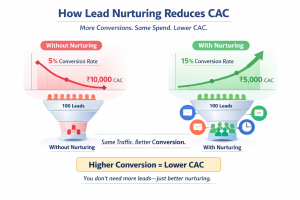
 

Lead nurturing reduces customer acquisition cost

Lead nurturing reduces customer acquisition cost


If you’re wondering how to convert more leads without increasing ad spend, the answer lies in building a structured nurturing process that guides prospects toward a decision.

Now let’s connect the dots.

You’ve seen:

  • Leads don’t convert immediately
  • Most businesses don’t nurture properly

So what happens when you do nurture?

Your Customer Acquisition Cost starts dropping—without reducing spend.

Let’s break down how.

1. Improves Lead-to-Customer Conversion Rate

This is the biggest lever.

If more leads convert into customers:

Your CAC automatically goes down.

Scenario:

You generate 100 leads.

  • Without nurturing → 5 customers
  • With nurturing → 15 customers

Same traffic. Same budget.

But your CAC drops by 3X.

Why this works:

Nurturing:

  • Builds trust
  • Answers objections
  • Keeps your brand top-of-mind

So when the lead is ready…

They choose you.

2. Maximizes ROI on Existing Traffic

Every lead you generate already costs you money.

Through:

  • Ads
  • Content
  • SEO
  • Social media

Scenario:

A user downloads your guide.

Without nurturing:
They leave and never return

With nurturing:

  • You send follow-up emails
  • Share relevant content
  • Invite them to a webinar

That same lead now converts.

Key Idea:

You don’t need more traffic.

You need to extract more value from the traffic you already have.

3. Reduces Dependency on Paid Ads

Most businesses fall into this trap:

“We need more leads → Increase ad spend”

But here’s the smarter way:

Convert more from what you already have.

Scenario:

  • Without nurturing → 2% conversion rate
  • With nurturing → 6% conversion rate

Now you get:
3X more customers from the same leads

Which means:
Less pressure to keep increasing ad budgets

Valuable Tip

Before scaling ads, fix your funnel.

Because:
Scaling a broken funnel = scaling your losses

4. Shortens the Sales Cycle

Time is money.

The longer it takes to convert a lead:

  • The more follow-ups needed
  • The more effort required
  • The higher your cost

Scenario:

Two leads:

Lead A (Not nurtured):
  • Asks basic questions
  • Needs multiple calls
  • Takes 30 days to convert
Lead B (Nurtured):
  • Already read your content
  • Understands your offering
  • Takes 10 days to convert

What changed?

Education.

Nurtured leads:

  • Come prepared
  • Ask better questions
  • Decide faster

5. Increases Customer Lifetime Value (LTV)

This is often overlooked.

Lead nurturing doesn’t stop at conversion.

Scenario:

A SaaS company:

  • Without onboarding → users drop off
  • With onboarding emails + guidance → users stay longer

Result:

  • Higher retention
  • More repeat purchases
  • Higher lifetime value

Why this matters for CAC:

When Customer Life Time Value increases:

You can afford higher CAC
Or maintain the same CAC with better profitability


Key Insight

Here’s the truth most businesses miss:

CAC doesn’t drop because you spend less
It drops because you convert more efficiently

This is where conversion rate optimization plays a critical role—because even small improvements in how leads move through your funnel can significantly reduce your overall CAC.

✅ Key Takeaway

Lead nurturing is not a cost-cutting tactic.

It’s a revenue efficiency system

That:

  • Converts more leads
  • Faster
  • With less effort

How Lead Nurturing Increases Conversions (Stage-by-Stage)

The most effective lead nurturing strategies to increase conversions focus on delivering the right message at the right stage of the buyer journey.

Now let’s make this practical.

Not all leads are the same.

And more importantly:

Not all leads are at the same stage.

Big Mistake Most Businesses Make

They send the same message to everyone.

Result?

  1. Low engagement
  2. Low conversions

The Smarter Approach

Align your messaging with the buyer’s journey

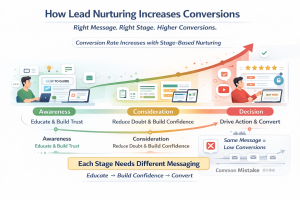
Stage 1: Awareness → Interest

This is where the journey begins.

The lead is:

  • Exploring
  • Learning
  • Trying to understand the problem

Goal: Build Trust

Not sell.

What to Share:

  • Educational emails
  • Blog content
  • Guides and checklists
  • Industry insights

Scenario:

A business owner searches:
“How to improve website traffic”

They land on your content.

If you immediately pitch:

You lose them

But if you:

  • Educate
  • Provide value
  • Simplify their problem

You earn attention and trust

Tip

Focus on:
Helping, not selling

At this stage:
Trust > Transaction
How Lead Nurturing increases conversion

Stage 2: Interest → Consideration

Now the lead is thinking:

“This looks interesting… but is it right for me?”

Goal: Reduce Doubt

What to Share:

  • Case studies
  • Product benefits
  • Comparisons
  • Use-case examples

Scenario:

A SaaS user is evaluating tools.

They’re comparing:

  • Features
  • Pricing
  • Results

If you provide:

  • Real results
  • Customer success stories

You move from “option” to “preferred choice”

Tip

Answer questions like:

  • “Will this work for me?”
  • “Is it worth it?”

Stage 3: Consideration → Decision

This is where conversion happens.

But even here…

Leads hesitate.

Goal: Drive Action

What to Share:

  • Testimonials
  • Product demos
  • Free trials
  • Limited-time offers

Scenario:

A lead:

  • Visited your pricing page
  • Opened multiple emails

They’re close.

Now is the time to:
Nudge them forward

Tip

Use:

  • Urgency
  • Clarity
  • Strong CTA

But keep it:
Helpful, not pushy

Big Insight (This Changes Everything)

Each stage needs different messaging.

If you:

  • Sell too early → you lose trust
  • Educate too late → you lose momentum

Simple Way to Remember

  • Awareness → Educate
  • Consideration → Build confidence
  • Decision → Convert

✅ Key Takeaway

Lead nurturing works because it aligns:

  1. The right message
  2. With the right person
  3. At the right time

And when that happens:

Conversions increase naturally.

Lead nurturing is a key part of customer journey optimization, ensuring that each interaction moves the prospect closer to a confident buying decision.

Types of Lead Nurturing That Drive Real Results

Now that we understand why nurturing matters…

Let’s talk about how to actually do it.

Because here’s the truth:

🔸Lead nurturing is not one tactic.
🔸It’s a system of touchpoints working together.

1. Email Drip Campaigns

This is the foundation of most nurturing systems.

A drip email campaign is a sequence of emails sent over time based on:

  • User action
  • Signup
  • Behavior

Scenario:

A user downloads your guide.

Instead of sending just one email, you send:

  • Day 1 → Welcome + resource
  • Day 3 → Educational content
  • Day 5 → Case study
  • Day 7 → Offer/demo

Why it works:

  • Keeps your brand top-of-mind
  • Builds trust gradually
  • Moves the lead step-by-step

Tip:

Each email should have one clear goal
Don’t try to educate, sell, and survey all in one email.

2. Retargeting Ads

Not every lead converts the first time.

But that doesn’t mean they’re lost.

Scenario:

A visitor:

  • Visits your pricing page
  • Leaves without taking action

You run retargeting ads showing:

  • Testimonials
  • Benefits
  • Limited-time offers

They come back and convert.

Why it works:

  • Reinforces your message
  • Reminds users of their interest
  • Targets high-intent audiences

 Tip:

Don’t show generic ads
Show stage-specific ads based on user behavior

3. WhatsApp / SMS Follow-Ups

This is where speed and visibility matter.

Emails can be ignored.

But messages?

They get opened.

Scenario:

A lead signs up for a demo.

You send:
“Hey, just confirming your demo for tomorrow. Let us know if you have any questions.”

Simple. Human. Effective.

Why it works:

  • High open rates
  • Feels personal
  • Faster response

Tip:

Use this for:

  • Reminders
  • Quick nudges
  • Important updates

Avoid overuse—it can feel intrusive.

4. Webinar Sequences

Webinars are powerful for:

  • Education
  • Trust-building
  • High-intent engagement

Scenario:

You host a webinar on:
“How to Reduce CAC for SMEs”

Your nurturing flow:

  • Before → Reminder emails
  • During → Value-packed session
  • After → Replay + offer

Why it works:

  • Builds authority
  • Engages leads deeply
  • Warms up cold audiences

Tip:

Don’t stop at the webinar
The post-webinar follow-up is where conversions happen

5. Personalized Content Journeys

This is where nurturing becomes powerful.

Instead of sending the same content to everyone…

You tailor it based on behavior.

Scenario:

  • Lead A → Reads beginner blogs → gets educational emails
  • Lead B → Visits pricing page → gets case studies + demo invites

Why it works:

  • Feels relevant
  • Matches intent
  • Increases engagement

Tip:

Even simple segmentation (beginner vs high-intent) can make a big difference

Big Insight

Multi-channel nurturing performs better than single-channel

Because your audience is not in one place.

They:

  • Check emails
  • Scroll social media
  • Use WhatsApp
  • Watch videos

Simple Rule

Be present across channels…

But stay consistent in your message

✅ Key Takeaway

The best nurturing systems are:

  • Timely
  • Relevant
  • Multi-channel
  • Behavior-driven

Real-World Scenarios 

Let’s bring everything together with real examples.

Because this is where theory becomes clear.

Scenario 1: SaaS Business

Problem:

Free trial users sign up… but don’t convert.

What’s really happening?

Users:

  • Don’t understand features
  • Don’t see value quickly
  • Get overwhelmed

Solution:

  • Onboarding email sequence
  • Feature walkthroughs
  • Use-case-based education

Result:

  • Higher activation
  • More users experience value
  • More conversions

CAC drops because more users convert from the same pool

Scenario 2: Service-Based Business

Problem:

Leads inquire… then go silent.

What’s happening?

  • Lack of follow-up
  • No trust built
  • No differentiation

Solution:

  • Follow-up emails
  • Case studies
  • Testimonials
  • Educational insights

Result:

  • Builds credibility
  • Keeps conversation alive
  • Increases conversion chances


Scenario 3: E-commerce Business

Problem:

Customers add to cart… but don’t purchase.

What’s happening?

  • Price hesitation
  • Distraction
  • Second thoughts

Solution:

  • Cart reminder emails
  • Limited-time offers
  • Customer reviews

Result:

  • Recovered revenue
  • Increased conversions


Scenario 4: SME (Small & Medium Business)

Problem:

Leads come in through ads or website… but conversion is low.

What’s happening?

  • Leads are not ready
  • No structured follow-up
  • Sales team engages too early

Solution:

  • Lead nurturing email sequence
  • Educational content
  • Lead scoring to identify high-intent leads

Scenario:

An SME offering digital services:

  • Starts sending weekly insights + case studies
  • Tracks engagement

Result:

  • Warmer leads
  • Better sales conversations
  • Higher conversion rates

Same leads → better outcomes → lower CAC


Scenario 5: D2C Brand (Direct-to-Consumer)

Problem:

High traffic but low repeat purchases.

What’s happening?

  • No post-purchase engagement
  • Weak brand connection
  • No retention strategy

Solution:

  • Post-purchase email flow
  • Product usage tips
  • Loyalty offers
  • Re-engagement campaigns

Scenario:

A skincare brand:

  • Sends tips on product usage
  • Recommends complementary products
  • Offers repeat purchase discounts

Result:

  • Higher repeat purchases
  • Increased LTV
  • Better ROI on acquisition

Key Insight

In all these scenarios, the pattern is the same:

The problem is not lack of leads
The problem is lack of nurturing

Final Takeaway

Lead nurturing turns:

  • Interest → trust
  • Trust → action
  • Action → revenue

And when that happens:

  1. Your CAC drops
  2. Your conversions rise
  3. Your growth becomes sustainable 

Common Lead Nurturing Mistakes That Increase CAC (And How to Fix Them)

Here’s the uncomfortable truth:

Most businesses don’t have a lead problem.
They have a lead handling problem.

And every mistake here?
Quietly increases your CAC.

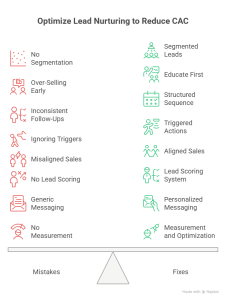
Let’s break down 8 high-impact mistakes—with fixes and real-world scenarios.

1. No Segmentation

What Happens:

All leads get the same emails, same offers, same messaging.

Why It Hurts:

A first-time visitor and a pricing-page visitor are not the same.

Fix:

Segment based on:

  • Behavior (visited pricing page, downloaded guide)
  • Source (ads, organic, referral)
  • Stage (cold, warm, hot)

Scenario:

SaaS:
A CRM tool sends the same onboarding emails to:

  • Trial users
  • Blog subscribers

Result: Low engagement.

Fix:

  • Trial users → product tutorials
  • Subscribers → educational content

Engagement improves → more conversions → lower CAC

2. Over-Selling Too Early

What Happens:

You push demos, pricing, or calls too soon.

Why It Hurts:

Trust isn’t built yet.

Fix:

Follow the rule:
Educate → Build trust → Then sell

Scenario:

Service Business:
A marketing agency sends:
“Book a paid consultation” immediately after signup.

Low response.

Fix:

  • First: Share insights/case studies
  • Then: Invite for consultation

Leads warm up → conversion increases
Common Lead Nurturing mistakes

 3. Inconsistent Follow-Ups

What Happens:

You follow up once… then disappear.

Why It Hurts:

Leads forget you.

Fix:

Create a structured follow-up sequence

  • Day 1
  • Day 3
  • Day 7
  • Day 14

Scenario:

SME (B2B):
A manufacturing supplier responds to inquiry once.

No reply → lead lost.

Fix:

  • Follow-up with:
    • Product comparison
    • Case study
    • Reminder

Lead re-engages → closes later

4. Ignoring Behavioral Triggers

What Happens:

You don’t act when leads show intent.

Why It Hurts:

High-intent signals go wasted.

Fix:

Trigger actions based on behavior:

  • Visited pricing page → send pricing breakdown
  • Abandoned cart → send reminder

Scenario:

D2C Brand:
User adds product to cart → leaves.

No follow-up.

Fix:

  • Send:
    • Reminder email
    • Offer
    • Review/testimonial

Recovery increases → CAC drops

5. Not Aligning with Sales

What Happens:

Marketing sends leads.
Sales says: “These aren’t good.”

Why It Hurts:

Wasted effort + poor conversions.

Fix:

Define together:
What is a “sales-ready” lead?

Scenario:

SaaS:
Marketing sends webinar attendees to sales.

Sales says:
“They’re not ready.”

Fix:
Only send leads who:

  • Attended webinar
  • Visited pricing page

Sales closes faster

6. No Lead Scoring System

What Happens:

You don’t prioritize leads.

Why It Hurts:

Hot leads don’t get immediate attention.

Fix:

Assign points:

  • Pricing page → +10
  • Webinar → +7
  • Email click → +3

Scenario:

Service Business:
A high-intent lead waits 3 days for response.

Lost to competitor.

Fix:
Lead scoring triggers instant sales call.

Faster response → higher close rate

7. Generic, Non-Personalized Messaging

What Happens:

Same email to everyone.

Why It Hurts:

Feels irrelevant → ignored.

Fix:

Personalize using:

  • Name
  • Industry
  • Behavior
  • Pain points

Scenario:

SME:
Sends generic “Our services” email.

Low CTR.

Fix:

  • “For manufacturing businesses struggling with X…”

Relevance increases → engagement improves

8. No Measurement or Optimization

What Happens:

You run campaigns without tracking performance.

Why It Hurts:

You don’t know what’s working.

Fix:

Track:

  • Open rates
  • CTR
  • Conversion rate
  • CAC

Scenario:

D2C:
Runs email campaigns blindly.

No improvement.

Fix:

  • Identify top-performing emails
  • Double down

Better ROI → lower CAC

Actionable Tip

Fixing just 2–3 of these mistakes can:

  1. Increase conversions by 20–40%
  2. Reduce CAC significantly without increasing ad spend

Key Takeaway

  1. You don’t reduce CAC by spending less
  2. You reduce CAC by wasting fewer leads

How to Build a Simple Lead Nurturing System (Step-by-Step)

A simple lead nurturing system for small businesses doesn’t need to be complex—it just needs to be consistent, targeted, and aligned with how customers actually make decisions.

Let’s simplify this.

You don’t need complex tools.
You need a structured system.

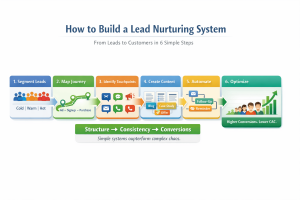
Step 1: Segment Your Leads

Group leads into:

  • Cold (just discovered you)
  • Warm (engaged)
  • Hot (ready to buy)

Tip:

Start simple. You can refine later.

Step 2: Map Your Customer Journey

Understand:

  • Where leads enter
  • What they need at each stage

Example:

SaaS Journey:
Ad → Signup → Trial → Upgrade

Step 3: Define Key Touchpoints

Identify:

  • Email
  • WhatsApp
  • Retargeting ads
  • Calls

Insight:

More touchpoints = higher conversion probability
How to build a lead nurturing system

Step 4: Create Targeted Content

Match content to stage:

  • Awareness → Educational
  • Consideration → Case studies
  • Decision → Offers/demo

Scenario:

Service Business:

  • Blog → Awareness
  • Case study → Consideration
  • Consultation → Decision

Step 5: Set Up Automation

Use tools to automate:

  • Email sequences
  • Follow-ups
  • Alerts

Tools:

  • CRM: HubSpot, Zoho
  • Email: Mailchimp, ActiveCampaign

With the right marketing automation in place, businesses can nurture leads consistently at scale without relying on manual follow-ups.

Step 6: Track and Optimize

Measure:

  • Conversion rates
  • Engagement
  • Drop-offs

Tip:

Improve one step at a time.

Real-World System Examples

1. SME Example

Problem:

Leads come from website but don’t convert.

System:

  • Day 1: Welcome email
  • Day 3: Case study
  • Day 7: Offer/free consultation

Result: Higher conversions without more ads

2. SaaS Example

Problem:

Free trials don’t convert.

System:

  • Day 1: Setup guide
  • Day 2: Feature tutorial
  • Day 5: Case study
  • Day 7: Upgrade offer

Result: Better activation → lower CAC

3. Service Business Example

Problem:

Leads go cold.

System:

  • Follow-up email sequence
  • Testimonials
  • Problem-solving content

Result: Trust builds → more deals closed

4. D2C Example

Problem:

Cart abandonment.

System:

  • 1 hour: Reminder
  • 24 hours: Offer
  • 48 hours: Social proof

Result: Recovered revenue

Final Insight

  1. You don’t need more leads
  2. You need a better system

Key Takeaway

Lead nurturing is not about sending emails.

It’s about guiding decisions

And when done right:

✔ More conversions
✔ Lower CAC
✔ Higher ROI 

Metrics That Prove Your CAC Is Decreasing

Let’s be honest.

You can feel things are improving…
But unless you measure it, you can’t prove it.

And in business:

What you can’t prove, you can’t scale.

So instead of tracking everything, focus on a few high-impact metrics that directly show whether your lead nurturing is working.

1. Conversion Rate (Your #1 Signal)

This is the most important metric.

Formula:
Leads → Customers

Why It Matters:

If more leads convert into customers…

Your CAC automatically drops

Scenario:

You generate 100 leads.

  • Earlier → 5 customers → 5% conversion
  • Now → 10 customers → 10% conversion

Same leads. Same spend.

But CAC is cut in half.

Tip:

Track conversion at each stage:

  • Visitor → Lead
  • Lead → Qualified
  • Qualified → Customer

This shows where you’re improving.

2. Cost per Lead vs Cost per Customer

This is where many businesses get confused.

They focus only on cost per lead (CPL).

But what really matters is:

Cost per customer (CAC)

Scenario:

You spend ₹50,000 on ads.

Case A:
  • 500 leads → ₹100 per lead
  • 5 customers → CAC = ₹10,000
Case B:
  • Same 500 leads
  • 10 customers → CAC = ₹5,000

Lead cost didn’t change
Conversion improved

Insight:

Low CPL ≠ success
High conversion = success

3. Email Engagement (Early Indicator)

Before conversions improve…

Engagement improves first.

Track:

  • Open rate
  • Click-through rate (CTR)
  • Reply rate

Scenario:

SaaS Business:
  • Old emails → 12% open rate
  • New nurturing sequence → 28% open rate

More engagement → more educated leads → higher conversions

Tip:

If engagement is low:
1.Your messaging is off

2. Not your product

4. Sales Cycle Length

How long does it take to convert a lead?

Scenario:

Service Business:
  • Earlier: 30 days to close
  • After nurturing: 18 days

Why?

Because leads:

  • Already understand the value
  • Already trust you

Insight:

Shorter sales cycle = lower cost per deal

Less time → less effort → lower CAC

5. Customer Lifetime Value (LTV)

CAC is only half the story.

The real game is:

CAC vs LTV

Scenario:

D2C Brand:
  • Without nurturing → one-time buyers
  • With nurturing → repeat purchases

LTV increases

Insight:

Better nurturing doesn’t just convert…

It creates better customers

Putting It All Together

Here’s the pattern you want:

✔ Conversion rate → Up
✔ Email engagement → Up
✔ Sales cycle → Down
✔ LTV → Up
✔ CAC → Down

Core Insight

  1. If conversions increase while spend stays the same
  2. CAC will drop automatically

No hacks. No tricks.

Just better funnel efficiency.

Advanced Insight: The CAC vs Conversion Flywheel

Most businesses think like this:

“We need more leads to grow”

But high-growth businesses think differently:

“We need to convert better”

That’s where the CAC vs Conversion Flywheel comes in.

The Flywheel Explained

Here’s the loop:

Better Nurturing
Higher Conversion Rate
Lower CAC
More Budget Efficiency
More Leads / Better Investment
More Growth
→ Back to Better Nurturing

Why This Changes Everything

This is not a one-time improvement.

It’s a compounding system.

Scenario:

Month 1:
  • Conversion rate = 5%
  • CAC = ₹10,000

You improve nurturing.

Month 3:
  • Conversion rate = 8%
  • CAC = ₹6,250

Now you reinvest savings into better campaigns.

Month 6:
  • More leads
  • Better conversion
  • Even lower CAC

Growth accelerates

The Real Power

Most businesses try to scale like this:

Spend more → hope for growth

But this is risky.

Smart businesses scale like this:

Improve system → then scale

Strategic Insight

Lead nurturing is not just a marketing tactic.

It’s a growth lever

Because it impacts:

  • Conversions
  • Costs
  • Revenue
  • Retention

Actionable Tip

Start small:

  1. Improve one nurture sequence
  2. Track conversion impact
  3. Reinvest gains into better campaigns

Repeat.

Final Takeaway

  1. CAC doesn’t drop randomly
  2. It drops when your system improves

And when you build this flywheel:

✔ Growth becomes predictable
✔ Marketing becomes efficient
✔ Sales becomes easier

Conclusion: Stop Chasing Leads—Start Converting Them

Let’s bring this home.

Most businesses believe their biggest problem is:
“We need more leads”

So they spend more on ads.
Try new channels.
Push harder for traffic.

But here’s the reality:

CAC is not just a cost problem. It’s a conversion problem.

If your funnel converts poorly,
even cheap leads become expensive.

If your funnel converts well,
even expensive leads become profitable.

The Real Shift

Lead nurturing is the missing link most businesses ignore.

It’s the bridge between:

Interest → Trust → Purchase

Without it:

  • Leads stay cold
  • Sales feels forced
  • CAC keeps rising

With it:

  • Leads get educated
  • Trust builds naturally
  • Conversions happen faster

Final Thought

“The businesses that win are not the ones that generate the most leads—
but the ones that convert the most from what they already have.”

That’s the difference between:

  • Constantly chasing growth
    vs
  • Building a system that creates it

Actionable Next Steps (Start Here)

Don’t overcomplicate this.

Start simple. Start practical.

1. Audit Your Current Funnel

Ask yourself:

  • Where are leads coming from?
  • What happens after they enter?

Most businesses don’t even have clarity here.

2. Identify Where Leads Drop Off

Look for leaks:

  • After signup?
  • After first visit?
  • Before purchase?

That’s where your CAC is increasing.

3. Set Up One Simple Nurturing Sequence

Start with just one:

Example:

  • Day 1: Welcome + value
  • Day 3: Insight or case study
  • Day 5: Problem-solving content
  • Day 7: Offer or CTA

Keep it simple. Consistency beats complexity.

4. Track Conversion Improvements

Watch:

  • Conversion rate
  • Engagement
  • Sales cycle

Even small improvements = big CAC reduction

Key Takeaway

Lead nurturing is not just another marketing tactic.

It’s a revenue optimization system

Because when you get it right:

✔ You convert more without spending more
✔ You reduce CAC naturally
✔ You build predictable growth
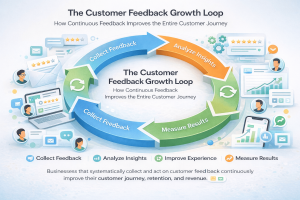
 

Customer Feedback – How to Collect Analyze and Use It to Improve Your Customer Journey

Customer feedback is one of the most powerful yet underused tools businesses have for understanding their customers and improving every stage of the customer journey.

If there’s one thing every successful business has in common, it’s this:

They don’t guess what customers want — they ask and listen.

Customer feedback isn’t just a box to tick or an optional survey you send at the end of a purchase. It’s the fuel that powers better experiences, smarter decisions, and stronger growth. Without it, you’re essentially flying blind — making assumptions about what your audience wants, how they behave, and what holds them back from converting.

Imagine this scenario:

You spend weeks optimizing your checkout page. You A/B test button colors, revise product descriptions, and tweak pricing layouts — all based on instinct.

But sales still don’t budge.

Why?

Because none of those changes were based on what your customers actually care about.

Now imagine another scenario:

You collect simple feedback at critical touchpoints — after onboarding, following a purchase, or after a support interaction. You discover that users abandon their carts not because of price, but because they’re confused by your shipping options.

That insight leads you to clarify costs upfront and rework your page layout — voila, cart drop-offs decrease and conversions jump.

That’s the power of customer feedback in action.

According to industry research, companies that systematically collect and act on customer feedback are significantly more likely to grow revenue and improve retention — because they’re not guessing what customers want… they know what they want.

In this article, we’ll dive deep into what customer feedback really is (and what it isn’t), why it matters, and how you can start using it to refine every stage of the customer journey — without being overwhelmed by data.

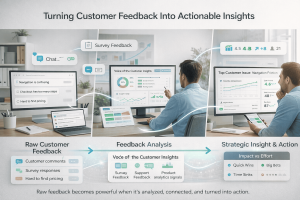
One of the most powerful ways to build a better customer experience is learning how to use customer feedback to improve your customer journey, because your customers constantly reveal where the journey is smooth and where it breaks

Businesses often collect feedback through surveys, reviews, or support interactions. But the real advantage comes when this feedback becomes part of a structured Voice of the Customer (VoC) system that continuously improves the customer journey.


What Customer Feedback Really Is (And Isn’t)

What Customer Feedback Is

At its core, customer feedback is simply what your customers tell you about their experience with your product, service, or brand. It’s their honest opinion about what worked, what didn’t, and how they felt during each interaction.

This can come in many forms:

  • A brief rating after a support chat
  • A written response on a post-purchase survey
  • A comment on social media
  • A review on a third-party platform
  • Behavioral signals, like abandoning a cart or revisiting a pricing page multiple times

In other words, feedback isn’t just words — it’s data, sentiment, and behavior. And when organized correctly, it becomes a rich source of insights that shows why people behave the way they do, not just what they did.

Here’s a simple example:

A customer completes a purchase and is then prompted with a quick 1–5 star rating plus an optional comment:
“How was your checkout experience?”

That short 30-second input can tell you:

  • Whether the process feels smooth or confusing
  • What might be blocking people from checking out
  • What language or UX elements delight your most loyal buyers

The smart part isn’t just collecting feedback — it’s acting on it.


What Customer Feedback Isn’t

This is where many businesses stumble.

Customer feedback is not:

❌ Just review scores on a product page
❌ A vanity metric you look at once a month
❌ A “set it and forget it” survey buried in an email
❌ A reason to argue with customers (“They don’t understand our pricing!”)

If feedback is collected but never acted on, it becomes noise — something that provides “information” but not insight.

Here’s a common misconception:

Sending an NPS survey and seeing your score go up or down — without connecting that feedback to the customer journey — is like glancing at your dashboard without checking the fuel gauge.

You have numbers, but you don’t know what to change.

Customer feedback only becomes useful when it’s timely, contextual, and tied to actions you can take.


Direct Feedback vs. Indirect Feedback

Not all feedback comes directly from customers’ mouths — and that’s important.

Direct feedback includes:

  • Survey responses
  • Reviews
  • Support tickets
  • Interview transcripts

Indirect feedback includes:

  • Analytics behavior (clicks, time on page)
  • Cart abandonment rates
  • Repeat vs. one-time purchases
  • Social media sentiment

For example, if analytics show that 60% of users leave during checkout, that’s indirect feedback — an outcome that signals friction. But customer comments explain why this is happening.

Good companies use both — the numbers point you to the problem, and customer feedback tells you what to fix.


Why Quality Feedback Beats Quantity

A common mistake is thinking more feedback is always better. But this isn’t true.

You want relevant, actionable feedback, not just noise.

A thousand generic ratings with no context are less useful than 100 targeted insights that tell you:

  • Where in the experience customers struggled
  • What motivated their decisions
  • What specific changes would improve satisfaction or conversions

In fact, research shows that focusing on structured feedback that ties directly into the customer experience — like CSAT, NPS, and behavior-linked triggers — delivers better business results than broad, unfocused surveys.


Quick Tip: Feedback Is a Conversation, Not a Report Card

Imagine if feedback was a face-to-face conversation:

  • You ask a question
  • Someone tells you their honest experience
  • You thank them
  • You take action
  • You report back

That’s the mindset that makes feedback truly effective — instead of treating it like a metric to check once a quarter.


Key Takeaways (So Far)

✔ Customer feedback is more than star ratings — it’s insight into customer behavior, expectations, and emotions.
✔ Feedback is most valuable when it’s contextual, timely, and tied to specific experiences.
✔ The real power of customer feedback comes from acting on it — not just collecting it.
✔ Quality feedback beats raw quantity every time.

Understanding why customer feedback is important for customer experience helps businesses move from guesswork to data-driven decisions that directly improve satisfaction and retention

Customer feed back growth loop

Where Feedback Fits in the Customer Journey

Customer feedback becomes truly powerful when it is collected at the right moments in the customer journey.

Many businesses make the mistake of collecting feedback randomly — perhaps sending a survey once in a while or asking customers for reviews only after a purchase. But the most successful companies collect feedback strategically at key customer touchpoints throughout the journey.

These moments are often called “feedback touchpoints.”

By listening to customers at these critical stages, businesses can understand exactly where customers feel delighted, confused, or frustrated.

Let’s look at where feedback fits across the typical customer journey.

  1. Awareness Stage

At this stage, potential customers are just discovering your brand. They might land on your website through search, social media, or a blog article.

This is a great opportunity to understand whether your content is answering their questions.

For example, you might ask a simple on-page question like:

“Did this article help you solve your problem?”

Tools such as heatmaps and quick polls can reveal whether visitors are finding value in your content or leaving with unanswered questions.

Example scenario:

A SaaS company noticed many visitors leaving their pricing page quickly. After adding a small feedback poll, they discovered that customers were confused about the pricing tiers. By clarifying the page, they increased conversions by 18%.


  1. Consideration Stage

In the consideration stage, prospects are evaluating your solution. They may download a guide, request a demo, or subscribe to your email list.

This is the stage where feedback helps you understand what problems customers are trying to solve.

For example, after a demo signup you could ask:

“What challenge are you hoping to solve with our solution?”

These responses often reveal valuable insights about customer priorities and buying motivations.

Research by the Harvard Business Review shows that companies that actively collect and analyze customer insights during the evaluation phase are 60% more likely to improve their sales conversion rates.


  1. Purchase Stage

The purchase stage is one of the most important moments to gather feedback.

Customers have just experienced your sales process — from browsing products to completing payment.

A simple post-purchase question such as:

“Was there anything that almost stopped you from completing your purchase today?”

can uncover hidden friction in your buying process.

For example:

An eCommerce store discovered through feedback that customers were abandoning purchases because the shipping cost was shown too late in the checkout process. By displaying it earlier, they reduced cart abandonment significantly.


  1. Post-Purchase and Retention Stage

After customers start using your product or service, feedback becomes even more valuable.

This is where you can measure satisfaction and long-term loyalty using surveys such as:

These insights help identify whether customers are happy, frustrated, or at risk of leaving.

According to research by Bain & Company, companies that systematically measure and act on customer feedback grow 4–8% faster than their competitors.


Why This Matters

When businesses intentionally collect customer feedback across the customer journey, they gain a clearer picture of the entire customer experience — not just isolated moments.

As customer experience expert Jeanne Bliss explains:

“Customer experience improvement begins when organizations listen to customers at the moments that matter most.”

The key insight is simple:

Feedback should follow the customer journey — not the company’s internal process.


Practical Tip

Start by identifying 3–5 key feedback touchpoints in your customer journey, such as:

  • Website visits
  • Demo requests
  • Purchases
  • Customer support interactions
  • Product usage milestones

Collecting feedback at these points gives you a continuous stream of insight to improve the entire experience.

When businesses intentionally collect customer feedback in the customer journey, they gain visibility into the exact moments where customers feel delighted, confused, or frustrated.


Where to Collect Customer Feedback in the Journey

Here’s where most businesses go wrong:

They collect feedback at the end.

After the sale.
After the support ticket.
After the damage is done.

But customer experience doesn’t happen at one point.
It happens across the entire journey.

If you only measure at the finish line, you miss the friction that happens along the way.

Let’s walk through each stage.


1. At the Awareness Stage: Are You Attracting the Right People?

This is where customers first discover you — through ads, search, social media, or referrals.

At this stage, feedback helps answer a crucial question:

Does your messaging match customer expectations?

Scenario:

You’re running Google Ads promising “Affordable CRM for SMEs.”

People click.

But they bounce.

Is it price?
Is it confusion?
Is it mismatch in expectations?

Instead of guessing, add a simple landing page poll:

“What were you hoping to find today?”

That one question can tell you whether your positioning is aligned.

Tools:

  • Social listening (monitor comments, brand mentions)
  • Landing page polls
  • Short website exit pop-ups

According to research by Microsoft, 90% of consumers consider customer service when deciding whether to do business with a brand. That decision often starts at awareness. If expectations are misaligned here, everything downstream suffers.

Pro Tip:

If your bounce rate is high, that’s indirect feedback. Pair it with a quick poll to understand why.

Collecting customer feed back in the customer journey

2. During Onboarding: First Impressions Matter More Than You Think

You never get a second chance at a first impression.

Onboarding is where customers decide:

“Was this a good decision?”

For SaaS or service businesses, this is critical.

According to Wyzowl, 63% of customers say onboarding influences their decision to continue using a product.

Scenario:

A user signs up for your platform.

They log in once.

They don’t return.

Was the interface confusing?
Were next steps unclear?
Did they get stuck?

Instead of assuming, ask:

“What almost stopped you from getting started today?”

That question reveals friction instantly.

Tools:

  • In-app surveys
  • Onboarding email check-ins
  • Guided setup feedback prompts

Valuable Insight:

Don’t wait 30 days to send a survey.

Ask within the first 24–72 hours while the experience is fresh.


3. In-Product or Post-Purchase: Did You Deliver on Your Promise?

This is where expectations meet reality.

Now the question shifts from:

“Will I try this?”
To:
“Was it worth it?”

This is where CSAT and NPS come into play.

What to Measure:

  • Satisfaction (CSAT)
  • Likelihood to recommend (NPS)
  • Ease of use
  • Outcome achieved

According to Bain & Company (creators of NPS), companies with high Net Promoter Scores grow more than twice as fast as competitors in many industries.

Scenario:

You sell an online course.

Completion rates are low.

Instead of reworking the entire course blindly, ask:

“What made it difficult to continue?”

Sometimes it’s not content quality — it’s time commitment or unclear structure.

Tools:

  • Automated post-purchase emails
  • CSAT surveys
  • NPS prompts
  • In-product feedback widgets


4. Post-Support: How Did We Handle the Problem?

Support interactions are emotional moments.

They can either build loyalty — or destroy it.

Zendesk reports that a majority of customers will switch brands after multiple poor service experiences.

Here’s the truth:

Customers don’t expect perfection.

They expect responsiveness and empathy.

Scenario:

A customer contacts support because of a billing issue.

The issue is resolved.

But how do they feel about the interaction?

Add a simple thumbs up/down at the end of live chat.

If thumbs down → follow up with:

“What could we have done better?”

Short. Direct. Actionable.

Tools:

  • Ticket surveys
  • Live chat rating prompts
  • Email follow-ups after resolution


5. At Churn or Exit: The Most Honest Feedback You’ll Ever Get

This is the goldmine most businesses ignore.

When customers leave, they’re often brutally honest.

Instead of asking:

“Why are you cancelling?”

Try asking:

“What didn’t work for you?”

The difference is subtle — but powerful.

The first feels defensive.
The second invites honesty.

Scenario:

A subscription business notices rising churn.

Exit surveys reveal:

“Too complex.”
“Didn’t use enough.”
“Found alternative.”

That insight can reshape onboarding, pricing tiers, or product simplicity.

According to Harvard Business Review, reducing customer churn by just 5% can increase profits by 25% to 95%.

Feedback at churn is not about saving that customer.

It’s about preventing the next 100 from leaving.


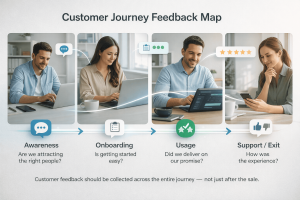
Visual Concept: Customer Journey Feedback Map

Imagine a simple journey map:

Awareness → Onboarding → Usage → Support → Renewal or Exit

Now mark feedback collection points at each stage.

That’s how modern businesses design feedback systems.

Not randomly.
Strategically.


Key Takeaway

Customer feedback works best when it’s contextual.

Not generic.
Not delayed.
Not disconnected.

Tie feedback to specific actions, specific touchpoints, and specific experiences.

That’s when it becomes powerful.

A well-designed customer feedback strategy for business growth turns everyday customer conversations into insights that guide product/service improvements and marketing decisions.


How to Ask Questions That Get Actionable Answers

Let’s be honest.

Most surveys fail not because customers don’t care…

…but because the questions are vague.

If you ask weak questions, you get weak answers.

Closed vs Open Questions: When to Use Which


Closed Questions (Quantitative)

These give you measurable data.

Example:

  • “Rate your experience from 1–5.”
  • “Would you recommend us?”

Best for:

  • Spotting trends
  • Benchmarking performance
  • Tracking improvements over time

Open Questions (Qualitative)

These tell you why.

Example:

  • “What almost stopped you from completing your purchase?”
  • “What could we improve?”

Best for:

  • Discovering friction
  • Understanding emotions
  • Finding unexpected issues

Pro Insight:

Use both together.

First ask a rating.
Then ask why they gave that rating.

That’s where real insight happens.

Proven Feedback Frameworks That Work

1. Likert Scale

“How satisfied are you?” (1–5)

Great for tracking improvement over time.

2. NPS (Net Promoter Score)

“How likely are you to recommend us?”

Segment customers into:

  • Promoters
  • Passives
  • Detractors

Then follow up with:

“What’s the main reason for your score?”

That’s the real value.

3. The Friction Question

“What stopped you from…?”

This question is gold.

It identifies blockers instantly.


Avoiding Survey Fatigue

Customers are overwhelmed.

If every interaction triggers a survey, they’ll ignore all of them.

Research shows response rates drop significantly when customers are surveyed too frequently.

Best Practices:

  • Limit surveys to key journey moments.
  • Keep surveys under 60 seconds.
  • Don’t ask 10 questions when 1 will do.


How to Survey Without Annoying Customers

✔ Use conversational language
✔ Ask one clear question
✔ Be transparent about why you’re asking
✔ Thank customers for their input
✔ Share when changes are made because of feedback

People respond when they feel heard.


High-Impact Questions by Stage


Awareness:
“What were you hoping to find today?”


Onboarding:
“What felt confusing during setup?”


Post-Purchase:
“What nearly stopped you from buying?”


Support:
“Did we fully resolve your issue?”


Churn:
“What didn’t meet your expectations?”

Each question targets a specific moment.

That’s intentional design.

Actionable Tip

Use conversational language and ask one clear question per survey.

Not:
“Please provide detailed feedback about your overall experience with our platform and services.”

Instead:
“What could we improve?”

Simple wins.

Key Takeaway

The quality of your questions determines the quality of your feedback.

Better questions → clearer insights → smarter decisions → better customer journeys.


Tools & Platforms for Collecting Feedback

Let’s address a common mistake right away:

Most businesses don’t fail at feedback because they lack tools.

They fail because:

  • Tools are disconnected
  • Data sits in silos
  • Nobody acts on it

The right tool doesn’t just collect feedback.

It makes feedback visible, organized, and actionable.

Today there are several affordable customer feedback tools for small businesses that make it easy to collect surveys, reviews, and behavioral insights.

Let’s break this down by use case.


1. Website & In-App Feedback Tools

These tools capture feedback in the moment — while the experience is happening.

🔸 Hotjar

Best known for heatmaps and session recordings, Hotjar shows you how users interact with your site.

But here’s where it gets powerful:

You can trigger on-page surveys like:

“What stopped you from completing your purchase today?”

That combines behavioral data with direct feedback.


🔸 Qualaroo

Qualaroo specializes in targeted micro-surveys based on user behavior.

For example:

  • Show a survey only if someone visits pricing twice.
  • Ask different questions to new vs returning visitors.

That’s contextual feedback — not random polling.


🔸 Intercom

Intercom blends chat, onboarding flows, and product feedback inside apps.

You can:

  • Send onboarding check-ins
  • Trigger feedback based on feature usage
  • Collect quick NPS inside the platform


🔸 Drift

Drift (now part of Salesloft) focuses on conversational feedback via chatbots and live chat.

Instead of formal surveys, you gather feedback conversationally.

That often increases response rates because it feels human.

2. Email Feedback Tools

Sometimes, simple works best.

🔸 Typeform

Typeform makes surveys feel like conversations.

Higher engagement. Cleaner UX. Better completion rates.

🔸 Google Forms

Google offers free, simple surveys.

Perfect for:

  • SMEs starting out
  • Internal testing
  • Early-stage feedback systems

🔸 SurveyMonkey

SurveyMonkey is more advanced — good for segmentation and structured analysis.

According to SurveyMonkey’s own data, shorter surveys (under 5 questions) significantly improve response rates.

That’s a reminder:
Keep it tight.


3. Product Analytics Tools (Indirect Feedback Goldmine)

Sometimes customers don’t tell you what’s wrong.

They show you.

🔸 Mixpanel

Mixpanel tracks user behavior events.

You can identify:

  • Drop-off points
  • Feature adoption patterns
  • Retention cohorts


🔸 Heap

Heap automatically captures user interactions without manual tagging.

That reduces tracking blind spots.


🔸 FullStory

FullStory lets you replay sessions to see exactly where users struggle.

Pair that with direct survey feedback and you get a powerful combination.

Behavior tells you what happened.

Feedback tells you why it happened.


4. Support Feedback Systems

Support is one of the richest feedback channels.

🔸 Zendesk

Zendesk allows post-ticket CSAT ratings.

Zendesk research consistently shows that customers who rate support highly are more likely to remain loyal.


🔸 Freshdesk

Freshdesk (by Freshworks) offers automated ticket surveys.


🔸 Help Scout

Help Scout focuses on personalized support experiences and lightweight satisfaction tracking.


5. CRM Integrations: The Real Game-Changer

Here’s where advanced businesses win:

They don’t leave feedback in separate tools.

They sync it into their CRM.

Platforms like:

  • HubSpot
  • Zoho
  • Salesforce

Allow you to attach feedback scores to individual customer profiles.

Now imagine this:

A lead in your CRM shows:

  • NPS: 3
  • Multiple support complaints
  • High churn risk

That’s actionable intelligence.

Not just data.

✅ Actionable Checklist: How to Choose the Right Tool

Before you sign up for anything, ask:

✔ Is this tool easy for customers to use?
✔ Does it integrate with my CRM?
✔ Can it trigger feedback based on behavior?
✔ Does it support automation?
✔ Can I export data easily?
✔ Is it scalable for growth?

If the answer is “no” to most of these — keep looking.

Key Takeaway

The best feedback system is:

Integrated.
Automated.
Simple for customers.

Because feedback only works when it’s frictionless.

When integrated together, these tools can form the foundation of a Voice of the Customer (VoC) system that captures insights across the entire customer journey.


Turning Feedback Into Insight: Analysis Techniques

Many successful brands grow faster by using customer feedback to improve products and services, ensuring their offerings evolve with real customer needs.

Collecting feedback is step one.

Understanding it is where real growth happens.

Raw data doesn’t drive decisions.

Patterns do.

1. Qualitative Feedback Analysis

When customers write open-ended responses, you’ll see recurring themes.

That’s where thematic coding comes in.

What Is Thematic Coding?

You group responses into themes.

Example:

50 customers mention:

  • “Confusing navigation”
  • “Hard to find pricing”
  • “Too many steps”

Theme = Navigation friction

Now it’s not random comments.

It’s a pattern.

2. Sentiment Analysis

Modern tools use AI to detect whether feedback is:

Positive
Neutral
Negative

Even simple tagging (manual or AI-based) helps prioritize emotional pain points.

According to McKinsey, companies that leverage customer analytics outperform competitors in profit growth.

Why?

Because they turn emotion into measurable insight.

Turning customer feed back into insights

3. Quantitative Analysis

Numbers show trends.

Trend Lines

Are CSAT scores improving or declining month over month?

One bad week is noise.

A three-month decline is a signal.

CSAT / NPS Benchmarking

Track:

  • Your current score
  • Industry average
  • Historical trend

But remember:

Benchmarking without context is meaningless.

If NPS drops, ask:
What changed?


4. Heatmaps & Funnel Analytics

Tools like Hotjar or Mixpanel show:

  • Where users click
  • Where they stop
  • Where they exit

If 65% drop at checkout step 2 — that’s friction.

Pair it with:
“What stopped you from completing your purchase?”

Now you know why.

5. Dashboards: Make Feedback Visible

Feedback hidden in spreadsheets doesn’t drive action.

Create a simple dashboard that shows:

  • Top 5 recurring issues
  • CSAT trend
  • NPS trend
  • Churn-related feedback themes
  • Most requested feature

This creates clarity.

6. Prioritizing Feedback Based on Impact

Not all feedback deserves equal action.

Use a simple Impact vs Effort matrix:

High Impact + Low Effort = Quick wins
High Impact + High Effort = Strategic priority
Low Impact + High Effort = Ignore (for now)

According to research by Bain & Company, improving customer retention by just 5% can increase profits by 25–95%.

So prioritize feedback that impacts retention.

7. Voice of the Customer (VoC): Turning Feedback Into Strategic Insight

When businesses start collecting feedback across multiple touchpoints, they often reach a point where simple surveys are no longer enough. That’s where a Voice of the Customer (VoC) program becomes valuable.

The Voice of the Customer (VoC) refers to a structured process for collecting, analyzing, and acting on customer feedback across the entire customer journey.

Instead of looking at feedback in isolated pieces, a VoC system connects signals from different sources, such as:

  • Surveys and feedback forms
  • Customer support conversations
  • Product usage behavior
  • Social media comments
  • Online reviews

The goal is to create a single, unified view of what customers are experiencing and saying about your business.

According to research from Qualtrics, companies that implement structured VoC programs are able to identify customer experience issues up to 2–3 times faster than organizations relying on ad-hoc feedback.

Example Scenario

Imagine a SaaS company receiving the following signals:

  • NPS survey comments mention slow onboarding
  • Support tickets show repeated login issues
  • Product analytics reveal high drop-off during account setup

Individually, these insights might look unrelated.

But a VoC system connects them and reveals the real problem:

👉 The onboarding process is confusing and causing frustration.

Once identified, the company can redesign onboarding and improve the overall experience.

Why VoC Matters for Growing Businesses

A strong Voice of the Customer program helps businesses:

  • Detect customer pain points early
  • Prioritize improvements based on real feedback
  • Align product, marketing, and support teams
  • Build customer trust by acting on feedback

Customer experience expert Jeanne Bliss explains:

“Voice of the Customer isn’t just about collecting feedback — it’s about creating an organization that listens and responds.”

Practical Tip

If you are just starting, your VoC program does not need to be complex.

Start with three core feedback sources:

  1. Customer surveys (NPS or CSAT)
  2. Support ticket feedback
  3. Website or product behavior analytics

Over time, you can expand your VoC system to include reviews, social listening, and customer interviews.

Key Insight

Customer feedback gives you data points.

A Voice of the Customer program connects those data points into a clear story about the customer experience.

Voice of the Customer (VoC): Turning Feedback Into Strategic Insight

When businesses start collecting feedback across multiple touchpoints, they often reach a point where simple surveys are no longer enough. That’s where a Voice of the Customer (VoC) program becomes valuable.

The Voice of the Customer (VoC) refers to a structured process for collecting, analyzing, and acting on customer feedback across the entire customer journey.

Instead of looking at feedback in isolated pieces, a VoC system connects signals from different sources, such as:

  • Surveys and feedback forms
  • Customer support conversations
  • Product usage behavior
  • Social media comments
  • Online reviews

The goal is to create a single, unified view of what customers are experiencing and saying about your business.

According to research from Qualtrics, companies that implement structured VoC programs are able to identify customer experience issues up to 2–3 times faster than organizations relying on ad-hoc feedback.

Example Scenario

Imagine a SaaS company receiving the following signals:

  • NPS survey comments mention slow onboarding
  • Support tickets show repeated login issues
  • Product analytics reveal high drop-off during account setup

Individually, these insights might look unrelated.

But a VoC system connects them and reveals the real problem:

👉 The onboarding process is confusing and causing frustration.

Once identified, the company can redesign onboarding and improve the overall experience.

Why VoC Matters for Growing Businesses

A strong Voice of the Customer program helps businesses:

  • Detect customer pain points early
  • Prioritize improvements based on real feedback
  • Align product, marketing, and support teams
  • Build customer trust by acting on feedback

Customer experience expert Jeanne Bliss explains:

“Voice of the Customer isn’t just about collecting feedback — it’s about creating an organization that listens and responds.”

Practical Tip

If you are just starting, your VoC program does not need to be complex.

Start with three core feedback sources:

  1. Customer surveys (NPS or CSAT)
  2. Support ticket feedback
  3. Website or product behavior analytics

Over time, you can expand your VoC system to include reviews, social listening, and customer interviews.

Key Insight

Customer feedback gives you data points.

A Voice of the Customer program connects those data points into a clear story about the customer experience.

✅ Actionable Tip: Build a Frequency vs Impact Dashboard

Create two columns:

Frequency (How often does this issue appear?)
Impact (How much revenue or retention does it affect?)

Now score each issue 1–5.

The ones scoring highest?
That’s where you focus.

Key Takeaway

Analysis turns raw feedback into patterns.

Patterns create clarity.

Clarity drives confident decisions.

Without analysis, feedback is noise.

With analysis, feedback becomes a competitive advantage.

Knowing how to analyze customer feedback effectively helps businesses identify patterns, prioritize improvements, and avoid reacting to isolated opinions


Acting on Feedback: How to Make Improvements That Stick

Collecting feedback feels productive.

Analyzing feedback feels strategic.

But acting on feedback?

That’s where most businesses quietly struggle.

You’ve probably seen it happen:
Customers share suggestions.
Teams discuss them in meetings.
Someone says, “Yes, this is important.”

And then… nothing changes.

Let’s fix that.

1. Triage Feedback: Quick Wins vs Strategic Reforms

Not all feedback deserves the same response time.

If you treat every suggestion like a product overhaul, you’ll overwhelm your team.
If you ignore patterns because they seem “small,” you’ll slowly erode trust.

The smarter way? Triage.

Think in two buckets:

✅ Quick Wins (Low Effort, High Impact)

  • Confusing button label
  • Broken checkout link
  • Missing FAQ answer
  • Slow response time from support

These are friction points. They directly affect experience and conversions.

Example:
A SaaS company notices 15 customers mention “I couldn’t find pricing easily.”
They move pricing to the main menu.
Conversion rate improves within weeks.

That’s a quick win.

Strategic Reforms (High Effort, High Impact)

  • Product feature gaps
  • Onboarding redesign
  • Pricing model changes
  • Customer support restructuring

These require planning, resources, and stakeholder buy-in.

According to research by Harvard Business Review, companies that systematically act on customer feedback outperform competitors in revenue growth by prioritizing improvements based on impact, not noise.

Practical Tip:
Create a simple 2×2 grid:

  • High impact / Low effort → Do now
  • High impact / High effort → Plan roadmap
  • Low impact / Low effort → Optional
  • Low impact / High effort → Reconsider

This prevents emotional decisions.

2. How to Communicate Changes to Customers

One of the most underrated growth strategies?

Tell customers you listened.

When you implement feedback and stay silent, you miss a trust-building opportunity.

💬 Example:
“Based on your feedback, we’ve simplified our onboarding steps.”

That single sentence builds credibility.

According to a report by Microsoft, 77% of consumers view brands more favorably if they proactively seek and act on customer feedback.

Notice the key word: act.


3. Closing the Loop With Feedback Providers

Closing the loop means:

You don’t just collect feedback.
You respond to the person who gave it.

Imagine this scenario:

A customer submits feedback saying your mobile dashboard is hard to use.
Three months later, you improve it.

You send them a short message:

“Hi Sarah, you mentioned issues with our mobile dashboard. We’ve redesigned it based on feedback like yours. Would love to hear what you think.”

That creates loyalty.

This approach turns passive users into advocates.

According to research from Bain & Company, companies that excel at customer experience grow revenues 4–8% above market average.

Closing the loop is a big reason why.


4. Feedback Governance: Ownership and Accountability

Here’s where many SMEs struggle:

Who owns feedback?

Marketing collects it.
Support hears it.
Product discusses it.
Sales complains about it.

But no one owns it.

Feedback without ownership becomes a shared responsibility — which usually means no responsibility.

Best practice:

  • Assign one feedback owner (CX lead, Product Manager, or Founder in SMEs)
  • Define a monthly review process
  • Create clear action categories (Fix, Improve, Monitor, Decline)

This turns feedback into a structured system — not random conversations.


5. Real-World Example: Feedback Turning Into Growth

Let’s look at a well-known example.

Slack built much of its product refinement through user feedback loops. Early users constantly reported friction in notifications and integrations. Instead of ignoring them, Slack iterated aggressively — weekly improvements based on usage feedback.

The result?
A product customers felt they co-created.

Even smaller companies can replicate this at scale.

💡 Scenario for SMEs:

An e-commerce brand notices repeated feedback:
“Delivery tracking updates are unclear.”

They:

  • Simplify tracking emails
  • Add WhatsApp notifications
  • Clarify delivery timelines

Customer anxiety drops.
Support tickets decrease.
Repeat purchases increase.

Feedback → Action → Retention.


Actionable Tip: Use a Feedback Loop Board

Create a simple board in:

  • Trello
  • Notion
  • ClickUp

Columns:

  1. Feedback Received
  2. Category
  3. Impact Score
  4. Action Planned
  5. In Progress
  6. Implemented
  7. Customer Notified

This visual workflow prevents feedback from disappearing into Slack chats or email threads.


✅ Key Takeaway

Feedback is not valuable because it’s collected.

It’s valuable because it drives change.

Action is the currency of feedback — without it, insights are just noise.

Feedback Metrics That Matter

Now let’s talk measurement.

Because here’s the truth:

If you improve customer experience but can’t measure it,
you can’t prove ROI.

And if you can’t prove ROI,
improvements get deprioritized.

Let’s focus on metrics that actually matter.

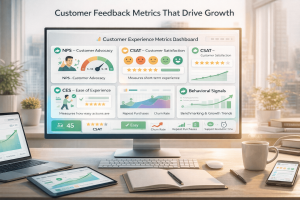
Customer feed back metrics that drive growth

1. Net Promoter Score (NPS) — Why It Matters

NPS asks one simple question:

“How likely are you to recommend us to a friend or colleague?”

Respondents are grouped into:

  • Promoters (9–10)
  • Passives (7–8)
  • Detractors (0–6)

It measures advocacy — not just satisfaction.

According to Bain & Company, creators of the NPS framework, companies with higher NPS grow more consistently because promoters drive referrals and repeat purchases.

💡 Why SMEs should care:
High NPS = lower acquisition cost.

But remember:
NPS alone isn’t enough. It tells you what people feel — not why.

Always add:
“What’s the primary reason for your score?”


2. Customer Satisfaction Score (CSAT)

CSAT measures short-term satisfaction.

Example:
“How satisfied were you with your recent support interaction?”

Usually measured on a 1–5 scale.

This metric is powerful for:

  • Post-support surveys
  • Post-purchase check-ins
  • Onboarding completion

It’s immediate and tactical.

💡 Scenario:
If your CSAT drops after onboarding changes, you know something broke.


3. Customer Effort Score (CES)

CES measures how easy it was for customers to complete an action.

Example:
“How easy was it to resolve your issue?”

Research published in Harvard Business Review suggests reducing customer effort is a stronger predictor of loyalty than delighting customers.

In other words:
Make it easy. Not flashy.

For SMEs, lowering friction often delivers better ROI than adding new features.


4. Behavioral Signals (Often More Honest Than Surveys)

Customers don’t always tell you the full story.

But their behavior does.

Track:

  • Repeat purchase rate
  • Churn rate
  • Time to close support tickets
  • Product usage frequency
  • Feature adoption rate

Example:
If NPS is high but churn is increasing, something deeper is wrong.

Feedback + behavior = full picture.


5. Benchmarking Your Scores

Don’t obsess over industry averages.

Instead:

  • Benchmark against your past performance.
  • Aim for month-over-month improvement.
  • Set realistic improvement goals (2–5% per quarter).

Consistency beats dramatic spikes.

Actionable Tip: Build a Monthly Metrics Scoreboard

Create a simple dashboard that tracks:

  • NPS
  • CSAT
  • CES
  • Churn Rate
  • Repeat Purchase Rate
  • Support Resolution Time

Review it monthly.

Tie each metric back to:
Revenue
Retention
Customer Lifetime Value

When leadership sees how CX metrics affect business KPIs, feedback becomes strategic — not optional.

✅ Key Takeaway

Metrics measure impact.

Without them, feedback feels subjective.

With them, feedback becomes a growth lever.


Common Feedback Pitfalls and How to Avoid Them

Let’s be honest.

Collecting feedback feels good. Acting on it feels productive.

But mismanaging feedback?
That can quietly hurt your growth.

SMEs make the same mistakes again and again. The good news? They’re avoidable.

Let’s break them down.


❌ 1. Focusing Only on Positive Feedback

It’s natural.

You receive five-star reviews and glowing testimonials — and you feel validated.

But here’s the danger:
If you only amplify praise and ignore criticism, you stop improving.

Positive feedback tells you what to keep doing.
Negative feedback tells you what to fix.

And the second one drives growth.

According to research by Harvard Business Review, companies that actively analyze negative feedback improve retention more effectively than those that only track satisfaction.

Scenario:
An online service receives multiple reviews saying, “Great service, but onboarding was confusing.”

If they only highlight the “Great service” part, they miss the friction hurting conversions.

Smart move: Create a monthly “Top 5 Complaints” review. Treat complaints like improvement opportunities.


❌ 2. Ignoring Low-Frequency but High-Impact Issues

Some problems don’t happen often — but when they do, they’re catastrophic.

Example:

  • Payment gateway failure for a few users
  • Account lockouts
  • Data privacy concerns
  • Severe shipping delays

These might represent only 2–3% of feedback.
But they destroy trust.

Research from PwC shows that 32% of customers will stop doing business with a brand they love after just one bad experience.

One.

So don’t just track frequency. Track impact.

Ask:

  • Does this issue directly affect revenue?
  • Does it affect trust?
  • Does it create churn risk?

Sometimes, the loudest growth lever isn’t the most frequent complaint — it’s the most damaging one.


❌ 3. Over-Surveying Your Customers

Feedback is powerful.

But too much feedback collection becomes annoying.

We’ve all experienced it:

  • “Rate your experience.”
  • “Tell us how we did.”
  • “Quick 30-second survey.”
  • “One more question…”

Survey fatigue is real.

According to data from SurveyMonkey, response rates drop significantly when customers are surveyed too frequently.

And worse — over-surveying reduces goodwill.

Rule of thumb:

  • Trigger feedback at meaningful moments.
  • Keep surveys short (1–3 questions).
  • Space them appropriately.

Ask yourself:
Is this survey necessary? Or are we asking because we can?


❌ 4. Reacting to Feedback Without Strategic Alignment

This one is subtle — and dangerous.

A customer requests a feature.
Another requests a completely opposite feature.
You try to satisfy both.

Suddenly your product becomes cluttered. Your messaging becomes unclear. Your roadmap loses direction.

Not all feedback should be implemented.

It must align with:

  • Your positioning
  • Your ideal customer profile
  • Your long-term strategy

As Steve Jobs famously said,
“It’s not the customer’s job to know what they want.”

Customers describe pain.
It’s your job to interpret and solve it strategically.


Actionable Tip: Use a Decision Matrix

Before acting on any feedback, evaluate it through:

Impact vs Effort Matrix

  • High Impact / Low Effort → Implement immediately
  • High Impact / High Effort → Add to roadmap
  • Low Impact / Low Effort → Optional
  • Low Impact / High Effort → Decline

This protects your team from emotional, reactive decisions.


✅ Key Takeaway

A feedback system isn’t powerful because it collects data.

It’s powerful because it stays focused, strategic, and sustainable.

Avoiding these mistakes ensures your feedback engine doesn’t become noise.


Scaling Your Feedback System for Growth

When you’re small, feedback is simple.

You check emails.
You read reviews.
You track comments in a spreadsheet.

But as your business grows, that approach breaks.

If your feedback system doesn’t scale with you, you lose visibility — and eventually, customers.

Let’s talk about scaling intelligently.


1. When to Move From Spreadsheets to Automation

Spreadsheets work when:

  • You get fewer than 50 feedback inputs per month.
  • You have one product or service.
  • You have a small team.

You need automation when:

  • Feedback is coming from multiple channels.
  • Support tickets exceed 100+ per month.
  • You have multiple teams involved.
  • Patterns are hard to detect manually.

At this stage, manual tracking creates blind spots.

Automation helps:

  • Categorize feedback automatically
  • Tag sentiment
  • Assign ownership
  • Track resolution time

If analysis feels overwhelming, it’s time to upgrade.


2. Predictive Feedback With Behavior Scoring

This is where modern businesses get smarter.

Instead of waiting for customers to complain, you predict dissatisfaction through behavior.

For example:

  • Reduced product usage
  • Slower login frequency
  • Abandoned carts
  • Increased support tickets

Companies using behavior analytics tools often integrate this with churn prediction models.

Research by Gartner suggests that businesses using predictive analytics significantly improve customer retention compared to reactive models.

Feedback isn’t just what customers say.
It’s what their behavior signals.


3. Using AI for Sentiment and Topic Analysis

As feedback volume grows, manual analysis becomes impossible.

AI tools can:

  • Detect emotional tone
  • Group similar complaints
  • Identify emerging patterns
  • Highlight urgent risk signals

For example:
If 200 comments mention “slow” or “delay,” AI clusters them automatically.

This allows you to:

  • Identify root causes faster
  • Detect reputation risks early
  • Make data-backed decisions

Even SMEs today can leverage affordable AI-powered analytics built into modern platforms.


4. Cross-Team Feedback Sharing

Feedback trapped in one department loses power.

Support hears complaints.
Sales hears objections.
Marketing hears expectations.
Product hears feature requests.

But if these insights don’t connect — strategy suffers.

High-performing companies build structured feedback sharing loops.

According to research from McKinsey & Company, organizations that break silos and share customer insights across teams outperform peers in customer satisfaction and operational efficiency.

Practical move:
Hold a monthly “Customer Insight Review” meeting:

  • Top 5 complaints
  • Top 5 feature requests
  • Top churn reasons
  • Support trends

Make feedback visible. Not hidden.


5. Connecting Feedback to Revenue and Retention Metrics

Here’s where scaling becomes strategic.

Early-stage businesses collect feedback to improve experience.

Growth-stage businesses connect feedback to money.

Start asking:

  • Does improving CSAT reduce churn?
  • Do promoters (high NPS) spend more?
  • Does faster support resolution increase repeat purchase rate?

According to research from Bain & Company, increasing customer retention rates by just 5% can increase profits by 25% to 95%.

That’s not a small lever.

Scenario:
You discover that customers who rate onboarding 8/10 or higher have:

  • 30% higher retention
  • 20% higher lifetime value

Now onboarding feedback becomes a revenue lever — not just a UX improvement metric.

When feedback is tied to revenue dashboards, leadership pays attention.


6. Segmenting Feedback by Customer Type

As you grow, one mistake becomes common:

Treating all feedback equally.

But a complaint from your ideal high-value customer is not the same as feedback from a one-time bargain buyer.

Segment feedback by:

  • Customer lifetime value
  • Industry (for B2B)
  • Subscription tier
  • Geography
  • New vs long-term customers

Why?

Because patterns differ across segments.

Research from McKinsey & Company shows that personalization and segmentation significantly improve retention and engagement outcomes.

Example:
Enterprise customers complain about integrations.
Small customers complain about pricing.

If you mix both together, strategy becomes confusing.

Segmentation gives clarity.


7. Building a Continuous Feedback Culture (Not Just a System)

Tools scale.
Processes scale.

But culture determines whether feedback actually drives growth.

In high-performing companies:

  • Feedback isn’t owned by one department.
  • Product decisions reference customer insights.
  • Sales objections feed product roadmap.
  • Support trends influence onboarding changes.

Feedback becomes part of decision-making DNA.

According to Gartner, organizations that embed customer insights into strategic planning outperform competitors in customer retention and operational performance.

Practical move:
Add one slide in every monthly leadership meeting:
“Voice of the Customer Highlights.”

Make it non-negotiable.


8. Creating Feedback-to-Innovation Loops

At scale, feedback shouldn’t just fix problems.

It should spark innovation.

Look at companies like Amazon. Their “working backwards from the customer” approach starts with customer pain and builds solutions around it.

Instead of asking:
“What should we build next?”

Ask:
“What are customers struggling with repeatedly?”

Example for SMEs:
If customers frequently ask:
“Can you integrate with WhatsApp?”

Instead of answering manually every time,
build the integration and promote it as a feature.

Recurring feedback patterns often reveal product expansion opportunities.

That’s how feedback fuels growth — not just damage control.

Quick Recap of All 8 Scaling Levers

As your business grows, your feedback system should evolve to include:

  1. Automation beyond spreadsheets
  2. Predictive behavior scoring
  3. AI-powered sentiment analysis
  4. Cross-team feedback sharing
  5. Revenue-linked insight tracking
  6. Segmented feedback analysis
  7. Cultural embedding of customer insights
  8. Innovation loops driven by recurring pain points


Actionable Tip: Scaling Checklist

Here’s a simple progression model:

Beginner Level

  • Manual surveys
  • Spreadsheet tracking
  • Basic CSAT tracking

Intermediate Level

  • Integrated survey tools
  • Automated tagging
  • Dashboard reporting
  • Monthly review meetings

Advanced Level

  • Predictive behavior scoring
  • AI sentiment analysis
  • Cross-team data integration
  • Feedback tied to revenue KPIs

Ask yourself:
Where are we today?
What’s the next logical upgrade?


✅ Key Takeaway

Feedback systems evolve.

What works at 100 customers won’t work at 10,000.

The best feedback systems are:

  • Integrated
  • Automated
  • Strategic
  • Scalable

And most importantly — aligned with growth.

Conclusion

Let’s bring this full circle.

Customer journeys don’t improve because we assume what customers want.

They improve because we listen intentionally, analyze intelligently, and act consistently.

If there’s one thing you should take away from this entire guide, it’s this:

Customer feedback is not a survey tool.
It’s a journey enhancement system.


🔁 Feedback Is a Continual Loop — Not a One-Time Activity

Many businesses treat feedback like a campaign.

They:

  • Run a survey.
  • Review results.
  • Make a few changes.
  • Move on.

That’s not a system. That’s an event.

The companies that win long-term treat feedback as a loop:

  1. Collect
  2. Analyze
  3. Act
  4. Communicate
  5. Measure
  6. Repeat

According to research from Bain & Company, companies that consistently close the feedback loop see stronger customer loyalty and long-term revenue growth compared to those that don’t.

Feedback isn’t a checkbox.
It’s an operating rhythm.

And when embedded into your journey touchpoints — awareness, onboarding, purchase, support, retention — it becomes a growth engine.


Why Feedback Is a Journey Enhancer

Let’s simplify this.

Without feedback:
You guess.

With feedback:
You prioritize.

Without feedback:
You build based on assumptions.

With feedback:
You build based on real friction, real needs, real expectations.

That’s the difference between reactive growth and intentional growth.

Research from PwC shows that customer experience is a key driver of loyalty, yet many businesses misjudge what matters most to customers. Feedback corrects that misalignment.

In simple terms:
Feedback aligns perception with reality.

And that alignment improves:

  • Conversion rates
  • Retention
  • Lifetime value
  • Referrals


A Simple 3-Step Action Plan (Start This Week)

Let’s make this practical.

You don’t need complex tools to begin. You need clarity.


✅ Step 1: Map Out Your Feedback Touchpoints

Open a blank page and write down:

  • Where do customers first interact with us?
  • Where do they make decisions?
  • Where do they experience friction?
  • Where do they leave?

Mark 5–7 key touchpoints across your journey:

  • Landing page
  • Onboarding
  • Checkout
  • Product usage
  • Support interaction
  • Renewal / repurchase

Now ask:
Where are we currently collecting feedback?
Where are we blind?

Clarity creates opportunity.


✅ Step 2: Build Your First Focused Feedback Survey

Don’t overcomplicate it.

Start with one clear objective.

Examples:

  • Improve onboarding
  • Reduce churn
  • Improve support experience

Then build a short survey (1–3 questions max).

For example:

  1. On a scale of 1–10, how satisfied are you with your onboarding experience?
  2. What was the most confusing part?

That’s it.

Keep it conversational.
Keep it specific.
Keep it actionable.

Remember:
The quality of your questions determines the quality of your feedback.

✅ Step 3: Set One KPI to Measure Success

Feedback without measurement becomes opinion.

Choose one KPI tied to your objective:

  • Reduce churn by 5%
  • Improve CSAT by 10%
  • Increase repeat purchases
  • Improve onboarding completion rate

Track it monthly.

According to Gartner, organizations that align customer experience metrics with business KPIs are significantly more likely to achieve growth targets.

Measurement turns feedback into ROI.


Final Perspective

Feedback isn’t about pleasing everyone.

It’s about understanding patterns.

It’s about identifying friction before it becomes churn.

It’s about creating experiences that feel intuitive because they are built on real insight.

The businesses that scale sustainably aren’t the ones with the loudest marketing.

They’re the ones with the clearest understanding of their customers.

And that clarity comes from a structured, evolving feedback system.

Businesses that consistently improve their customer journey don’t rely on occasional surveys. They build a continuous Voice of the Customer system that listens, analyzes, and acts on feedback at every stage.


Key Takeaway

Feedback isn’t a destination.
It’s not a one-time project.
It’s not a survey tool.

Customer feedback is your strategic advantage — when you turn it into action.