Nurturing Lead to Close More Deals With Less Effort

In a world flooded with ads, emails, and “free” offers, getting someone’s attention is tough. But keeping it—and turning that interest into revenue? That’s where nurturing leads becomes the secret sauce for success.

If you’re a small or medium-sized business owner, chances are you’re working with limited time, budget, and resources. That’s why a smart, streamlined lead nurturing strategy isn’t just nice to have—it’s a must.

Let’s walk through what lead nurturing really means today, why it matters more than ever, and how to do it right (without needing a team of 10 marketers).

What Is Lead Nurturing and Why Does It Matter?

Lead nurturing is all about building trust. Instead of pushing a sale right away, you’re guiding potential customers through their journey—answering questions, solving problems, and giving them every reason to choose you when they’re ready.

And here’s the kicker:
Nurtured leads make 47% larger purchases and convert 50% more often than non-nurtured leads (Salesmate).

So if you’re not nurturing your leads, you’re leaving serious money on the table.

The Core Building Blocks of a Nurturing Strategy

Before you dive into email campaigns or content calendars, make sure you’ve got a solid foundation. Here’s what that looks like:

1.Understand Your Ideal Buyer

Start with buyer personas—detailed profiles of your target audience based on real data and behavior. The more specific, the better.

Pro tip: Use surveys, CRM insights, and past sales data to find out:

  • What challenges your leads face
  • Where they hang out online
  • How they prefer to communicate

2. Know Your Sales Cycle

For some, it’s a week. For others, it’s months. Either way, you need to know how long it typically takes for someone to go from “just browsing” to “take my money.” This helps you time your messages and content perfectly.

Modern Lead Nurturing is not a one-size-fits-all journey—integrating the right timing with the right message transforms casual interest into high-converting engagement.

3. Build a Segmented Lead Database

Why it matters:
Grouping leads by attributes like industry, behavior, stage in the sales funnel, or engagement level enables you to send more personalized and relevant messaging.

How to do it:
Use your CRM integration to automatically assign leads to segments based on actions (e.g., downloading a guide or visiting your pricing page).

CRM Integration helps you deliver more relevant messaging and ensures your Sales Funnel stays optimized for conversion.

✔️ Pro Tip: Start with three basic segments—cold, warm, and hot leads—then refine based on engagement or persona type.

4. Create Multi-Channel Touchpoints

Why it matters:
Your leads don’t live in one place—they check email, scroll social, watch videos, and maybe even read texts. A good nurturing strategy meets them across platforms.

How to do it:
Design campaigns that integrate email drip campaigns, social media posts, SMS messages, and retargeting ads—each aligned with the buyer’s journey.

✔️ Pro Tip: Use tools like Mailchimp + Facebook Ads Manager for unified multi-channel outreach.

5. Establish a Content Delivery Timeline

Why it matters:
Even the best content won’t perform if it’s sent at the wrong time. You need a cadence that builds trust without overwhelming your leads.

How to do it:
Create a nurturing calendar that schedules touches based on activity and time gaps. Use marketing automation tools to set sequences for different stages.

✔️ Pro Tip: Trigger a new sequence if a lead hasn’t engaged in 30 days—offer fresh content or a special incentive.

By combining Email Marketing, behavioral data, and  Marketing Automation, you can build nurturing workflows that feel personal—even at scale.

Powerful Lead Nurturing Strategies That Actually Work
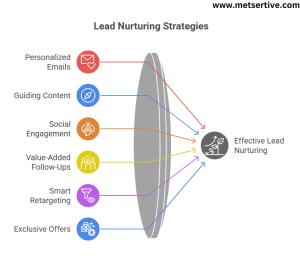
 

Lead Nurturing Strategies

  1. Personalized Email Campaigns

No more one-size-fits-all emails. Use segmentation and behavior data to tailor your emails to what each lead cares about most.

✔️ Try this: Use automation to send different follow-ups based on what a lead downloads or clicks.

  1. Content That Guides, Not Sells

Blog posts, whitepaper, case studies, guides, webinars and videos—these contents build authority and gently lead prospects to a decision.

✔️ Try this: Map your content to the buyer’s journey:

  • Awareness: Blogs, explainer videos
  • Consideration: Case studies, webinars
  • Decision: Free trials, testimonials
  1. Engage on Social Where They Are

Don’t just post—listen. Join conversations, answer questions, and stay relevant.

✔️ Try this: Use tools like Hootsuite or Sprout Social to monitor social media mentions and jump in with helpful info.

  1. Follow-Up Calls That Add Value

Calls don’t have to be cold. If a lead downloaded something or asked a question—call them!

✔️ Try this: Call with a specific reason like “I saw you checked out our case study. Want to dive into how we could help your team?”

  1. Smart Retargeting Ads

Remind visitors of what they left behind. Show them testimonials or free trials based on past behavior.

Retargeting leads based on their behavior and pairing it with tailored messaging is a powerful way to support your broader Inbound Marketing and Content Marketing strategy.

✔️ Try this: Retarget leads who visited your pricing page with a special offer.

  1. Prioritize with Lead Scoring

Not every lead is ready to buy. Use CRM and automation tools to assign scores based on actions like email opens, website visits, and content downloads.

✔️ Try this: Assign scores based on actions (opens, clicks, downloads) and set up alerts for high scorers.

  1. Run Educational Webinars

Position yourself as the expert. Webinars are a great way to educate and build trust. Hosting webinars and live Q&A sessions provides leads with in-depth knowledge about your products or industry while building trust and authority. These events also allow direct interaction with potential customers.

✔️ Try this: End each session with a low-pressure CTA like “Want help applying this to your business?”

  1. SMS Marketing (Yes, Really!)

People check their texts more than email. Use it wisely. Email isn’t the only channel for nurturing leads—SMS marketing allows for quick, direct, and personal communication. With high open rates, SMS can be a powerful tool for sending reminders, special offers, and follow-ups

✔️ Try this: Send a short, personalized message after a missed follow-up: “Hi Jamie, still interested in that free demo?”

  1. Use Customer Proof Like a Boss

People trust people. Show off those glowing reviews and case studies.

✔️ Try this: Add a “Real Results” or “Customer Stories” section to your site and include case studies in nurturing emails.

  1. Exclusive Offers and Discounts to Move the Needle

Providing special incentives for leads who have been engaging with your brand can push them toward making a purchase. Exclusive discounts, free trials, or early access to new features create urgency.

✔️ Try this: Segment leads based on engagement and offer tailored discounts (e.g., “As a valued subscriber, here’s 10% off your first purchase!“). Use countdown timers in emails to increase urgency.

These tactics, especially when fueled by Lead Generation and personalized nurture tracks, help push high-potential leads across the finish line.

Measure What Matters: Lead Nurturing Metrics to Track

To ensure your lead nurturing strategies are effective, it’s crucial to track and analyze key performance indicators (KPIs).

1. Conversion Rates

Monitor the percentage of nurtured leads that convert into customers. An increase indicates the effectiveness of your nurturing efforts.

2. Engagement Metrics

Assess open rates, click-through rates, and content engagement levels to gauge how well your audience is responding to your nurturing tactics.

3. Sales Cycle Length

A shorter sales cycle often results from effective lead nurturing, as prospects receive the information they need to make decisions faster.

4. Customer Lifetime Value (CLV)

Nurtured leads tend to become loyal customers. Tracking Customer Lifetime Value helps you understand the long-term value of your nurturing strategies.

Tracking and optimizing Lead Nurturing performance helps align your content, campaigns, and Customer Journey for predictable revenue growth.

Common Challenges in Lead Nurturing and How to Fix It

Even with the best intentions, lead nurturing can hit roadblocks. Here’s how to recognize them and tackle each one head-on—with practical examples and tools you can actually use.
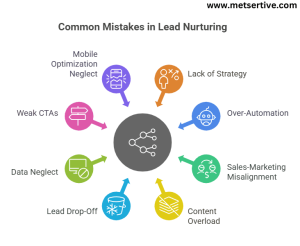
Common mistakes in Lead Nurturing

1: No Clear Strategy

What’s happening:
Without a structured plan, your messages might be inconsistent or misaligned with where the lead is in the sales funnel. This leads to confusion and lost opportunities.

How to fix it:

  • Map out the buyer’s journey: Awareness → Consideration → Decision.
  • Create a simple workflow that outlines what content or action happens at each stage.

Example:
Use a tool like HubSpot to visualize your funnel. If a lead downloads a guide (awareness), follow up with a case study (consideration), then offer a free consultation (decision).

Pro Tip: Integrate this with your CRM for a seamless experience (CRM integration).

2: Overusing Automation

What’s happening:
Yes, marketing automation is powerful—but overdoing it makes your communication feel robotic and impersonal.

How to fix it:

  • Use automated email drip campaigns, but personalize subject lines, content, and even timing.
  • Mix automation with real human interactions—especially for warm or high-value leads.

Example:
If a lead completes a webinar, don’t just send a templated follow-up. Add a personal note like, “Hey Sarah, I saw you attended our session on growing B2B pipelines. Curious if you’d like a 1:1 strategy call?”

Remember: the right balance between Email Drip Campaigns and human connection can keep your nurturing efforts feeling genuine and results-driven.

3: Sales and Marketing Aren’t Synced

What’s happening:
Misalignment leads to missed follow-ups, redundant communication, or even pitching the wrong solution to the wrong lead.

How to fix it:

  • Create a Service Level Agreement (SLA) that defines when a lead becomes “sales-ready.”
  • Sync both teams on a shared CRM to track lead stages, notes, and activity logs.

Example:
If marketing scores a lead as hot (based on lead scoring), sales should get an automated alert for immediate follow-up with a tailored pitch.

4: Content Overload

What’s happening:
Your leads are overwhelmed with content—and if it’s not relevant, they tune out.

How to fix it:

  • Focus on value-driven, stage-specific content. Don’t flood inboxes with every new blog post.
  • Use behavioral triggers (like clicks or downloads) to guide what you send next.

Example:
Instead of a general newsletter, send a targeted email: “You downloaded our eBook on lead generation—here’s a quick video that shows how it works in action.”

5: Leads Drop Off Over Time

What’s happening:
Sometimes leads just go cold. Life gets busy. Interest fades. But that doesn’t mean they’re gone forever.

How to fix it:

  • Launch re-engagement campaigns using exclusive content, surveys, or offers.
  • Use analytics to pinpoint where drop-off is happening.

Example:
Send a message like, “Still thinking about streamlining your funnel? Here’s a 20% discount just for you—expires in 3 days!”

Pro Tip: A/B test subject lines and offers to see what reactivates leads fastest.

6: Not Using Data to Personalize the Journey

What’s happening:
Many businesses send the same message to all leads, regardless of where they are in the sales funnel or what actions they’ve taken. This results in disengagement and lost trust.

How to fix it:

  • Tap into CRM data and analytics tools to personalize every touchpoint—emails, follow-ups, offers.
  • Use lead behavior (pages visited, content consumed) to tailor next steps.

Example:
If a lead has opened your emails but hasn’t clicked through, send a follow-up message with a different format—like a short video or infographic.

✔️ Tip: Combine CRM integration with tools like Hotjar or HubSpot’s tracking to create dynamic, behavior-based workflows.

Using behavioral insights from your CRM Integration and #Analytics tools lets you create dynamic nurturing flows tailored to each lead’s journey.

7: Weak or Generic Calls to Action (CTAs)

What’s happening:
Your emails or landing pages might be missing a clear next step—or worse, have CTAs that feel boring or irrelevant.

How to fix it:

  • Make CTAs ultra-specific and contextual. Every CTA should help the lead move one step closer to purchase.
  • Use action-driven phrases tied to value (“Get Your Free Funnel Audit” vs. “Learn More”).

Example:
In a lead scoring system, when a lead hits a certain threshold, trigger an email with the CTA: “Based on your recent interest, here’s your custom quote ready to review.”

✔️ Tip: A/B test CTAs in your email drip campaigns to optimize click-through rates.

Strong CTAs tied to user behavior within your Sales Funnel can dramatically improve engagement and lead velocity.

8: Ignoring Mobile Optimization

What’s happening:
A huge chunk of your audience is viewing emails and landing pages on mobile—but if the design is clunky or slow, they bounce.

How to fix it:

  • Ensure all your emails, landing pages, and lead magnets are fully responsive and optimized for mobile.
  • Compress images, shorten copy, and make CTAs easily tappable.

Example:
If you’re running an SMS campaign or email drip sequence, link to a mobile-optimized landing page with a one-click sign-up form or calendar integration.

✔️ Tip: Use tools like Google’s Mobile-Friendly Test or Mailchimp’s mobile preview to catch issues before launch.

Tech Tools That Supercharge Lead Nurturing

Using the right tools doesn’t just save time—it helps you deliver the right message to the right person at exactly the right moment. Here’s a breakdown of the best tech tools to power your lead nurturing engine:

  1. Customer Relationship Management (CRM) Integration

CRMs like HubSpot, Zoho, or Salesforce help you organize and track every interaction with your leads. They serve as the central brain of your lead nurturing efforts.

Actionable Tip:
Set up automated alerts for your sales team when a lead hits a specific lead scoring threshold.

Example:
When a lead downloads a pricing sheet and watches a demo, your CRM notifies a sales rep to follow up within 24 hours.

      2. Marketing Automation Platforms

These tools (like ActiveCampaign or Mailchimp) automate repetitive tasks such as email sends, behavior tracking, and campaign management, helping you scale your outreach.

Actionable Tip:
Use behavioral triggers to personalize your outreach—for example, send a case study if a lead viewed your services page twice in a week.

Example:
A new sign-up triggers a welcome sequence that includes three emails over five days, tailored to the user’s interests.

    3. Analytics and Tracking Tools

Tools like Google Analytics, Hotjar, or Crazy Egg show you how leads interact with your site—where they drop off, what they click, and what keeps them engaged.

Actionable Tip:
Track which blog posts or landing pages generate the most conversions and use them in your email drip campaigns.

Example:
You find that your “Free Tools” page gets the most visits. You now include it in all awareness-stage nurturing emails.

     4. AI-Powered Chatbots and Conversational Tools

Tools like Drift, ManyChat, and Intercom use AI to answer questions, qualify leads, and even book meetings—24/7, without human intervention.

Actionable Tip:
Script your chatbot to ask qualifying questions and route hot leads directly to a live rep when needed.

Example:
A chatbot asks, “What’s your biggest marketing challenge?” and based on the answer, offers a downloadable guide or books a strategy call.

   5. Interactive Content Platforms

Platforms like Outgrow, Typeform, or SurveyMonkey let you create calculators, quizzes, and surveys that collect data and drive engagement.

Actionable Tip:
Use interactive lead magnets to both capture and qualify leads based on their responses.

Combining Interactive Content with Lead Scoring and segmentation helps you not only capture more leads—but qualify and nurture them smarter.

 Final Word: Keep It Personal, Keep It Consistent

Lead nurturing isn’t about sending more emails. It’s about building relationships at scale with genuine value, smart timing, and tailored messages. For SMEs, this isn’t just effective—it’s essential.

So take a step today. Audit your current funnel, segment your list, or just send one personal check-in to a warm lead. Every small effort counts.

Effective Lead Nurturing isn’t just about communication—it’s about delivering value at every stage of the Customer Journey. With the right mix of Marketing Automation, Content Marketing, and CRM Integration, you can turn passive leads into loyal customers.

📞 Need help building a lead nurturing system that actually converts? Reach out—we’ll walk you through
Unique Selling Proposition That Helps You Stand Out and Win More Customers

In today’s saturated market, standing out isn’t just beneficial—it’s essential. Whether you’re a startup or an established enterprise, your ability to differentiate can make or break your success. This is where your Unique Selling Proposition (USP) comes into play.

A well-crafted USP articulates what sets your business apart, compelling potential customers to choose you over competitors. It’s not just a catchy slogan; it’s the core of your marketing strategy, influencing everything from branding to customer engagement.

Meaning of Unique Selling Proposition

At its core, a Unique Selling Proposition is a clear statement that describes the unique benefit of your product or service, how it solves your customers’ needs, and what distinguishes it from the competition.

Unlike a general value proposition, which outlines the overall value you provide, a USP zeroes in on the specific, unique value that only your business offers. It’s the answer to the customer’s question: “Why should I choose you?”

Why Your Business Needs a Strong USP

In a marketplace flooded with similar offerings, a compelling USP is your beacon. Here’s why it’s indispensable:

  • Differentiation: It sets you apart in a crowded market.
  • Clarity: Provides a clear message about what you offer.
  • Customer Attraction: Draws in your ideal customers by addressing their specific needs.
  • Marketing Focus: Guides your marketing efforts, ensuring consistency and effectiveness.

Without a strong USP, your marketing messages may become diluted, making it harder to connect with your target audience.

Unique Value Proposition vs USP

While often used interchangeably, your value proposition and Unique Selling Proposition (USP) serve different purposes in your brand messaging.

  • A value proposition is the broad promise of value you deliver to your customers. It encompasses the benefits, outcomes, and overall experience someone can expect from doing business with you.
  • A USP, on the other hand, is more focused—it defines the specific, unique, and competitive advantage that sets you apart in the market.

Think of your value proposition as the full meal, while your USP is the star dish that keeps people coming back.

Tip:
Use your value proposition to communicate your overall brand promise, and your USP to sharpen your messaging when competing directly with others in your space.

Example:
Let’s say you run a financial planning app:

  • Value Proposition: “Helping individuals take control of their finances with simple, data-driven insights.”
  • USP: “The only budgeting app that tracks spending, automates saving, and optimizes tax refunds in one dashboard.”

Unique Selling Proposition Example

Understanding how leading brands utilize USPs can provide valuable insights:

  • Domino’s Pizza: “You get fresh, hot pizza delivered to your door in 30 minutes or less—or it’s free.” This promise emphasized speed and reliability, setting Domino’s apart in the fast-food industry.
  • FedEx: “When it absolutely, positively has to be there overnight.” FedEx built its reputation on guaranteed overnight delivery, appealing to customers’ need for reliability.
  • M&M’s: “Melts in your mouth, not in your hand.” Highlighting a unique product feature, this USP addressed a common consumer concern, differentiating M&M’s from other chocolates.

These examples showcase how a clear and specific USP can resonate with customers and drive brand loyalty.

How to Discover Your Unique Selling Proposition

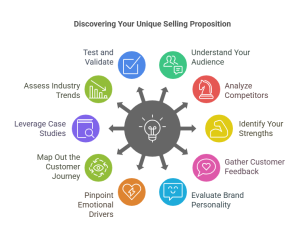
Identifying your USP involves both introspection and market analysis. Here’s a comprehensive 10-step guide to help you uncover what truly sets your business apart:

How to discover your Unique Selling Proposition

  1. Understand Your Audience

    Research your target market deeply—demographics, behaviors, needs, pain points, and aspirations. The better you understand them, the more tailored and effective your USP will be.

Tip: Create buyer personas that include demographics, goals, challenges, and motivations.
Example: A skincare brand targeting eco-conscious Gen Z might build a USP around sustainability, like “All-natural skincare made for the planet and your glow.”

  1. Analyze Competitors

    Study your direct and indirect competitors. What are they doing well? More importantly, where are they falling short? Spotting gaps can help you position your offer as the smarter choice.

Tip: Use tools like SEMrush or SimilarWeb to evaluate competitors’ traffic sources, ad copy, and top-performing content.
Example: If all your competitors offer 3-day shipping, offering same-day delivery could be your edge.

  1. Identify Your Strengths

    Make a list of your business’s strengths. What do you consistently do better than anyone else? This might be innovation, speed, quality, service, or price.

Tip: Think about what customers praise you for most—speed, creativity, innovation, service, etc.
Example: A small digital marketing agency may discover clients love their agility and personalized service. USP: “Big agency results with boutique-level attention.”

  1. Gather Customer Feedback

    Ask current and past customers what they like most about your product or service. Use surveys, testimonials, or social media comments to identify common themes.

Tip: Use feedback tools like Google Forms or Typeform to gather testimonials, NPS scores, or insights via post-project surveys.
Example: If customers say they love how easy it was to communicate with you, emphasize “Clear, human-first communication that keeps your projects stress-free.”

  1. Evaluate Your Brand Personality

    Consider the tone, values, and personality of your brand. Are you approachable, authoritative, quirky, or luxurious? Align your USP with how your audience perceives your brand.

Tip: Define your tone—are you bold and edgy, warm and supportive, or high-end and luxurious?
Example: Dollar Shave Club’s humorous, laid-back tone became a part of their USP: “A great shave for a few bucks a month—no gimmicks.”

  1. Pinpoint Emotional Drivers

    Customers don’t just buy products—they buy feelings. Identify the emotions your product or service evokes: security, excitement, convenience, pride, etc. Infuse your USP with emotional resonance.

Tip: Ask: How do you want your customers to feel after using your product or service? Confident? Secure? Excited?
Example: Apple doesn’t sell just phones; it sells innovation and status. Your USP might target a feeling like “Confidence through data-driven digital marketing.”

  1. Map Out the Customer Journey

    Understand the full experience a customer goes through—customer journey from discovering your brand to post-purchase. A unique aspect of your journey (like exceptional onboarding or support) could be your USP.

Tip: List out every touchpoint—from the first ad click to after-sales support—and look for “wow” moments.
Example: If your onboarding process is ultra-smooth, your USP could be: “Launch campaigns in 5 days or less—with zero headaches.”

       8.Leverage Case Studies and Success Stories

Analyze past successes. What did you do in a standout client project that led to extraordinary results? These success stories can surface unique capabilities to emphasize in your USP.

Tip: Review past client projects where you exceeded expectations and identify what made them successful.
Example: If your strategy helped a client 10x their ROI in 3 months, your USP could be: “Real results. Like 10x ROI in 90 days. Let’s make it happen.”

       9. Assess Industry Trends and Pain Points

Stay up to date with market shifts and new customer demands. Being ahead of trends can allow you to develop a USP that speaks to current and future customer needs.

Tip: Read industry blogs, Reddit threads, and product reviews to spot emerging gaps or frustrations.
Example: If customers are overwhelmed by marketing platforms, your USP could be: “One dashboard. One team. Everything managed.”

     10.Test and Validate

Draft a few different USP options and test them in your marketing materials—email campaigns, ads, or website banners. Track engagement and conversion metrics to see which one resonates most.

Tip: Use A/B testing in ads or landing pages to see which USP resonates. Tools like Google Optimize or Unbounce are great for this.
Example: Test two variations: “ROI-focused marketing” vs. “Hands-free campaign management.” Go with the one that gets better engagement.

Crafting a Compelling USP: Step-by-Step Guide (With Tips & Examples)

A compelling Unique Selling Proposition doesn’t just communicate what you do—it tells your audience why they should choose you over everyone else. Here’s a refined 10-step framework to help you craft a standout USP:

1. Define Your Target Audience

Start by clearly identifying who your ideal customer is. The more specific your audience, the more personal and effective your USP will be.

Tip: Use demographic, geographic, and psychographic data to create buyer personas.
Example: Instead of “business owners,” narrow it to “wellness coaches looking to grow their client base online.”

2. Highlight Unique Benefits

Determine what your business offers that competitors don’t. Focus on benefits—not features—that make your offer stand out.

Tip: Avoid comparisons like “better than” and instead emphasize what’s different.
Example: “We provide 1-on-1 strategy sessions with every project—no generic templates here.”

3. Articulate the Value

Show your audience what they’ll gain by working with you. Whether it’s saving time, increasing revenue, or boosting efficiency, your USP should make the value crystal clear.

Tip: Tie your benefit to a specific customer pain point or goal.
Example: “Triple your leads in 60 days without increasing your ad budget.”

4. Keep It Concise and Memorable

Your USP should be short, sharp, and easy to recall. If someone can’t remember your USP, they probably won’t remember your brand.

Tip: Aim for a one-liner that could fit in a social media bio or ad headline.
Example: “Clean teeth in 30 seconds, anytime, anywhere.”

5. Make It Customer-Centric

Frame your USP around what your customer needs, wants, or struggles with. The focus should be on solving their pain points—not just showcasing your business strengths.

Tip: Position the benefit as a direct solution to a problem they face daily.
Example (Product): Instead of saying “We make high-performance headphones,” say “Block out chaos with noise-canceling headphones designed for focus and clarity.”

6. Use Specific Language, Not Jargon

Avoid buzzwords that sound impressive but lack clarity. The more specific your language, the more trust and understanding you build.

Tip: Translate complex terms into simple, result-oriented language your customers instantly understand.
Example (Finance): Replace “integrated wealth optimization solutions” with “Grow your savings 3x faster with tailored investment portfolios.”

7. Reflect Your Brand Voice

Your USP should match your brand personality—whether you’re sleek and premium, fun and quirky, or authoritative and technical.

Tip: Ensure the tone of your USP reflects the tone used across your product packaging, customer service, and social media.
Example (Consumer Brand): For a sustainable cleaning brand with a playful voice: “Tough on mess. Gentle on the planet. Loved by clean freaks everywhere.”

8. Build in Proof or Credibility

People trust brands that can back up their claims. Adding numbers, credentials, or recognitions makes your USP more credible.

Tip: Use client stats, testimonials, awards, or certifications to reinforce your promise.
Example (Tech Startup): “Trusted by over 10,000 businesses to protect their data—ISO-certified and GDPR compliant.”

9. Stress the Transformation

Great USPs don’t just talk about what your product is—they show what your customer becomes after using it.

Tip: Highlight the “before and after” journey to make your solution feel more powerful.
Example (Health & Wellness Service): “Go from burned out to balanced in 30 days—with a personal wellness coach by your side.”

10. Test and Refine Regularly

Markets change, and so should your USP. Test variations to see what resonates most with your audience and improves conversions.

Tip: Use surveys, A/B testing tools, or customer interviews to refine your messaging.
Example (Ecommerce Brand): Test whether “Designed for comfort” or “Stay cozy all day with cloud-soft fabrics” leads to more sales on your product pages.

By applying these 10 steps, your USP will not only be powerful and persuasive—it’ll be something your audience remembers and responds to.

Where and How to Use Your USP in Marketing

Your Unique Selling Proposition isn’t just a slogan—it’s a positioning tool that should be visible across your entire marketing ecosystem. The more places you reinforce it, the more memorable and compelling your brand becomes.

Here are 7 essential places to integrate your USP:

1. Website (Homepage and Landing Pages)

Your homepage is often the first impression visitors get, so your USP should be front and center—ideally in your Above the Fold /hero section or as a key value statement.

Tip: Use your USP in the headline or subheading of your landing pages to quickly communicate value.

2. Social Media Bios and Posts

Platforms like Instagram, LinkedIn, and Twitter offer limited space—making them perfect for concise, punchy USPs that hook your audience.

Tip: Include your USP in your bio and use it as a recurring theme in post captions and visuals.

3. Paid Advertising Campaigns

Your USP should be the backbone of your ad copy, especially in Facebook, Google, and LinkedIn ads where grabbing attention fast is critical.

Tip: Test variations of your USP in headline A/B testing to see which performs best.

4. Email Marketing

Reinforce your USP in email headers, welcome emails, and footers to remind subscribers why they chose you in the first place.

Tip: Use it as a tagline beneath your logo in email templates or as part of your email signature.

5. Sales Pages and Proposals

Sales collateral and pricing pages are high-conversion zones. Embedding your USP here reassures potential clients of your value.

Tip: Add a short USP near pricing tiers or package comparisons to position yourself as the best choice.

6. Business Cards and Print Materials

Offline branding still matters—especially at networking events, conferences, or local meetups. Use your USP to make your brand stick.

Tip: Place your USP on the back of your business card or at the top of flyers and brochures.

7. Video and Podcast Intros

In audio-visual content, your USP should be part of the hook. It establishes credibility and sets context for your audience.

Tip: Start every podcast episode or YouTube video with a 5-10 second USP pitch to instantly tell viewers who you are and why they should care.

By using your USP consistently in these seven areas, you create a unified brand message that builds trust, boosts conversions, and makes your business unforgettable.

Common USP Mistakes to Avoid

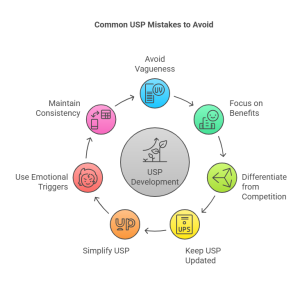
Crafting a Unique Selling Proposition is a powerful step—but getting it wrong can confuse your audience or weaken your brand. Here are 7 common mistakes to watch out for:

Common USP mistakes to avoid

1. Being Too Vague or Generic

Saying things like “high quality” or “great customer service” doesn’t distinguish you. These are expected, not exceptional.

Fix: Use specific language and outcomes that prove your value.
Better: “Results-driven SEO that lands you on page one in 90 days.”

2. Focusing on Features Instead of Benefits

Features describe what your product does; benefits describe what the customer gets. Your USP should emphasize outcomes.

Fix: Ask yourself, “So what?” for every feature until you reach the benefit.
Example: Feature: “Automated reports.” → Benefit: “Save 5 hours a week with hands-free analytics.”

3. Copying the Competition

If your USP sounds just like your competitors’, you’re not giving customers a reason to choose you.

Fix: Conduct competitor audits and look for gaps you can fill.
Avoid: “We’re the #1 digital agency.”
Try: “We scale boutique brands using tailored data-driven funnels.”

4. Failing to Keep It Updated

As your services evolve or your audience shifts, your USP must evolve too. A stale USP can mislead or undersell your brand.

Fix: Review and refresh your USP every 6–12 months, or after a major shift in your business.
Example: Adjust your USP if you expand from local to national service offerings.

5. Making It Too Long or Complicated

A USP should be clear and quick to understand—ideally one sentence. If people can’t repeat it, they won’t remember it.

Fix: Trim any fluff and focus on the strongest value hook.
Tip: Say it out loud—if it doesn’t sound natural, rewrite it.

6. Ignoring Emotional Triggers

People buy based on emotion and justify with logic. A USP that only appeals to logic misses the chance to connect deeply.

Fix: Tie your USP to an emotional outcome—confidence, ease, pride, freedom.
Example: “Never feel overwhelmed by your marketing again.”

7. Not Using It Consistently Across Platforms

Your USP won’t work if it’s hidden or only shown in one place. Consistency breeds familiarity—and trust.

Fix: Incorporate your USP into your website, ads, email footers, social bios, and more.
Tip: Create a brand message guide to ensure your team uses the USP consistently.

Avoiding these pitfalls will help ensure your USP is not only impactful but also a key driver of trust, conversion, and long-term brand recognition.

How a Digital Marketing Agency Can Help Develop Your USP

Partnering with a digital marketing agency can enhance your USP development by:

  • Conducting Market Research:

Agencies can provide insights into market trends and customer behavior.

  • Effective brand messaging:

It is the consistent use of language, tone, and key ideas that communicate your company’s values, benefits, and personality across all touchpoints..

  • Ensuring Consistency:

Agencies ensure your USP is consistently applied across all marketing channels.

  • Optimizing for SEO:

Integrating your USP into your website’s SEO strategy can improve visibility and attract the right audience.

By leveraging their expertise, a digital marketing agency can help you craft a USP that not only differentiates your brand but also drives growth.

Key Takeaways:

  • A USP clearly articulates what makes your business unique and why customers should choose you.
  • It’s essential for differentiation, clarity, and effective marketing.
  • Crafting a USP involves understanding your audience, analyzing competitors, and highlighting your unique strengths.
  • Consistent application across all marketing channels reinforces your brand identity.
  • Avoid common mistakes like vagueness and overpromising.
  • A digital marketing agency can provide valuable assistance in developing and promoting your USP.

Final Thoughts: Stand Out or Be Overlooked

In a competitive landscape, a strong Unique Selling Proposition isn’t just a marketing tool—it’s a necessity. It defines your brand, guides your marketing strategy, and connects you with your ideal customers.

If you’re ready to develop a compelling USP that sets your business apart, consider partnering with a digital marketing agency. Their expertise can help you articulate your unique value and communicate it effectively to your target audience.