
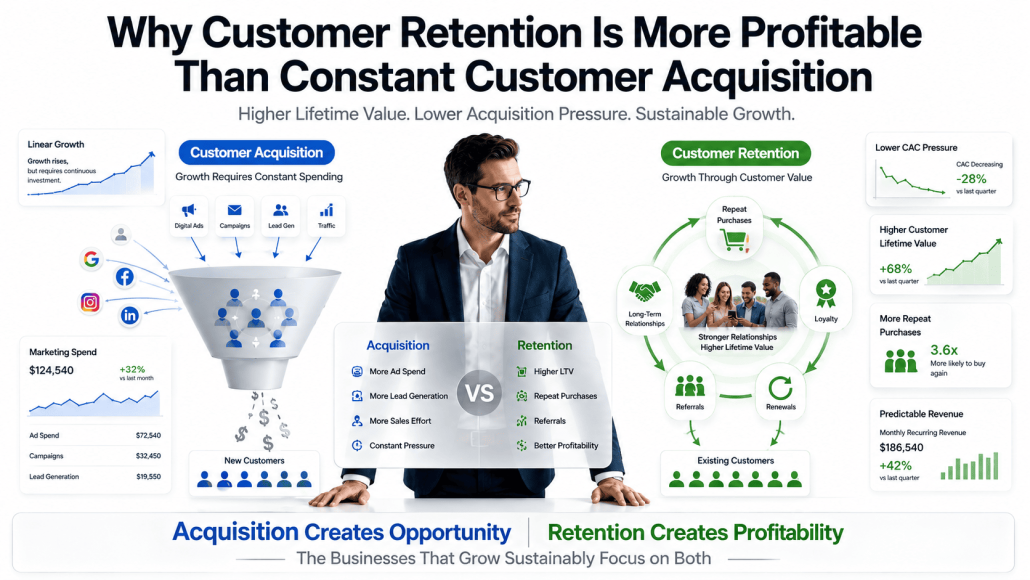
Why Customer Retention Is More Profitable Than Acquisition
Most businesses believe growth comes from one thing:
Acquiring more customers.
So they invest in:
• More ads
• More lead generation
• More sales activity
• More marketing campaigns
And while new customers do drive growth…
There’s a question many businesses never stop to ask:
What happens after the customer buys?
Because this is where a surprising amount of revenue is either created—or lost.
Many businesses work hard to acquire customers only to watch them disappear after the first purchase, cancel after a few months, or slowly disengage without realizing the long-term impact on profitability.
The result?
- Rising acquisition costs
• Constant pressure to generate more leads
• Revenue that feels unpredictable
• Growth that becomes harder and more expensive to sustain
Meanwhile, other businesses seem to grow with less pressure.
Not because they’re acquiring dramatically more customers.
But because they’re keeping customers longer, increasing customer value, and generating more revenue from relationships they’ve already earned.
That’s the power of customer retention.
In this guide, you’ll discover:
✔ Why customer retention is often more profitable than customer acquisition
✔ The hidden revenue leaks that occur after conversion
✔ How retention impacts Customer Acquisition Cost (CAC), Customer Lifetime Value (LTV), and profitability
✔ Why many businesses have a retention problem disguised as a lead generation problem
✔ Practical ways to increase customer value and create more sustainable growth
Because long-term growth isn’t just about getting more customers.
It’s about maximizing the value of the customers you already have.
And the businesses that understand that distinction often outperform competitors who are trapped in the endless cycle of chasing the next lead.
What Is Customer Retention?
Let’s simplify this.
What is customer retention?
Customer retention means:
Keeping customers engaged, satisfied, and buying over time.
That’s the core idea.
It’s about building relationships that continue after the first sale.
Because the first purchase is not the finish line.
It’s the beginning of the customer relationship.
Retention Is About Long-Term Customer Value
Most businesses focus heavily on this question:
“How do we get customers?”
But fewer ask:
“How do we keep them?”
That second question is where retention lives.
Retention includes things like:
- Repeat purchases
• Renewals
• Upsells
• Continued engagement
• Customer loyalty
• Reduced churn
• Long-term relationships
In simple terms:
Retention measures how long customers continue doing business with you.
Simple Example
Let’s say two businesses each acquire 100 customers.
Business A
- Most customers buy once
• Few return
• Revenue resets every month
Business B
- Customers come back repeatedly
• Some upgrade
• Some refer others
• Revenue compounds over time
Both acquired customers.
But only one maximized customer value.
That’s retention in action.
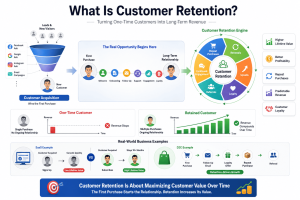
Acquisition Gets the Customer Once
Retention keeps generating revenue from the same customer repeatedly.
This is the key distinction.
Acquisition creates the first transaction.
Retention increases:
The total value of that relationship.
And that’s where profitability improves dramatically.
Why Retention Matters Financially
Every new customer costs money to acquire.
Through:
• Ads
• SEO
• Content marketing
• Sales calls
• Outreach
• Lead nurturing
So when a customer leaves quickly…
You may never fully recover your acquisition cost.
But when customers stay longer:
• Profit margins improve
• Revenue becomes more predictable
• Marketing becomes more efficient
Because now:
One customer generates multiple revenue opportunities.
SaaS Example
A SaaS company acquires a customer for ₹10,000 CAC.
Scenario 1
Customer cancels after 1 month.
Result:
Low profitability
Scenario 2
Customer stays for 18 months.
Result:
Much higher lifetime value
Same acquisition cost.
Completely different business outcome.
D2C Example
An ecommerce brand acquires a customer through Instagram ads.
Without retention:
- Customer buys once
• Never returns
With retention:
- Follow-up emails
• Loyalty offers
• Product recommendations
• Personalized engagement
Now the customer:
• Buys again
• Spends more
• Becomes loyal
That’s retention-driven growth.
The Big Insight
Here’s what many businesses miss:
Revenue becomes more efficient when customers stay longer.
Because retaining customers often costs less than constantly replacing them.
That creates:
• Better margins
• Lower pressure on acquisition
• More predictable growth
Building long-term customer relationships creates trust, increases loyalty, and generates additional revenue opportunities over time.
Retention Is Not Passive
Many businesses assume retention happens automatically.
It doesn’t.
Retention requires:
• Consistent customer experience
• Communication
• Follow-up
• Onboarding
• Value delivery
• Trust-building
Without those systems:
Customers slowly disengage.
Actionable Tip
Track these simple retention indicators:
- Repeat purchase rate
• Renewal rate
• Churn rate
• Customer engagement
• Average customer lifespan
These metrics reveal whether your business is building customers…
Or simply collecting transactions.
Key Takeaway
Customer retention is the process of keeping customers engaged and valuable over time.
Because real growth doesn’t happen only when customers buy.
It happens when they stay.
Understanding the customer retention importance is critical because long-term profitability often depends more on keeping customers than constantly replacing them.
Why Most Businesses Obsess Over Customer Acquisition
Let’s be honest.
Acquisition feels exciting.
You launch ads.
You generate leads.
You see traffic increasing.
New customers start coming in.
It feels like growth is happening.
So naturally, most businesses focus heavily on:
• More leads
• More campaigns
• More traffic
• More ad spend
And on the surface…
It makes sense.
Because acquisition is visible.
You can measure:
• Clicks
• Impressions
• Cost per lead
• Conversion numbers
It creates activity.
And activity often feels like progress.
But here’s where many businesses quietly struggle:
Acquisition creates constant pressure.
Every month becomes:
• “We need more leads”
• “Increase the ad budget”
• “Launch another campaign”
• “Push harder”
The business starts depending on continuous customer acquisition just to maintain growth.
And that becomes expensive.
The Hidden Problem Most Businesses Miss
Here’s what often happens:
A business increases ad spend.
More leads come in.
Sales increase temporarily.
But profits barely improve.
Why?
Because customers don’t stay long enough.
So while the business keeps filling the top of the funnel…
Revenue keeps leaking from the bottom.
It’s like pouring water into a bucket with holes.
Real-World Scenario
Imagine two SaaS companies.
Business A
Focuses almost entirely on acquisition.
Every month:
• Runs more ads
• Generates more trials
• Pushes sales aggressively
But:
• Customers churn quickly
• Users don’t stay engaged
• Retention is weak
Result?
Growth becomes expensive.
To maintain revenue:
• They must continuously spend more money acquiring new customers.
Now look at:
Business B
Acquires customers too.
But also focuses on:
• Onboarding
• Customer education
• Support experience
• Product adoption
• Relationship building
Customers stay longer.
Renew more often.
Upgrade more frequently.
Result?
Revenue compounds over time.
Business B doesn’t need to chase acquisition as aggressively because existing customers continue generating value.
That’s the difference.
The Big Insight
Acquisition creates spikes.
Retention creates stability.
Acquisition helps you grow faster temporarily.
Retention helps you grow sustainably.
And sustainable growth is what builds profitable businesses.
Why This Matters More Than Ever
Today:
• Ad costs are rising
• Competition is increasing
• Attention spans are shrinking
Which means:
Acquiring customers is becoming harder and more expensive.
If businesses focus only on acquisition:
Profit margins get squeezed.
But businesses with strong retention systems can:
• Recover CAC faster
• Increase LTV
• Improve profitability
• Reduce dependency on ads
That’s why retention is becoming one of the biggest competitive advantages.
Actionable Tip
Ask yourself these questions:
• How many customers buy more than once?
• How long do customers stay?
• Where do customers disengage?
• Are we maximizing value after conversion?
Because growth doesn’t stop at acquisition.
That’s where profitability actually begins.
Key Takeaway
Acquisition gets attention.
But retention builds efficient revenue.
Businesses that focus only on getting customers:
Constantly chase growth.
Businesses that focus on keeping customers:
Build compounding growth.
And over time…
Compounding always wins.
Why Customer Retention Is More Profitable Than Acquisition
Now let’s get to the real question:
Why is retention often more profitable?
Because profitability is not just about getting customers.
It’s about:
• How long they stay
• How often they buy
• How much value they generate over time
And that’s exactly where retention changes the economics of growth.
Let’s break this down clearly.
1. Retaining Customers Costs Less Than Acquiring New Ones
Acquisition is expensive.
Think about everything involved:
• Ads
• Content creation
• Sales calls
• Follow-ups
• Marketing tools
• Lead generation systems
Every new customer requires effort and cost.
But existing customers?
They already know you.
Which changes everything.
You don’t need to:
• Build trust from scratch
• Explain your value repeatedly
• Convince them you’re legitimate
That reduces:
• Sales effort
• Marketing pressure
• Conversion friction
Scenario
Imagine an e-commerce brand.
New Customer
To acquire them, the business spends:
• Paid ads
• Influencer campaigns
• Retargeting
• Discounts
Result:
High CAC.
Now compare that to an existing customer.
The brand sends:
• A personalized email
• A product recommendation
• A loyalty offer
And the customer purchases again.
Much lower cost.
Faster conversion.
That’s retention efficiency.
Key Insight
Existing customers are already warm.
And warm customers convert cheaper than cold audiences.
Many business owners underestimate how customer retention improves profitability, but retained customers typically generate more revenue while requiring less selling effort.
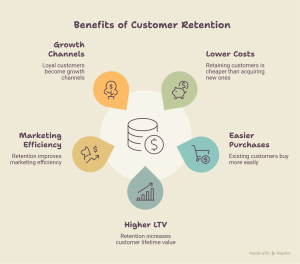
2. Existing Customers Buy More Easily
This is one of the most overlooked advantages of retention.
Existing customers:
• Open emails more often
• Respond faster
• Trust recommendations quicker
• Need fewer objections handled
Why?
Because familiarity reduces resistance.
Simple Comparison
New Customer
Needs:
• Education
• Trust-building
• Social proof
• Multiple touchpoints
Existing Customer
Already understands:
• Your brand
• Your product
• Your process
So the buying journey becomes shorter and easier.
Example
A SaaS company launches a new feature.
Cold audience:
Needs:
• Demo
• Education
• Comparisons
• Sales calls
Existing customers:
Already trust the platform.
So they:
• Try the feature faster
• Upgrade more easily
• Require less convincing
Same offer.
Different conversion difficulty.
Understanding how repeat customers increase profitability helps businesses recognize why retention often delivers a higher return on investment than acquisition alone.
Insight
Retention reduces friction.
And lower friction usually means:
Higher profitability.
A strong repeat purchase strategy encourages customers to buy more frequently, increasing customer lifetime value without increasing acquisition costs.
3. Retention Increases Customer Lifetime Value (LTV)
This is where retention becomes extremely powerful.
Because retention doesn’t just create repeat purchases.
It increases customer lifetime value.
LTV means:
The total revenue a customer generates over time.
And small improvements in retention can massively increase profitability.
Scenario
Let’s compare two customers.
Customer A
Buys once
• Never returns
Customer B
Buys repeatedly for 3 years
• Upgrades services
• Refers others
Both customers had:
The same acquisition cost.
But their profitability is completely different.
Why This Matters
If customers stay longer:
• Revenue increases
• CAC becomes easier to recover
• Profit margins improve
That’s why high-retention businesses often outperform competitors even without aggressive acquisition.
Key Insight
The real value of a customer is rarely in the first purchase.
It’s in the relationship that follows.
If you’re wondering how to increase customer lifetime value, start by improving customer retention, reducing churn, and creating opportunities for repeat purchases.
4. Retention Improves Marketing Efficiency
Most businesses try to solve growth problems by increasing marketing spend.
But retention changes the equation.
Because when customers stay longer:
You don’t need to replace them constantly.
That reduces acquisition pressure.
Scenario
Business A:
Loses customers quickly.
So every month:
Must acquire large numbers of new customers just to maintain revenue.
Business B:
Retains customers longer.
Result:
Can grow without constantly increasing ad spend.
That creates:
• Better budget efficiency
• More predictable revenue
• Healthier profit margins
Why This Matters
Retention improves:
• CAC recovery
• Revenue predictability
• Marketing ROI
And businesses with efficient retention systems can scale more sustainably.
5. Loyal Customers Become Growth Channels
This is where retention becomes even more valuable.
Because satisfied customers don’t just buy again.
They help you grow.
They become:
• Referrals
• Advocates
• Review sources
• Word-of-mouth marketers
And this type of growth is incredibly powerful because:
Trust transfers faster between people than through ads.
Example
A service business delivers an exceptional experience.
The client:
• Renews the contract
• Refers two other businesses
• Leaves a positive testimonial
Now one retained customer creates:
Multiple new acquisition opportunities.
Without additional ad spend.
That’s compounding growth.
Insight
Retention creates organic momentum.
And organic momentum reduces dependency on paid acquisition.
The Bigger Reality Most Businesses Miss
Acquisition creates customers.
Retention creates profitability.
And businesses that ignore retention often experience:
• High churn
• Rising CAC
• Unstable revenue
• Growth pressure
While businesses focused on retention build:
• Predictable revenue
• Stronger customer relationships
• Better margins
• Sustainable growth systems
That’s why retention is not just a support function.
It’s a revenue strategy.
Actionable Tip
Start measuring:
• Repeat purchase rate
• Renewal rate
• Customer churn
• Average customer lifespan
• Revenue per customer over time
Because what gets measured:
Gets improved.
And improving retention often produces faster profitability gains than increasing acquisition.
Key Takeaway
Customer retention is more profitable because:
- Existing customers cost less to convert
• They buy more easily
• They increase lifetime value
• They improve marketing efficiency
• They create organic growth opportunities
And over time…
Businesses that maximize customer value outperform businesses that only chase new customers.
The Hidden Revenue Leak: What Happens After Conversion
This is where many businesses lose profitability without realizing it.
Most companies spend enormous effort optimizing:
- Ads
- Funnels
- Landing pages
- Lead generation
- Conversion rates
But after the customer buys…
The system becomes weak.
And that’s where the real revenue leak begins.
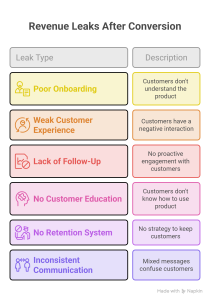
The Biggest Mistake Businesses Make
Many businesses think:
“The sale is the finish line.”
But in reality:
The sale is the beginning of the customer relationship.
If customers buy once and disappear…
You constantly need:
- More traffic
- More leads
- More ad spend
- More sales effort
That creates pressure.
And over time:
Growth becomes expensive.
What Revenue Leaks Look Like After Conversion
Retention problems usually don’t look dramatic.
They happen quietly.
1. Poor Onboarding
This is extremely common in:
- SaaS
- Service businesses
- D2C brands
Customers buy…
But don’t fully understand:
- How to use the product
- What to do next
- How to get value quickly
Example:
A SaaS company gets:
- 500 trial signups
But users:
- Never complete setup
- Never activate core features
- Stop using the platform after a few days
The company thinks:
“We need more signups.”
But the real issue is:
Existing users are not succeeding.
2. Weak Customer Experience
Customers remember experiences more than promises.
If the experience feels:
- Confusing
- Slow
- Inconsistent
- Frustrating
Retention drops quickly.
Scenario:
An e-commerce brand:
- Delivers products late
- Sends unclear shipping updates
- Responds slowly to support tickets
Customers may still receive the product…
But trust weakens.
Result?
- Fewer repeat purchases
- Lower loyalty
- More churn
3. Lack of Follow-Up
Many businesses disappear after conversion.
No:
- Check-ins
- Helpful guidance
- Usage reminders
- Relationship-building
The customer feels forgotten.
Insight:
Silence after conversion often signals:
“We only cared about the sale.”
4. No Customer Education
Customers stay longer when they achieve outcomes.
But many businesses assume:
“Customers will figure it out.”
They don’t.
Example:
A software company launches powerful features.
But customers:
- Don’t know they exist
- Don’t understand benefits
- Never adopt them
Result:
1. Customers underuse the product
2. Perceived value drops
3. Churn increases
Valuable Tip:
Customer Education is retention.
The more customers understand:
The more value they experience.
5. No Retention System
Many businesses have:
- Sales systems
- Marketing systems
- Lead generation systems
But no retention system.
There’s no structured process for:
- Engagement
- Renewals
- Upsells
- Customer success
- Long-term relationship building
So retention becomes reactive instead of intentional.
6. Inconsistent Communication
Customers don’t want constant messaging.
But they do want:
Consistent presence.
If communication becomes random:
- Customers disengage
- Brand recall weakens
- Relationships fade
Example:
A service business sends:
- Frequent messages during sales
- Almost nothing after onboarding
Customers slowly lose connection with the brand.
Real-World Scenario: The Revenue Leak Most Businesses Ignore
Let’s say a SaaS company gets:
- 500 signups per month
Sounds great.
But then:
- 60% stop using the platform within 14 days
- 25% never activate key features
- Only 10% become long-term paying users
The company keeps focusing on:
Getting more signups.
But the real problem is:
Customers are leaking out after acquisition.
This is why some businesses:
- Grow revenue temporarily
- But struggle with profitability long-term
The Important Shift Most Businesses Need
Most companies focus on:
“How do we acquire more customers?”
Smarter companies ask:
“How do we keep customers longer?”
That shift changes everything.
Because:
- Longer retention increases LTV
- Higher LTV improves profitability
- Better profitability reduces acquisition pressure
Actionable Tips to Reduce Revenue Leaks
Start simple.
1. Improve onboarding
Help customers achieve a quick win early.
2. Create follow-up systems
Don’t disappear after the sale.
3. Educate consistently
Teach customers how to maximize value.
4. Track customer behavior
Identify where engagement drops.
5. Build retention touchpoints
Emails, onboarding guides, check-ins, reminders, customer success content.
The Big Insight
Here’s the truth many businesses miss:
Revenue leaks don’t only happen before conversion.
They happen after conversion too.
And often:
The biggest profitability opportunity is not acquiring more customers…
It’s keeping more of the customers you already acquired.
Key Takeaway
Acquisition creates customers.
Retention creates profitability.
Businesses that ignore post-conversion experience:
Constantly replace lost customers.
Businesses that optimize retention:
Compound customer value over time.
And that’s where sustainable growth begins.
Why Retention Creates Sustainable Growth
Now let’s connect the bigger picture.
Because this is where retention becomes more than:
- A customer success metric
- A support metric
- A loyalty metric
It becomes a growth strategy.
The Difference Between Linear Growth and Compounding Growth
Most businesses grow linearly.
Meaning:
Spend more → get more customers
The moment spending slows:
Growth slows too.
This creates constant pressure.
You always need:
- More leads
- More traffic
- More campaigns
- More acquisition spend
That’s acquisition-driven growth.
Why Acquisition-Only Growth Becomes Expensive
Acquisition works.
But there’s a problem:
It resets every month.
Example:
A company spends heavily on ads.
Every month:
- New leads come in
- New customers convert
But many customers leave quickly.
So next month:
They must spend again just to maintain revenue.
That’s exhausting growth.
Retention Creates Compounding Revenue
Retention changes the equation.
Instead of constantly replacing customers:
Existing customers continue generating revenue.
That creates momentum.
Example:
Month 1:
- 100 customers
Month 2:
- 80 stay
- 30 new customers added
Now revenue compounds.
Instead of rebuilding from zero every month:
Growth stacks over time.
Why This Changes Profitability
When customers stay longer:
- CAC becomes easier to recover
- Marketing efficiency improves
- Revenue becomes more predictable
- Profit margins improve
This is why high-retention businesses often scale faster:
Even without aggressively increasing acquisition spend.
Unlike acquisition campaigns that prioritize new leads, retention-focused marketing is designed to strengthen customer relationships and encourage long-term engagement.
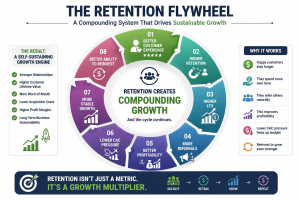
The Retention Flywheel (Powerful Growth Concept)
Retention creates a compounding system.
Here’s what happens:
Better customer experience
→ Higher retention
→ Higher LTV
→ More referrals
→ Better profitability
→ Lower CAC pressure
→ More stable growth
→ Better ability to reinvest
And the cycle continues.
Let’s Break This Down Simply
1. Higher Retention → Higher LTV
When customers stay longer:
Each customer becomes more valuable.
Instead of:
- One purchase
You create:
- Repeat purchases
- Renewals
- Upsells
- Long-term relationships
2. Higher LTV → Better Profitability
Same acquisition cost.
But more revenue generated per customer.
Example:
Customer A:
- Buys once for ₹5,000
Customer B:
- Buys repeatedly for 3 years worth ₹75,000
Same CAC.
Completely different profitability.
3. Better Profitability → Lower CAC Pressure
When retention improves:
You don’t need constant aggressive acquisition.
You can:
- Spend smarter
- Scale sustainably
- Recover CAC faster
This reduces growth pressure significantly.
4. Loyal Customers Create Organic Growth
Retention also creates:
- Referrals
- Reviews
- Recommendations
- Advocacy
Satisfied customers often become:
Your most effective marketing channel.
Scenario:
A service business delivers exceptional customer experience.
Clients:
- Refer peers
- Share testimonials
- Return for additional services
Now growth becomes partially self-sustaining.
Why Predictable Revenue Matters
Retention also improves stability.
Businesses with strong retention often experience:
- More recurring revenue
- Better forecasting
- Less volatility
That makes decision-making easier.
You can:
- Invest confidently
- Hire strategically
- Scale more predictably
The Strategic Shift Smart Businesses Make
Average businesses ask:
“How do we get more customers?”
Growth-focused businesses ask:
“How do we maximize customer value over time?”
That shift changes:
- Profitability
- Efficiency
- Sustainability
Actionable Tips to Improve Retention-Driven Growth
1. Improve onboarding
Help customers succeed early.
2. Stay visible after conversion
Use nurturing, education, and follow-ups.
3. Track retention metrics
Measure:
- Churn
- Repeat purchase rate
- Renewal rate
- LTV
4. Build customer success systems
Don’t leave retention to chance.
5. Focus on customer outcomes
Customers stay when they achieve results.
The Big Insight
Most businesses think growth is about:
Acquiring more customers.
But sustainable growth comes from:
Increasing the value of the customers you already have.
Because:
Retention compounds revenue over time.
And compounding is where scalable profitability happens.
Key Takeaway
Acquisition can grow revenue.
But retention builds sustainable growth.
Why?
Because retained customers:
- Buy again
- Stay longer
- Refer others
- Increase profitability
- Reduce growth pressure
And over time:
Customer value compounds into predictable, scalable revenue.
Businesses that retain customers effectively often experience stronger recurring revenue growth, making revenue more predictable and easier to scale.
The Real Relationship Between Retention, CAC, and Profitability
This is where many businesses misunderstand growth economics.
They focus heavily on:
- CAC (Customer Acquisition Cost)
- Lead generation
- Ad performance
But ignore the metric that changes everything:
Customer Lifetime Value (LTV)
And that creates a dangerous blind spot.

Why CAC Alone Doesn’t Tell the Full Story
Most businesses ask:
“How much does it cost to acquire a customer?”
That’s important.
But the smarter question is:
“How much value does that customer generate over time?”
Because CAC only makes sense relative to:
Customer Lifetime Value.
Let’s Simplify This
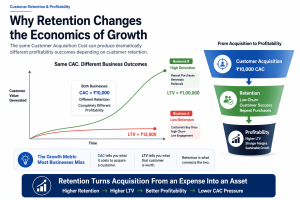
Imagine two businesses.
Both spend:
₹10,000 to acquire one customer
At first glance:
Same CAC.
But now look deeper.
Business A
- Customers buy once
- Churn quickly
- Rarely return
- Low engagement
- No retention system
Customer value:
₹12,000 total revenue
Profit margin becomes extremely thin.
Now the business must:
- Acquire more customers constantly
- Spend more on ads
- Replace lost customers every month
Growth becomes stressful and expensive.
Business B
- Customers stay longer
- Buy repeatedly
- Renew subscriptions
- Refer others
- Engage consistently
Customer value:
₹1,00,000 over time
Same CAC.
Completely different business economics.
Why?
Retention multiplied customer value.
The Real Insight Most Businesses Miss
Acquisition gets the customer.
Retention determines:
Whether the customer becomes profitable.
That’s the shift.
Because if customers leave quickly:
- CAC becomes harder to recover
- Profitability drops
- Growth pressure increases
But when customers stay longer:
- CAC becomes easier to justify
- Profit margins improve
- Growth becomes more sustainable
Why Strong Retention Improves Acquisition Economics
This is one of the most important growth concepts businesses should understand.
Retention doesn’t replace acquisition.
It improves the efficiency of acquisition.
Here’s how:
1. Higher LTV Offsets CAC
If customers stay longer:
You earn more revenue per acquisition.
This means you can:
- Spend more confidently on marketing
- Scale sustainably
- Recover acquisition costs faster
2. Reduced Churn Lowers Growth Pressure
When customers stay:
You don’t need to constantly replace lost revenue.
That reduces:
- Marketing pressure
- Sales pressure
- Ad dependency
Growth becomes less reactive.
3. Better Retention Improves Profit Margins
Acquiring customers repeatedly is expensive.
Retaining existing customers is usually far more efficient.
Why?
Because existing customers:
- Already trust you
- Require less persuasion
- Convert faster
- Need lower acquisition effort
That improves profitability significantly.
Real-World Scenario
Let’s take two SaaS companies.
SaaS Company A
- Gets 1,000 signups monthly
- High churn after 30 days
- Low renewals
Result:
Constant acquisition pressure.
They keep spending more just to maintain revenue.
SaaS Company B
- Gets fewer signups
- But retains customers longer
- Uses onboarding and education
- Builds customer success systems
Result:
- Higher renewals
- Higher LTV
- Lower CAC pressure
- Better profitability
Business B often grows more sustainably—even with fewer leads.
The Dangerous Trap Businesses Fall Into
When profits drop…
Most businesses immediately think:
“We need more leads.”
So they:
- Increase ad spend
- Launch more campaigns
- Chase more traffic
But sometimes:
The real issue is retention.
Because acquiring more customers into a leaking system:
Only increases inefficiency.
The Smarter Growth Mindset
Instead of asking:
“How do we acquire more customers?”
Ask:
“How do we maximize the value of each customer we acquire?”
That’s where:
- Retention
- LTV
- Profitability
- Sustainable growth
all connect together.
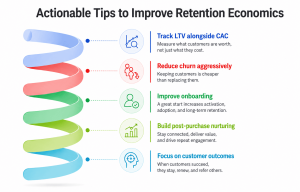
Actionable Tips to Improve Retention Economics
1. Track LTV alongside CAC
Never evaluate CAC alone.
2. Reduce churn aggressively
Even small retention improvements can dramatically improve profitability.
3. Improve onboarding
Customers who succeed early tend to stay longer.
4. Build post-purchase nurturing
Retention starts immediately after conversion.
5. Focus on customer outcomes
Customers stay when they consistently experience value.
The Big Insight
Here’s the truth many businesses miss:
Acquisition creates revenue opportunities.
But retention determines:
Whether those opportunities become profitable.
And that’s why:
Retention improves the economics of acquisition itself.
Key Takeaway
CAC alone doesn’t determine business success.
What matters is:
How much value customers generate after acquisition.
Businesses with:
- High retention
- High LTV
- Lower churn
almost always build:
More profitable and sustainable growth systems.
Because:
Retention turns acquisition from an expense into an asset.
The debate around customer retention vs customer acquisition is not about choosing one over the other—it is about understanding which activity contributes more efficiently to long-term profitability.
Signs Your Business Has a Retention Problem
Here’s the difficult part about retention problems:
They often hide behind acquisition metrics.
Many businesses think:
- “We need more traffic”
- “We need more leads”
- “We need better ads”
But sometimes:
The real issue is customers are not staying.
And when that happens:
Growth becomes unstable.
Quick Retention Problem Checklist
Let’s make this practical.
If several of these feel familiar…
Your business may have a retention problem.
1. Customers Buy Once and Disappear
This is one of the clearest warning signs.
Customers:
- Purchase once
- Engage briefly
- Never return
Example:
An e-commerce brand gets:
- Strong first-time purchases
But repeat purchase rates remain extremely low.
The business keeps spending aggressively on acquisition…
just to replace lost customers.
2. Repeat Purchase Rates Are Low
Retention-driven businesses generate:
Ongoing revenue from existing customers.
If repeat purchases rarely happen:
Customer value remains limited.
Scenario:
A D2C brand spends heavily on ads.
But most customers:
- Never reorder
- Never subscribe
- Never return
Result:
Profit margins stay weak despite growing sales.
3. Churn Keeps Increasing
This is especially important for:
- SaaS
- Membership businesses
- Subscription models
- Service retainers
Example:
A SaaS company acquires:
- 200 new users monthly
But loses:
- 180 existing users monthly
Technically:
Growth exists.
But practically:
The business keeps running in circles.
4. Customer Engagement Drops Quickly
Customers may initially engage…
Then disappear.
Examples:
- Emails stop getting opened
- Product usage declines
- Website visits decrease
- Messages go ignored
This usually signals:
Customers are losing perceived value.
5.Revenue Growth Feels Unstable
This is a major hidden sign.
If revenue constantly feels:
- Unpredictable
- Volatile
- Difficult to maintain
Retention may be weak.
Because stable growth usually comes from:
Existing customers continuing to generate revenue.
6.Acquisition Costs Keep Rising
This often surprises businesses.
They think:
“Ads are getting expensive.”
Sometimes that’s true.
But often:
Poor retention is amplifying the problem.
Why?
Because if customers leave quickly:
You must constantly reacquire revenue.
That increases acquisition pressure dramatically.
7.You Constantly Need More Leads
This is one of the biggest signs.
If your business always feels dependent on:
- More traffic
- More campaigns
- More leads
- More acquisition spend
Retention may be weak underneath.
Scenario:
A business says:
“Every month feels like starting from zero.”
That usually indicates:
Customers are not staying long enough.
The Insight That Changes Everything
Many businesses think:
They have a lead generation problem.
But often:
They actually have a retention problem.
Because:
- Leads are entering the system
- Customers are converting
But customer value is not compounding.
And without compounding:
Growth becomes expensive.
Why This Matters So Much
Businesses with poor retention often experience:
- Higher CAC pressure
- Lower profitability
- Revenue instability
- Slower scaling
- Constant marketing dependency
Meanwhile businesses with strong retention:
- Recover CAC faster
- Improve LTV
- Build predictable revenue
- Grow more sustainably
Actionable Tips to Diagnose Retention Problems
1.Track repeat customer behavior
Don’t only measure first purchases.
2. Monitor churn trends
Retention problems often worsen gradually.
3. Analyze customer drop-off points
Where are customers disengaging?
4.Measure engagement after conversion
Retention starts after the sale.
5.Review onboarding experience
Poor onboarding often causes silent churn.
The Strategic Shift Smart Businesses Make
Instead of focusing only on:
“How do we get more customers?”
They also focus on:
“How do we keep customers longer?”
That shift improves:
- Profitability
- Efficiency
- Predictability
- Sustainable growth
Key Takeaway
Retention problems often disguise themselves as:
- Lead problems
- Traffic problems
- Marketing problems
But the real issue is:
Customers are not staying long enough to maximize value.
And when retention improves:
Growth becomes more stable, scalable, and profitable.
How Businesses Can Improve Customer Retention
A well-designed customer retention strategy helps businesses maximize revenue from existing customers instead of relying solely on acquiring new ones.
Now let’s make this practical.
Because many businesses understand:
Retention matters.
But the real question is:
How do you actually improve it?
The good news?
You don’t need:
- Complex systems
- Massive teams
- Enterprise-level tools
You need:
Consistent customer value after conversion.
That’s where retention starts.
1. Improve Onboarding
This is one of the biggest retention opportunities most businesses overlook.
First impressions matter.
When customers buy:
They immediately ask themselves:
- “Did I make the right decision?”
- “How do I use this?”
- “What happens next?”
If onboarding feels:
- Confusing
- Slow
- Overwhelming
- Unclear
Customers disengage quickly.
SaaS Scenario
A SaaS company gets:
- Hundreds of trial signups
But users:
- Never complete setup
- Don’t activate core features
- Leave after a few days
The problem isn’t acquisition.
It’s onboarding friction.
Simple Retention Insight
Customers stay longer when they experience:
Quick wins early.
The faster customers see value:
The higher retention usually becomes.
Actionable Tips
- Simplify onboarding steps
- Guide customers clearly
- Use welcome emails or walkthroughs
- Help customers achieve one meaningful result quickly
One of the biggest benefits of retention-focused initiatives is customer churn reduction, which helps businesses preserve revenue and improve profitability.
2. Build Post-Purchase Communication
Many businesses communicate heavily before conversion…
Then disappear after the sale.
That’s a mistake.
Retention depends on:
Ongoing relationship-building.
Customers want to feel:
- Supported
- Guided
- Valued
Not abandoned.
Example
An e-commerce customer buys a product.
After purchase:
- No follow-up
- No usage guidance
- No recommendations
- No engagement
The relationship ends immediately.
Now compare that to a brand that sends:
- Helpful product tips
- Usage ideas
- Follow-up emails
- Personalized recommendations
The customer stays connected longer.
Valuable Insight
Retention often improves simply because:
The business stays present after conversion.
Actionable Tips
Use post-purchase communication for:
- Education
- Check-ins
- Upsells
- Cross-sells
- Relationship nurturing
The most effective customer retention strategies for SMEs often focus on better follow-up communication, customer education, and improving the post-purchase experience.
3. Educate Customers Continuously
Customers retain products and services longer when they:
Understand how to maximize value.
Education reduces:
- Confusion
- Frustration
- Underutilization
And increases:
- Engagement
- Confidence
- Retention
Scenario
A software platform has powerful features.
But users:
- Don’t know they exist
- Never adopt them
- Fail to experience full value
Result?
Customers leave thinking the product is “not useful.”
The issue wasn’t the product.
It was lack of customer education.
Key Insight
Education is not just marketing.
Education is retention.
Actionable Tips
Create:
- Tutorials
- Guides
- Email tips
- Webinars
- FAQs
- Case studies
Help customers continuously discover value.
Some of the most effective ways to improve customer retention and loyalty include personalized communication, proactive support, and continuous customer education.
4. Use Multi-Channel Follow-Ups
Customers don’t engage the same way.
Some:
- Open emails
- Respond to WhatsApp
- Notice ads
- Engage on social media
If communication happens in only one channel:
Many customers disengage silently.
Example
A service business:
- Sends only emails after onboarding
Many customers ignore them.
Now they add:
- WhatsApp reminders
- Educational content on LinkedIn
- Check-in calls
Engagement improves significantly.
Insight
Multi-channel retention increases:
1. Visibility
2. Familiarity
3. Consistency
And consistency strengthens customer relationships.
Actionable Tips
Start simple:
- Email + WhatsApp
- Email + retargeting ads
- Email + customer success calls
You don’t need every channel.
You need connected touchpoints.
5. Personalize Customer Experience
Customers stay longer when experiences feel relevant.
Generic communication creates distance.
Personalized communication creates:
Connection.
Scenario
Two businesses send follow-ups.
Business A:
Sends the same generic email to everyone.
Business B:
Sends recommendations based on:
- Customer behavior
- Interests
- Usage patterns
- Purchase history
Which business feels more valuable?
Business B.
Important Insight
Personalization doesn’t always require advanced AI.
Even simple personalization:
- Using customer names
- Recommending relevant products
- Sending targeted content
can improve retention significantly.
Actionable Tips
Personalize:
- Recommendations
- Follow-ups
- Educational content
- Offers
- Onboarding sequences
6. Collect and Act on Feedback
Retention improves when customers feel:
Heard.
Many businesses collect feedback…
But never act on it.
That weakens trust.
Example
Customers repeatedly mention:
“The onboarding process is confusing.”
A business that ignores this:
Continues losing customers.
A business that improves onboarding:
Reduces churn.
Valuable Insight
Feedback reveals:
Hidden retention leaks.
Actionable Tips
Ask customers:
- What confused them?
- What nearly made them leave?
- What would improve their experience?
Most importantly:
Act on patterns.
7. Create Retention-Focused Customer Journeys
Most businesses map:
- Marketing journeys
- Sales funnels
- Acquisition touchpoints
But never map:
The post-conversion journey.
That’s where retention systems become powerful.
Example Journey
Customer buys product →
Gets onboarding email →
Receives tutorial →
Gets follow-up check-in →
Receives usage tips →
Gets personalized recommendation →
Renews or purchases again
That’s intentional retention design.
Insight
Retention rarely happens accidentally.
Strong retention is usually system-driven.
Actionable Tips
Map:
- What customers experience after purchase
- Where engagement drops
- Where confusion happens
- Where trust weakens
Then optimize those moments.
The Most Important Starting Point
If you want to improve retention:
Start by identifying where customers disengage after conversion.
Ask:
- Where do customers stop engaging?
- When does usage decline?
- What causes churn?
- Where does communication weaken?
That’s where your biggest retention opportunities exist.
Final Insight
Most businesses focus heavily on:
Getting customers.
But the more profitable businesses focus equally on:
Keeping customers.
Because:
Retention compounds customer value over time.
And customer value is what creates sustainable profitability.
Key Takeaway
Improving retention doesn’t require:
- More complexity
- More aggressive marketing
- More acquisition spend
It requires:
Better post-conversion experiences.
Businesses that:
- Improve onboarding
- Stay connected
- Educate customers
- Personalize experiences
- Build retention systems
almost always create:
Higher LTV, lower churn, and more sustainable growth.
The most successful businesses implement multiple customer retention strategies, including onboarding, customer education, personalized communication, and loyalty initiatives.
Real-World Retention Scenarios
Now let’s make this real.
Because retention is easier to understand when you see:
How it impacts actual businesses.
The important thing to remember:
Retention strategies may look different across industries…
But the goal is always the same:
Increase customer value over time.
SaaS Example
Better Onboarding → Lower Churn → Higher LTV
This is one of the clearest examples of retention-driven growth.
Scenario
A SaaS company gets:
- 1,000 trial signups monthly
At first:
- Many users sign up
- Few become long-term customers
Why?
Because users:
- Feel overwhelmed
- Don’t understand the platform
- Never experience value quickly
So the company improves onboarding.
They introduce:
- Guided walkthroughs
- Welcome emails
- Product tutorials
- Setup checklists
- Customer success support
What Happens?
Users:
- Activate features faster
- Understand value sooner
- Stay engaged longer
Result:
- Lower churn
- Higher retention
- Higher LTV
And suddenly:
Acquisition becomes more profitable.
Insight
In SaaS:
Retention often improves more through onboarding than marketing.
D2C Example
Post-Purchase Emails + Loyalty Offers → Repeat Purchases
Many D2C brands focus heavily on:
- Ads
- Influencer campaigns
- Customer acquisition
But profitability often comes from:
Repeat purchases.
Scenario
A skincare brand gets:
- Strong first-time sales from Instagram ads
But customers rarely reorder.
So the brand introduces:
- Post-purchase email flows
- Product usage tips
- Loyalty rewards
- Personalized offers
- Replenishment reminders
What Happens?
Customers:
- Stay engaged longer
- Return more frequently
- Buy additional products
Result:
- Repeat purchases increase
- LTV improves
- Ad dependency decreases
Insight
For D2C brands:
Retention often matters more than first-purchase volume.
Service Business Example
Consistent Follow-Up → Recurring Clients
Service businesses often rely heavily on:
Constant lead generation.
But recurring relationships usually create:
More stable profitability.
Scenario
A consulting business:
- Completes projects successfully
- But rarely follows up afterward
Clients disappear.
Now the business introduces:
- Quarterly check-ins
- Helpful email insights
- Strategy updates
- Relationship nurturing
What Happens?
Past clients:
- Return for additional services
- Refer others
- Stay connected longer
Revenue becomes more predictable.
Valuable Insight
Many service businesses lose repeat revenue simply because:
They stop communicating after delivery.
SME Example
Retention-Focused Communication → Referrals + Repeat Business
SMEs often believe growth depends entirely on:
Acquiring new customers.
But retention can become a major competitive advantage.
Scenario
A local business starts:
- Following up consistently
- Checking customer satisfaction
- Sending helpful updates
- Offering loyalty incentives
Customers begin:
- Returning more often
- Recommending the business
- Referring friends and peers
What Happens?
The business experiences:
- Stronger customer loyalty
- Lower acquisition pressure
- More word-of-mouth growth
Insight
For SMEs:
Retention often creates the most cost-efficient growth.
The Bigger Pattern Across All Industries
Whether it’s:
- SaaS
- D2C
- Service businesses
- SMEs
The principle remains the same:
Businesses grow more sustainably when customers stay longer.
Because retention improves:
- LTV
- Profitability
- Predictability
- Growth efficiency
Actionable Takeaways
Ask yourself:
- What happens after customers buy?
- Where do customers disengage?
- Are we nurturing relationships after conversion?
- Are we maximizing customer value over time?
Those answers reveal:
Your biggest retention opportunities.
Key Takeaway
Retention is not industry-specific.
It’s a universal growth advantage.
Businesses that:
- Improve onboarding
- Stay connected
- Educate customers
- Build long-term relationships
almost always create:
Higher profitability and more sustainable growth over time.
The Big Shift: Stop Thinking Only About Acquisition
Most businesses think growth comes from:
1.More traffic
2.More ads
3.More leads
So naturally, their strategy becomes:
“How do we acquire more customers?”
At first, this feels logical.
More customers should mean more growth.
But over time, many businesses start noticing something frustrating:
• Revenue feels unstable
• Profit margins stay thin
• Acquisition costs keep increasing
• Growth becomes harder to sustain
Why?
Because they’re only focusing on:
Customer acquisition
And ignoring what happens after conversion.
The Smarter Perspective Shift
The businesses that grow sustainably think differently.
Instead of asking:
“How do we get more customers?”
They ask:
“How do we increase value from every customer?”
That changes everything.
Because growth is not only about:
• How many customers you acquire
It’s also about:
• How long they stay
• How often they buy
• How much value they generate over time
That’s where retention becomes powerful.
Why This Shift Matters So Much
Acquisition creates activity.
Retention creates efficiency.
And efficient revenue is what builds profitable businesses.
Example:
Two businesses acquire 100 customers.
Business A
• Focuses only on acquisition
• Customers buy once and disappear
• Constantly spends more on ads
Business B
• Focuses on retention
• Customers buy again
• Refers others
• Stays longer
After one year:
Business B usually becomes far more profitable
Even if both acquired the same number of customers initially.
Why?
Because retained customers continue generating value.
Retention Changes the Quality of Revenue
This is an important shift many businesses miss.
Not all revenue is equal.
Revenue from constantly replacing lost customers is:
• Expensive
• Unstable
• Hard to scale
But revenue from retained customers becomes:
• More predictable
• More profitable
• More sustainable
Insight:
Retention improves revenue quality
Because repeat customers:
• Need less persuasion
• Convert faster
• Trust more easily
• Cost less to retain than new customers cost to acquire
Retention Improves Profitability
This is where the financial impact becomes significant.
Most acquisition strategies involve costs like:
• Ads
• Sales calls
• Lead nurturing
• Content creation
• Follow-ups
But existing customers already know you.
That means:
• Lower selling effort
• Lower acquisition pressure
• Higher profitability per customer
Scenario:
A SaaS company spends heavily acquiring trial users.
Without retention:
• Users churn quickly
• CAC becomes difficult to recover
With better onboarding and retention:
• Users stay longer
• Subscription revenue compounds
• Profit margins improve significantly
Same acquisition.
Completely different outcome.
Retention Creates Predictable Growth
Acquisition-only growth often feels stressful.
Why?
Because every month starts from zero.
1.More leads needed
2.More campaigns needed
3.More ad spend needed
But retention changes the equation.
When customers stay longer:
Revenue becomes more stable
Businesses can forecast growth more confidently because:
• Renewals continue
• Repeat purchases happen
• Existing customers keep generating revenue
That predictability reduces pressure.
Retention Makes Growth Sustainable
This is the biggest long-term advantage.
Acquisition-driven growth is often linear:
Spend more → get more customers
But retention-driven growth compounds.
Because retained customers can:
• Buy repeatedly
• Upgrade
• Refer others
• Increase lifetime value
Over time:
Growth becomes easier and more efficient
That’s the real power of retention.
It creates momentum instead of constant replacement.
The goal of retention is not simply to keep customers longer but to achieve ongoing customer value optimization throughout the customer journey.
Real-World Example
Imagine two D2C brands.
Brand A
Focuses only on ads.
Result:
• Constant acquisition pressure
• Rising CAC
• Low repeat purchases
Brand B
Focuses on:
• Post-purchase emails
• Loyalty offers
• Personalized follow-ups
• Customer experience
Result:
• Higher repeat orders
• Better retention
• Lower dependency on ads
Brand B becomes more profitable over time.
Not because they acquired more customers…
But because they kept customers longer.
Actionable Tip
Start asking better growth questions.
Instead of:
“How do we get more leads?”
Ask:
“How do we increase value from the customers we already have?”
Then evaluate:
• Repeat purchase rate
• Churn points
• Customer engagement after purchase
• Retention touchpoints
• Customer lifetime value (LTV)
Because often:
The fastest path to growth is improving retention—not only increasing acquisition.
Key Takeaway
The biggest growth shift businesses can make is this:
Stop viewing customers as:
One-time conversions
Start viewing them as:
Long-term revenue relationships
Because retention transforms:
• Revenue quality
• Profitability
• Predictability
• Growth sustainability
And businesses that understand this stop chasing short-term growth…
They start building compounding growth systems.
One reason why businesses should focus on retention is that retained customers generate compounding revenue while reducing dependence on expensive acquisition channels.
Conclusion
Let’s bring everything together..
Most businesses believe growth comes from:
• More traffic
• More leads
• More customer acquisition
And while acquisition is important…
Acquisition alone does not create sustainable growth.
Because acquiring customers creates:
Opportunity
But retaining customers creates:
Profitability
That’s the difference most businesses overlook.
The Real Growth Shift
The businesses that grow sustainably are not always:
The ones acquiring the most customers
Very often, they are:
• The ones keeping customers longer
• Increasing customer value over time
• Reducing revenue leakage after conversion
Why?
Because retention changes the economics of growth.
When customers stay longer:
• Customer Lifetime Value (LTV) increases
• CAC becomes easier to recover
• Revenue becomes more predictable
• Profit margins improve
• Growth becomes more stable
That’s what creates long-term business momentum.
The Bigger Insight Most Businesses Miss
Many companies spend enormous effort optimizing:
• Ads
• Funnels
• Lead generation
• Conversion rates
But after conversion…
The customer journey weakens
And that’s where hidden revenue loss happens.
Because growth is not just about:
Winning customers
It’s also about:
• Keeping them engaged
• Delivering continued value
• Building long-term relationships
Businesses that ignore retention often experience:
• Rising acquisition pressure
• Higher churn
• Unstable revenue
• Lower profitability
While businesses focused on retention build:
Compounding revenue systems
Real-World Perspective
Imagine two businesses.
Business A
Constantly spends more on acquisition.
Every month:
• New ads
• New campaigns
• New leads needed
Growth feels stressful and expensive.
Business B
Focuses on:
• Customer experience
• Retention systems
• Follow-up communication
• Repeat purchases
• Long-term customer value
Over time:
Business B usually becomes more profitable
Not because they acquired more customers…
But because they maximized the value of existing ones.
That’s the power of retention.
Actionable Next Steps
If you want to improve retention, start simple.
-
Audit Your Retention Journey
Ask:
• What happens after conversion?
• Where do customers disengage?
• Where does communication stop?
-
Identify Churn Points
Look for:
• Drop-offs
• Reduced engagement
• Cancellation patterns
• Low repeat purchases
These reveal hidden revenue leaks.
-
Improve the Post-Purchase Experience
Focus on:
• Better onboarding
• Follow-up communication
• Customer education
• Support experience
Because:
First impressions after purchase matter significantly.
-
Build Retention Touchpoints
Stay connected through:
• Emails
• WhatsApp
• Loyalty offers
• Educational content
• Customer check-ins
Consistent engagement builds long-term value.
-
Track Retention Metrics
Monitor:
• Customer Lifetime Value (LTV)
• Repeat purchase rate
• Churn rate
• Retention rate
• Revenue per customer
Because:
What gets measured gets improved.
Key Takeaway
Customer retention is not just about:
• Loyalty
• Customer support
• Sending follow-up emails
It’s about:
• Revenue efficiency
• Profitability
• Predictable growth
• Long-term business sustainability
Because sustainable growth does not come from:
Constantly replacing customers
It comes from:
1.Keeping customers longer
2.Increasing customer value
3.Building revenue that compounds over time
And businesses that understand this stop chasing short-term growth…
They start building durable growth systems.


Leave a Reply
Want to join the discussion?Feel free to contribute!