Posts

Why Customer Retention Starts Before the First Purchase

Most businesses assume customer retention begins after a customer makes a purchase.

They believe retention is something that happens during:

• Onboarding
• Customer support
• Account management
• Loyalty programs
• Post-purchase communication

But the reality is often very different.

Customer retention frequently starts long before the first transaction takes place.

In many cases, customers decide whether they will stay or leave before they ever become customers.

Why?

Because retention is heavily influenced by the expectations people develop before buying.

The messages they see.

The promises they hear.

The content they consume.

The conversations they have with your sales team.

All of these factors shape how customers perceive your business and what they expect after purchasing.

When expectations and reality align, customers are more likely to stay.

When expectations and reality conflict, dissatisfaction and churn often follow.

This is why many retention problems are not created after conversion.

They are created before conversion.

In this guide, you’ll discover:

• Why customer retention starts before the first purchase
• How marketing directly influences retention outcomes
• Why expectation management is one of the most overlooked retention strategies
• How businesses unintentionally create future churn before a prospect becomes a customer

Understanding this shift can completely change how you think about customer retention, customer experience, and sustainable growth.

Because retention is not simply a post-sale activity.

It is the result of everything a customer experiences before and after they buy.

What Does “Retention Starts Before the First Purchase” Actually Mean?

Let’s simplify this.

When most businesses think about retention, they think about what happens after the sale.

They focus on:

• Customer onboarding
• Follow-up communication
• Support systems
• Loyalty programs
• Customer success initiatives

Those things matter.

But retention actually begins earlier than that.

Retention starts the moment a prospect begins forming expectations about your business.

Before someone buys from you, they are already evaluating:

• Your messaging
• Your promises
• Your positioning
• Your content
• Your website
• Your sales conversations

Every interaction helps them create a mental picture of what working with your business will be like.

And that picture influences whether they stay after they buy.
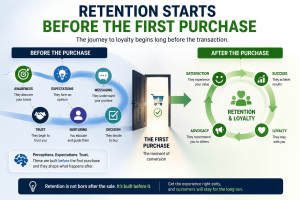
Customer retention starts before the first purchase

The Expectations Effect

Think about it this way.

Customers don’t simply purchase products or services.

They purchase expectations.

If those expectations are met or exceeded:

  • Trust grows.
  • Satisfaction increases.
  • Retention becomes easier.

But when expectations don’t match reality:

  • Frustration appears.
  • Confidence drops.
  • Churn becomes more likely.

This is why retention and acquisition are more connected than most businesses realize.

Simple SaaS Example

Imagine a SaaS company running ads that promise:

“Double your productivity in just 7 days.”

The prospect signs up expecting immediate results.

But after purchasing, they discover:

• The platform requires training
• Team adoption takes time
• Results typically take 60–90 days

The software itself may be excellent.

The customer may still achieve success.

But because expectations were set incorrectly, disappointment appears long before results do.

Eventually the customer cancels.

The company sees it as a retention problem.

In reality:

The retention problem started during marketing.

Service Business Example

Consider a digital marketing agency.

During sales conversations they suggest:

“We’ll generate leads almost immediately.”

The client signs the contract expecting rapid growth.

However, the actual process involves:

• Market research
• Strategy development
• Content creation
• Campaign optimization

Results may take several months.

Again, the service may be valuable.

But expectations and reality are misaligned.

The client becomes impatient.

Trust declines.

Retention suffers.

The churn didn’t start after delivery.

It started before the client signed.

Why the Buying Decision and Retention Decision Are Connected

Many businesses separate acquisition and retention into different departments.

Marketing acquires customers.

Customer success retains customers.

Support keeps customers happy.

But customers don’t experience your business in separate departments.

They experience one continuous journey.

From the first advertisement they see…

To the first conversation…

To the purchase…

To onboarding…

To long-term engagement.

Every stage influences the next.

That’s why the buying decision and the retention decision are often connected.

A customer who enters with realistic expectations is far more likely to stay.

A customer who enters with unrealistic expectations is far more likely to leave.

The Big Insight

Retention is not something you “start” after a customer buys.

Retention is something you influence before they buy.

The strongest retention systems don’t begin with customer support.

They begin with:

• Honest messaging
• Clear positioning
• Proper qualification
• Expectation management
• Trust-building communication

Because customers who understand what to expect are usually easier to retain.

Actionable Tip

Review your current customer journey and ask:

What expectations are prospects forming before they buy?

Look at:

• Your website copy
• Landing pages
• Ads
• Sales conversations
• Lead nurturing emails

Then compare those expectations with the actual customer experience.

If there is a gap between promise and reality, that gap may be creating future churn.

And fixing it could improve retention before a customer ever makes their first purchase.

Key Takeaway

Customer retention doesn’t begin after conversion.

It begins when prospects start forming expectations about your business.

Because the experience customers expect often determines whether they stay long enough to experience the value you deliver.

The Hidden Link Between Acquisition and Retention

One of the biggest misconceptions businesses have about growth is how they think about acquisition and retention.

Most treat them as completely separate activities.

Marketing focuses on generating leads and acquiring customers.

Sales focuses on converting prospects.

Customer success focuses on retaining customers.

Support focuses on solving problems.

On paper, that structure seems logical.

But from the customer’s perspective, none of these functions are separate.

They experience one continuous journey.

And that’s where many businesses get into trouble.
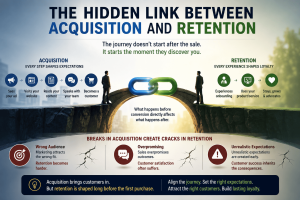
Hidden Link between Customer Retention and Acquisition

The Common Business Mindset

Ask a leadership team where retention responsibility begins.

Many will say:

After the sale

Or:

Once onboarding starts

Or:

When customer success takes over

This mindset creates a dangerous blind spot.

Because it assumes retention begins only after a customer enters the business.

But customers start forming opinions much earlier.

Long before they buy.

Long before onboarding.

Long before customer success gets involved.

And those early impressions often determine whether customers stay or leave later.

Why This Thinking Is Wrong

The customer journey doesn’t reset after a purchase.

It continues.

Every interaction builds on the one before it.

Think about the journey:

• A prospect sees your ad
• Visits your website
• Reads your content
• Speaks with your sales team
• Becomes a customer
• Experiences onboarding
• Uses your product or service

Each stage influences the next.

If unrealistic expectations are created during acquisition…

Customer success inherits the consequences.

If marketing attracts the wrong audience…

Retention becomes harder.

If sales overpromises outcomes…

Customer satisfaction often suffers.

This is why acquisition and retention are deeply connected.

What happens before conversion directly affects what happens after conversion.

A Simple SaaS Example

Imagine a SaaS company running advertisements that say:

“Get results in just 7 days.”

The message generates attention.

Signups increase.

The acquisition campaign appears successful.

But there’s one problem.

The software typically requires:

• Team setup
• User training
• Workflow adoption
• Data collection

Meaning most customers don’t see meaningful results until 60 days later.

Now imagine what happens.

The customer buys expecting immediate outcomes.

Seven days pass.

Results don’t appear.

Fourteen days pass.

Still no significant improvement.

The customer begins questioning the purchase.

Not because the software is poor.

Not because the company failed.

But because expectations and reality don’t match.

Eventually:

  • Satisfaction drops
  • Trust declines
  • Churn increases

The business sees a retention problem.

But the root cause started during acquisition.

The Service Business Version

The same thing happens in service businesses.

Imagine a consulting firm promising:

“We’ll double your revenue quickly.”

A client signs the contract expecting rapid transformation.

However, real growth requires:

• Strategy development
• Market testing
• Process improvements
• Team execution

Results may take months.

The service itself may be excellent.

The consultant may deliver significant value.

But the client’s expectations were set incorrectly from the beginning.

Now frustration appears.

Not because the service lacks value.

Because the timeline didn’t match the promise.

Again:

Acquisition created the retention problem.

The Cost of Misalignment

When acquisition and retention are disconnected, businesses often experience:

• Higher churn
• Lower customer satisfaction
• More support issues
• Increased refund requests
• Poor reviews
• Lower lifetime value

And often they respond by trying to generate even more leads.

Which only feeds the cycle.

Because acquiring more customers into a system that creates disappointment doesn’t solve the problem.

It simply scales the problem.

The Strategic Shift

The smartest businesses understand something many competitors miss:

Retention starts influencing growth before retention officially begins.

That’s why they focus on:

• Honest positioning
• Clear messaging
• Accurate expectations
• Better customer qualification
• Realistic promises

Because attracting the right customer with the right expectations makes retention dramatically easier later.

Actionable Tip

Review your marketing and sales messaging.

Ask:

Are we attracting the right customers?

Are we setting realistic expectations?

Could a new customer reasonably expect something we cannot consistently deliver?

If the answer is yes, you may already be creating future churn without realizing it.

Fixing retention sometimes starts by fixing acquisition.

Key Takeaway

Most businesses view acquisition and retention as separate growth activities.

But customers experience them as one continuous journey.

And when expectations created before the sale don’t align with reality after the sale:

Retention suffers.

Because poor acquisition strategies often create future retention problems long before a customer decides to leave

Expectations Drive Retention

If there is one factor that quietly influences retention more than most businesses realize, it’s expectations.

Not pricing.

Not features.

Not even customer support.

Expectations.

Because customers rarely judge your business based on reality alone.

They judge reality compared to what they expected to experience.

And that difference often determines whether they stay or leave.
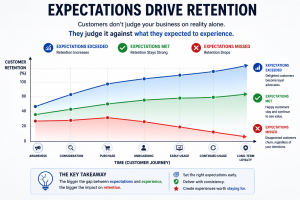
Expectations drive customer retention

Why Expectations Matter More Than Most Businesses Realize

Most businesses focus heavily on delivering value.

And that’s important.

But value alone doesn’t guarantee retention.

Why?

Because customer satisfaction isn’t based only on what you deliver.

It’s based on the gap between:

What customers expected

And

What customers experienced

This is where many businesses unintentionally create churn.

Not because they fail to deliver.

But because they create expectations they can’t consistently meet.

A Simple Way to Think About It

Imagine a customer rates their actual experience as:

8 out of 10.

That’s a strong experience.

Most businesses would consider that a success.

But now let’s compare two different expectation levels.

Scenario A

Customer expectation:

8 out of 10

Actual experience:

8 out of 10

Result:

The customer feels satisfied.

The promise matched the reality.

Trust remains intact.

Retention becomes more likely.

Scenario B

Customer expectation:

10 out of 10

Actual experience:

8 out of 10

The actual experience is identical.

Nothing changed.

But now the customer feels disappointed.

Why?

Because reality failed to match expectations.

The customer doesn’t evaluate the experience objectively.

They evaluate the gap.

And that gap creates dissatisfaction.

How Businesses Accidentally Create Expectation Gaps

This often happens through:

• Overpromising in marketing
• Exaggerated sales claims
• Unrealistic timelines
• Vague positioning
• Misleading case studies
• Poor qualification processes

Businesses usually do this with good intentions.

They want to attract attention.

Generate leads.

Increase conversions.

But when promises become bigger than reality, future retention becomes harder.

Real-World Example

Imagine a business software company promoting:

“Set up in minutes.”

A prospect signs up expecting a quick and effortless experience.

After purchasing, they discover:

• Data migration is required
• Team training is needed
• Internal approvals slow implementation

The software may still solve the customer’s problem.

But the setup process doesn’t match what was promised.

Now frustration begins.

Not because the product failed.

Because expectations were inaccurate.

The Hidden Relationship Between Expectations and Churn

Many businesses see churn as a customer success issue.

But often churn starts much earlier.

When expectations are inflated:

• Satisfaction decreases faster
• Trust erodes quicker
• Patience disappears sooner
• Perceived value drops

And customers become far more likely to leave.

In many cases, churn is simply disappointment in disguise.

The Smarter Retention Strategy

The goal isn’t to lower expectations.

The goal is to create accurate expectations.

The best businesses don’t promise perfection.

They promise clarity.

They help customers understand:

• What success looks like
• How long it takes
• What effort is required
• What challenges may appear
• What outcomes are realistic

This creates confidence.

And confidence strengthens retention.

Actionable Tip

Review your customer journey and identify:

Where expectations are being created.

Look at:

• Ads
• Landing pages
• Sales calls
• Discovery meetings
• Proposals
• Onboarding materials

Then ask:

Does the experience consistently match the promise?

Any gap you find today may become a retention problem tomorrow.

Key Takeaway

Retention problems often begin as expectation problems.

Because customers don’t judge your business based on reality alone.

They judge reality against what they expected.

And when expectations and experiences align:

  1. Trust increases.
  2. Satisfaction improves.
  3. Retention becomes much easier.

How Businesses Accidentally Create Churn Before the Sale

Most businesses assume churn starts when customers become unhappy after buying.

But often, churn begins much earlier.

In fact, many retention problems are unknowingly created during marketing and sales activities.

The customer simply doesn’t feel the consequences until after they buy.

How Businesses accidentally create churn

Let’s look at some of the most common ways businesses accidentally create future churn before the sale ever happens.

1. Overpromising Results

This is one of the biggest causes of future retention problems.

To generate more leads or close more deals, businesses often make promises that sound exciting but are difficult to deliver consistently.

Examples include:

  • “Get results in 7 days.”
  • “Double your revenue in 30 days.”
  • “Guaranteed success.”
  • “Completely automated growth.”

These messages attract attention.

But they also create expectations.

And expectations become dangerous when reality cannot match them.

Scenario

A business purchases a marketing service because they were promised rapid growth.

They expect meaningful results within a week.

But in reality:

  • Strategy takes time
  • Testing takes time
  • Optimization takes time

After a month, the customer starts feeling frustrated.

Not necessarily because the service is bad.

But because the outcome doesn’t match what they expected.

The problem wasn’t delivery.

The problem was expectation creation.

The Hidden Cost

Overpromising may improve short-term conversions.

But it often increases:

  • Refund requests
  • Customer dissatisfaction
  • Negative reviews
  • Early churn

Actionable Tip

Make your promises aspirational but realistic.

Instead of saying:

“Results in 7 days.”

Try:

“Most businesses begin seeing measurable improvements within 60–90 days, depending on their starting point.”

Realistic expectations often create better retention than exciting promises.

2. Attracting the Wrong Customers

Not every prospect is the right customer.

Yet many businesses try to appeal to everyone.

At first, this seems like a growth strategy.

More people.

More leads.

More opportunities.

But it often creates the opposite effect.

Scenario

Imagine a SaaS platform built specifically for large enterprise organizations.

The product is designed for:

  • Multiple departments
  • Complex workflows
  • Advanced reporting

However, the marketing focuses on attracting freelancers and solo entrepreneurs.

Many sign up.

Many purchase.

But shortly afterward:

  • Adoption is low
  • Features feel overwhelming
  • Customers struggle to find value

Result?

High churn.

Not because the product is poor.

But because the wrong customers entered the system.

The Bigger Insight

Customer retention improves when customer fit improves.

The better the fit:

  • The easier adoption becomes
  • The faster value is realized
  • The longer customers stay

Actionable Tip

Review your messaging and ask:

“Are we attracting the customers most likely to succeed with our solution?”

The goal isn’t more customers.

The goal is better-fit customers.

3. Poor Qualification

Many sales teams are rewarded for closing deals.

As a result, conversations often focus on getting a “yes.”

But sometimes the better outcome is helping the prospect realize they are not a fit.

That may seem counterintuitive.

But it’s often better for both sides.

Scenario

A company purchases software because a salesperson convinced them it could solve a specific challenge.

After implementation they discover:

  • The software isn’t designed for that use case
  • Internal resources are missing
  • Expectations were misunderstood

The deal closes.

But the customer struggles.

Eventually they leave.

What Really Happened?

The sale succeeded.

The qualification failed.

The Bigger Insight

Retention becomes difficult when customers buy solutions that don’t align with their needs.

A qualified customer is far more likely to become a long-term customer.

Actionable Tip

During sales conversations, spend as much time evaluating fit as you do selling.

Ask:

  • Is this customer ready?
  • Is this the right solution?
  • Can they realistically achieve success?

Sometimes protecting retention means saying “not yet.”

4. Misaligned Messaging

This is surprisingly common.

Marketing says one thing.

Sales says another.

The product delivers something different.

And the customer is left trying to figure out what is actually true.

Scenario

Marketing promotes:

“Easy setup in minutes.”

Sales says:

“Our team will guide you through implementation.”

After purchase, the customer discovers:

Setup requires significant internal resources and training.

Now confusion begins.

Trust starts eroding.

And trust is extremely difficult to rebuild.

Why This Matters

Customers expect consistency.

When messaging changes throughout the journey, customers begin questioning credibility.

Even small inconsistencies can create doubt.

The Bigger Insight

Retention is heavily influenced by trust.

And trust is built through consistency.

The message customers hear before the sale should closely match the experience they receive afterward.

Actionable Tip

Audit your customer journey regularly.

Compare:

  • Marketing messages
  • Sales conversations
  • Onboarding experience
  • Product delivery

Ask:

“Are we telling the same story at every stage?”

Consistency reduces disappointment and strengthens retention.

The Key Takeaway

Many businesses think churn is caused by what happens after the sale.

But often, the seeds of churn are planted before the customer ever buys.

When businesses:

  • Overpromise
  • Attract the wrong customers
  • Skip qualification
  • Create inconsistent expectations

They unintentionally create future retention problems.

Because retention isn’t only about keeping customers happy after conversion.

It’s also about making sure the right customers buy for the right reasons in the first place.

Why Customer Experience Begins Before Conversion

Most businesses think customer experience starts after the purchase.

When onboarding begins.

When implementation starts.

When support gets involved.

But that’s not actually where customer experience begins.

Customer experience starts much earlier.

It begins the very first time someone interacts with your business.

Before the sale.

Before the contract.

Before the transaction.

Because every interaction shapes perception.

And perception shapes trust.

Customer Experience Starts Before Someone Becomes a Customer

Think about the journey a prospect takes before buying.

They may:

  • Visit your website
  • Read your content
  • Watch your videos
  • Attend a webinar
  • Speak with your sales team
  • Request a demo
  • Download a resource

Every one of these interactions contributes to the customer experience.

The customer may not have purchased yet.

But they are already forming opinions.

Questions like:

  • Can I trust this company?
  • Do they understand my problem?
  • Are they transparent?
  • Will they be easy to work with?

Are being answered long before money changes hands.

Example: Two Different Experiences

Imagine two businesses selling similar services.

Business A

A prospect visits the website.

The messaging is vague.

Contact forms receive delayed responses.

Sales conversations feel rushed.

Questions are answered inconsistently.

The prospect eventually buys.

But uncertainty remains.

Business B

A prospect visits the website.

The messaging is clear.

Educational content answers key questions.

Responses are timely.

Sales conversations are consultative and transparent.

The prospect buys.

But trust already exists.

Both businesses made the sale.

But one started building the customer experience much earlier.

And that difference often influences retention later.

Trust Begins Before Conversion

One of the biggest drivers of retention is trust.

And trust rarely appears overnight.

It develops gradually.

Every helpful interaction strengthens it.

Every confusing interaction weakens it.

Scenario

Imagine a prospect researching a SaaS solution.

Over several weeks they encounter:

  • Helpful educational content
  • Honest expectations
  • Transparent pricing
  • Valuable onboarding guidance before purchase

By the time they become a customer:

Trust already exists.

Now adoption becomes easier.

Engagement improves.

Retention becomes more likely.

Because confidence was built before conversion.

Why This Matters for Retention

Customers who enter the relationship with trust and realistic expectations tend to:

  • Stay longer
  • Engage more
  • Experience less frustration
  • Give businesses more opportunities to solve problems

Meanwhile customers who enter with uncertainty often leave faster when challenges appear.

The difference is rarely the product alone.

It’s often the experience that preceded the purchase.

The Strategic Insight

Many businesses try to improve retention by focusing only on post-purchase activities:

  • Better onboarding
  • More support
  • Additional follow-up

Those initiatives matter.

But retention improvements often start much earlier.

Because customers don’t suddenly become customers.

They transition into customer relationships.

And every interaction during that transition influences what happens next.

Actionable Tips

If you want stronger retention, improve the pre-purchase experience.

Start by evaluating:

  1. Is your messaging clear and realistic?
  2. Does your content educate rather than simply promote?
  3. Are sales conversations focused on fit and expectations?
  4. Is the buying journey easy and transparent?
  5. Are prospects receiving value before they purchase?

The better the experience before conversion, the easier retention becomes after conversion.

The Key Takeaway

Customer experience doesn’t begin after the sale.

It begins the moment a prospect interacts with your business.

Every piece of content.

Every conversation.

Every promise.

Every expectation.

Contributes to the relationship you’re building.

And in many cases, retention is simply the outcome of the experience customers had before they ever became customers.

Because customers are far more likely to stay when trust, clarity, and realistic expectations are established before the first purchase.

The Psychology Behind Long-Term Customer Relationships

At its core, customer retention is not just a business concept.

It’s a human behavior concept.

Because customers don’t stay simply because you sold them something.

They stay because they continue to believe the relationship is valuable.

And that belief is influenced by psychology far more than most businesses realize.

Many companies focus heavily on:

  • Features
  • Pricing
  • Promotions
  • Sales tactics

But long-term customer relationships are usually built on something deeper:

Trust.

And trust doesn’t happen automatically.

It develops over time through consistent experiences.

Why People Stay

Think about the relationships you have with brands, products, or service providers you continue using.

Why do you stay?

Usually not because of a single transaction.

You stay because:

  • Expectations were met
  • Trust was earned
  • Value continued to be delivered
  • The experience remained positive

The same psychology applies to customers.

When these factors exist consistently, customers become comfortable continuing the relationship.

When they disappear, customers begin looking elsewhere.

The Four Drivers of Long-Term Retention

1. Expectations Are Met

Customers enter every purchase with expectations.

Some are created by marketing.

Some by sales conversations.

Some by previous experiences.

Retention becomes much easier when reality aligns with those expectations.

Scenario

A SaaS company tells prospects:

“Most customers see meaningful improvements within 60–90 days.”

After implementation, the customer experiences exactly that.

Result:

  • Expectations were met
  • Trust increases
  • Satisfaction grows

Now compare that to unrealistic promises that never materialize.

Retention becomes significantly harder.

2. Trust Is Built

Trust is one of the strongest retention drivers.

Customers stay longer when they believe:

  • You are honest
  • You are reliable
  • You consistently act in their best interest

Trust reduces uncertainty.

And people naturally prefer staying with businesses they trust rather than starting over with unknown alternatives.

Example

A service business encounters a delay in a client project.

Instead of hiding the issue, they communicate proactively.

They explain:

  • What happened
  • What is being done
  • What the revised timeline looks like

The client may not love the delay.

But transparency strengthens trust.

And trust often strengthens retention.

3. Value Is Consistent

Customers don’t evaluate value once.

They evaluate it continuously.

This is especially important for:

  • SaaS businesses
  • Membership businesses
  • Subscription services
  • Retainer-based service businesses

The question customers repeatedly ask themselves is:

“Is this still worth it?”

If the answer remains yes, they stay.

If the answer becomes uncertain, retention risk increases.

Scenario

A customer subscribes to a software platform.

Initially, they’re excited.

But over time:

  • Product usage declines
  • Communication disappears
  • New value isn’t highlighted

Eventually the customer wonders:

“Why am I still paying for this?”

Retention begins declining long before cancellation occurs.

4. Outcomes Are Achieved

Customers rarely buy products.

They buy outcomes.

They buy progress.

They buy transformation.

The closer customers get to the outcome they want, the longer they tend to stay.

Example

A fitness coaching client joins to lose weight.

If they begin seeing measurable progress:

  • Motivation increases
  • Trust increases
  • Retention improves

The same principle applies across industries.

Customers stay when they feel they are moving toward their desired result.

The Trust Equation

One of the simplest ways to understand retention psychology is through this progression:

Visibility → Credibility → Trust → Loyalty

Let’s break that down.

Visibility

Customers must see you consistently.

Through:

  • Content
  • Communication
  • Customer support
  • Product engagement

You can’t build relationships if customers rarely hear from you.

Credibility

Visibility alone isn’t enough.

Customers must also believe you know what you’re talking about.

Credibility is built through:

  • Expertise
  • Proof
  • Consistency
  • Results

Trust

When visibility and credibility accumulate over time, trust develops.

Customers begin thinking:

“This company understands my needs.”

“They consistently deliver value.”

“I can rely on them.”

Loyalty

Loyalty is the outcome.

Not the starting point.

Customers become loyal because trust was built repeatedly over time.

The Big Insight

Many businesses assume retention is mostly transactional.

They think customers stay because of:

  • Discounts
  • Contracts
  • Pricing
  • Features

Those things matter.

But they’re rarely the entire reason.

Because retention is often emotional before it becomes transactional.

People stay with businesses they trust.

Businesses that consistently deliver value.

Businesses that make them feel confident in their decision.

And that’s why retention is ultimately a relationship-building exercise—not just a revenue strategy.

Actionable Tips

To strengthen retention psychology:

  • Set realistic expectations early
  • Communicate consistently
  • Demonstrate credibility regularly
  • Focus on customer outcomes, not just product usage
  • Look for trust-building opportunities at every stage of the customer journey

Because customers don’t stay simply because they bought.

They stay because they continue believing they made the right choice.

Why Lead Nurturing Plays a Major Role in Retention

Most businesses view lead nurturing through a very narrow lens.

They see it as a conversion tool.

Something designed to:

  • Generate sales
  • Increase conversions
  • Move prospects through the funnel

And while that’s true…

It’s only part of the story.

Because effective lead nurturing does something much bigger.

It improves customer retention.

This surprises many businesses.

After all, how can something that happens before the sale influence whether customers stay after the sale?

The answer is simple.

Lead nurturing shapes expectations, understanding, trust, and customer fit.

All of which influence retention later.

Lead Nurturing Is More Than Follow-Up

When people hear the term lead nurturing, they often think:

  • Email sequences
  • Follow-up messages
  • Retargeting ads
  • Sales reminders

But great nurturing is really about education.

It’s about helping prospects understand:

  • The problem
  • The solution
  • The process
  • The expected outcomes

The more clarity prospects have before buying, the fewer surprises they encounter afterward.

And fewer surprises usually mean stronger retention.

Why Poorly Nurtured Customers Often Churn Faster

Let’s imagine two prospects.

Both eventually become customers.

But they arrive through very different journeys.

Customer A

Sees an advertisement.

Books a call.

Purchases quickly.

Little education.

Limited understanding.

Unclear expectations.

After purchase they discover:

  • More work is required than expected
  • Results take longer than expected
  • Their role is bigger than expected

Frustration appears.

Retention becomes difficult.

Customer B

Goes through a nurturing journey.

They consume:

  • Educational content
  • Case studies
  • Webinars
  • Emails
  • Helpful resources

Before purchasing they understand:

  • How the solution works
  • What success requires
  • Realistic timelines
  • Expected outcomes

After becoming a customer:

There are fewer surprises.

Trust already exists.

Retention becomes much easier.

Lead Nurturing Creates Better-Fit Customers

One of the most overlooked benefits of nurturing is qualification.

Good nurturing doesn’t just attract prospects.

It helps prospects determine whether they’re a good fit.

Scenario

A SaaS company creates educational content explaining:

  • Who the platform is for
  • Who it is not for
  • Required resources
  • Expected implementation process

Some prospects realize:

“This isn’t the right fit.”

And they don’t buy.

At first this might seem like a lost opportunity.

But it’s actually a retention win.

Because poor-fit customers often become future churn.

Lead Nurturing Builds Trust Before the Sale

Think about how trust develops.

Rarely through a single interaction.

Trust grows through repeated exposure and consistent value.

This is exactly what nurturing does.

Through content, communication, and education, prospects gradually become familiar with your business.

By the time they purchase:

  • Trust already exists
  • Expectations are clearer
  • Confidence is higher

And customers who trust you before the sale are often more likely to stay after the sale.

The Connection Between Nurturing and Retention

This is the important shift many businesses miss.

They think:

Lead nurturing improves conversion.

But nurturing also improves:

  • Customer quality
  • Expectation management
  • Product adoption
  • Customer success
  • Retention

Because retention doesn’t begin after conversion.

As we’ve discussed throughout this blog:

Retention often starts before the first purchase.

And nurturing is one of the most powerful ways to influence that process.
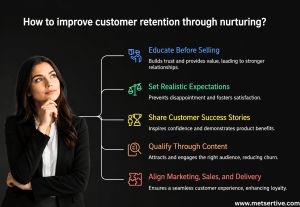
Improving Retention Through Lead Nurturing

Actionable Tips

If you want nurturing to improve retention—not just conversions—focus on these areas:

1. Educate Before Selling

Help prospects understand:

  • The problem
  • The solution
  • The process

Not just the offer.

2. Set Realistic Expectations

Avoid:

Overpromising

Focus on:

Clarity

  • Transparency
  • Realistic outcomes

3. Share Customer Success Stories

Use real examples that demonstrate:

  • Results
  • Timelines
  • Challenges
  • Outcomes

This helps prospects develop accurate expectations.

4. Qualify Through Content

Create content that explains:

  • Who your solution is for
  • Who it is not for

Better-fit customers generally retain longer.

5. Align Marketing, Sales, and Delivery

The message prospects hear before purchase should match the experience they receive afterward.

Consistency strengthens retention.

The Big Insight

Many businesses treat lead nurturing as a conversion activity.

But the smartest businesses recognize something deeper.

Lead nurturing is also a retention strategy.

Because when prospects:

  • Understand the product
  • Understand the process
  • Understand expected outcomes

They become better customers.

And better customers tend to stay longer.

Key Takeaway

Lead nurturing doesn’t just help customers buy.

It helps the right customers buy for the right reasons.

And when that happens:

  • Expectations improve
  • Trust improves
  • Customer success improves
  • Retention improves

Which is why well-nurtured customers often become long-term customers.

The SaaS, D2C, SME, and Service Business Examples

By now, the idea should be becoming clear:

Retention does not magically begin after the sale.

It is influenced by everything that happens before the sale.

The messaging prospects see.

The expectations they develop.

The promises they hear.

The trust they build.

Let’s look at how this plays out across different business models.

SaaS Example: Retention Starts Before Signup

Many SaaS companies focus heavily on acquiring users.

They optimize:

  • Landing pages
  • Free trials
  • Demos
  • Sign-up flows

But retention often depends on something much simpler:

Whether customers understood what they were signing up for.

Scenario

A SaaS company promotes its platform as:

“Easy to implement in just one day.”

New customers sign up expecting immediate success.

But after purchase they discover:

  • Setup takes several weeks
  • Team involvement is required
  • Data migration is needed

Result:

  • Frustration
  • Lower adoption
  • Increased churn

Now compare that to a company that clearly explains:

  • Setup requirements
  • Learning curve
  • Expected timelines
  • Success milestones

Customers arrive with realistic expectations.

They know what success looks like.

They know what is required.

Result:

Better onboarding

  • Higher adoption
  • Lower churn

Key Insight

Many SaaS churn problems are not onboarding problems.

They are expectation-setting problems that started before signup.

Actionable Tip

Audit your website, demos, and sales conversations.

Ask:

“Are we creating realistic expectations before customers buy?”

D2C Example: Retention Starts Before the First Order

For D2C brands, retention often begins with product expectations.

Customers decide whether they trust your brand based on what they see before purchasing.

Scenario

An online brand uses heavily edited product images.

The product appears:

  • Larger
  • Higher quality
  • More luxurious

than it actually is.

The customer purchases.

When the product arrives:

Reality does not match expectations.

Result:

  • Returns increase
  • Negative reviews increase
  • Repeat purchases decline

Now compare that to a brand that uses:

  • Accurate product photography
  • Honest descriptions
  • Clear specifications
  • Transparent communication

Customers know exactly what they’re buying.

When the product arrives:

Expectation and reality align.

Result:

  • Higher satisfaction
  • Fewer returns
  • Stronger trust
  • More repeat purchases

Key Insight

Retention often starts with accurate representation.

Because disappointed customers rarely become loyal customers.

Actionable Tip

Review product pages regularly.

Ask:

“Are we helping customers make informed buying decisions—or simply trying to maximize conversions?”

Service Business Example: Retention Starts During the Sales Process

Service businesses frequently create retention problems without realizing it.

Why?

Because sales conversations often focus on winning the client instead of preparing the client.

Scenario

An agency promises:

  • Fast results
  • Immediate improvements
  • Quick turnaround times

The client signs the contract.

But once the project begins:

  • Deliverables take longer
  • Results require testing
  • Progress happens gradually

The client begins questioning the decision.

Not because the service is poor.

But because expectations were unrealistic.

Now compare that to a service provider that communicates:

  • Realistic timelines
  • Clear deliverables
  • Expected responsibilities
  • Potential challenges

The client understands the journey before it begins.

Result:

  • Higher trust
  • Better communication
  • Stronger retention

Key Insight

Many service-business retention problems begin in the sales process—not in service delivery.

Actionable Tip

Review your proposals and sales presentations.

Look for places where expectations may be unintentionally inflated.

SME Example: Retention Starts During Lead Nurturing

Many SMEs focus on generating leads.

Far fewer focus on educating leads.

And that’s where future retention opportunities often get lost.

Scenario

An SME sells business consulting services.

Instead of pushing for an immediate sale, they nurture prospects through:

  • Educational content
  • Case studies
  • Industry insights
  • Success frameworks

Prospects gradually learn:

  • How the process works
  • What results are realistic
  • What commitment is required

By the time they become customers:

They are informed.

They are qualified.

They are aligned.

Result:

1.Better customer fit

2.Higher engagement

3.Stronger retention

4.Higher Customer Lifetime Value (LTV)

Key Insight

Educational nurturing doesn’t just improve conversions.

It improves customer quality.

And better customers tend to stay longer.

The Bigger Pattern

Notice what all four examples have in common.

The retention outcome was influenced before the transaction occurred.

Not after.

Whether you’re:

  • SaaS
  • D2C
  • SME
  • Service business

The principle remains the same:

Better expectations create better retention.

Because customers stay when reality matches what they believed they were buying.

Key Takeaway

Retention isn’t owned by customer success alone.

It’s influenced by:

  • Marketing
  • Sales
  • Positioning
  • Messaging
  • Lead nurturing
  • Expectation setting

Which means retention begins much earlier than most businesses think.

Often before the first purchase ever happens.

The Retention Flywheel Starts Before Conversion

Most businesses think retention looks like this:

Customer Purchase

Customer Experience

Retention

But the reality is much bigger.

Retention is not a single stage.

It’s the result of an entire chain of events.

Let’s visualize it.

The Retention Flywheel

Marketing Messaging

Expectation Setting

Customer Acquisition

Customer Experience

Retention

Customer Lifetime Value (LTV)

Referrals

Profitability

Growth

And then the cycle starts again.

Step 1: Marketing Messaging

Everything starts here.

Your marketing creates the first impression.

It tells prospects:

  • What you do
  • Who you help
  • What outcomes they can expect

This messaging becomes the foundation of future expectations.

If messaging creates clarity:

Retention becomes easier.

If messaging creates unrealistic expectations:

Retention becomes harder.

Step 2: Expectation Setting

This is one of the most overlooked growth activities.

Because expectations act like a lens.

Customers evaluate every future experience through that lens.

When expectations and reality align:

Trust grows.

When expectations and reality diverge:

Disappointment appears.

And disappointment is often the first step toward churn.

Step 3: Customer Acquisition

This is where most businesses focus.

Leads become customers.

Contracts get signed.

Subscriptions begin.

But acquisition is not the finish line.

It’s merely the transition point.

Step 4: Customer Experience

Now the customer begins interacting with your business.

They experience:

  • Onboarding
  • Product usage
  • Service delivery
  • Support
  • Communication

This is where expectations are either validated or broken.

Step 5: Retention

If expectations were realistic and value is consistently delivered:

Customers stay.

They continue buying.

They continue engaging.

They continue trusting.

Retention becomes the natural outcome.

Step 6: Customer Lifetime Value (LTV)

When customers stay longer:

Value accumulates.

Revenue compounds.

Profitability improves.

The relationship becomes significantly more valuable than the initial transaction.

Step 7: Referrals

Satisfied customers often become advocates.

They:

  • Recommend you
  • Refer others
  • Leave reviews
  • Share experiences

Now retention begins influencing acquisition.

The flywheel starts accelerating.

Step 8: Profitability

At this stage:

  • CAC becomes easier to recover
  • Marketing efficiency improves
  • Revenue quality improves

Because customer value continues growing.

Step 9: Growth

This is where sustainable growth emerges.

Not from constantly replacing customers.

But from maximizing customer value over time.

Growth becomes:

  • More predictable
  • More profitable
  • More sustainable

The Big Insight

Many businesses view retention as a post-sale activity.

Something managed by:

  • Customer success
  • Support teams
  • Account managers

But this flywheel reveals a different reality.

Retention is the outcome of the entire customer journey.

Marketing influences it.

Sales influences it.

Positioning influences it.

Expectation setting influences it.

Customer experience influences it.

By the time retention becomes visible, many of the factors affecting it have already been in motion for weeks or months.

Actionable Tip

Map your customer journey from:

First touchpoint
→ First purchase
→ First success moment

Then ask:

“Where might we be creating expectations that we can’t consistently fulfill?”

The answer often reveals hidden retention opportunities.

Key Takeaway

Retention doesn’t begin after conversion.

It begins before conversion.

Because every stage of the customer journey contributes to whether customers stay, leave, expand, refer, and generate long-term value.

And that’s why the strongest retention systems are built long before the first purchase ever happens.

Signs You’re Creating Future Churn Before Customers Buy

One of the biggest misconceptions about retention is that churn begins when customers become unhappy after the purchase.

But in many businesses, churn begins much earlier.

Sometimes months earlier.

Often during:

  • Marketing campaigns
    • Lead nurturing
    • Sales conversations
    • Product positioning
    • Customer acquisition

The reality is simple:

Many businesses unknowingly create future churn before customers ever buy.

Let’s make this practical.

If several of the following signs sound familiar, your retention challenges may actually be starting before conversion.

1. Marketing Promises More Than Delivery

This is one of the most common causes of future churn.

Marketing creates expectations.

But if delivery cannot consistently match those expectations, disappointment follows.

SaaS Example

Marketing message:

“Get results in 7 days.”

Reality:

Implementation takes 15 days.

Customers feel misled.

D2C Example

Product advertisements show dramatic transformations.

Customers receive the product.

Results are far less dramatic than expected.

Returns increase.

Service Business Example

An agency promises explosive growth within weeks.

Actual results require months of testing and optimization.

Clients become frustrated.

SME Example

A business consultant promises “guaranteed growth.”

Client expectations become unrealistic.

Trust begins eroding almost immediately.

Actionable Tip

Review your marketing messages.

Ask:

“Can our delivery team consistently fulfill this promise?”

If not, adjust the promise before it becomes future churn.

2. Wrong-Fit Customers Keep Entering

Not every lead is a good customer.

Yet many businesses focus on maximizing volume instead of improving fit.

SaaS Example

Enterprise software is marketed to freelancers.

Customers purchase.

Product complexity overwhelms them.

Churn rises.

D2C Example

Premium products attract bargain shoppers through discount-heavy promotions.

Customers purchase once.

Never return.

Service Business Example

An agency specializes in long-term strategic growth.

Marketing attracts businesses seeking instant results.

Mismatch occurs.

Relationships end quickly.

SME Example

A specialized B2B solution attracts businesses outside the ideal customer profile.

Customers struggle to implement recommendations.

Retention suffers.

Actionable Tip

Stop asking:

“How do we get more customers?”

Start asking:

“How do we attract better-fit customers?”

3. Customers Frequently Misunderstand the Offer

If customers regularly say:

• “I thought this included more.”
• “I didn’t know that.”
• “This isn’t what I expected.”

You may have an expectation-setting problem.

SaaS Example

Customers assume a feature is included.

It isn’t.

Disappointment follows.

D2C Example

Customers misunderstand product specifications.

Returns increase.

Service Business Example

Clients assume ongoing support is included.

It wasn’t part of the agreement.

Trust declines.

SME Example

Customers misunderstand implementation requirements.

Adoption suffers.

Actionable Tip

Look for recurring questions from prospects and customers.

Those questions often reveal unclear messaging.

4. Expectations Are Unclear

Unclear expectations create uncertainty.

And uncertainty creates dissatisfaction.

Even when the product itself performs well.

Scenario

A customer doesn’t know:

  • What success looks like
    • How long results take
    • What their responsibilities are
    • What happens next

The experience feels confusing.

Confusion eventually becomes frustration.

Actionable Tip

Clearly communicate:

  • Timeline
    • Deliverables
    • Expected outcomes
    • Customer responsibilities

The clearer the expectations, the stronger the retention.

5. Early Churn Is Common

Early churn is often one of the clearest warning signs.

Because customers are leaving before they fully experience value.

SaaS Example

Users cancel within the first 30 days.

D2C Example

Customers buy once and disappear.

Service Business Example

Clients leave after the initial engagement.

SME Example

Customers stop engaging shortly after implementation.

Actionable Tip

Investigate what customers expected before purchasing.

Compare it with what they actually experienced.

The gap often reveals the root cause.

6. Refund Requests Are Increasing

Refund requests often reveal expectation misalignment.

Not necessarily product failure.

Example

A product works exactly as designed.

But customers expected something completely different.

Result:

Refund request.

The issue wasn’t performance.

The issue was expectation.

Actionable Tip

Review refund reasons quarterly.

Patterns often reveal retention problems long before churn data does.

7. Customers Say:

“I Thought This Would Be Different.”

This single sentence contains more retention insight than many analytics dashboards.

Because it usually means:

Reality failed to match expectations.

And expectations were often shaped before the purchase.

Actionable Tip

Collect this feedback.

Don’t ignore it.

Use it to improve:

• Marketing
• Positioning
• Sales conversations
• Onboarding

The Insight That Changes Everything

Most businesses assume retention problems begin after conversion.

But many actually begin before conversion.

Because:

• Marketing influences expectations
• Expectations influence experience
• Experience influences retention

Which means:

Many retention problems are actually acquisition problems in disguise.

How to Build Retention Before the First Purchase

If retention starts before conversion…

Then improving retention starts before conversion too.

The goal isn’t simply to acquire customers.

The goal is to acquire customers who:

• Understand your offer
• Fit your solution
• Have realistic expectations
• Are positioned for success

Here’s how to make that happen.

  1. Align Marketing and Delivery

One of the most important retention strategies is simple:

Promise only what can be delivered.

When marketing, sales, and delivery operate independently:

Problems emerge quickly.

SaaS Example

Marketing promotes simplicity.

Product onboarding feels complex.

Trust declines.

D2C Example

Advertising highlights premium quality.

Customer experience feels average.

Repeat purchases decline.

Service Business Example

Sales promises aggressive timelines.

Delivery teams struggle to meet expectations.

Client satisfaction falls.

SME Example

Marketing communicates one outcome.

Operations deliver something different.

Customers become confused.

Actionable Tip

Bring marketing, sales, and delivery teams together regularly.

Review customer promises.

Ensure everyone is communicating the same reality.
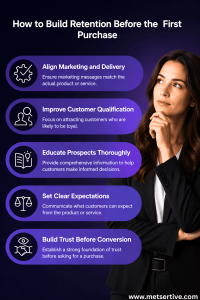
Building Customer Retention before first purchase

  1. Improve Customer Qualification

Not every lead should become a customer.

This can feel counterintuitive.

But stronger qualification often improves retention dramatically.

SaaS Example

A company rejects customers who lack technical resources.

Result:

Better adoption.

Lower churn.

Service Business Example

An agency declines clients seeking unrealistic outcomes.

Result:

Stronger long-term relationships.

D2C Example

A premium brand focuses on ideal customers rather than discount seekers.

Result:

Higher loyalty.

SME Example

A consultant works only with businesses ready to implement recommendations.

Result:

Better customer success.

Actionable Tip

Define:

  • Ideal customer profile
    • Customer fit criteria
    • Success requirements

Then qualify prospects against those standards.

  1. Educate Prospects Thoroughly

Education improves retention.

Because educated customers make better decisions.

Help prospects understand:

What They’ll Get

Clarify:

  • Features
    • Benefits
    • Deliverables

What They Won’t Get

This is equally important.

Transparency builds trust.

What Success Requires

Many customers underestimate their role in achieving results.

Explain:

  • Time commitment
    • Resources required
    • Responsibilities

Actionable Tip

Create educational content that prepares prospects for success before they buy.

  1. Set Clear Expectations

Retention problems often begin when expectations remain vague.

Clear expectations reduce surprises.

And fewer surprises usually lead to stronger retention.

Example

Instead of saying:

“You’ll see results quickly.”

Say:

“Most customers begin seeing measurable improvements within 60–90 days.”

One creates excitement.

The other creates trust.

Trust usually wins long-term.

Actionable Tip

Document your:

  • Timelines
    • Milestones
    • Success metrics
    • Customer responsibilities

Then communicate them repeatedly.

  1. Build Trust Before Conversion

Trust is one of the strongest predictors of retention.

And trust rarely appears overnight.

It develops gradually.

Through:

  • Helpful content
    • Consistent communication
    • Transparency
    • Authenticity
    • Delivering on small promises

SaaS Example

Educational webinars build credibility before signup.

D2C Example

Honest product reviews build confidence.

Service Business Example

Thought leadership content establishes expertise.

SME Example

Case studies and customer stories reduce uncertainty.

Actionable Tip

Focus on helping prospects make better decisions—not just faster decisions.

Trust formed early often lasts longer.

The Strategic Shift

Most businesses focus on:

“How do we acquire more customers?”

The smarter question is:

“How do we acquire customers who are more likely to stay?”

Because retention is rarely created by luck.

It’s created by:

  • Clear expectations
    • Strong qualification
    • Honest communication
    • Better-fit customers
    • Early trust

Key Takeaway

Customer retention doesn’t begin after the first purchase.

It begins long before it.

The strongest retention systems are built through:

1.Better marketing

2.Better qualification

3.Better expectation setting

4.Better education

5.Better trust-building

Because when customers know exactly what they’re buying, what success requires, and what to expect…

They are far more likely to stay.

And that’s where sustainable growth begins.

The Big Shift: Stop Thinking of Retention as a Post-Sale Activity

Most businesses think about retention the wrong way.

They assume retention begins after the sale.

After onboarding.

After implementation.

After customer success gets involved.

After support starts interacting with the customer.

And on the surface, that seems logical.

After all, retention is often measured after someone becomes a customer.

But here’s the perspective shift that changes everything:

Retention is measured after the sale.

But it often begins before the sale.

That distinction is important.

Because by the time a customer decides to stay or leave, many of the factors influencing that decision have already been set in motion.

Why This Matters

Think about a customer who cancels after 60 days.

Most businesses investigate:

• Product issues
• Support tickets
• Onboarding problems
• Service delivery challenges

Those are all important.

But sometimes the real cause started much earlier.

The customer purchased with expectations that were never realistic.

And when reality failed to match those expectations, churn became almost inevitable.

The problem wasn’t necessarily the product.

The problem was the expectation.

The Traditional View of Retention

Many businesses see retention as the responsibility of:

• Customer support
• Customer success
• Account management
• Operations teams

In this model:

Marketing acquires customers.

Sales closes customers.

Then retention becomes someone else’s responsibility.

But customer behavior doesn’t work that way.

Customers experience your business as one continuous journey.

They don’t separate:

• Marketing
• Sales
• Onboarding
• Delivery
• Support

To them, it’s all one experience.

Which means every stage contributes to retention.

SaaS Example

A SaaS company invests heavily in customer success.

They hire onboarding specialists.

They improve support.

They launch educational resources.

Yet churn remains high.

Why?

Because marketing promised:

“Instant results.”

Customers expected success immediately.

But actual adoption requires:

• Training
• Team alignment
• Implementation

Customer success teams are now trying to recover from expectations created before signup.

The retention problem started before onboarding ever began.

D2C Example

A D2C brand launches an aggressive advertising campaign.

The ads create enormous excitement.

Customers purchase.

But the actual product experience feels ordinary compared to what was promised.

Returns increase.

Repeat purchases decline.

Customer service works hard to solve complaints.

But the root issue wasn’t customer service.

It was expectation management.

Retention challenges were created before the first order was placed.

Service Business Example

A consulting firm promises transformational outcomes during sales conversations.

The client signs.

But after engagement begins, the client discovers:

• Results take time
• Internal execution is required
• Success depends on collaboration

The client feels disappointed.

Not because the service lacks value.

But because expectations were unrealistic.

The retention issue began during the sales process.

SME Example

An SME focuses heavily on lead generation.

Marketing campaigns perform well.

Customers convert.

But engagement quickly declines after purchase.

When leadership investigates, they discover many customers:

• Didn’t fully understand the solution
• Didn’t understand implementation requirements
• Had unrealistic expectations

The acquisition process attracted customers.

But it didn’t prepare customers.

And that preparation gap eventually became a retention problem.

The Insight Most Businesses Miss

The strongest retention strategies often begin inside:

• Marketing
• Positioning
• Lead nurturing
• Sales conversations
• Expectation setting

Not inside customer support.

Not inside onboarding.

Not inside customer success.

Because by the time those teams become involved, expectations already exist.

And expectations strongly influence whether customers stay.

The Strategic Shift

Instead of asking:

“How do we improve retention after customers buy?”

Start asking:

“How do we improve retention before customers buy?”

That question changes everything.

Because it forces businesses to think about:

• Customer fit
• Messaging accuracy
• Sales alignment
• Expectation management
• Customer education

And all of those factors influence retention long before churn becomes visible.

Actionable Tip

Review your customer journey from the prospect’s perspective.

Ask:

• What expectations are we creating?
• Are those expectations realistic?
• Can we consistently deliver what we’re promising?
• Are we attracting the right customers?

The answers often reveal retention opportunities hiding inside acquisition.

Key Takeaway

Strategic businesses understand something many competitors miss:

Retention begins when expectations are formed.

And expectations are usually formed long before the first purchase.

Which means one of the most powerful retention strategies often starts in marketing—not customer support.

Conclusion:

For years, businesses have viewed retention as a post-sale activity.

Something managed through:

• Follow-ups
• Loyalty programs
• Customer support
• Account management
• Customer success initiatives

And while all of those matter, they only tell part of the story.

Because retention begins much earlier than most businesses realize.

Long before:

• The first purchase
• The signed contract
• The onboarding process
• The welcome email

Retention begins when a prospect starts forming expectations about your business.

And those expectations influence everything that follows.

What We’ve Learned

Throughout this discussion, we’ve seen that retention is connected to far more than post-sale communication.

It’s influenced by:

• Marketing messaging
• Positioning
• Lead nurturing
• Sales conversations
• Customer qualification
• Expectation setting
• Trust-building

All of these factors shape how customers perceive your business before they buy.

And perception often influences retention more than businesses realize.

The Businesses That Win Retention Early

The businesses with the strongest retention often gain an advantage before customers ever become customers.

They don’t simply focus on generating more leads.

They focus on creating better-fit customers.

They:

1.Attract the right customers

2.Set realistic expectations

3.Educate prospects thoroughly

4.Build trust early

5.Deliver consistent value

As a result, customers arrive better informed, better prepared, and more likely to succeed.

And customers who succeed tend to stay.

SaaS Perspective

The best SaaS companies don’t just optimize onboarding.

They optimize expectation setting before signup.

Because informed users adopt faster and churn less.

D2C Perspective

The strongest D2C brands don’t just focus on acquiring buyers.

They focus on ensuring customers know exactly what they’re purchasing.

Because trust drives repeat purchases.

Service Business Perspective

The most successful service providers don’t simply close deals.

They qualify clients carefully and communicate honestly.

Because aligned expectations create stronger long-term relationships.

SME Perspective

Growing SMEs don’t just invest in lead generation.

They invest in customer education.

Because educated customers often become more profitable customers.

The Final Insight

Most businesses ask:

“How do we improve retention?”

But a more powerful question is:

“What expectations are we creating before customers buy?”

Because expectations influence:

• Trust
• Satisfaction
• Engagement
• Loyalty
• Churn
• Lifetime Value

And ultimately:

Profitability.

Actionable Next Steps

If you want to improve retention, start here:

  1. Audit your marketing promises
  2. Review customer expectations
  3. Improve customer qualification
  4. Align marketing, sales, and delivery
  5. Educate prospects more thoroughly
  6. Identify where expectation gaps occur
  7. Track early churn patterns

Often, the biggest retention opportunities are hiding before conversion.

Key Takeaway

Customer retention doesn’t start after the first purchase.

It starts the moment a prospect begins deciding whether they can trust you.

And businesses that understand this build:

  • Higher retention
  • Higher Customer Lifetime Value (LTV)
  • Lower churn
  • More predictable growth
  • More profitable customer relationships

Because the first sale doesn’t start retention.

Expectations do.
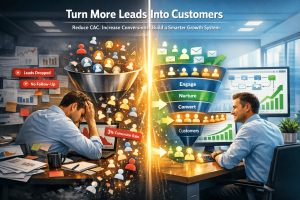
 

Lead Nurturing Reduces Customer Acquisition Cost and Increases Conversions

Lead nurturing reduces customer acquisition cost (CAC) by improving conversion rates, building trust with prospects, and maximizing the value of existing leads instead of constantly acquiring new ones. When businesses guide leads through the buyer journey with relevant content and timely follow-ups, they convert more leads into customers—lowering CAC and increasing overall marketing ROI.

Here’s the problem most businesses face:

They invest heavily in ads, generate leads…
but only a small percentage actually convert.

The result?
High CAC, wasted budget, and inconsistent growth.

But the real issue isn’t traffic.

It’s what happens after the lead comes in.

Most leads are not ready to buy immediately.
They need:

  • Clarity
  • Trust
  • Confidence

And that’s exactly what lead nurturing provides.

Instead of pushing for a sale too early,
lead nurturing focuses on:

  • Educating prospects
  • Addressing objections
  • Building relationships over time

Think of it this way:

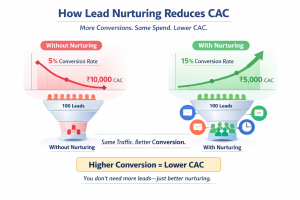
If 100 leads enter your funnel and only 2 convert, your CAC is high by default.
But if you can convert 5, 10, or even 15 of those same leads…

Your CAC drops—without increasing your ad spend.

Understanding how lead nurturing reduces customer acquisition cost comes down to one principle—converting more of the leads you already paid to acquire.

In this guide, you’ll learn how to use lead nurturing as a system, not just a tactic—so you can reduce CAC, increase conversions, and build a more efficient, scalable growth engine.

What Is Customer Acquisition Cost (CAC) — And Why It Matters

Let’s simplify this.

Customer Acquisition Cost (CAC) is:

The total cost you spend to acquire one customer.

Simple Formula:

CAC = Total Marketing + Sales Cost ÷ Number of Customers Acquired

What goes into CAC?

Most businesses underestimate this.

It’s not just ad spend.

Your CAC includes:

  • Ad spend (Google Ads, Meta Ads, etc.)
  • Tools (CRM, email software, analytics tools)
  • Team salaries (marketing + sales teams)
  • Content creation (blogs, videos, creatives)
  • Sales effort (calls, demos, follow-ups)

Why This Matters More Than You Think

Here’s where most businesses go wrong:

They assume:

“High CAC = expensive marketing”

But that’s not always true.

The Real Insight

High CAC often means:

Low conversion efficiency

Let’s look at a simple example:

You spend ₹1,00,000 on marketing.

Case 1:

  • You acquire 10 customers
    CAC = ₹10,000

Case 2:

  • You acquire 20 customers
    CAC = ₹5,000

What changed?

Not your budget.
Not your ads.

Your conversion rate improved.

That’s the game changer

You don’t always need to reduce spend to lower CAC.

You need to increase how many leads turn into customers.

Reduce Customer Acquisition Cost and increase conversion

Real-World Scenario

A SaaS company runs ads and gets:

  • 500 sign-ups for a free trial

But only:

  • 10 people convert to paid users

CAC stays high.

Now they introduce:

  • Onboarding emails
  • Product walkthroughs
  • Feature education

Conversions go from:

  • 10 → 30 users

Same traffic. Same spend. Lower CAC.

Valuable Tip

Before increasing your marketing budget, ask:

  • Are we converting enough of the leads we already have?
  • Where are leads dropping off in our funnel?
  • Do we have a system to nurture them?

Because:

Optimizing conversion is often cheaper than acquiring new leads.

✅ Key Takeaway

Customer Acquisition Cost is not just about how much you spend.

It’s about how efficiently you turn attention into customers.

And that’s exactly where lead nurturing becomes your biggest advantage.

The Real Problem: Most Leads Don’t Convert (And Why)

Here’s something most businesses don’t realize:

The majority of your leads are not ready to buy when they first interact with you.

But many businesses treat every lead like they’re ready to purchase immediately.

And that’s where things start breaking.

Let’s look at what actually happens:

A potential customer:

  • Visits your website
  • Downloads a guide
  • Signs up for a webinar

What does that mean?

They’re interested.
But not necessarily ready to buy.

So why don’t most leads convert?

Let’s break it down.

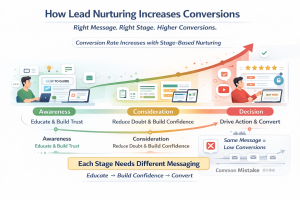
1. Leads Are Not Ready to Buy Immediately

Every buyer goes through a journey:

  • Awareness
  • Consideration
  • Decision

Most leads are stuck in the early stages.

Scenario:

A business owner downloads your “SEO checklist.”

That doesn’t mean:
They’re ready to hire you today

It means:
They’re trying to understand the problem

If you immediately pitch your service…

You lose them.

2. Lack of Trust

People don’t buy from brands they don’t trust.

Especially in:

  • B2B
  • High-ticket services
  • SaaS

Scenario:

A lead visits your pricing page.

They’re interested.

But they still wonder:

  • “Will this actually work for me?”
  • “Can I trust this company?”

Without:

  • Case studies
  • Testimonials
  • Educational content

They hesitate… and leave.

3. No Follow-Up (or Poor Follow-Up)

This is one of the biggest revenue leaks.

Scenario:

A lead fills out your contact form.

You respond after 3 days.

By then:

  • They’ve forgotten you
  • Or chosen a competitor

Or worse…

You send:
One email
And then nothing

That lead goes cold.

4. Generic Messaging

Not all leads are the same.

But many businesses communicate like they are.

Scenario:

  • A first-time visitor gets the same email as a pricing-page visitor
  • A curious reader gets the same message as a high-intent buyer

Result?

The message doesn’t resonate
The lead disengages

Important Data Insight

Studies consistently show:

Only a small percentage of leads are sales-ready at the first touchpoint

Which means:

Most of your leads need nurturing before they convert

Common Mistakes That Kill Conversions

  • Treating all leads the same
  • Pushing for a sale too early
  • Not understanding buyer intent
  • Ignoring follow-ups

Think of it this way:

If someone just walked into a store…

Would you immediately say:

“Buy this now.”

Or would you:

  • Understand their needs
  • Answer questions
  • Guide them

That’s exactly what your funnel should do.

Key Takeaway

Without nurturing, you’re leaking money at every stage of your funnel.

You paid to acquire the lead.

But without:

  • Follow-up
  • Education
  • Trust-building

That investment goes to waste.

At its core, effective lead nurturing is a form of sales funnel optimization—it ensures that leads don’t just enter your funnel, but actually move through it and convert.

What Is Lead Nurturing (And What It’s Not)

Now that we understand the problem…

Let’s talk about the solution.

What Is Lead Nurturing?

Lead nurturing is a structured process of:

  • Educating your leads
  • Engaging them over time
  • Building trust gradually

So that when they’re ready to buy…

They choose you.

Simple Way to Understand It

Lead nurturing is not about pushing a sale.

It’s about guiding a prospect toward a decision.

Real-World Example

A SaaS company gets a new sign-up.

Instead of immediately selling…

They send:

  • Day 1: Welcome email + quick start guide
  • Day 3: Feature walkthrough
  • Day 5: Case study
  • Day 7: Invite to demo

By the time they pitch:

The user already understands the value

Conversion becomes easier.

What Lead Nurturing Looks Like in Practice

  • Helpful emails
  • Educational content
  • Timely follow-ups
  • Personalized messaging
  • Behavior-based communication

What Lead Nurturing Is NOT

Let’s clear some common misconceptions.

1. Random email blasts

Sending emails without:

  • Strategy
  • Timing
  • Relevance

That’s noise, not nurturing.

2. Hard selling in every message

If every email says:
“Buy now”

Leads will:
Ignore or unsubscribe

3. One-size-fits-all communication

Different leads need different messages.

  • New leads → education
  • Interested leads → value
  • High-intent leads → conversion

Valuable Tip

Before sending any message, ask:

“What does this lead need at this stage?”

Not:

“What do I want to sell?”

Another Practical Insight

Good nurturing feels like:

  • Guidance
  • Help
  • Clarity

Not:

  • Pressure
  • Spam
  • Noise

Core Idea

Lead nurturing = Guiding a prospect toward a decision, not forcing one.

✅ Key Takeaway

When done right, lead nurturing:

  • Builds trust
  • Reduces hesitation
  • Increases conversions

And most importantly…

It turns your existing leads into customers—without increasing your ad spend. 

How Lead Nurturing Directly Reduces CAC


Lead nurturing reduces customer acquisition cost

Lead nurturing reduces customer acquisition cost


If you’re wondering how to convert more leads without increasing ad spend, the answer lies in building a structured nurturing process that guides prospects toward a decision.

Now let’s connect the dots.

You’ve seen:

  • Leads don’t convert immediately
  • Most businesses don’t nurture properly

So what happens when you do nurture?

Your Customer Acquisition Cost starts dropping—without reducing spend.

Let’s break down how.

1. Improves Lead-to-Customer Conversion Rate

This is the biggest lever.

If more leads convert into customers:

Your CAC automatically goes down.

Scenario:

You generate 100 leads.

  • Without nurturing → 5 customers
  • With nurturing → 15 customers

Same traffic. Same budget.

But your CAC drops by 3X.

Why this works:

Nurturing:

  • Builds trust
  • Answers objections
  • Keeps your brand top-of-mind

So when the lead is ready…

They choose you.

2. Maximizes ROI on Existing Traffic

Every lead you generate already costs you money.

Through:

  • Ads
  • Content
  • SEO
  • Social media

Scenario:

A user downloads your guide.

Without nurturing:
They leave and never return

With nurturing:

  • You send follow-up emails
  • Share relevant content
  • Invite them to a webinar

That same lead now converts.

Key Idea:

You don’t need more traffic.

You need to extract more value from the traffic you already have.

3. Reduces Dependency on Paid Ads

Most businesses fall into this trap:

“We need more leads → Increase ad spend”

But here’s the smarter way:

Convert more from what you already have.

Scenario:

  • Without nurturing → 2% conversion rate
  • With nurturing → 6% conversion rate

Now you get:
3X more customers from the same leads

Which means:
Less pressure to keep increasing ad budgets

Valuable Tip

Before scaling ads, fix your funnel.

Because:
Scaling a broken funnel = scaling your losses

4. Shortens the Sales Cycle

Time is money.

The longer it takes to convert a lead:

  • The more follow-ups needed
  • The more effort required
  • The higher your cost

Scenario:

Two leads:

Lead A (Not nurtured):
  • Asks basic questions
  • Needs multiple calls
  • Takes 30 days to convert
Lead B (Nurtured):
  • Already read your content
  • Understands your offering
  • Takes 10 days to convert

What changed?

Education.

Nurtured leads:

  • Come prepared
  • Ask better questions
  • Decide faster

5. Increases Customer Lifetime Value (LTV)

This is often overlooked.

Lead nurturing doesn’t stop at conversion.

Scenario:

A SaaS company:

  • Without onboarding → users drop off
  • With onboarding emails + guidance → users stay longer

Result:

  • Higher retention
  • More repeat purchases
  • Higher lifetime value

Why this matters for CAC:

When Customer Life Time Value increases:

You can afford higher CAC
Or maintain the same CAC with better profitability


Key Insight

Here’s the truth most businesses miss:

CAC doesn’t drop because you spend less
It drops because you convert more efficiently

This is where conversion rate optimization plays a critical role—because even small improvements in how leads move through your funnel can significantly reduce your overall CAC.

✅ Key Takeaway

Lead nurturing is not a cost-cutting tactic.

It’s a revenue efficiency system

That:

  • Converts more leads
  • Faster
  • With less effort

How Lead Nurturing Increases Conversions (Stage-by-Stage)

The most effective lead nurturing strategies to increase conversions focus on delivering the right message at the right stage of the buyer journey.

Now let’s make this practical.

Not all leads are the same.

And more importantly:

Not all leads are at the same stage.

Big Mistake Most Businesses Make

They send the same message to everyone.

Result?

  1. Low engagement
  2. Low conversions

The Smarter Approach

Align your messaging with the buyer’s journey

Stage 1: Awareness → Interest

This is where the journey begins.

The lead is:

  • Exploring
  • Learning
  • Trying to understand the problem

Goal: Build Trust

Not sell.

What to Share:

  • Educational emails
  • Blog content
  • Guides and checklists
  • Industry insights

Scenario:

A business owner searches:
“How to improve website traffic”

They land on your content.

If you immediately pitch:

You lose them

But if you:

  • Educate
  • Provide value
  • Simplify their problem

You earn attention and trust

Tip

Focus on:
Helping, not selling

At this stage:
Trust > Transaction

How Lead Nurturing increases conversion

Stage 2: Interest → Consideration

Now the lead is thinking:

“This looks interesting… but is it right for me?”

Goal: Reduce Doubt

What to Share:

  • Case studies
  • Product benefits
  • Comparisons
  • Use-case examples

Scenario:

A SaaS user is evaluating tools.

They’re comparing:

  • Features
  • Pricing
  • Results

If you provide:

  • Real results
  • Customer success stories

You move from “option” to “preferred choice”

Tip

Answer questions like:

  • “Will this work for me?”
  • “Is it worth it?”

Stage 3: Consideration → Decision

This is where conversion happens.

But even here…

Leads hesitate.

Goal: Drive Action

What to Share:

  • Testimonials
  • Product demos
  • Free trials
  • Limited-time offers

Scenario:

A lead:

  • Visited your pricing page
  • Opened multiple emails

They’re close.

Now is the time to:
Nudge them forward

Tip

Use:

  • Urgency
  • Clarity
  • Strong CTA

But keep it:
Helpful, not pushy

Big Insight (This Changes Everything)

Each stage needs different messaging.

If you:

  • Sell too early → you lose trust
  • Educate too late → you lose momentum

Simple Way to Remember

  • Awareness → Educate
  • Consideration → Build confidence
  • Decision → Convert

✅ Key Takeaway

Lead nurturing works because it aligns:

  1. The right message
  2. With the right person
  3. At the right time

And when that happens:

Conversions increase naturally.

Lead nurturing is a key part of customer journey optimization, ensuring that each interaction moves the prospect closer to a confident buying decision.

Types of Lead Nurturing That Drive Real Results

Now that we understand why nurturing matters…

Let’s talk about how to actually do it.

Because here’s the truth:

🔸Lead nurturing is not one tactic.
🔸It’s a system of touchpoints working together.

1. Email Drip Campaigns

This is the foundation of most nurturing systems.

A drip email campaign is a sequence of emails sent over time based on:

  • User action
  • Signup
  • Behavior

Scenario:

A user downloads your guide.

Instead of sending just one email, you send:

  • Day 1 → Welcome + resource
  • Day 3 → Educational content
  • Day 5 → Case study
  • Day 7 → Offer/demo

Why it works:

  • Keeps your brand top-of-mind
  • Builds trust gradually
  • Moves the lead step-by-step

Tip:

Each email should have one clear goal
Don’t try to educate, sell, and survey all in one email.

2. Retargeting Ads

Not every lead converts the first time.

But that doesn’t mean they’re lost.

Scenario:

A visitor:

  • Visits your pricing page
  • Leaves without taking action

You run retargeting ads showing:

  • Testimonials
  • Benefits
  • Limited-time offers

They come back and convert.

Why it works:

  • Reinforces your message
  • Reminds users of their interest
  • Targets high-intent audiences

 Tip:

Don’t show generic ads
Show stage-specific ads based on user behavior

3. WhatsApp / SMS Follow-Ups

This is where speed and visibility matter.

Emails can be ignored.

But messages?

They get opened.

Scenario:

A lead signs up for a demo.

You send:
“Hey, just confirming your demo for tomorrow. Let us know if you have any questions.”

Simple. Human. Effective.

Why it works:

  • High open rates
  • Feels personal
  • Faster response

Tip:

Use this for:

  • Reminders
  • Quick nudges
  • Important updates

Avoid overuse—it can feel intrusive.

4. Webinar Sequences

Webinars are powerful for:

  • Education
  • Trust-building
  • High-intent engagement

Scenario:

You host a webinar on:
“How to Reduce CAC for SMEs”

Your nurturing flow:

  • Before → Reminder emails
  • During → Value-packed session
  • After → Replay + offer

Why it works:

  • Builds authority
  • Engages leads deeply
  • Warms up cold audiences

Tip:

Don’t stop at the webinar
The post-webinar follow-up is where conversions happen

5. Personalized Content Journeys

This is where nurturing becomes powerful.

Instead of sending the same content to everyone…

You tailor it based on behavior.

Scenario:

  • Lead A → Reads beginner blogs → gets educational emails
  • Lead B → Visits pricing page → gets case studies + demo invites

Why it works:

  • Feels relevant
  • Matches intent
  • Increases engagement

Tip:

Even simple segmentation (beginner vs high-intent) can make a big difference

Big Insight

Multi-channel nurturing performs better than single-channel

Because your audience is not in one place.

They:

  • Check emails
  • Scroll social media
  • Use WhatsApp
  • Watch videos

Simple Rule

Be present across channels…

But stay consistent in your message

✅ Key Takeaway

The best nurturing systems are:

  • Timely
  • Relevant
  • Multi-channel
  • Behavior-driven

Real-World Scenarios 

Let’s bring everything together with real examples.

Because this is where theory becomes clear.

Scenario 1: SaaS Business

Problem:

Free trial users sign up… but don’t convert.

What’s really happening?

Users:

  • Don’t understand features
  • Don’t see value quickly
  • Get overwhelmed

Solution:

  • Onboarding email sequence
  • Feature walkthroughs
  • Use-case-based education

Result:

  • Higher activation
  • More users experience value
  • More conversions

CAC drops because more users convert from the same pool

Scenario 2: Service-Based Business

Problem:

Leads inquire… then go silent.

What’s happening?

  • Lack of follow-up
  • No trust built
  • No differentiation

Solution:

  • Follow-up emails
  • Case studies
  • Testimonials
  • Educational insights

Result:

  • Builds credibility
  • Keeps conversation alive
  • Increases conversion chances


Scenario 3: E-commerce Business

Problem:

Customers add to cart… but don’t purchase.

What’s happening?

  • Price hesitation
  • Distraction
  • Second thoughts

Solution:

  • Cart reminder emails
  • Limited-time offers
  • Customer reviews

Result:

  • Recovered revenue
  • Increased conversions


Scenario 4: SME (Small & Medium Business)

Problem:

Leads come in through ads or website… but conversion is low.

What’s happening?

  • Leads are not ready
  • No structured follow-up
  • Sales team engages too early

Solution:

  • Lead nurturing email sequence
  • Educational content
  • Lead scoring to identify high-intent leads

Scenario:

An SME offering digital services:

  • Starts sending weekly insights + case studies
  • Tracks engagement

Result:

  • Warmer leads
  • Better sales conversations
  • Higher conversion rates

Same leads → better outcomes → lower CAC


Scenario 5: D2C Brand (Direct-to-Consumer)

Problem:

High traffic but low repeat purchases.

What’s happening?

  • No post-purchase engagement
  • Weak brand connection
  • No retention strategy

Solution:

  • Post-purchase email flow
  • Product usage tips
  • Loyalty offers
  • Re-engagement campaigns

Scenario:

A skincare brand:

  • Sends tips on product usage
  • Recommends complementary products
  • Offers repeat purchase discounts

Result:

  • Higher repeat purchases
  • Increased LTV
  • Better ROI on acquisition

Key Insight

In all these scenarios, the pattern is the same:

The problem is not lack of leads
The problem is lack of nurturing

Final Takeaway

Lead nurturing turns:

  • Interest → trust
  • Trust → action
  • Action → revenue

And when that happens:

  1. Your CAC drops
  2. Your conversions rise
  3. Your growth becomes sustainable 

Common Lead Nurturing Mistakes That Increase CAC (And How to Fix Them)

Here’s the uncomfortable truth:

Most businesses don’t have a lead problem.
They have a lead handling problem.

And every mistake here?
Quietly increases your CAC.

Let’s break down 8 high-impact mistakes—with fixes and real-world scenarios.

1. No Segmentation

What Happens:

All leads get the same emails, same offers, same messaging.

Why It Hurts:

A first-time visitor and a pricing-page visitor are not the same.

Fix:

Segment based on:

  • Behavior (visited pricing page, downloaded guide)
  • Source (ads, organic, referral)
  • Stage (cold, warm, hot)

Scenario:

SaaS:
A CRM tool sends the same onboarding emails to:

  • Trial users
  • Blog subscribers

Result: Low engagement.

Fix:

  • Trial users → product tutorials
  • Subscribers → educational content

Engagement improves → more conversions → lower CAC

2. Over-Selling Too Early

What Happens:

You push demos, pricing, or calls too soon.

Why It Hurts:

Trust isn’t built yet.

Fix:

Follow the rule:
Educate → Build trust → Then sell

Scenario:

Service Business:
A marketing agency sends:
“Book a paid consultation” immediately after signup.

Low response.

Fix:

  • First: Share insights/case studies
  • Then: Invite for consultation

Leads warm up → conversion increases

Common Lead Nurturing mistakes

 3. Inconsistent Follow-Ups

What Happens:

You follow up once… then disappear.

Why It Hurts:

Leads forget you.

Fix:

Create a structured follow-up sequence

  • Day 1
  • Day 3
  • Day 7
  • Day 14

Scenario:

SME (B2B):
A manufacturing supplier responds to inquiry once.

No reply → lead lost.

Fix:

  • Follow-up with:
    • Product comparison
    • Case study
    • Reminder

Lead re-engages → closes later

4. Ignoring Behavioral Triggers

What Happens:

You don’t act when leads show intent.

Why It Hurts:

High-intent signals go wasted.

Fix:

Trigger actions based on behavior:

  • Visited pricing page → send pricing breakdown
  • Abandoned cart → send reminder

Scenario:

D2C Brand:
User adds product to cart → leaves.

No follow-up.

Fix:

  • Send:
    • Reminder email
    • Offer
    • Review/testimonial

Recovery increases → CAC drops

5. Not Aligning with Sales

What Happens:

Marketing sends leads.
Sales says: “These aren’t good.”

Why It Hurts:

Wasted effort + poor conversions.

Fix:

Define together:
What is a “sales-ready” lead?

Scenario:

SaaS:
Marketing sends webinar attendees to sales.

Sales says:
“They’re not ready.”

Fix:
Only send leads who:

  • Attended webinar
  • Visited pricing page

Sales closes faster

6. No Lead Scoring System

What Happens:

You don’t prioritize leads.

Why It Hurts:

Hot leads don’t get immediate attention.

Fix:

Assign points:

  • Pricing page → +10
  • Webinar → +7
  • Email click → +3

Scenario:

Service Business:
A high-intent lead waits 3 days for response.

Lost to competitor.

Fix:
Lead scoring triggers instant sales call.

Faster response → higher close rate

7. Generic, Non-Personalized Messaging

What Happens:

Same email to everyone.

Why It Hurts:

Feels irrelevant → ignored.

Fix:

Personalize using:

  • Name
  • Industry
  • Behavior
  • Pain points

Scenario:

SME:
Sends generic “Our services” email.

Low CTR.

Fix:

  • “For manufacturing businesses struggling with X…”

Relevance increases → engagement improves

8. No Measurement or Optimization

What Happens:

You run campaigns without tracking performance.

Why It Hurts:

You don’t know what’s working.

Fix:

Track:

  • Open rates
  • CTR
  • Conversion rate
  • CAC

Scenario:

D2C:
Runs email campaigns blindly.

No improvement.

Fix:

  • Identify top-performing emails
  • Double down

Better ROI → lower CAC

Actionable Tip

Fixing just 2–3 of these mistakes can:

  1. Increase conversions by 20–40%
  2. Reduce CAC significantly without increasing ad spend

Key Takeaway

  1. You don’t reduce CAC by spending less
  2. You reduce CAC by wasting fewer leads

How to Build a Simple Lead Nurturing System (Step-by-Step)

A simple lead nurturing system for small businesses doesn’t need to be complex—it just needs to be consistent, targeted, and aligned with how customers actually make decisions.

Let’s simplify this.

You don’t need complex tools.
You need a structured system.

Step 1: Segment Your Leads

Group leads into:

  • Cold (just discovered you)
  • Warm (engaged)
  • Hot (ready to buy)

Tip:

Start simple. You can refine later.

Step 2: Map Your Customer Journey

Understand:

  • Where leads enter
  • What they need at each stage

Example:

SaaS Journey:
Ad → Signup → Trial → Upgrade

Step 3: Define Key Touchpoints

Identify:

  • Email
  • WhatsApp
  • Retargeting ads
  • Calls

Insight:

More touchpoints = higher conversion probability

How to build a lead nurturing system

Step 4: Create Targeted Content

Match content to stage:

  • Awareness → Educational
  • Consideration → Case studies
  • Decision → Offers/demo

Scenario:

Service Business:

  • Blog → Awareness
  • Case study → Consideration
  • Consultation → Decision

Step 5: Set Up Automation

Use tools to automate:

  • Email sequences
  • Follow-ups
  • Alerts

Tools:

  • CRM: HubSpot, Zoho
  • Email: Mailchimp, ActiveCampaign

With the right marketing automation in place, businesses can nurture leads consistently at scale without relying on manual follow-ups.

Step 6: Track and Optimize

Measure:

  • Conversion rates
  • Engagement
  • Drop-offs

Tip:

Improve one step at a time.

Real-World System Examples

1. SME Example

Problem:

Leads come from website but don’t convert.

System:

  • Day 1: Welcome email
  • Day 3: Case study
  • Day 7: Offer/free consultation

Result: Higher conversions without more ads

2. SaaS Example

Problem:

Free trials don’t convert.

System:

  • Day 1: Setup guide
  • Day 2: Feature tutorial
  • Day 5: Case study
  • Day 7: Upgrade offer

Result: Better activation → lower CAC

3. Service Business Example

Problem:

Leads go cold.

System:

  • Follow-up email sequence
  • Testimonials
  • Problem-solving content

Result: Trust builds → more deals closed

4. D2C Example

Problem:

Cart abandonment.

System:

  • 1 hour: Reminder
  • 24 hours: Offer
  • 48 hours: Social proof

Result: Recovered revenue

Final Insight

  1. You don’t need more leads
  2. You need a better system

Key Takeaway

Lead nurturing is not about sending emails.

It’s about guiding decisions

And when done right:

✔ More conversions
✔ Lower CAC
✔ Higher ROI 

Metrics That Prove Your CAC Is Decreasing

Let’s be honest.

You can feel things are improving…
But unless you measure it, you can’t prove it.

And in business:

What you can’t prove, you can’t scale.

So instead of tracking everything, focus on a few high-impact metrics that directly show whether your lead nurturing is working.

1. Conversion Rate (Your #1 Signal)

This is the most important metric.

Formula:
Leads → Customers

Why It Matters:

If more leads convert into customers…

Your CAC automatically drops

Scenario:

You generate 100 leads.

  • Earlier → 5 customers → 5% conversion
  • Now → 10 customers → 10% conversion

Same leads. Same spend.

But CAC is cut in half.

Tip:

Track conversion at each stage:

  • Visitor → Lead
  • Lead → Qualified
  • Qualified → Customer

This shows where you’re improving.

2. Cost per Lead vs Cost per Customer

This is where many businesses get confused.

They focus only on cost per lead (CPL).

But what really matters is:

Cost per customer (CAC)

Scenario:

You spend ₹50,000 on ads.

Case A:
  • 500 leads → ₹100 per lead
  • 5 customers → CAC = ₹10,000
Case B:
  • Same 500 leads
  • 10 customers → CAC = ₹5,000

Lead cost didn’t change
Conversion improved

Insight:

Low CPL ≠ success
High conversion = success

3. Email Engagement (Early Indicator)

Before conversions improve…

Engagement improves first.

Track:

  • Open rate
  • Click-through rate (CTR)
  • Reply rate

Scenario:

SaaS Business:
  • Old emails → 12% open rate
  • New nurturing sequence → 28% open rate

More engagement → more educated leads → higher conversions

Tip:

If engagement is low:
1.Your messaging is off

2. Not your product

4. Sales Cycle Length

How long does it take to convert a lead?

Scenario:

Service Business:
  • Earlier: 30 days to close
  • After nurturing: 18 days

Why?

Because leads:

  • Already understand the value
  • Already trust you

Insight:

Shorter sales cycle = lower cost per deal

Less time → less effort → lower CAC

5. Customer Lifetime Value (LTV)

CAC is only half the story.

The real game is:

CAC vs LTV

Scenario:

D2C Brand:
  • Without nurturing → one-time buyers
  • With nurturing → repeat purchases

LTV increases

Insight:

Better nurturing doesn’t just convert…

It creates better customers

Putting It All Together

Here’s the pattern you want:

✔ Conversion rate → Up
✔ Email engagement → Up
✔ Sales cycle → Down
✔ LTV → Up
✔ CAC → Down

Core Insight

  1. If conversions increase while spend stays the same
  2. CAC will drop automatically

No hacks. No tricks.

Just better funnel efficiency.

Advanced Insight: The CAC vs Conversion Flywheel

Most businesses think like this:

“We need more leads to grow”

But high-growth businesses think differently:

“We need to convert better”

That’s where the CAC vs Conversion Flywheel comes in.

The Flywheel Explained

Here’s the loop:

Better Nurturing
Higher Conversion Rate
Lower CAC
More Budget Efficiency
More Leads / Better Investment
More Growth
→ Back to Better Nurturing

Why This Changes Everything

This is not a one-time improvement.

It’s a compounding system.

Scenario:

Month 1:
  • Conversion rate = 5%
  • CAC = ₹10,000

You improve nurturing.

Month 3:
  • Conversion rate = 8%
  • CAC = ₹6,250

Now you reinvest savings into better campaigns.

Month 6:
  • More leads
  • Better conversion
  • Even lower CAC

Growth accelerates

The Real Power

Most businesses try to scale like this:

Spend more → hope for growth

But this is risky.

Smart businesses scale like this:

Improve system → then scale

Strategic Insight

Lead nurturing is not just a marketing tactic.

It’s a growth lever

Because it impacts:

  • Conversions
  • Costs
  • Revenue
  • Retention

Actionable Tip

Start small:

  1. Improve one nurture sequence
  2. Track conversion impact
  3. Reinvest gains into better campaigns

Repeat.

Final Takeaway

  1. CAC doesn’t drop randomly
  2. It drops when your system improves

And when you build this flywheel:

✔ Growth becomes predictable
✔ Marketing becomes efficient
✔ Sales becomes easier

Conclusion: Stop Chasing Leads—Start Converting Them

Let’s bring this home.

Most businesses believe their biggest problem is:
“We need more leads”

So they spend more on ads.
Try new channels.
Push harder for traffic.

But here’s the reality:

CAC is not just a cost problem. It’s a conversion problem.

If your funnel converts poorly,
even cheap leads become expensive.

If your funnel converts well,
even expensive leads become profitable.

The Real Shift

Lead nurturing is the missing link most businesses ignore.

It’s the bridge between:

Interest → Trust → Purchase

Without it:

  • Leads stay cold
  • Sales feels forced
  • CAC keeps rising

With it:

  • Leads get educated
  • Trust builds naturally
  • Conversions happen faster

Final Thought

“The businesses that win are not the ones that generate the most leads—
but the ones that convert the most from what they already have.”

That’s the difference between:

  • Constantly chasing growth
    vs
  • Building a system that creates it

Actionable Next Steps (Start Here)

Don’t overcomplicate this.

Start simple. Start practical.

1. Audit Your Current Funnel

Ask yourself:

  • Where are leads coming from?
  • What happens after they enter?

Most businesses don’t even have clarity here.

2. Identify Where Leads Drop Off

Look for leaks:

  • After signup?
  • After first visit?
  • Before purchase?

That’s where your CAC is increasing.

3. Set Up One Simple Nurturing Sequence

Start with just one:

Example:

  • Day 1: Welcome + value
  • Day 3: Insight or case study
  • Day 5: Problem-solving content
  • Day 7: Offer or CTA

Keep it simple. Consistency beats complexity.

4. Track Conversion Improvements

Watch:

  • Conversion rate
  • Engagement
  • Sales cycle

Even small improvements = big CAC reduction

Key Takeaway

Lead nurturing is not just another marketing tactic.

It’s a revenue optimization system

Because when you get it right:

✔ You convert more without spending more
✔ You reduce CAC naturally
✔ You build predictable growth


What Is Lead Scoring and How to Use It Effectively

Let’s face it—no matter how many leads your business attracts, not all of them are ready to buy. Some are curious window shoppers, some are doing early research, and a few are hot and ready to make a decision. So, how do you know who to follow up with, and who to hold off on?

That’s where lead scoring comes in.

Lead scoring is a simple, powerful way to rank your leads based on how likely they are to become paying customers. It’s like having a compass that tells you which prospects are worth your time, and which ones need more nurturing.

For small and medium-sized businesses (SMEs), this is game-changing. When resources are limited, lead scoring helps you prioritize the leads that matter most, so your sales team isn’t wasting time chasing people who just aren’t ready.

And here’s the kicker: lead scoring is the missing link between lead generation and lead nurturing. It tells you who to nurture—and when. Without it, you’re guessing. With it, you’re strategic. Implementing an effective lead scoring system is crucial for small and medium businesses aiming to streamline their sales funnel optimization and enhance customer segmentation.

What Is Lead Scoring?

At its core, lead scoring is a system that assigns points to your leads based on certain criteria—like their behavior, engagement, and fit for your product or service. The higher the score, the more qualified the lead is.

Imagine this:

  • A lead visits your pricing page (+10 points)
  • They download an eBook (+5)
  • They open three emails in a row (+3)
  • They’re from your target industry (+7)

Total score = 25 points.
You can now compare that to your internal “sales-ready” threshold (say, 30 points) and decide what kind of follow-up makes sense.

🎯 Types of Lead Scoring Criteria

  1. Demographic data – e.g., job title, location, age
  2. Firmographic data – e.g., company size, industry, revenue
  3. Behavioral actions – e.g., email clicks, website visits, downloads
  4. Engagement history – e.g., webinar attendance, social media interaction

These signals help you paint a fuller picture of each lead’s potential.

🧠 Tip: Use both “explicit” and “implicit” data

  • Explicit data is what the lead tells you directly—like their company size or budget.
  • Implicit data is what you observe based on their behavior—like how many times they visited your case study page.

Both are essential for accurate scoring.

✅ Real-World Example:

Let’s say you’re selling CRM software. A lead who:

  • Works as a sales director at a 200-person company (explicit fit)
  • Attended your webinar and downloaded your ROI calculator (implicit behavior)

…is much more likely to convert than someone who just visited your homepage once.

That’s the power of scoring—it filters out the noise and keeps your pipeline focused.

By leveraging behavioral analytics, companies can assign scores to leads, distinguishing between marketing qualified leads (MQL) and sales qualified leads (SQL).

Why Lead Scoring Matters for SMEs

If you’re running a small or medium business, you know the struggle: not all leads are created equal, but they all demand your attention.

So how do you decide who gets a follow-up call today—and who’s better off in a long-term nurture sequence?

That’s where lead scoring earns its keep.

1. It Helps You Focus on High-Potential Leads

You probably don’t have a 20-person sales team. That means your time—and your team’s time—is precious. Lead scoring shows you who’s hot, who’s warm, and who’s just browsing.

Example:
A lead that watched your demo video, opened three emails, and requested pricing info should get your immediate attention. One that visited your homepage once? Maybe not just yet.

2. It Aligns Sales and Marketing (Finally)

Sales says, “We need better leads.”
Marketing says, “We gave you 200 this week.”

Sound familiar?

With a shared lead scoring model, everyone speaks the same language. Sales knows which leads are truly qualified. Marketing knows what it takes to move a lead from cold to warm.

✔️ Tip: Sit both teams down and define what a “sales-ready” lead actually looks like.

3. It Increases Conversion Rates

When you prioritize the right leads and engage them at the right time, you close more deals—without burning out your team or budget.

According to a study by MarketingSherpa, companies that use lead scoring see a 77% increase in lead generation ROI.

Now that’s a stat worth paying attention to.

Common Lead Scoring Models (and Which One You Should Use)

Lead scoring isn’t one-size-fits-all. In fact, there are several ways to do it—and the right model depends on your business goals, tools, and buyer journey.

Let’s break them down:

1. The Point-Based Model (Most Common)

This is the classic approach.
You assign points based on specific actions or attributes.

  • +10 for visiting your pricing page
  • +5 for opening an email
  • +15 for booking a demo
  • -10 for unsubscribing from your newsletter

You set a threshold (say, 50 points), and once a lead hits it, they’re passed to sales.

Tip: Use your CRM or marketing automation platform to auto-score leads. Tools like HubSpot, Zoho, and ActiveCampaign make this easy.

2. Fit + Interest Model

This model blends:

  • Fit = how well a lead matches your ideal customer (job title, industry, company size)
  • Interest = how engaged they are (website visits, downloads, webinar signups)

It helps you separate:

  • Good fit + high interest = hot lead
  • Good fit + low interest = nurture more
  • Bad fit + high interest = may not be worth chasing

3. Predictive Lead Scoring (Advanced)

Predictive Lead Scoring uses machine learning and AI to analyze patterns in your data and predict which leads are most likely to convert. It’s powerful—but often overkill for SMEs just starting out.

✅ Best for: companies with large lead volumes and data teams.
❌ Not ideal if you’re new to lead scoring or don’t have a CRM packed with historical data.

4. Demographic-Based Lead Scoring

Not every lead fits your ideal customer profile—and that’s okay. But the ones who do should score higher.

This model focuses purely on the attributes of the lead or company—things like industry, job title, location, or company size. It works well for businesses that sell to specific niches (e.g., SaaS companies targeting HR managers in tech firms).

✔️ Example:

  • +10 for job title = “Marketing Director”
  • +8 for company size = 50–200 employees
  • +5 for location = North America
  • -5 for job title = “Student” or “Intern”

Tip: Use this model when your product is highly tailored to specific roles, industries, or regions.

 5. Negative Scoring Model

Scoring shouldn’t just reward good signals—it should also detect when a lead is cooling off.

The negative scoring model subtracts points for behaviors that suggest disinterest or poor fit. It’s especially helpful for keeping your pipeline clean and preventing “false positives” (leads that seem active but aren’t serious buyers).

✔️ Example:

  • -10 for email bounce
  • -5 for visiting careers page (job seekers, not buyers)
  • -7 for no engagement in 30 days
  • -10 for unsubscribing from email list

Tip: Combine this with your existing scoring system to balance out the hype and bring more accuracy to lead readiness.

6. Time-Decay Lead Scoring Model

Interest fades. If your scoring system doesn’t account for time, you’re treating yesterday’s news like a breaking story.

Time-decay scoring gradually reduces a lead’s score if they haven’t engaged in a while. This model helps you focus only on active, high-intent leads and avoid wasting sales resources.

✔️ Example:

  • -5 after 14 days of inactivity
  • -10 after 30 days
  • -15 after 45+ days without engagement

Tip: Automate decay logic in your CRM so leads naturally drop in priority unless they re-engage.

How to Build a Simple Lead Scoring System

You don’t need fancy AI or a data science team to get started with lead scoring. In fact, many high-converting businesses begin with a basic, spreadsheet-based system.

Lead Scoring System Cycle

Here’s a simple, step-by-step framework to get you rolling:

🔹 Step 1: Define Your Ideal Customer Profile (ICP)

Start by identifying what a “perfect-fit” customer looks like for your business.

✔️ Example Criteria:

  • Industry: SaaS or service-based
  • Job Title: Marketing Manager or CEO
  • Company Size: 10–100 employees
  • Region: North America or EU

Tip: Interview your top customers or analyze your CRM to find patterns.

🔹 Step 2: Identify High-Intent Behaviors

What actions tell you someone is truly interested? These are the “conversion clues” you’ll score.

✔️ Examples of High-Intent Behavior:

  • Downloading a lead magnet (+5)
  • Visiting your pricing page (+10)
  • Signing up for a webinar (+7)
  • Returning to your website 3+ times in a week (+8)

Tip: Start with 5–7 behaviors and refine as you gather data.

🔹 Step 3: Assign Point Values

Now assign point values to each behavior and attribute.

Action

Points

Opened an email
+2
Clicked a CTA in an email
+3
Downloaded a guide
+5
Attended a webinar
+7
Visited pricing page
+10
Filled out contact form
+15

Tip: You can also assign negative points for low engagement (e.g., -5 for unsubscribing).

🔹 Step 4: Determine a Sales-Readiness Score

Set a score threshold that tells you when a lead is “ready for sales.” For many SMEs, this might be 30–50 points.

✔️ Example: Once a lead hits 40 points, they’re sent to a rep for a discovery call.

Tip: Adjust the threshold based on your average sales cycle and conversion rates.

🔹 Step 5: Use a CRM or Spreadsheet to Track

If you’re just starting out, a Google Sheet will do the trick. But to scale, use CRM platforms like HubSpot, Zoho, or ActiveCampaign to automate tracking and scoring.

Pro Tip: Set up email alerts or Slack notifications when leads cross your sales-readiness threshold.

🔹 Step 6: Test Your Model with Historical Data

Before going live, validate your scoring system against past leads.

✔️ Example: Look at leads who converted last quarter. Do their behaviors match your current scoring values? If top customers consistently scored lower than your “sales-ready” threshold, it may need adjusting.

Tip: This helps fine-tune point weights and ensures your model reflects real buyer behavior.

🔹 Step 7: Set Up Alerts and Automations

Scoring is most powerful when it’s automated and actionable.

✔️ Use your CRM or marketing platform to:

  • Send alerts to your sales team when a lead crosses the readiness threshold
  • Trigger tailored email sequences based on score brackets
  • Notify marketing if a lead cools off and drops below a threshold

Tip: Automations help move leads through your funnel faster—and more efficiently.

🔹 Step 8: Review and Optimize Monthly

Lead scoring isn’t “set it and forget it.” Your business—and buyer behavior—evolves.

✔️ Schedule a monthly or quarterly review to:

  • Analyze conversion rates by score range
  • Adjust point values based on new insights
  • Add new behaviors as your marketing channels grow (e.g., webinar replays, chatbot engagement)

Tip: Collaborate with both sales and marketing in this review to keep alignment sharp.

Utilizing CRM software like HubSpot or Zoho can simplify the process of setting up a predictive lead scoring model tailored to your business needs.

Tools and CRMs for Lead Scoring

Choosing the right CRM can simplify lead scoring and make it easier to scale. Here are four platforms that work well for SMEs and mid-size teams:

1. HubSpot

✅ Built-in lead scoring
✅ Drag-and-drop automation workflows
✅ Easy to integrate with email and sales pipelines

Why it’s great: HubSpot’s free CRM is user-friendly and powerful enough for growing teams. It also lets you create scoring rules based on both behavior and contact properties.

2. Zoho CRM

✅ Custom scoring rules
✅ Strong contact management features
✅ Affordable for small businesses

Why it’s great: Zoho lets you automate scoring based on specific actions like website visits or email opens—ideal for SMEs looking for customization on a budget.

3. Salesforce Pardot

✅ Advanced lead scoring and grading
✅ AI-powered insights
✅ Deep integration with Salesforce Sales Cloud

Why it’s great: Pardot is best suited for B2B companies with complex sales cycles. If you’re already using Salesforce, it’s a natural extension.

4. ActiveCampaign

✅ Easy-to-use automation builder
✅ Behavioral-based scoring
✅ Integrated email marketing & CRM

Why it’s great: ActiveCampaign is great for marketing-first teams who want email + scoring + nurturing all in one dashboard.

🧩 Tip: Look for CRM Integration

Selecting the right CRM tools for lead scoring is essential; platforms like Salesforce Pardot offer robust features for tracking and evaluating lead interactions.

Make sure your chosen tool integrates smoothly with your website forms, email platform, and sales pipeline. This ensures lead scoring happens in real-time—not manually.

Real-World Examples

Let’s bring all this theory to life. Here are few examples of how lead scoring works in practice—and how it helps businesses focus where it matters most.

Scenario 1: A B2B SaaS Company Using Webinar Engagement

Webinar attendance isn’t just a sign of interest—it’s a strong buying signal.

A B2B SaaS company hosts monthly product webinars. They assign lead scores like this:

  • +10 for registering
  • +15 for attending live
  • +5 for asking a question
  • +20 for booking a demo afterward

One attendee, Jane, signs up, attends, asks two detailed questions, and books a call—earning 50 points in total. Their CRM (HubSpot) automatically flags her as “sales-ready,” and a rep follows up within hours.

Takeaway:
Engagement-based scoring can help you identify high-intent leads faster and close warmer deals.

Scenario 2: E-commerce Store Prioritizing Cart Abandoners

Not all window shoppers are worth chasing—but some are almost at checkout.

An e-commerce brand selling eco-friendly skincare uses lead scoring to track site behavior:

  • +5 for viewing 3+ product pages
  • +10 for adding items to the cart
  • +15 for abandoning the cart
  • +10 for clicking on a retargeting email

When a lead reaches 40 points, they automatically receive a personalized SMS:
“Hey! You left something behind. Here’s 10% off your first order—just for you.”

Result: A 17% recovery rate on abandoned carts and a 20% lift in email open rates from warm leads.

Scenario 3: An Online Course Business Qualifying Signups

Not every email subscriber is ready to enroll—but some are already halfway there.

An online course creator tracks behaviors that indicate genuine learning intent:

  • +5 for signing up for a free course
  • +10 for watching 75% of a video lesson
  • +7 for joining a live Q&A session
  • +10 for visiting the checkout page

A lead who completes two free lessons and joins the live webinar gets flagged at 32 points, triggering a limited-time discount email sequence.

Tip: Educational businesses can use video completion and content depth as powerful engagement signals.

Scenario 4: A Healthcare SaaS Provider Targeting Medical Practices

Healthcare buyers are cautious—scoring helps spot the ones ready to move.

A B2B healthcare platform assigns points based on both role relevance and compliance needs:

  • +8 for job title “Operations Director” or “Practice Manager”
  • +10 for downloading a HIPAA compliance checklist
  • +12 for attending a product webinar
  • +5 for revisiting the pricing page within a week

Once a lead crosses 35 points, they’re routed to a sales specialist who offers a tailored compliance walkthrough.

Tip: Niche industries should focus on role-specific content and pain-point behaviors.

Scenario 5: A B2B Services Agency Targeting Mid-Market Clients

The right company size and the right engagement combo equals a hot lead.

A digital marketing agency uses fit + behavior scoring:

  • +10 for company size over 50 employees
  • +8 for downloading their case study
  • +6 for scheduling a free consultation
  • +5 for visiting the blog 3+ times in a week

A lead from a 75-person company books a call and reviews two service pages, reaching 29 points—just above the sales-readiness line. A custom proposal is sent within 48 hours.

Tip: For agencies, blend firmographic filters (company size, industry) with engagement signals for precision targeting.

Mistakes to Avoid

Even the best systems can go off track if you’re not careful. Here are four common lead scoring mistakes—and how to avoid them.


Lead Scoring Mistakes to Avoid

Mistake 1: Overcomplicating the Scoring Model

Trying to score every possible detail usually leads to confusion—not clarity.

When your model has 50+ scoring rules, it becomes harder to manage and trust. Focus on 5–10 core actions that best predict buying behavior.

✔️ Tip: Start simple. You can always refine your model later based on performance data.

Mistake 2: Not Aligning with the Sales Team

If marketing thinks a lead is hot, but sales disagrees—you have a misfire.

Lead scoring should be a shared framework between sales and marketing. Define what “sales-ready” means together and revisit the criteria often.

✔️ Tip: Use feedback from sales calls to improve your scoring logic (e.g., “Leads from webinars close faster”).

Mistake 3: Failing to Update the Model Regularly

What worked last quarter may not reflect your current buyer behavior.

If your content or strategy changes, so should your scoring rules. Leads that convert today may follow different paths than six months ago.

✔️ Tip: Review scoring rules quarterly and adjust based on funnel conversion trends.

Mistake 4: Ignoring Lead Decay

A lead who clicked your email three months ago isn’t “hot” anymore.

Without lead decay (subtracting points over time), your system may keep old leads looking artificially active.

✔️ Example: Subtract 5 points if a lead hasn’t visited your site or opened an email in 30 days.

Mistake 5: Using Only Marketing Data

Relying solely on website or email behavior gives you half the picture.

If your scoring model ignores sales input or offline conversations, you’re missing critical signals. For instance, a verbal confirmation during a discovery call may indicate a higher readiness than a click ever could.

✔️ Tip: Combine marketing data with sales insights to create a well-rounded scoring system.

Mistake 6: Not Testing and Validating the Model

If you’re not testing your scores against actual conversions, you’re guessing.

Lead scoring should evolve through data. What you think signals purchase intent might not reflect what’s happening in your funnel.

✔️ Tip: Review top converting leads each month—do their scores align with your expectations?

Mistake 7: Treating All Leads the Same Post-Scoring

Scoring is just the start—what you do with that score matters even more.

Some businesses score leads but still send all of them the same content or offers. That defeats the purpose.

✔️ Tip: Create different nurture paths for hot, warm, and cold leads—each with tailored messages.

Mistake 8: Setting the Sales Threshold Too High (or Low)

If your threshold is off, you’ll either miss out or overload sales with poor fits.

Some teams set unrealistic thresholds that most leads never hit, while others flood sales reps with weak leads.

✔️ Tip: Revisit the scoring threshold monthly. Track which score ranges actually convert into paying customers.

Neglecting to define clear lead qualification criteria can result in misaligned sales efforts and missed opportunities.

Conclusion

Lead scoring isn’t just for big brands with massive CRMs—it’s one of the most effective, low-cost ways for SMEs to qualify leads, prioritize follow-ups, and boost close rates without wasting time or effort.

When done right, lead scoring helps you:
✅ Focus on the right leads
✅ Align sales and marketing
✅ Build scalable, automated nurturing funnels
✅ Improve your ROI from every campaign

Understanding various lead scoring models and techniques empowers businesses to prioritize leads effectively, ultimately improving sales conversions

Now that you know who to prioritize, here’s how to nurture leads effectively


Target Marketing Strategies That Attract the Right Customers and Grow Your Business

Imagine trying to sell winter coats in the middle of summer to people living in the tropics. Sounds pointless, right? That’s exactly what happens when businesses market their products to the wrong audience. Instead of casting a wide net and hoping for the best, smart businesses use target marketing strategies to attract the right customers—people who actually want and need their products.

By understanding your ideal customer and tailoring your marketing efforts to them, you can increase conversions, reduce wasted ad spend, and build a loyal customer base. In this article, we’ll break down actionable target marketing strategies that will help your business grow, backed by expert insights and data.

What Is Target Marketing?

Target marketing is the process of identifying, understanding, and reaching a specific group of consumers who are most likely to buy your products or services. Instead of marketing to everyone, you focus on a defined audience segment based on factors like:

  • Demographics (age, gender, income, education)
  • Psychographics (values, interests, lifestyles)
  • Geographics (location-based targeting)
  • Behavioral Data (purchasing habits, product preferences)

According to HubSpot, businesses that implement targeted marketing campaigns experience up to 20% higher revenue growth than those using generic marketing approaches

 Why Target Marketing Strategies Work

The success of target marketing strategies lies in their ability to deliver personalized and relevant messages to potential customers. Research by McKinsey & Company shows that businesses using personalized marketing see 5 to 8 times the ROI on their marketing spend

Here’s why it works:

Increases Conversion Rates: Customers engage more when they feel understood.
Reduces Wasted Ad Spend: Your marketing budget is spent on high-potential leads.
Builds Customer Loyalty: Personalized interactions create stronger customer relationships.

How to Define Your Target Audience

To create an effective target marketing strategy, you need to define your ideal customer clearly. Here’s how:

Defining your target audience

Step 1: Analyze Your Current Customers

Look at your existing customers—who are they? What problems do they have? Use tools like Google Analytics and Facebook Insights to gather data on demographics and behavior.

Step 2: Conduct Market Research

Use surveys, interviews, and competitor analysis to understand market demand. Tools like SEMrush and Ahrefs can help identify trends in your industry.

Step 3: Create Buyer Personas

A buyer persona is a fictional representation of your ideal customer. Include:

  • Age, gender, location
  • Interests and buying habits
  • Pain points and goals

For example, if you’re a digital marketing agency, your buyer persona could be:

“Sarah, a 35-year-old small business owner, struggling with online advertising but eager to grow her brand using digital marketing services.”

Step 4: Identify Customer Pain Points

Understanding the biggest challenges your audience faces helps you craft marketing messages that offer solutions. Read customer reviews, participate in online forums, or use tools like AnswerThePublic to identify common concerns in your industry.

Step 5: Analyze Competitor Audiences

Look at your competitors’ customers. Who follows them on social media? Who engages with their content? Tools like SimilarWeb and BuzzSumo can help you analyze audience demographics and engagement trends.

Step 6: Use Social Media Insights

Platforms like Facebook, Instagram, and LinkedIn provide audience insights that show follower demographics, interests, and behaviors. This data helps you refine your target marketing strategy to reach the right people.

Step 7: Segment Your Audience

Not all customers are the same. Divide them into smaller segments based on:

  • Age group
  • Buying behavior
  • Location
  • Level of engagement (new visitors vs. repeat customers)

According to Epsilon, 80% of consumers are more likely to purchase from brands that offer personalized experiences (source: Epsilon).

Step 8: Test and Optimize Your Targeting

Run A/B tests on different audience segments and track performance. For example, you can:

  • Test different messaging for different age groups.
  • Compare engagement rates between email and social media campaigns.
  • Adjust targeting settings based on ad performance metrics.

Continuous testing ensures your target marketing strategies are always improving.

Effective Target Marketing Strategies

Now that you’ve defined your audience, let’s explore the best target marketing strategies to reach them.

Target Marketing Strategies

   1. Segmentation and Personalization

👉 Example: An e-commerce store selling fitness gear can target:

  • Beginners (offering easy workout plans)
  • Professional Athletes (highlighting high-performance gear)
  • Home Fitness Enthusiasts (promoting space-saving equipment)

   2. Content Marketing for Targeted Outreach

strong content marketing strategy includes:

  • Blog Posts & SEO
  • Video Marketing
  • Email Campaigns

     3. Social Media Advertising with Precise Targeting

Use Facebook’s Lookalike Audiences to find people similar to your best customers.

     4. Retargeting Campaigns to Re-engage Potential Buyers

According to AdRoll, retargeted visitors are 70% more likely to convert.

     5. Influencer & Affiliate Marketing

92% of consumers trust influencers more than brand ads.

     6.Search Engine Optimization (SEO) for Organic Reach

Optimizing your website with relevant keywords can increase organic traffic.
Example: A digital marketing agency can target “Best SEO services for small businesses.”

     7.Local Marketing Strategies

If your business serves a specific location, use:

  • Google My Business optimization
  • Local SEO and directory listings
  • Community engagement and sponsorships
  1. Interactive Marketing (Quizzes, Polls, and Chatbots)

Engagement-based strategies help businesses capture leads and improve conversions.
Example: A skincare brand could offer a “Find Your Perfect Routine” quiz to generate leads.

 Measuring and Optimizing Your Target Marketing Efforts

To ensure your target marketing strategies are working, track these key metrics:

📊 Conversion Rate – Are your efforts leading to sales?
📈 Customer Acquisition Cost (CAC) – How much does it cost to gain a customer?
🎯 Return on Ad Spend (ROAS) – Are your ads generating revenue?

How to Optimize Target Marketing Strategies

1️⃣ A/B Testing – Experiment with different headlines, ad copies, and CTAs to see which performs best.
Example: If an e-commerce store runs two versions of a Facebook ad with different images, they can analyze which one leads to more clicks.

2️⃣ Refine Audience Targeting – If your ad engagement is low, adjust your targeting criteria based on demographics and interests.
Example: A fashion brand targeting “women 25-35 interested in sustainable fashion” can narrow it down further based on buying behavior.

3️⃣ Improve Website User Experience (UX) – A slow or confusing website can lead to high bounce rates. Optimize page speed, simplify navigation, and ensure mobile-friendliness.
Example: If a landing page takes too long to load, users may leave before converting.

4️⃣ Optimize Content for SEO – Refresh old blog posts with new data, update keywords, and enhance readability to improve rankings.
Example: A marketing agency can update a 2023 blog post on “SEO trends” with 2025 insights.

5️⃣ Analyze Customer Feedback – Use surveys and reviews to understand pain points and adjust your messaging accordingly.
Example: If multiple customers say a product is “too expensive,” consider offering a limited-time discount or payment plans.

Final Thoughts: Take Action Today!

Target marketing isn’t about selling to everyone—it’s about selling to the right people. By understanding your audience, using personalized marketing strategies, and leveraging digital tools, you can increase conversions, maximize ad spend, and grow your business faster.

Ready to implement powerful target marketing strategies? Contact us today for expert digital marketing services!