
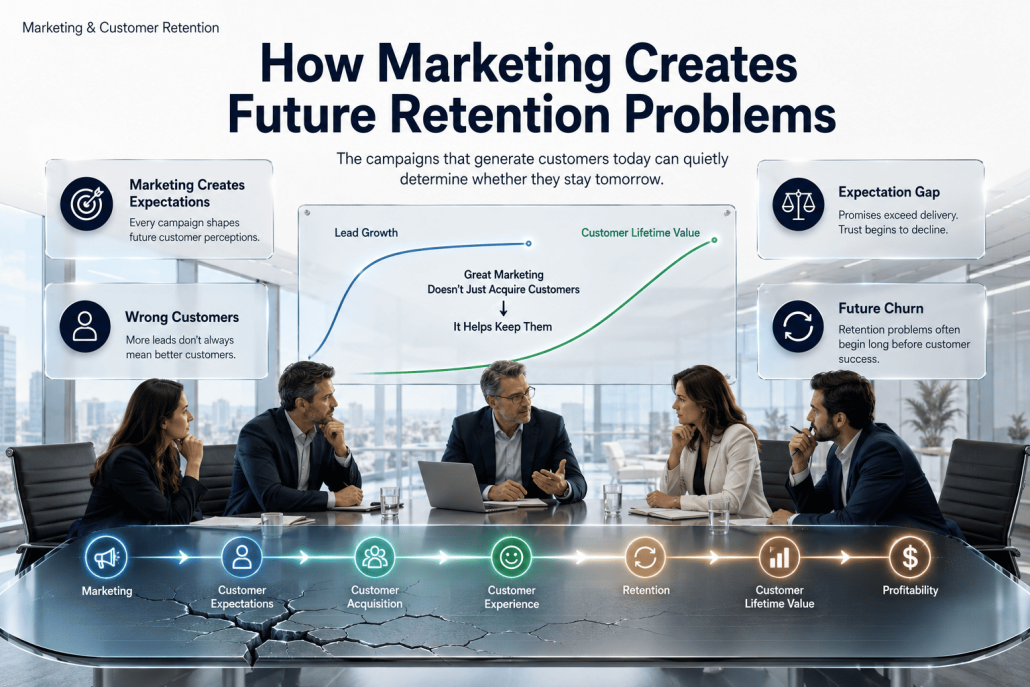
How Marketing Creates Future Retention Problems
Marketing and Customer Retention are far more connected than most businesses realise. Most businesses measure the success of their marketing using familiar metrics:
- Website traffic
- Lead generation
- Conversion rates
- Cost per acquisition (CAC)
Those metrics are important.
But they only tell part of the story.
Because generating a customer is not the same as keeping one.
This is where many businesses unknowingly create a growth problem.
They assume marketing’s responsibility ends when someone becomes a customer.
In reality, marketing continues influencing the customer long after the sale.
Every promise made in an advertisement…
Every claim on a landing page…
Every sales conversation…
Every piece of content…
Shapes what customers expect after they buy.
And those expectations often determine whether customers stay—or leave.
This means many retention challenges don’t begin with poor customer support or weak onboarding.
They begin much earlier.
They begin with marketing.
Businesses that focus only on acquiring customers often overlook an important question:
“Are we attracting customers who are likely to succeed with us?”
Because acquiring the wrong customers…
Creating unrealistic expectations…
Or communicating inconsistent messages…
Can quietly increase churn, reduce customer lifetime value (LTV), and weaken profitability.
Throughout this guide, you’ll discover:
- Why marketing plays a much bigger role in customer retention than most businesses realize.
- How unrealistic messaging quietly creates future churn.
- Why attracting the wrong customers make retention far more difficult.
- How better marketing improves customer lifetime value (LTV), profitability, and sustainable business growth.
The businesses with the strongest customer retention rarely rely on customer success alone.
They begin building retention from the very first interaction a prospect has with their brand.
Because marketing doesn’t simply influence whether customers buy.
It influences whether they stay long enough to experience the value you promised.
Why Businesses Separate Marketing and Retention
At first glance, marketing and retention appear to be two completely different functions.
In many businesses, they’re even managed by different teams.
Marketing is responsible for:
- Driving traffic
- Generating leads
- Running advertising campaigns
- Increasing conversions
- Supporting sales growth
Once a prospect becomes a customer, the responsibility is often handed over to another team.
Customer success focuses on:
- Onboarding
- Customer support
- Renewals
- Upselling
- Loyalty
- Retention
On paper, this division seems perfectly logical.
Each department has its own goals, processes, and performance metrics.
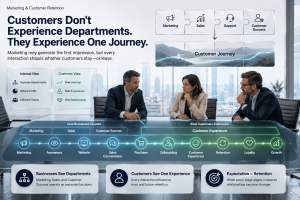
But customers don’t experience your business through departments.
They experience one continuous journey.
From the moment they first discover your business…
To the content they read…
The advertisements they click…
The conversations they have with your sales team…
The onboarding process…
The product or service itself…
And every interaction that follows.
To the customer, it all feels like one experience.
They don’t think:
“Marketing promised this.”
Then later:
“Customer Success delivered that.”
Instead, they simply ask:
“Did this business deliver what I expected?”
That single question connects marketing and retention more closely than many businesses realize.
When marketing creates accurate expectations, customer success begins with trust.
When marketing overpromises, customer success starts by trying to repair disappointment.
This is why customer retention is not only influenced by what happens after the sale.
It is also influenced by everything that happened before it.
The debate around Customer Acquisition vs Customer Retention shouldn’t be about choosing one over the other—it should be about ensuring acquisition supports long-term retention.
Let’s look at how this plays out across different types of businesses.
SME Example
Imagine a manufacturing SME that markets itself as offering “complete business transformation in just a few weeks.”
The message attracts plenty of inquiries.
Many businesses sign contracts expecting immediate operational improvements.
But the reality is different.
The implementation process requires:
- Process analysis
- Team training
- Workflow adjustments
- Ongoing optimization
Meaningful improvements take several months.
The consulting team delivers exactly what was promised—but according to a realistic timeline.
Unfortunately, customers expected much faster results.
As frustration grows, confidence begins to decline.
Some customers leave before experiencing the full value of the engagement.
From the company’s perspective, it looks like a retention problem.
In reality, the issue began much earlier.
Marketing created expectations that the delivery team could never realistically satisfy.
Service Business Example
Consider a digital marketing agency promoting its services with statements like:
“Generate qualified leads almost immediately.”
The messaging attracts business owners eager for rapid growth.
After signing the agreement, clients discover the actual process includes:
- Market research
- Competitor analysis
- Strategy development
- Content creation
- Campaign testing
- Continuous optimization
The agency follows best practices and delivers high-quality work.
But the client’s expectations were based on speed rather than process.
Each week without dramatic results increases anxiety.
Eventually, the relationship becomes strained.
The service itself isn’t the problem.
The expectation created before the sale is.
SaaS Example
A SaaS company launches a campaign highlighting:
“Get your team up and running in minutes.”
The message generates a surge in sign-ups.
However, the platform is designed for medium and large organizations.
Successful implementation requires:
- Team onboarding
- Workflow configuration
- Data migration
- User training
Although the software performs exactly as intended, customers expecting an instant setup become frustrated.
Some stop using the platform within weeks.
Customer Success works hard to improve adoption.
But they are trying to solve a problem that marketing unintentionally created.
The onboarding team inherited expectations they didn’t create.
D2C Example
A premium skincare brand advertises dramatic transformations using highly polished marketing visuals.
Customers purchase with high expectations.
When the products arrive, they discover that consistent use over several weeks is required before noticeable improvements appear.
The product is effective.
But customers expecting overnight results become disappointed.
Some request refunds.
Others leave negative reviews.
Many never purchase again.
The issue isn’t product quality.
It’s the gap between marketing expectations and the actual customer experience.
The Bigger Reality
These examples all point to the same insight.
Marketing and retention are not separate stages of growth.
They are deeply connected.
Every advertisement…
Every landing page…
Every email…
Every webinar…
Every social media post…
Every sales conversation…
Either strengthens future retention…
Or quietly weakens it.
This is why businesses that treat marketing and retention as isolated functions often struggle with churn, even when they invest heavily in customer success.
Retention doesn’t begin when onboarding starts.
It begins when expectations begin.
And expectations are largely shaped by marketing.
Actionable Tips
If you want marketing to support retention—not just acquisition—start with these practical steps:
-
Align Marketing With Customer Success
Bring your marketing, sales, and customer success teams together regularly.
Review whether the promises made before the sale match the experience customers receive afterward.
Consistency builds trust.
-
Measure More Than Conversions
Don’t evaluate marketing only by:
- Lead volume
- Conversion rate
- Cost per lead
Also monitor:
- Customer retention rate
- Customer Lifetime Value (LTV)
- Churn rate
- Repeat purchase rate
- Product adoption
These metrics reveal the long-term impact of your marketing.
-
Review Customer Expectations
Ask recent customers:
“Before purchasing, what did you expect?”
Then compare their answers with the actual experience.
Small expectation gaps today can become major retention problems tomorrow.
-
Create One Continuous Customer Journey
Instead of thinking:
Marketing → Sales → Customer Success
Start thinking:
Customer Journey
Every stage should reinforce the same message, build the same trust, and prepare customers for long-term success.
-
Remember What Marketing Really Does
Marketing doesn’t just influence whether people buy.
It influences:
- Who buys
- Why they buy
- What they expect
- How satisfied they become
- Whether they stay
That’s why the best marketing strategies don’t stop at conversion.
They help build stronger customer relationships long before the first purchase.
Key Takeaway
Many businesses separate marketing and retention because different teams manage different stages of the customer journey.
Customers don’t see those internal divisions.
They experience one continuous relationship with your business.
That means every marketing message, every promise, and every expectation set before the sale influences what customers think, feel, and do after they buy.
Businesses that align marketing with customer success don’t just acquire more customers.
They acquire better-fit customers, build stronger trust, improve retention, increase customer lifetime value (LTV), and create more profitable, sustainable growth.
The Customer Journey Starts Long Before the Sale
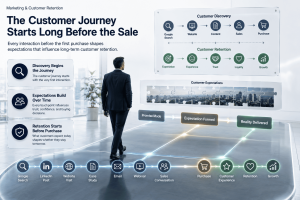
When businesses think about the customer journey, many imagine it beginning with the first purchase.
In reality, it starts much earlier.
Long before someone becomes a customer, they are already interacting with your business.
That first interaction may happen through:
- A Google search
- A LinkedIn post
- A social media advertisement
- A recommendation
- A webinar
- An email
- A conversation with your sales team
Each interaction shapes how prospects perceive your business.
And whether they realize it or not, they begin forming expectations almost immediately.
Understanding how marketing affects customer retention helps businesses realize that every advertisement, landing page, and sales conversation influences long-term customer loyalty.
They ask themselves questions like:
- “Can this company solve my problem?”
- “Will their process be easy?”
- “Can I trust what they’re saying?”
- “Are these results realistic?”
- “Is this solution right for my business?”
Every advertisement…
Every website page…
Every landing page…
Every case study…
Every social media post…
Every sales conversation…
Adds another piece to that picture.
By the time someone finally decides to buy, they have already created a mental expectation of what working with your business will be like.
That expectation becomes the benchmark they use to judge every experience after the sale.
A Simple Example
Imagine a prospect reading an advertisement that says:
“Double your revenue in just 30 days.”
The message captures attention.
The prospect clicks.
Visits the website.
Books a discovery call.
Signs the contract.
But after becoming a customer, they discover that sustainable revenue growth requires:
- Research
- Strategy
- Testing
- Optimization
- Continuous improvement
Results take several months.
The service may be excellent.
The team may be highly skilled.
But the customer compares reality to the expectation formed months earlier.
Disappointment begins.
The business eventually labels it a retention problem.
In truth, the retention problem started the day the advertisement was published.
SME Example
A manufacturing SME promotes itself as providing “instant operational transformation.”
Business owners sign up expecting immediate efficiency gains.
Instead, improvements require process changes, employee training, and gradual implementation.
Customers lose confidence—not because the solution is ineffective, but because expectations were unrealistic.
Service Business Example
A consulting firm markets its services with promises of rapid business growth.
Clients expect visible improvements within weeks.
The consulting team delivers a thorough strategic roadmap, but implementation naturally takes time.
Clients become impatient and question the value of the engagement.
The issue isn’t service quality.
It’s the expectation created before the contract was signed.
SaaS Example
A SaaS platform advertises “setup in minutes.”
After subscribing, customers realize implementation requires data migration, user permissions, integrations, and staff training.
Although the platform performs exactly as intended, customers expected simplicity rather than a structured implementation process.
Some cancel before experiencing the platform’s full value.
D2C Example
An online fitness brand advertises dramatic physical transformations.
Customers purchase expecting rapid results.
After a few weeks, they realize consistent exercise, nutrition, and discipline are required.
Many stop using the program.
Again, the issue isn’t the product.
It’s the expectation created during marketing.
The Bigger Insight
Customer retention isn’t shaped only by what customers experience after buying.
It’s shaped by what they believe before buying.
Marketing is often the customer’s very first experience with your business.
And first impressions influence every interaction that follows.
The stronger and more realistic those first impressions are, the easier it becomes to build long-term customer relationships.
Actionable Tips
-
Audit Every Customer Touchpoint
Review your customer touchpoints:
- Advertisements
- Website
- Landing pages
- Emails
- Sales presentations
- Product demonstrations
Ask:
“What expectations does this create?”
-
Compare Marketing With Delivery
If your marketing promises simplicity…
Does onboarding feel simple?
If marketing promises speed…
Can your operations consistently deliver it?
Consistency reduces future disappointment.
-
Think Beyond Conversions
Before launching any campaign, ask:
“Will this message help us retain the customers it attracts?”
Sometimes a campaign that generates fewer—but better-qualified—customers creates much stronger long-term growth.
-
Remember the Customer Journey Is Continuous
Customers don’t divide your business into departments.
To them, every interaction is part of one continuous experience.
Make sure every stage reinforces the same expectations.
Key Takeaway
Marketing isn’t simply the beginning of the sales process.
It’s the beginning of the customer relationship.
Every expectation created before the sale influences customer satisfaction, trust, and retention after the sale.
Businesses that recognize this don’t just create better marketing.
They build stronger customer relationships from the very first interaction.
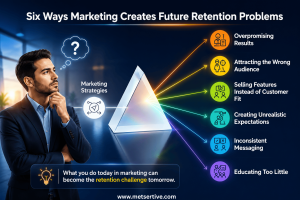
The Six Ways Marketing Creates Future Retention Problems
When customers leave, most businesses immediately look at what happened after the sale.
They review:
- Customer support
- Onboarding
- Product quality
- Service delivery
Those areas certainly matter.
But many retention problems have much deeper roots.
They begin in marketing.
Every campaign, advertisement, landing page, email, and sales message shapes the kind of customers you attract and the expectations they bring with them.
When marketing sends the wrong signals, retention becomes much harder—even if your product or service delivers genuine value.
One of the biggest lessons for modern businesses is understanding how marketing creates customer churn through unrealistic promises, poor qualification, and inconsistent messaging.
Let’s explore six of the most common ways this happens.
-
Overpromising Results
This is one of the biggest contributors to future churn.
In an effort to generate more leads, businesses often make promises that sound exciting but are difficult—or impossible—to deliver consistently.
Common examples include:
- “Guaranteed success.”
- “Double your revenue in 30 days.”
- “Instant results.”
- “Effortless growth.”
- “Completely automated.”
These claims attract attention.
But they also create expectations that reality may struggle to match.
SME Example
A business consulting firm advertises dramatic operational improvements within two weeks.
The client signs the agreement expecting immediate transformation.
In reality, meaningful improvements require employee adoption, process redesign, and management support.
The project succeeds.
But the customer’s expectations were never realistic.
Service Business Example
A digital marketing agency promises rapid lead generation.
Campaign optimization takes several months.
The client becomes frustrated long before meaningful results appear.
SaaS Example
A CRM platform promotes itself as “ready to use immediately.”
Customers later discover onboarding, integrations, and staff training are required.
Some leave before adoption is complete.
D2C Example
A skincare brand promises visible improvements within days.
Actual results require consistent use over several weeks.
Returns increase.
Customer reviews become more negative.
Bigger Insight
Marketing should create confidence—not unrealistic expectations.
Short-term excitement often creates long-term disappointment.
-
Attracting the Wrong Audience
Many businesses celebrate large numbers of leads.
But more leads don’t automatically mean better customers.
Growth isn’t just about volume.
It’s about fit.
SME Example
A manufacturing company markets itself to every industry.
Many inquiries arrive.
Few customers remain long-term because the solution isn’t designed for all industries.
Service Business Example
A premium consulting firm attracts businesses looking for low-cost execution.
Clients quickly realize the service isn’t what they expected.
Relationships end early.
SaaS Example
Enterprise software is marketed toward freelancers.
Many subscribe.
Few successfully adopt the platform.
Churn rises.
D2C Example
A premium product is promoted primarily through heavy discount campaigns.
Price-sensitive customers purchase once.
Very few return.
Bigger Insight
Retention improves dramatically when marketing attracts customers who are genuinely positioned to succeed.
-
Selling Features Instead of Customer Fit
Many marketing campaigns focus almost entirely on:
- Features
- Benefits
- Discounts
- Offers
- Technology
Very few explain:
Who the solution is designed for.
More importantly…
Who it is not designed for.
This creates a dangerous situation.
People buy because the product sounds impressive—not because it’s the right fit.
SME Example
A business management platform highlights dozens of advanced capabilities.
Small businesses purchase it.
Most only need basic functionality.
Complexity leads to poor adoption.
Service Business Example
An agency promotes every service it offers.
Prospects struggle to understand whether the agency is the right partner for their specific challenges.
SaaS Example
A software company highlights AI automation, dashboards, and analytics.
Very little attention is given to the implementation effort required.
Customers become overwhelmed.
D2C Example
A premium kitchen appliance advertises advanced features.
Many buyers simply wanted an easy-to-use product.
Complexity reduces satisfaction.
Bigger Insight
The best marketing doesn’t convince everyone to buy.
It helps the right customers decide to buy.
-
Creating Unrealistic Expectations
Marketing naturally simplifies complex solutions.
But oversimplifying often creates future dissatisfaction.
Reality usually includes:
- Learning
- Collaboration
- Time
- Adaptation
- Continuous improvement
Customers who expect simplicity become disappointed when they encounter normal implementation challenges.
Bigger Insight
Customers rarely judge reality alone.
They judge reality compared with what they expected.
That expectation gap often determines retention.
-
Inconsistent Messaging Across the Customer Journey
Another hidden cause of churn is inconsistency.
Marketing communicates one message.
Sales communicates another.
Customer Success explains something different.
The product experience tells yet another story.
Customers begin asking:
“Which version should I believe?”
Trust starts to erode.
SaaS Example
Marketing promotes:
“Simple setup.”
Sales says:
“Our specialists will help.”
After purchase, customers discover they need extensive internal resources to implement the platform.
Confusion replaces confidence.
Bigger Insight
Consistency builds credibility.
Credibility builds trust.
Trust improves retention.
-
Educating Too Little Before the Sale
Many businesses rush prospects toward conversion.
They focus on closing deals rather than preparing customers for success.
As a result, customers buy without fully understanding:
- How the solution works
- What implementation requires
- Their own responsibilities
- Realistic timelines
- Success factors
The sale happens.
But the customer isn’t ready.
Service Business Example
A consulting client signs immediately after a sales presentation.
Only later do they discover how much internal involvement is required.
Engagement declines.
D2C Example
Customers purchase an expensive product without understanding how to use it correctly.
Negative reviews follow—not because of poor quality, but because expectations and education were insufficient.
Bigger Insight
Education isn’t just a conversion tool.
Customer education is one of the strongest retention strategies available.
Well-informed customers usually become more successful customers.
Actionable Tips
-
Promise Outcomes Responsibly
Create excitement without sacrificing credibility.
-
Market to the Right Customers
Focus on customer fit rather than maximum reach.
-
Explain Who Should—and Shouldn’t—Buy
The right customer retained is more valuable than the wrong customer acquired.
-
Align Marketing, Sales, and Delivery
Ensure every customer hears the same message throughout the journey.
-
Educate Before You Sell
Use content, webinars, guides, demos, and case studies to prepare prospects for success.
-
Measure Long-Term Marketing Success
Evaluate campaigns using:
- Customer Retention Rate
- Customer Lifetime Value (LTV)
- Churn Rate
- Product Adoption
- Repeat Purchase Rate
These metrics reveal whether your marketing is attracting customers who stay—not just customers who buy.
Key Takeaway
Marketing doesn’t just influence customer acquisition.
It influences customer quality, expectations, trust, adoption, and long-term retention.
Businesses that overpromise, attract the wrong audience, sell features instead of customer fit, create unrealistic expectations, communicate inconsistently, or educate too little often create future retention problems before a customer ever makes a purchase.
The most effective marketing strategies don’t simply generate more customers.
They attract the right customers, prepare them for success, and lay the foundation for stronger retention, higher customer lifetime value (LTV), and more profitable, sustainable growth.
Expectation Gaps Become Churn
If there is one concept every business leader should understand about customer retention, it’s this:
Customers don’t judge your business based on reality alone.
They judge your business based on the difference between what they expected…and what they actually experienced.
That difference is what we call the Expectation Gap.
Strong Customer Expectation Management helps businesses reduce disappointment by ensuring the experience customers receive closely matches the expectations created during marketing.
But Expectation Gap is one of the most overlooked causes of customer churn.
Think of it as a simple chain of events:
Expectation
↓
Reality
↓
Customer Experience
↓
Retention
Every customer begins their journey with an expectation.
That expectation is shaped by:
- Your advertisements
- Your website
- Your landing pages
- Your sales conversations
- Your product demonstrations
- Your social media content
- Customer testimonials
- Case studies
By the time someone becomes a customer, they’ve already created a mental picture of what success with your business will look like.
Everything that happens afterward is measured against that picture.
Not against objective reality.
Against expected reality.
This is why two customers can receive exactly the same product or service and walk away with completely different opinions.
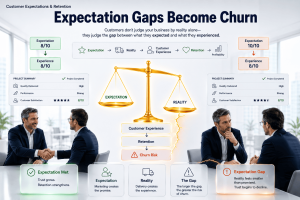
A Simple Scenario
Imagine two customers using the same business solution.
Customer A
Expectation:
8/10
Experience:
8/10
Result:
The customer feels satisfied.
The experience matched what they expected.
Trust grows.
Retention becomes easier.
Customer B
Expectation:
10/10
Experience:
8/10
Objectively, the experience is still very good.
But emotionally…
The customer feels disappointed.
Not because the solution failed.
Because reality failed to match the expectation.
Eventually they begin exploring alternatives.
The business sees churn.
The real issue was the expectation gap.
Not the customer experience itself.
This is why managing expectations is just as important as delivering value.
SME Example
A business consulting firm markets its services as delivering “rapid operational transformation.”
Business owners expect dramatic improvements within a few weeks.
The consultants provide valuable recommendations, employee workshops, and implementation support.
Real improvements begin appearing after three months.
The consulting quality is excellent.
But because expectations were set too high, many clients become impatient before seeing the long-term benefits.
The gap between expectation and reality creates dissatisfaction.
Service Business Example
A branding agency promises that a new brand identity will significantly accelerate business growth.
The client assumes new customers will begin arriving immediately after launch.
Instead, the new branding strengthens credibility and improves long-term positioning—but measurable growth takes time.
The agency delivered exceptional work.
The customer expected a different outcome.
The relationship weakens.
SaaS Example
A project management platform promotes itself as “simple enough for any team.”
After purchasing, enterprise customers discover they need structured onboarding, process changes, user training, and system integrations.
The software performs exactly as intended.
But implementation requires more effort than expected.
Adoption slows.
Some customers cancel before realizing the platform’s full value.
D2C Example
A premium nutrition brand showcases dramatic before-and-after transformations.
Customers purchase expecting rapid physical changes.
After several weeks, they realize lasting results require consistency, healthy habits, and lifestyle adjustments.
The product works.
But expectations were unrealistic.
Many customers stop purchasing before experiencing meaningful benefits.
Why Expectation Gaps Are So Dangerous
Expectation gaps create invisible friction.
Customers begin thinking:
- “This isn’t what I expected.”
- “I thought it would be easier.”
- “I expected faster results.”
- “I thought the process would be different.”
These thoughts gradually reduce:
- Trust
- Confidence
- Engagement
- Patience
Eventually, customers disengage.
From the business perspective, it appears to be a retention problem.
But the customer’s experience wasn’t necessarily poor.
Their expectations simply exceeded reality.
The Bigger Insight
Retention is rarely determined by reality alone.
It’s determined by how closely reality matches the expectations created before the sale.
Businesses that consistently align expectations with delivery often retain customers longer—even when competitors offer similar products or services.
Because customers appreciate predictability.
They value honesty.
And they stay when businesses consistently deliver what they promised.
Actionable Tips
-
Review Your Marketing Promises
Look at your advertisements, website, emails, and sales presentations.
Ask:
“Are we creating realistic expectations?”
-
Measure Customer Expectations
During onboarding, ask new customers:
“What were you expecting before you purchased?”
Their answers often reveal hidden expectation gaps.
-
Prepare Customers for the Journey
Explain:
- What success requires
- Typical timelines
- Customer responsibilities
- Common challenges
- Expected milestones
Prepared customers usually remain more patient and engaged.
-
Communicate Progress Frequently
Customers become more confident when they understand where they are in the journey.
Even if results take time, visible progress strengthens trust.
-
Promise Less. Deliver More.
Businesses often believe bigger promises generate more sales.
In reality, realistic promises often generate stronger customer relationships.
Under-promising and over-delivering creates positive expectation gaps.
And positive expectation gaps improve retention.
Key Takeaway
Customers don’t evaluate your business based only on what you deliver.
They evaluate it based on whether your delivery matches the expectations they formed before they became customers.
When expectations and reality stay aligned:
- Trust grows.
- Customer satisfaction improves.
- Retention becomes easier.
But when the gap becomes too large, even a good product or service can struggle to keep customers.
Because in business, expectations often shape customer loyalty long before the product or service does.
Why High-Converting Marketing Can Still Hurt Growth
At first, this idea sounds completely backward.
Every business wants higher conversions.
More leads.
More customers.
More sales.
And there’s nothing wrong with that.
But here’s the question many businesses never ask:
“Are the customers we’re converting actually the customers who are most likely to stay?”
Because a campaign that generates impressive conversion numbers isn’t automatically creating profitable growth.
In some cases, it can do the opposite.
It can increase customer acquisition while quietly weakening customer retention.
And when that happens, growth becomes expensive.
The Hidden Growth Equation
Many businesses measure marketing success like this:
Higher Conversions
↓
More Customers
↓
Business Growth
But the real equation is often much different.
Higher Conversions
↓
Lower Retention
↓
Lower Customer Lifetime Value (LTV)
↓
Lower Profitability
↓
More Pressure to Acquire New Customers
This creates a cycle that feels like growth…
But behaves like survival.
Revenue increases temporarily.
Then customers leave.
Marketing spends more to replace them.
The cycle repeats.
But when customers stay longer, buy again, and become advocates, Customer Lifetime Value (LTV) increases naturally, making growth more sustainable and profitable.
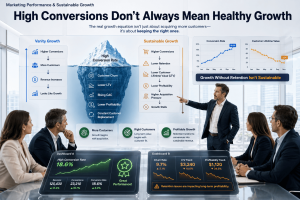
Why This Happens
Some marketing campaigns are designed to maximize immediate action.
They rely on:
- Heavy discounts
- Limited-time offers
- Clickbait headlines
- Unrealistic guarantees
- Aggressive urgency
- Oversimplified messaging
These tactics often increase conversions.
But they don’t always attract customers who are committed to long-term success.
Instead, they may attract people who are motivated primarily by:
- Price
- Urgency
- Curiosity
- Short-term expectations
Those customers often leave just as quickly as they arrived.
SME Example
An SME launches a campaign offering extremely deep discounts to attract new customers.
Sales increase rapidly.
But many customers never purchase again after the promotional offer ends.
Revenue spikes.
Then declines.
The campaign succeeded at generating sales.
It failed at building lasting customer relationships.
Service Business Example
A consulting firm promises rapid business growth to encourage more discovery calls.
Many businesses sign contracts.
But once they realize meaningful transformation requires time, collaboration, and implementation, frustration grows.
The agency acquires more clients.
But client retention falls.
SaaS Example
A SaaS company offers a free trial with messaging that makes implementation appear effortless.
Thousands of users sign up.
After onboarding, many discover successful adoption requires training, process changes, and team involvement.
Trial conversions look impressive.
Renewals remain weak.
The marketing campaign optimized sign-ups—not long-term customer success.
D2C Example
An online retailer promotes massive flash sales every month.
Customers become conditioned to purchase only during discounts.
Very few buy at full price.
Brand loyalty weakens.
Profit margins shrink.
Repeat purchases become dependent on continuous promotions.
The business grows revenue…
But sacrifices profitability.
The Bigger Insight
Marketing doesn’t exist to generate the highest possible conversion rate.
Its purpose is to generate profitable customer relationships.
Sometimes that means accepting fewer conversions.
Because fewer well-qualified customers often create:
- Higher retention
- Higher LTV
- Stronger referrals
- Better margins
- More predictable revenue
In other words…
Quality often outperforms quantity.
The Revenue Trap
Many businesses proudly celebrate metrics like:
- More leads
- Higher click-through rates
- Lower cost per lead
- Better conversion rates
Those numbers look impressive.
But they don’t answer an even more important question:
“Did those customers become profitable?”
That’s the metric that matters.
Because marketing should never be judged solely by how many customers it creates.
It should also be judged by how much long-term value those customers generate.
Actionable Tips
-
Measure Beyond Conversions
Track marketing performance using:
- Customer Retention Rate
- Customer Lifetime Value (LTV)
- Churn Rate
- Renewal Rate
- Repeat Purchase Rate
- Revenue Per Customer
These metrics reveal whether your marketing is creating lasting value.
-
Optimize for Customer Quality
Ask:
“Will this campaign attract customers who are likely to succeed with our solution?”
Customer fit should be a marketing objective—not just a sales objective.
-
Be Careful with Aggressive Promotions
Discounts and urgency can increase conversions.
But use them strategically.
Don’t build your entire acquisition strategy around tactics that attract short-term buyers.
-
Align Marketing Success with Business Success
Marketing KPIs shouldn’t end at conversions.
Include:
- Retention
- LTV
- Profitability
- Customer Success
When marketing is measured this way, campaigns naturally become more sustainable.
-
Build Trust Instead of Hype
The strongest marketing doesn’t simply persuade people to buy.
It prepares the right customers to succeed after they buy.
And successful customers almost always become more profitable customers.
Key Takeaway
A campaign that generates the highest conversion rate isn’t necessarily the campaign that creates the most profitable business.
When marketing prioritizes conversions over customer fit, expectation management, and long-term value, businesses often experience:
- Higher churn
- Lower customer lifetime value (LTV)
- Greater dependence on continuous acquisition
- Reduced profitability
The smartest businesses don’t optimize marketing for the first sale alone.
They optimize it for the entire customer relationship.
Because the true measure of marketing success isn’t how many customers it acquires.
It’s how many customers stay, grow, and create lasting value over time.
The Hidden Cost of Wrong-Fit Customers
Most businesses celebrate every new customer.
After all, more customers usually mean more revenue.
Or so it seems.
But here’s a question that rarely gets asked:
“Are these the right customers for our business?”
Because not every customer contributes to sustainable growth.
Some customers generate revenue.
Others generate problems.
When marketing attracts people who aren’t a good fit for your product or service, the cost goes far beyond a lost sale.
It quietly affects almost every part of the business.
Many of these costs never appear in marketing reports.
But they show up everywhere else.
The Hidden Costs Businesses Often Miss
Wrong-fit customers typically increase:
- Customer support requests
- Refunds and cancellations
- Customer churn
- Sales pressure to replace lost revenue
- Difficulty recovering Customer Acquisition Cost (CAC)
- Employee stress and burnout
- Negative reviews and poor referrals
Individually, these problems may seem manageable.
Together, they create a growth system that becomes increasingly expensive to maintain.
The business feels busy.
Revenue may even appear to be growing.
But profitability quietly declines.
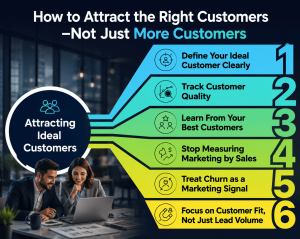
Why Wrong-Fit Customers Struggle
A customer who isn’t the right fit often experiences challenges such as:
- Difficulty adopting the product
- Unrealistic expectations
- Limited internal resources
- Different business objectives
- Misunderstanding the value proposition
Even when your solution performs exactly as intended, these customers are less likely to succeed.
And customers who don’t achieve success rarely become long-term customers.
Service Business Example
Imagine a digital transformation consultancy.
Its ideal clients are medium-sized businesses willing to invest time in long-term operational improvements.
However, the marketing campaigns focus heavily on messages like:
“Fast business growth.”
The campaign attracts companies looking for immediate results.
Sales increase.
The marketing team celebrates.
New contracts are signed every month.
But after about 60 days, a different pattern begins to emerge.
Clients become frustrated because they expected rapid outcomes rather than a structured transformation process.
Projects are cancelled.
Refund requests increase.
The delivery team spends more time managing dissatisfied clients than delivering strategic value.
Customer Success works harder.
Sales works harder to replace lost revenue.
Finance notices that profit margins are shrinking.
Marketing appears successful.
The business becomes less profitable.
The problem wasn’t lead generation.
The problem was customer fit.
SME Example
A manufacturing SME markets its services broadly across multiple industries.
The campaigns attract a high volume of inquiries.
Many companies purchase.
But several customers require solutions outside the company’s expertise.
Projects become difficult.
Implementation takes longer.
Customer satisfaction falls.
The business spends valuable resources serving customers it was never ideally positioned to help.
SaaS Example
A SaaS platform built for enterprise organizations launches campaigns targeting startups and freelancers.
Sign-ups increase dramatically.
However, smaller businesses struggle with:
- Advanced workflows
- Complex reporting
- Multi-user configurations
- Implementation requirements
Many customers cancel within a few months.
The software wasn’t the problem.
The audience was.
D2C Example
A premium home appliance brand relies heavily on discount-driven advertising.
The campaigns attract bargain hunters looking for the lowest possible price.
Sales rise during promotional periods.
But repeat purchases remain low.
Brand loyalty weakens.
Customers simply wait for the next discount—or buy from competitors.
Revenue grows.
Long-term customer value does not.
The Bigger Reality
Wrong-fit customers create pressure throughout the organization.
Sales teams feel constant pressure to replace lost customers.
Customer Success spends more time solving preventable problems.
Support teams manage more complaints.
Marketing increases acquisition efforts.
Finance struggles to improve profitability.
Leadership wonders why growth feels so difficult.
The answer often isn’t a lack of customers.
It’s a lack of the right customers.
The businesses that grow sustainably don’t simply acquire more customers.
They consistently attract customers who are positioned to succeed.
Because successful customers tend to:
- Stay longer
- Buy more
- Recommend others
- Generate higher Customer Lifetime Value (LTV)
Customer quality almost always matters more than customer quantity.
Actionable Tips
-
Define Your Ideal Customer Clearly
Document:
- Business size
- Industry
- Budget
- Goals
- Operational maturity
- Typical challenges
The clearer your Ideal Customer Profile (ICP), the easier it becomes to attract customers who are likely to succeed.
-
Track Customer Quality—Not Just Lead Volume
Review:
- Retention rate by customer segment
- Average Customer Lifetime Value (LTV)
- Churn by acquisition source
- Refund rates
- Customer success metrics
These reveal whether marketing is attracting the right audience.
-
Learn From Your Best Customers
Ask:
“What characteristics do our longest-retained customers have in common?”
Then build future campaigns around those insights.
-
Stop Measuring Marketing Only by Sales
Successful marketing doesn’t simply create customers.
It creates customers who remain profitable over time.
-
Treat Churn as a Marketing Signal
When certain customer groups consistently leave early, investigate whether marketing attracted people who were never an ideal fit.
Improving retention often starts by improving customer selection.
Key Takeaway
The cost of a wrong-fit customer extends far beyond a single lost account.
It increases support costs, refund requests, customer churn, sales pressure, CAC recovery time, employee burnout, and negative reviews.
Businesses that prioritize customer fit instead of customer volume build stronger retention, healthier profit margins, and more sustainable growth.
Because the right customer doesn’t just buy.
They succeed, stay, and continue creating value for both your business and theirs.
Marketing Should Pre-Qualify Customers
One of the biggest misconceptions about marketing is that its primary job is to attract as many customers as possible.
For years, businesses have measured marketing success by asking questions like:
- How many leads did we generate?
- How many visitors came to our website?
- How many people filled out our forms?
- How many customers converted?
These metrics are useful.
But they don’t answer a much more important question.
“Were these the right customers?”
Because attracting people who are unlikely to succeed with your product or service isn’t growth.
It’s expensive acquisition.
This is where the role of marketing needs to change.
Marketing shouldn’t only attract.
Marketing should also filter.
Great marketing doesn’t try to convince everyone to buy.
It helps the right customers recognize they’re a good fit—and helps the wrong customers recognize they’re not.
That may sound counterintuitive.
After all, why would a business intentionally discourage potential buyers?
Because every wrong-fit customer who doesn’t buy today may prevent future churn, refunds, negative reviews, and wasted resources tomorrow.
In many cases, saying “This solution isn’t right for you” is one of the most profitable marketing decisions a business can make.
What Pre-Qualification Really Means
Pre-qualification begins long before a sales conversation.
It happens through the way your business communicates.
Your website.
Your advertisements.
Your content.
Your case studies.
Your pricing.
Your messaging.
All of these should help prospects answer two important questions:
“Is this solution designed for businesses like mine?”
And just as importantly:
“Am I likely to succeed with this solution?”
When customers can answer those questions before buying, they make better purchasing decisions.
And businesses acquire customers who are more likely to stay.
SME Example
An SME provides supply chain optimization for medium-sized manufacturing businesses.
Previously, its marketing promoted:
“We improve operational efficiency.”
The message attracted manufacturers of every size.
Some businesses lacked the systems, budgets, or internal teams needed to implement the recommendations successfully.
The company refined its messaging to say:
“Designed for growing manufacturers with established operations and dedicated improvement teams.”
Lead volume decreased slightly.
But customer quality improved dramatically.
Projects became smoother.
Retention increased.
Service Business Example
A premium business consulting firm stopped promoting itself as the solution for “every business.”
Instead, its website clearly explained:
- Who benefits most
- Who may not be ready
- What level of commitment is required
- Typical implementation timelines
Some prospects decided not to proceed.
Those who did were better informed, more committed, and stayed much longer.
The business closed fewer unsuitable clients and retained more ideal ones.
SaaS Example
A SaaS company added a section to its product pages titled:
“Who This Platform Is Best For”
Alongside it, they included another section:
“Who May Need a Different Solution”
Rather than reducing sign-ups, this transparency improved trust.
Customers who subscribed understood what to expect.
Implementation became smoother.
Support tickets declined.
Renewals increased.
D2C Example
A premium mattress brand created a buying guide explaining:
- Who the mattress was designed for
- Preferred sleeping positions
- Firmness levels
- Who might prefer a softer alternative
Some shoppers chose not to purchase.
But those who did experienced greater satisfaction.
Returns decreased.
Positive reviews increased.
Customer confidence improved before the purchase even happened.
The Bigger Insight
Many businesses believe that excluding prospects means losing revenue.
In reality, attracting the wrong customers often costs far more than declining them.
The strongest marketing doesn’t appeal to everyone.
It speaks clearly to the customers most likely to benefit.
That clarity improves:
- Customer satisfaction
- Product adoption
- Customer success
- Retention
- Customer Lifetime Value (LTV)
- Profitability
Marketing becomes more than a demand-generation function.
It becomes a customer-quality function.
Actionable Tips
-
Clearly Define Who Your Solution Is For
Don’t make prospects guess.
State your ideal customer profile openly.
-
Explain Who May Not Be a Good Fit
Being transparent builds credibility.
Customers appreciate honesty.
-
Educate Before You Persuade
Use content, guides, webinars, FAQs, and case studies to help prospects understand:
- What success looks like
- What commitment is required
- Typical timelines
- Expected outcomes
Education helps customers self-qualify.
-
Align Marketing With Customer Success
Ask your Customer Success team:
“Which customers achieve the best long-term results?”
Use those insights to refine your marketing messages and targeting.
-
Measure Customer Fit as a Marketing KPI
In addition to tracking leads and conversions, monitor:
- Retention Rate
- Customer Lifetime Value (LTV)
- Churn by acquisition source
- Product Adoption
- Renewal Rate
These metrics reveal whether your marketing is attracting customers who are built for long-term success.
Key Takeaway
The most effective marketing doesn’t try to convince everyone to become a customer.
It helps the right customers recognize the value of your solution while helping the wrong-fit customers understand that another option may serve them better.
When marketing acts as both an attraction and filtration system, businesses don’t just generate more sustainable growth.
They build stronger customer relationships, improve retention, increase Customer Lifetime Value (LTV), and create a healthier, more profitable business.
Why Honest Marketing Improves Retention
At first, this idea sounds like bad business advice.
Many marketers believe that making bigger promises leads to more sales.
After all, exciting headlines attract attention.
Bold claims generate clicks.
Aggressive offers increase inquiries.
And in the short term, that’s often true.
But there’s a hidden cost that many businesses fail to see.
The more your marketing exaggerates reality, the harder it becomes to meet the expectations it creates.
And when expectations aren’t met, trust begins to fade.
This is why honest marketing is often far more profitable than persuasive marketing.
Not because it generates more immediate sales.
But because it generates better customer relationships.
Honest Marketing Is Not Weak Marketing
Some businesses worry that if they’re completely honest about timelines, effort, or limitations, prospects will lose interest.
In reality, honesty doesn’t reduce value.
It increases credibility.
Customers don’t expect perfection.
They expect transparency.
When a business openly explains:
- What customers can realistically expect
- How long results usually take
- What challenges may arise
- What role the customer plays in success
Prospects feel more informed.
And informed customers tend to become more committed customers.
The Short-Term vs Long-Term Trade-Off
Honest marketing may reduce:
- Short-term conversions
- Impulse purchases
- Unqualified inquiries
- Unrealistic expectations
But it often improves:
- Customer trust
- Customer retention
- Customer Lifetime Value (LTV)
- Referral rates
- Profitability
That’s because the customers who move forward do so with a clear understanding of the journey ahead.
There are fewer surprises.
Fewer disappointments.
And far fewer reasons to leave early.
Scenario: Two Marketing Agencies
Imagine two digital marketing agencies competing for similar clients.
Agency A
Its website promises:
“Guaranteed leads in just 30 days.”
Prospects become excited.
Sales calls increase.
New clients sign quickly.
But after onboarding, clients discover:
- Research takes time
- Campaign testing is required
- Optimization is ongoing
- Meaningful results often take several months
Many clients become impatient.
Some request refunds.
Others cancel before the strategy has time to work.
The agency acquires clients quickly.
But struggles to retain them.
Agency B
Its website explains:
“Most businesses begin seeing measurable improvements within 60–90 days, depending on their market, competition, and existing digital presence.”
It also explains:
- The implementation process
- Client responsibilities
- Success milestones
- Common challenges
Some prospects decide they’re not ready.
Others appreciate the transparency.
Those who become clients understand the journey before it begins.
As a result:
- Trust starts earlier.
- Expectations remain realistic.
- Clients stay longer.
- Referrals increase.
Agency B may convert fewer prospects initially.
But it builds stronger, more profitable client relationships over time.
The difference wasn’t the quality of the service.
It was the quality of the expectations.
SME Example
An SME selling industrial automation solutions explains that implementation typically takes three to six months and requires collaboration between internal teams.
Some businesses looking for immediate results choose another provider.
Those that proceed understand the commitment involved.
Projects run more smoothly.
Customer satisfaction improves.
Renewals become more common.
Service Business Example
A leadership coaching firm clearly states that meaningful behavioral change requires ongoing coaching and active participation.
Rather than promising instant transformation, it emphasizes consistent progress.
Clients begin the engagement with realistic expectations.
Completion rates increase.
Long-term coaching relationships become more common.
SaaS Example
A SaaS company replaces the message:
“Set up in minutes.”
With:
“Most teams complete implementation within two to four weeks with guided onboarding.”
Trial sign-ups decrease slightly.
But product adoption improves.
Support requests decline.
Renewal rates increase because customers know what success requires.
D2C Example
A skincare brand stops advertising dramatic overnight results.
Instead, it explains:
- Typical improvement timelines
- Daily usage recommendations
- Factors that influence results
Customers begin purchasing with realistic expectations.
Returns decrease.
Repeat purchases increase.
The brand earns stronger customer trust.
The Bigger Insight
Many businesses believe marketing’s job is to persuade people to buy.
But sustainable growth requires something more.
Marketing should prepare customers for success.
Because customers who understand the journey are far more likely to complete it.
And customers who complete the journey are far more likely to stay.
Actionable Tips
-
Audit Your Marketing Promises
Review every customer-facing message.
Ask:
“Can we consistently deliver what we’re promising?”
If not, refine the message before refining the campaign.
-
Explain the Journey—Not Just the Destination
Talk about:
- The process
- Expected milestones
- Customer responsibilities
- Common obstacles
- Typical timelines
Clarity builds confidence.
-
Use Real Customer Stories
Highlight not only successful outcomes but also the effort, time, and collaboration involved.
Authentic success stories create healthier expectations than exaggerated claims.
-
Celebrate Transparency
Instead of fearing honest conversations, position them as a competitive advantage.
Customers remember businesses that tell the truth.
-
Measure Trust, Not Just Conversions
Track indicators such as:
- Customer retention
- Customer Lifetime Value (LTV)
- Renewal rates
- Referral rates
- Customer satisfaction
These metrics often reveal whether your marketing is creating lasting relationships.
Key Takeaway
Honest marketing may not always generate the highest number of immediate conversions.
But it often creates something far more valuable.
Customers who:
- Trust your business
- Understand the process
- Have realistic expectations
- Stay longer
- Generate higher lifetime value
Because sustainable growth isn’t built on exciting promises.
It’s built on promises that are consistently fulfilled.
Marketing’s New Job is Setting Customers Up for Success
For many years, marketing has been viewed as the department responsible for attracting attention.
Its objectives were clear:
- Generate awareness.
- Increase website traffic.
- Produce leads.
- Improve conversion rates.
Those goals are still important.
But today’s businesses need marketing to do something much bigger.
They need marketing to prepare customers for success.
Because acquiring a customer is only the beginning of the relationship.
What happens next determines whether that customer becomes profitable.
This is why marketing’s role is evolving.
It’s no longer just the first stage of the buying journey.
It’s becoming the first stage of customer success.
Once businesses understand why customer retention starts before the sale, they begin treating marketing as the first stage of customer success instead of simply the first stage of customer acquisition.
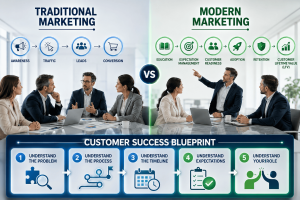
What Modern Marketing Should Teach
Before a prospect becomes a customer, they should already understand:
The Problem
Why does the problem exist?
How does it affect the business?
What happens if it isn’t solved?
When customers clearly understand the problem, they appreciate the solution more deeply.
The Process
Many businesses explain what they sell.
Far fewer explain how success is achieved.
Customers should know:
- What happens first
- What happens next
- How implementation works
- What the overall journey looks like
When the process is clear, uncertainty decreases.
The Timeline
One of the biggest causes of disappointment is unrealistic timing.
Modern marketing should explain:
- Typical implementation periods
- When customers usually begin seeing results
- Why meaningful outcomes often require consistency
Clear timelines create realistic expectations.
Expectations
Customers should understand:
- What the solution will do
- What it won’t do
- What’s included
- What’s not included
The fewer surprises customers encounter, the stronger retention becomes.
Required Commitment
Success is rarely one-sided.
Customers play an important role too.
Marketing should explain:
- What participation is required
- What resources are needed
- How customers contribute to successful outcomes
When customers understand their role, they become active participants rather than passive buyers.
The strongest Customer Retention Marketing doesn’t focus only on acquiring new customers—it also educates prospects, builds trust, and creates expectations that support long-term loyalty.
SME Example
An SME offering ERP implementation creates educational resources explaining the preparation, training, and internal collaboration required before implementation begins.
Prospective customers enter projects with greater confidence.
Adoption improves.
Projects experience fewer delays.
Customer relationships become stronger.
Service Business Example
A financial advisory firm shares a detailed roadmap showing how financial planning unfolds over the first twelve months.
Clients understand that meaningful wealth creation requires ongoing decisions rather than one-time actions.
Engagement increases.
Retention improves.
SaaS Example
Before asking users to start a free trial, a SaaS company provides an interactive onboarding preview.
Prospects learn:
- Setup requirements
- Team responsibilities
- Expected milestones
- Best practices
Customers begin their journey already prepared for success.
Activation rates increase.
Renewals improve.
D2C Example
A premium fitness equipment brand creates educational videos demonstrating assembly, maintenance, and realistic fitness expectations.
Customers know exactly what they’re purchasing and how to use it effectively.
Returns decline.
Customer satisfaction rises.
Repeat purchases become more frequent.
The Bigger Insight
Marketing shouldn’t simply persuade people to buy.
It should help people succeed after they buy.
When customers begin their journey with knowledge, clarity, and realistic expectations, every department benefits.
Sales spends less time managing objections.
Customer Success spends less time repairing misunderstandings.
Support receives fewer preventable questions.
Leadership sees stronger retention and healthier profit margins.
Marketing becomes more than a demand-generation function.
It becomes a growth-enablement function.
Actionable Tips
-
Create Educational Content for Every Stage
Don’t limit your content to promotional messaging.
Help prospects understand:
- The problem
- The solution
- The implementation journey
- Expected outcomes
-
Collaborate With Customer Success
Ask your Customer Success team:
“What do customers wish they knew before purchasing?”
Turn those insights into marketing assets.
-
Build Expectation Management Into Every Campaign
Every advertisement, landing page, webinar, and sales presentation should answer:
- What should customers expect?
- What commitment is required?
- What does success typically look like?
-
Measure Success Beyond Conversions
Evaluate marketing based on metrics such as:
- Customer Retention Rate
- Customer Lifetime Value (LTV)
- Product Adoption
- Renewal Rate
- Customer Satisfaction
These metrics reflect long-term business health.
-
Think Like the First Customer Success Team
Before launching any campaign, ask:
“Will this help future customers succeed after they buy?”
If the answer is yes, your marketing is contributing to retention—not just acquisition.
Key Takeaway
The role of marketing has evolved.
Its purpose is no longer limited to attracting prospects and increasing conversions.
Modern marketing prepares customers for success by helping them understand:
- The problem they’re solving
- The process they’ll follow
- The timeline they should expect
- The commitment success requires
- The role they’ll play in achieving results
When marketing creates clarity before the sale, customer success begins before onboarding.
And businesses that treat marketing as the first stage of customer success build stronger trust, higher retention, greater Customer Lifetime Value (LTV), and more sustainable long-term growth.
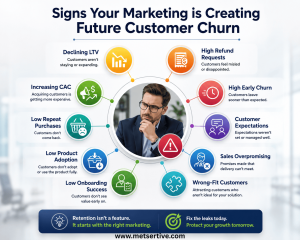
Signs Your Marketing Is Creating Future Churn
Marketing teams often celebrate metrics like impressions, clicks, leads, and conversions.
Those numbers matter.
But they don’t always tell the whole story.
A campaign can generate a large number of customers…
…and still create long-term growth problems if those customers don’t stay.
That’s why businesses should evaluate marketing not only by how many customers it acquires, but also by the quality of the customers it brings in.
The checklist below can help you identify whether your marketing is quietly creating future retention problems.
If several of these signs sound familiar, it may be time to rethink not just your marketing campaigns—but your entire customer acquisition strategy.
-
High Refund Requests
Refunds often indicate more than product dissatisfaction.
They can signal that customers purchased with expectations that were never aligned with reality.
SME Example
A business consultancy promotes:
“Transform your business in just 30 days.”
Clients quickly discover meaningful transformation requires several months.
Refund requests increase—not necessarily because the advice lacks value, but because expectations were unrealistic.
Service Business Example
A web development agency promises “launch in two weeks.”
The project requires multiple revisions, approvals, and integrations.
Clients become frustrated and request partial refunds.
SaaS Example
A CRM platform markets itself as “ready in minutes.”
Customers later discover implementation requires team training and data migration.
Many request cancellations before fully adopting the platform.
D2C Example
An online retailer showcases product images that differ significantly from the delivered product.
Return requests increase because expectations weren’t met.
Actionable Tip
Review your refund reasons regularly.
If customers repeatedly mention:
- “Not what I expected.”
- “Different from what was advertised.”
- “Didn’t realize this.”
…the issue may lie in your marketing, not your delivery.
-
High Early Churn
Customers leave shortly after buying.
This usually means they never experienced enough value to stay.
Often, the reason isn’t poor service.
It’s poor expectation management.
SME Example
Businesses purchase accounting software expecting immediate automation.
When they realize setup requires configuration, many abandon the platform within weeks.
Service Business Example
A consulting firm signs several new clients.
Most terminate within the first two months because they expected implementation—not strategic guidance.
SaaS Example
Users sign up after reading bold productivity claims.
Without understanding the onboarding process, they stop using the software after a few weeks.
D2C Example
A subscription box attracts customers through heavy discounts.
Many cancel immediately after the first shipment.
Actionable Tip
Track churn within the first 30, 60, and 90 days.
Early churn often reflects marketing quality more than customer support quality.
-
Customers Frequently Say…
“I Expected Something Different.”
This single sentence is one of the strongest warning signs a business can receive.
When customers consistently express surprise after buying, it usually indicates a disconnect between marketing and reality.
SME Example
Customers expected a fully managed service.
Instead, they purchased software requiring internal effort.
Service Business Example
Clients expected daily communication.
The agency operates with weekly reporting.
SaaS Example
Users assumed every feature was included.
They later discover premium functionality requires an upgrade.
D2C Example
Customers believed a product included accessories shown in advertisements.
It didn’t.
Actionable Tip
Collect post-purchase feedback.
Look specifically for comments related to unmet expectations.
Patterns reveal where messaging needs improvement.
-
Sales Teams Frequently Overpromise
Marketing creates interest.
Sales reinforces expectations.
If sales consistently promises outcomes beyond what the business can deliver, retention suffers.
SME Example
Sales guarantees implementation timelines that operations cannot realistically achieve.
Service Business Example
An agency promises first-page rankings on search engines within weeks.
Delivery takes months.
SaaS Example
Sales assures prospects that no training will be required.
Customer success later spends weeks helping users get started.
D2C Example
Customer support promises delivery dates during peak seasons that logistics cannot meet.
Actionable Tip
Regularly compare sales conversations with actual delivery experiences.
Alignment reduces disappointment later.
-
Wrong-Fit Customers Keep Entering
Not every customer should become a customer.
When marketing attracts people who cannot realistically succeed with your solution, churn becomes inevitable.
SME Example
A manufacturing ERP system attracts very small retailers.
The software feels unnecessarily complex.
Service Business Example
A premium consulting firm markets itself to startups with limited budgets and unrealistic expectations.
SaaS Example
Enterprise software attracts freelancers because messaging focuses only on affordability.
D2C Example
Luxury products are promoted primarily through discount messaging.
Price-sensitive buyers rarely become loyal customers.
Actionable Tip
Ask:
“Who are our happiest long-term customers?”
Then build marketing around attracting more people like them.
-
Low Onboarding Success
Customers purchase.
But never fully adopt.
That often indicates they weren’t adequately prepared before buying.
SME Example
Business owners expect software to replace internal processes instantly.
Instead, onboarding requires collaboration.
Service Business Example
Clients expect agencies to handle everything without their involvement.
Projects stall because responsibilities weren’t explained.
SaaS Example
Users skip onboarding because they don’t understand its importance.
D2C Example
Customers never activate loyalty programs because nobody explained the benefits beforehand.
Actionable Tip
Use marketing to educate customers about what success requires—not just what they’ll receive.
-
Low Product Adoption
Buying isn’t the same as using.
Marketing can generate purchases.
But adoption determines retention.
Actionable Tip
Monitor feature usage, login frequency, and customer engagement—not just sales.
-
Low Repeat Purchases
Customers buy once.
Then disappear.
Marketing may be optimized for first-time purchases while ignoring long-term relationships.
Actionable Tip
Evaluate campaigns based on repeat purchase behavior, not only initial conversion rates.
-
Customer Acquisition Cost (CAC) Keeps Increasing
Businesses often assume rising CAC is purely an advertising problem.
Sometimes it is.
But sometimes poor retention amplifies acquisition costs.
Because customers leave quickly…
Every month starts from zero again.
Actionable Tip
Compare CAC alongside customer lifespan.
Short customer relationships make even efficient acquisition expensive.
-
Customer Lifetime Value (LTV) Keeps Declining
This is often the final symptom.
Marketing generates customers.
But customers don’t generate lasting value.
Growth becomes increasingly dependent on acquiring new buyers.
Customer Churn Prevention begins with honest marketing, realistic messaging, and attracting customers who are genuinely aligned with your solution
Actionable Tip
Monitor LTV trends by acquisition channel.
Some campaigns may produce many customers—but very little long-term value.
The Big Insight
Marketing isn’t successful simply because it acquires customers.
It’s successful when it acquires customers who stay, succeed, and continue creating value.
The strongest marketing systems don’t just maximize conversions.
They maximize customer quality.
Because customer quality ultimately determines customer retention.
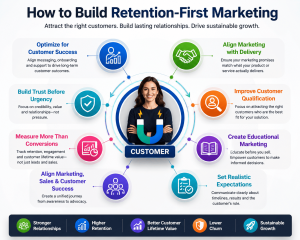
How to Build Retention-First Marketing
Most marketing strategies are built around one question:
“How do we generate more leads?”
Retention-first marketing asks a different question:
“How do we attract customers who are most likely to stay?”
That shift changes everything.
Instead of optimizing only for conversions, businesses begin optimizing for long-term customer success.
Here are eight practical ways to build marketing that supports retention—not just acquisition.
-
Align Marketing with Delivery
Your marketing should accurately reflect what your business can consistently deliver.
The more closely promises match reality, the easier it becomes to build trust.
Examples
SME: Promote achievable operational improvements instead of unrealistic transformation timelines.
Service Business: Explain the implementation process before discussing outcomes.
SaaS: Highlight both the platform’s capabilities and the onboarding journey.
D2C: Use authentic product images and realistic demonstrations.
Actionable Tip
Audit your website, ads, and sales materials every quarter.
Ask:
“Can our operations confidently deliver every promise we’re making?”
An effective Customer Retention Strategy begins long before onboarding by ensuring marketing attracts the right customers, sets realistic expectations, and prepares them for long-term success.
-
Improve Customer Qualification
Not every lead should become a customer.
The goal is customer fit—not customer volume.
Examples
SME: Clearly define company size, industry, and use cases.
Service Business: Explain ideal client profiles before booking consultations.
SaaS: Publish “Who this platform is best suited for.”
D2C: Recommend products based on customer needs rather than promoting every product equally.
Actionable Tip
Introduce qualification questions early in the buying journey.
-
Create Educational Marketing
The best marketing doesn’t just persuade.
It prepares customers for success.
Examples
SME: Publish implementation guides.
Service Business: Share behind-the-scenes project timelines.
SaaS: Offer onboarding webinars before sign-up.
D2C: Create product education videos and usage tutorials.
Actionable Tip
Every marketing asset should answer at least one customer question.
-
Set Realistic Expectations
Clarity often outperforms exaggeration.
Customers appreciate transparency.
Examples
SME: Explain typical project timelines.
Service Business: Clarify what clients must contribute.
SaaS: Describe realistic adoption periods.
D2C: Communicate shipping times and product limitations honestly.
Actionable Tip
Replace hype-driven claims with outcome-driven education.
-
Align Marketing, Sales & Customer Success
Customers should experience one consistent message throughout their journey.
Not three different stories.
Examples
SME: Marketing promises exactly what consultants later deliver.
Service Business: Sales proposals match project execution.
SaaS: Product demos reflect actual user experience.
D2C: Product pages match post-purchase support information.
Actionable Tip
Conduct regular alignment meetings across departments.
-
Measure More Than Conversions
Conversions are only the beginning.
Retention-first businesses measure customer success after the sale.
Track metrics such as:
- Customer Lifetime Value (LTV)
- Churn Rate
- CAC Recovery Period
- Product Adoption
- Repeat Purchase Rate
- Revenue Per Customer
Actionable Tip
Create dashboards that connect marketing campaigns with long-term customer performance.
-
Build Trust Before You Build Urgency
Many campaigns focus on creating urgency:
- Limited-time offers
- Countdown timers
- Flash sales
- Scarcity messaging
Urgency can increase conversions.
But trust is what increases retention.
Customers who buy because they trust you are more likely to stay than customers who buy because they fear missing out.
Examples
SME: Share client success stories and practical insights before asking for a meeting.
Service Business: Publish educational content that demonstrates expertise instead of relying only on promotional messaging.
SaaS: Offer interactive product tours and transparent pricing before encouraging prospects to start a trial.
D2C: Highlight authentic customer reviews, product demonstrations, and care instructions before promoting discounts.
Scenario
Two software companies launch identical products.
- Company A drives sign-ups with aggressive countdown offers.
- Company B builds trust through webinars, case studies, and product education.
Company A acquires more users initially.
Company B retains more users over the next 12 months.
The difference isn’t the product.
It’s the trust established before purchase.
Actionable Tip
Ask yourself:
“Does this campaign build confidence—or simply create urgency?”
Retention-first marketing prioritizes confidence.
-
Optimize Marketing for Customer Success, Not Just Customer Acquisition
Traditional marketing asks:
“How many customers did we acquire?”
Retention-first marketing asks:
“How many customers became successful?”
That’s a very different objective.
When marketing understands what success looks like after the sale, it attracts customers who are more likely to achieve it.
Examples
SME: Feature customer onboarding roadmaps in marketing materials.
Service Business: Explain the collaboration process and expected client involvement before contracts are signed.
SaaS: Showcase product adoption milestones rather than only feature lists.
D2C: Provide clear usage guidance, maintenance tips, and post-purchase education before checkout.
Scenario
An agency stops promoting “fast results” and instead explains its strategic process, realistic timelines, and client responsibilities.
Lead volume decreases slightly.
But client retention improves significantly because expectations are aligned from the start.
Actionable Tip
Work backward from your most successful long-term customers.
Identify:
- What they understood before buying.
- What expectations they had.
- Why they succeeded.
Then build your marketing to help future prospects develop the same understanding.
The Big Shift
The future of marketing isn’t about generating the maximum number of leads.
It’s about generating the right customers with the right expectations.
Because the businesses that grow sustainably don’t just optimize for acquisition.
They optimize for customer success before the sale even happens.
And when marketing consistently attracts well-informed, well-qualified customers, retention stops feeling like a separate function.
It becomes the natural outcome of a better customer journey.
Key Takeaway
Retention-first marketing recognizes that every advertisement, landing page, sales conversation, and piece of educational content shapes the kind of customer your business acquires.
When marketing:
- Attracts the right audience
- Sets realistic expectations
- Educates prospects before they buy
- Aligns with sales and delivery
- Builds trust instead of hype
- Measures long-term customer success—not just conversions
- Optimizes for customer outcomes instead of lead volume
- Continuously refines messaging based on retention insights
…it doesn’t just generate more customers.
It generates customers who stay longer, achieve better outcomes, increase lifetime value, and become advocates for your business.
That’s when marketing stops being just a lead-generation function and becomes one of the most powerful drivers of long-term profitability.
The Revenue Architecture Perspective
Throughout this guide, we’ve explored an idea that many businesses overlook:
Marketing doesn’t stop influencing the customer after the first purchase.
It continues shaping the customer experience long after the sale.
That realization leads to a much bigger strategic shift.
Marketing should no longer be evaluated only by the number of leads it generates.
It should also be evaluated by the quality of customers it brings into the business.
The Traditional Marketing Dashboard
Many businesses measure marketing using metrics such as:
- Website traffic
- Click-through rates
- Cost per lead
- Lead volume
- Conversion rate
- Cost per acquisition (CAC)
These metrics are useful.
But they tell only part of the story.
Imagine two marketing campaigns.
Campaign A generates 500 new customers.
Campaign B generates 300 new customers.
At first glance, Campaign A appears more successful.
But now look deeper.
Campaign A customers:
- Cancel quickly
- Request refunds
- Require heavy support
- Rarely buy again
- Leave poor reviews
Campaign B customers:
- Stay longer
- Spend more
- Renew consistently
- Refer other customers
- Become advocates
Which campaign actually created more value?
The answer is obvious.
The campaign that attracted better customers—not simply more customers.
That is the difference between measuring lead quantity and measuring revenue quality.
Revenue Quality Is the Metric That Matters
A customer is more than a conversion.
A customer is a future revenue stream.
Their value depends on what happens after they buy.
High-quality customers often:
- Stay longer
- Achieve better outcomes
- Purchase again
- Upgrade over time
- Recommend your business to others
- Cost less to support
- Generate higher lifetime value
Low-quality customers often:
- Leave early
- Demand refunds
- Create support challenges
- Increase churn
- Reduce profitability
The number of customers may look impressive.
But the quality of those customers determines the health of the business.
Businesses that want to Improve Customer Retention should evaluate not only what happens after the sale, but also how marketing influences customer expectations before conversion.
The Revenue Architecture Mindset
At Metsertive, we believe growth should never be viewed as isolated activities.
Marketing.
Sales.
Customer success.
Retention.
Each one influences the next.
They are all connected parts of a single revenue system.
That means every marketing decision affects more than acquisition.
It also affects:
- Customer fit
- Customer expectations
- Product adoption
- Customer satisfaction
- Retention
- Customer Lifetime Value (LTV)
- Profitability
When these elements work together, growth becomes easier to sustain.
When they work against one another, businesses experience hidden revenue leakage.
This is why we refer to growth as Revenue Architecture.
It’s about designing every stage of the customer journey so that each one strengthens the next.
What Revenue-First Marketing Looks Like
Instead of asking:
“How many leads did we generate this month?”
High-performing businesses ask:
- Did we attract the right customers?
- Did they understand what success requires?
- Are they adopting the product or service?
- Are they renewing?
- Are they becoming more valuable over time?
- Are they referring others?
Those questions connect marketing directly to business performance.
Not just campaign performance.
Examples Across Different Business Types
SME Example
An SME launches two marketing campaigns.
The first campaign offers steep discounts and attracts price-sensitive buyers.
The second campaign focuses on educating businesses that genuinely need the solution.
The first campaign generates more sales.
The second campaign generates customers who stay longer and buy repeatedly.
The second campaign produces higher revenue quality.
Service Business Example
A consulting firm shifts its messaging from:
“Guaranteed rapid business growth.”
to:
“A strategic partnership focused on sustainable, long-term growth.”
Although fewer prospects enquire initially, the clients who do engage have more realistic expectations.
Projects run more smoothly.
Client retention improves.
Referrals increase.
SaaS Example
A SaaS company replaces feature-heavy advertisements with educational content explaining:
- Who the platform is for
- What implementation involves
- Typical timelines for success
- The commitment required from customers
Trial sign-ups decline slightly.
But activation rates, renewals, and customer lifetime value increase significantly.
The company attracts fewer—but far better—customers.
D2C Example
An online retailer stops promoting unrealistic “instant transformation” claims.
Instead, it highlights authentic customer experiences, product benefits, and realistic outcomes.
Purchase volume remains steady.
Returns decrease.
Customer reviews improve.
Repeat purchases become more frequent.
Trust becomes a competitive advantage.
Actionable Tips
If you want marketing to contribute to long-term revenue—not just short-term conversions—consider these steps:
- Measure customer quality, not just customer quantity.
- Track metrics such as LTV, retention, and repeat purchases alongside lead generation.
- Align marketing goals with long-term business outcomes rather than monthly campaign targets.
- Regularly review whether your messaging is attracting customers who are most likely to succeed.
- Treat marketing as the beginning of the customer relationship—not the end of the sales process.
The Big Insight
Marketing should never be judged solely by the number of customers it acquires.
It should also be judged by the value those customers create over time.
Because businesses don’t become more profitable simply by acquiring more customers.
They become more profitable by acquiring customers who stay, grow, and contribute to long-term revenue.
Conclusion
For many years, businesses have viewed marketing through a narrow lens.
Its primary purpose was to generate awareness, attract leads, and drive conversions.
Once the customer made a purchase, responsibility shifted to customer support, onboarding, or customer success.
But as we’ve explored throughout this guide, that perspective is incomplete.
Marketing influences far more than the first transaction.
It shapes the expectations customers carry into the relationship.
It influences whether the right people choose your business.
It builds—or weakens—trust before the first conversation even begins.
And those early impressions often determine whether customers remain loyal months or years later.
The most effective marketing strategies to reduce customer churn focus on building trust, setting realistic expectations, and preparing customers for long-term success rather than chasing short-term conversions.
The Customer Journey Is One Continuous Experience
Customers don’t experience your business in disconnected departments.
They don’t separate:
- Marketing
- Sales
- Onboarding
- Customer Success
- Retention
They experience one continuous journey.
Every promise they hear before purchasing influences how they evaluate your business afterward.
When that journey is consistent, customers gain confidence.
When it’s inconsistent, trust begins to erode.
This is why marketing has a lasting impact on customer retention.
Great Marketing Prepares Customers for Success
The most effective marketing doesn’t simply persuade people to buy.
It prepares them to succeed after they buy.
It helps prospects understand:
- The problem they’re solving
- The solution you’re providing
- What the implementation process involves
- The expected timeline for results
- Their own role in achieving success
As a result, customers begin the relationship with clarity rather than confusion.
And clarity creates confidence.
The Businesses That Retain Customers Best Rarely Rely on Luck
Strong retention isn’t usually the result of exceptional customer support alone.
It starts much earlier.
The businesses that consistently retain customers are often the ones that:
- Attract the right audience instead of everyone
- Communicate honestly and consistently
- Set realistic expectations from the beginning
- Educate prospects before asking them to buy
- Build trust through transparency
- Align marketing, sales, and delivery around the same message
These businesses don’t simply acquire customers.
They create relationships designed to last.
The Strategic Shift
Instead of asking:
“How can marketing generate more leads?”
Ask:
“How can marketing attract customers who are most likely to succeed—and stay?”
That single shift changes how businesses think about growth.
Marketing becomes more than a lead generation function.
It becomes the first stage of customer success.
And customer retention becomes a natural outcome of a well-designed customer journey.
Final Takeaway
Great marketing doesn’t end when a prospect becomes a customer.
In many ways, that’s where its true impact begins.
Because the messages customers hear before they buy shape the expectations they carry after they buy.
And those expectations influence trust, adoption, satisfaction, and long-term loyalty.
Businesses that recognize this don’t just generate more customers.
They generate better customers.
Customers who stay longer.
Spend more.
Refer others.
And contribute to predictable, profitable growth.
At Metsertive, we believe sustainable growth isn’t created by optimizing isolated marketing campaigns.
It’s created by designing a Revenue Architecture where marketing, sales, customer experience, and retention work together as one connected system.
Because great marketing doesn’t just acquire customers.
It helps keep them.


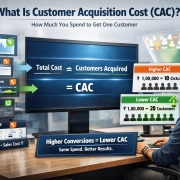


Leave a Reply
Want to join the discussion?Feel free to contribute!