Posts

How Marketing Creates Future Retention Problems

Marketing and Customer Retention are far more connected than most businesses realise. Most businesses measure the success of their marketing using familiar metrics:

  • Website traffic
  • Lead generation
  • Conversion rates
  • Cost per acquisition (CAC)

Those metrics are important.

But they only tell part of the story.

Because generating a customer is not the same as keeping one.

This is where many businesses unknowingly create a growth problem.

They assume marketing’s responsibility ends when someone becomes a customer.

In reality, marketing continues influencing the customer long after the sale.

Every promise made in an advertisement…

Every claim on a landing page…

Every sales conversation…

Every piece of content…

Shapes what customers expect after they buy.

And those expectations often determine whether customers stay—or leave.

This means many retention challenges don’t begin with poor customer support or weak onboarding.

They begin much earlier.

They begin with marketing.

Businesses that focus only on acquiring customers often overlook an important question:

“Are we attracting customers who are likely to succeed with us?”

Because acquiring the wrong customers…

Creating unrealistic expectations…

Or communicating inconsistent messages…

Can quietly increase churn, reduce customer lifetime value (LTV), and weaken profitability.

Throughout this guide, you’ll discover:

  • Why marketing plays a much bigger role in customer retention than most businesses realize.
  • How unrealistic messaging quietly creates future churn.
  • Why attracting the wrong customers make retention far more difficult.
  • How better marketing improves customer lifetime value (LTV), profitability, and sustainable business growth.

The businesses with the strongest customer retention rarely rely on customer success alone.

They begin building retention from the very first interaction a prospect has with their brand.

Because marketing doesn’t simply influence whether customers buy.

It influences whether they stay long enough to experience the value you promised.


Why Businesses Separate Marketing and Retention
Marketing and Customer Retention

At first glance, marketing and retention appear to be two completely different functions.

In many businesses, they’re even managed by different teams.

Marketing is responsible for:

  • Driving traffic
  • Generating leads
  • Running advertising campaigns
  • Increasing conversions
  • Supporting sales growth

Once a prospect becomes a customer, the responsibility is often handed over to another team.

Customer success focuses on:

  • Onboarding
  • Customer support
  • Renewals
  • Upselling
  • Loyalty
  • Retention

On paper, this division seems perfectly logical.

Each department has its own goals, processes, and performance metrics.

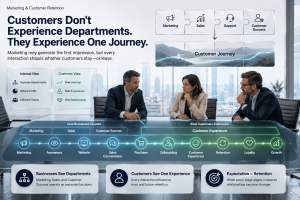
But customers don’t experience your business through departments.

They experience one continuous journey.

From the moment they first discover your business…

To the content they read…

The advertisements they click…

The conversations they have with your sales team…

The onboarding process…

The product or service itself…

And every interaction that follows.

To the customer, it all feels like one experience.

They don’t think:

“Marketing promised this.”

Then later:

“Customer Success delivered that.”

Instead, they simply ask:

“Did this business deliver what I expected?”

That single question connects marketing and retention more closely than many businesses realize.

When marketing creates accurate expectations, customer success begins with trust.

When marketing overpromises, customer success starts by trying to repair disappointment.

This is why customer retention is not only influenced by what happens after the sale.

It is also influenced by everything that happened before it.

The debate around Customer Acquisition vs Customer Retention shouldn’t be about choosing one over the other—it should be about ensuring acquisition supports long-term retention.

Let’s look at how this plays out across different types of businesses.

SME Example

Imagine a manufacturing SME that markets itself as offering “complete business transformation in just a few weeks.”

The message attracts plenty of inquiries.

Many businesses sign contracts expecting immediate operational improvements.

But the reality is different.

The implementation process requires:

  • Process analysis
  • Team training
  • Workflow adjustments
  • Ongoing optimization

Meaningful improvements take several months.

The consulting team delivers exactly what was promised—but according to a realistic timeline.

Unfortunately, customers expected much faster results.

As frustration grows, confidence begins to decline.

Some customers leave before experiencing the full value of the engagement.

From the company’s perspective, it looks like a retention problem.

In reality, the issue began much earlier.

Marketing created expectations that the delivery team could never realistically satisfy.

Service Business Example

Consider a digital marketing agency promoting its services with statements like:

“Generate qualified leads almost immediately.”

The messaging attracts business owners eager for rapid growth.

After signing the agreement, clients discover the actual process includes:

  • Market research
  • Competitor analysis
  • Strategy development
  • Content creation
  • Campaign testing
  • Continuous optimization

The agency follows best practices and delivers high-quality work.

But the client’s expectations were based on speed rather than process.

Each week without dramatic results increases anxiety.

Eventually, the relationship becomes strained.

The service itself isn’t the problem.

The expectation created before the sale is.

SaaS Example

A SaaS company launches a campaign highlighting:

“Get your team up and running in minutes.”

The message generates a surge in sign-ups.

However, the platform is designed for medium and large organizations.

Successful implementation requires:

  • Team onboarding
  • Workflow configuration
  • Data migration
  • User training

Although the software performs exactly as intended, customers expecting an instant setup become frustrated.

Some stop using the platform within weeks.

Customer Success works hard to improve adoption.

But they are trying to solve a problem that marketing unintentionally created.

The onboarding team inherited expectations they didn’t create.

D2C Example

A premium skincare brand advertises dramatic transformations using highly polished marketing visuals.

Customers purchase with high expectations.

When the products arrive, they discover that consistent use over several weeks is required before noticeable improvements appear.

The product is effective.

But customers expecting overnight results become disappointed.

Some request refunds.

Others leave negative reviews.

Many never purchase again.

The issue isn’t product quality.

It’s the gap between marketing expectations and the actual customer experience.

The Bigger Reality

These examples all point to the same insight.

Marketing and retention are not separate stages of growth.

They are deeply connected.

Every advertisement…

Every landing page…

Every email…

Every webinar…

Every social media post…

Every sales conversation…

Either strengthens future retention…

Or quietly weakens it.

This is why businesses that treat marketing and retention as isolated functions often struggle with churn, even when they invest heavily in customer success.

Retention doesn’t begin when onboarding starts.

It begins when expectations begin.

And expectations are largely shaped by marketing.

Actionable Tips

If you want marketing to support retention—not just acquisition—start with these practical steps:

  1. Align Marketing With Customer Success

Bring your marketing, sales, and customer success teams together regularly.

Review whether the promises made before the sale match the experience customers receive afterward.

Consistency builds trust.

  1. Measure More Than Conversions

Don’t evaluate marketing only by:

  • Lead volume
  • Conversion rate
  • Cost per lead

Also monitor:

  • Customer retention rate
  • Customer Lifetime Value (LTV)
  • Churn rate
  • Repeat purchase rate
  • Product adoption

These metrics reveal the long-term impact of your marketing.

  1. Review Customer Expectations

Ask recent customers:

“Before purchasing, what did you expect?”

Then compare their answers with the actual experience.

Small expectation gaps today can become major retention problems tomorrow.

  1. Create One Continuous Customer Journey

Instead of thinking:

Marketing → Sales → Customer Success

Start thinking:

Customer Journey

Every stage should reinforce the same message, build the same trust, and prepare customers for long-term success.

  1. Remember What Marketing Really Does

Marketing doesn’t just influence whether people buy.

It influences:

  • Who buys
  • Why they buy
  • What they expect
  • How satisfied they become
  • Whether they stay

That’s why the best marketing strategies don’t stop at conversion.

They help build stronger customer relationships long before the first purchase.

Key Takeaway

Many businesses separate marketing and retention because different teams manage different stages of the customer journey.

Customers don’t see those internal divisions.

They experience one continuous relationship with your business.

That means every marketing message, every promise, and every expectation set before the sale influences what customers think, feel, and do after they buy.

Businesses that align marketing with customer success don’t just acquire more customers.

They acquire better-fit customers, build stronger trust, improve retention, increase customer lifetime value (LTV), and create more profitable, sustainable growth.


The Customer Journey Starts Long Before the Sale

When businesses think about the customer journey, many imagine it beginning with the first purchase.

In reality, it starts much earlier.

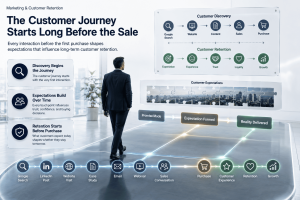
Long before someone becomes a customer, they are already interacting with your business.

That first interaction may happen through:

  • A Google search
  • A LinkedIn post
  • A social media advertisement
  • A recommendation
  • A webinar
  • An email
  • A conversation with your sales team

Each interaction shapes how prospects perceive your business.

And whether they realize it or not, they begin forming expectations almost immediately.

Understanding how marketing affects customer retention helps businesses realize that every advertisement, landing page, and sales conversation influences long-term customer loyalty.

They ask themselves questions like:

  • “Can this company solve my problem?”
  • “Will their process be easy?”
  • “Can I trust what they’re saying?”
  • “Are these results realistic?”
  • “Is this solution right for my business?”

Every advertisement…

Every website page…

Every landing page…

Every case study…

Every social media post…

Every sales conversation…

Adds another piece to that picture.

By the time someone finally decides to buy, they have already created a mental expectation of what working with your business will be like.

That expectation becomes the benchmark they use to judge every experience after the sale.
Customer journey starts long before the sale

A Simple Example

Imagine a prospect reading an advertisement that says:

“Double your revenue in just 30 days.”

The message captures attention.

The prospect clicks.

Visits the website.

Books a discovery call.

Signs the contract.

But after becoming a customer, they discover that sustainable revenue growth requires:

  • Research
  • Strategy
  • Testing
  • Optimization
  • Continuous improvement

Results take several months.

The service may be excellent.

The team may be highly skilled.

But the customer compares reality to the expectation formed months earlier.

Disappointment begins.

The business eventually labels it a retention problem.

In truth, the retention problem started the day the advertisement was published.

SME Example

A manufacturing SME promotes itself as providing “instant operational transformation.”

Business owners sign up expecting immediate efficiency gains.

Instead, improvements require process changes, employee training, and gradual implementation.

Customers lose confidence—not because the solution is ineffective, but because expectations were unrealistic.

Service Business Example

A consulting firm markets its services with promises of rapid business growth.

Clients expect visible improvements within weeks.

The consulting team delivers a thorough strategic roadmap, but implementation naturally takes time.

Clients become impatient and question the value of the engagement.

The issue isn’t service quality.

It’s the expectation created before the contract was signed.

SaaS Example

A SaaS platform advertises “setup in minutes.”

After subscribing, customers realize implementation requires data migration, user permissions, integrations, and staff training.

Although the platform performs exactly as intended, customers expected simplicity rather than a structured implementation process.

Some cancel before experiencing the platform’s full value.

D2C Example

An online fitness brand advertises dramatic physical transformations.

Customers purchase expecting rapid results.

After a few weeks, they realize consistent exercise, nutrition, and discipline are required.

Many stop using the program.

Again, the issue isn’t the product.

It’s the expectation created during marketing.

The Bigger Insight

Customer retention isn’t shaped only by what customers experience after buying.

It’s shaped by what they believe before buying.

Marketing is often the customer’s very first experience with your business.

And first impressions influence every interaction that follows.

The stronger and more realistic those first impressions are, the easier it becomes to build long-term customer relationships.

Actionable Tips

  1. Audit Every Customer Touchpoint

Review your customer touchpoints:

  • Advertisements
  • Website
  • Landing pages
  • Emails
  • Sales presentations
  • Product demonstrations

Ask:

“What expectations does this create?”

  1. Compare Marketing With Delivery

If your marketing promises simplicity…

Does onboarding feel simple?

If marketing promises speed…

Can your operations consistently deliver it?

Consistency reduces future disappointment.

  1. Think Beyond Conversions

Before launching any campaign, ask:

“Will this message help us retain the customers it attracts?”

Sometimes a campaign that generates fewer—but better-qualified—customers creates much stronger long-term growth.

  1. Remember the Customer Journey Is Continuous

Customers don’t divide your business into departments.

To them, every interaction is part of one continuous experience.

Make sure every stage reinforces the same expectations.

Key Takeaway

Marketing isn’t simply the beginning of the sales process.

It’s the beginning of the customer relationship.

Every expectation created before the sale influences customer satisfaction, trust, and retention after the sale.

Businesses that recognize this don’t just create better marketing.

They build stronger customer relationships from the very first interaction.


The Six Ways Marketing Creates Future Retention Problems

When customers leave, most businesses immediately look at what happened after the sale.

They review:

  • Customer support
  • Onboarding
  • Product quality
  • Service delivery

Those areas certainly matter.

But many retention problems have much deeper roots.

They begin in marketing.

Every campaign, advertisement, landing page, email, and sales message shapes the kind of customers you attract and the expectations they bring with them.
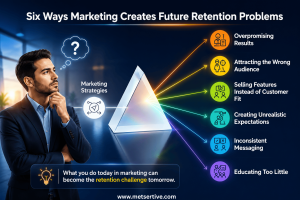
Six ways marketing creates future retention problems

When marketing sends the wrong signals, retention becomes much harder—even if your product or service delivers genuine value.

One of the biggest lessons for modern businesses is understanding how marketing creates customer churn through unrealistic promises, poor qualification, and inconsistent messaging.

Let’s explore six of the most common ways this happens.

  1. Overpromising Results

This is one of the biggest contributors to future churn.

In an effort to generate more leads, businesses often make promises that sound exciting but are difficult—or impossible—to deliver consistently.

Common examples include:

  • “Guaranteed success.”
  • “Double your revenue in 30 days.”
  • “Instant results.”
  • “Effortless growth.”
  • “Completely automated.”

These claims attract attention.

But they also create expectations that reality may struggle to match.

SME Example

A business consulting firm advertises dramatic operational improvements within two weeks.

The client signs the agreement expecting immediate transformation.

In reality, meaningful improvements require employee adoption, process redesign, and management support.

The project succeeds.

But the customer’s expectations were never realistic.

Service Business Example

A digital marketing agency promises rapid lead generation.

Campaign optimization takes several months.

The client becomes frustrated long before meaningful results appear.

SaaS Example

A CRM platform promotes itself as “ready to use immediately.”

Customers later discover onboarding, integrations, and staff training are required.

Some leave before adoption is complete.

D2C Example

A skincare brand promises visible improvements within days.

Actual results require consistent use over several weeks.

Returns increase.

Customer reviews become more negative.

Bigger Insight

Marketing should create confidence—not unrealistic expectations.

Short-term excitement often creates long-term disappointment.

  1. Attracting the Wrong Audience

Many businesses celebrate large numbers of leads.

But more leads don’t automatically mean better customers.

Growth isn’t just about volume.

It’s about fit.

SME Example

A manufacturing company markets itself to every industry.

Many inquiries arrive.

Few customers remain long-term because the solution isn’t designed for all industries.

Service Business Example

A premium consulting firm attracts businesses looking for low-cost execution.

Clients quickly realize the service isn’t what they expected.

Relationships end early.

SaaS Example

Enterprise software is marketed toward freelancers.

Many subscribe.

Few successfully adopt the platform.

Churn rises.

D2C Example

A premium product is promoted primarily through heavy discount campaigns.

Price-sensitive customers purchase once.

Very few return.

Bigger Insight

Retention improves dramatically when marketing attracts customers who are genuinely positioned to succeed.

  1. Selling Features Instead of Customer Fit

Many marketing campaigns focus almost entirely on:

  • Features
  • Benefits
  • Discounts
  • Offers
  • Technology

Very few explain:

Who the solution is designed for.

More importantly…

Who it is not designed for.

This creates a dangerous situation.

People buy because the product sounds impressive—not because it’s the right fit.

SME Example

A business management platform highlights dozens of advanced capabilities.

Small businesses purchase it.

Most only need basic functionality.

Complexity leads to poor adoption.

Service Business Example

An agency promotes every service it offers.

Prospects struggle to understand whether the agency is the right partner for their specific challenges.

SaaS Example

A software company highlights AI automation, dashboards, and analytics.

Very little attention is given to the implementation effort required.

Customers become overwhelmed.

D2C Example

A premium kitchen appliance advertises advanced features.

Many buyers simply wanted an easy-to-use product.

Complexity reduces satisfaction.

Bigger Insight

The best marketing doesn’t convince everyone to buy.

It helps the right customers decide to buy.

  1. Creating Unrealistic Expectations

Marketing naturally simplifies complex solutions.

But oversimplifying often creates future dissatisfaction.

Reality usually includes:

  • Learning
  • Collaboration
  • Time
  • Adaptation
  • Continuous improvement

Customers who expect simplicity become disappointed when they encounter normal implementation challenges.

Bigger Insight

Customers rarely judge reality alone.

They judge reality compared with what they expected.

That expectation gap often determines retention.

  1. Inconsistent Messaging Across the Customer Journey

Another hidden cause of churn is inconsistency.

Marketing communicates one message.

Sales communicates another.

Customer Success explains something different.

The product experience tells yet another story.

Customers begin asking:

“Which version should I believe?”

Trust starts to erode.

SaaS Example

Marketing promotes:

“Simple setup.”

Sales says:

“Our specialists will help.”

After purchase, customers discover they need extensive internal resources to implement the platform.

Confusion replaces confidence.

Bigger Insight

Consistency builds credibility.

Credibility builds trust.

Trust improves retention.

  1. Educating Too Little Before the Sale

Many businesses rush prospects toward conversion.

They focus on closing deals rather than preparing customers for success.

As a result, customers buy without fully understanding:

  • How the solution works
  • What implementation requires
  • Their own responsibilities
  • Realistic timelines
  • Success factors

The sale happens.

But the customer isn’t ready.

Service Business Example

A consulting client signs immediately after a sales presentation.

Only later do they discover how much internal involvement is required.

Engagement declines.

D2C Example

Customers purchase an expensive product without understanding how to use it correctly.

Negative reviews follow—not because of poor quality, but because expectations and education were insufficient.

Bigger Insight

Education isn’t just a conversion tool.

Customer education is one of the strongest retention strategies available.

Well-informed customers usually become more successful customers.

Actionable Tips

  1. Promise Outcomes Responsibly

Create excitement without sacrificing credibility.

  1. Market to the Right Customers

Focus on customer fit rather than maximum reach.

  1. Explain Who Should—and Shouldn’t—Buy

The right customer retained is more valuable than the wrong customer acquired.

  1. Align Marketing, Sales, and Delivery

Ensure every customer hears the same message throughout the journey.

  1. Educate Before You Sell

Use content, webinars, guides, demos, and case studies to prepare prospects for success.

  1. Measure Long-Term Marketing Success

Evaluate campaigns using:

  • Customer Retention Rate
  • Customer Lifetime Value (LTV)
  • Churn Rate
  • Product Adoption
  • Repeat Purchase Rate

These metrics reveal whether your marketing is attracting customers who stay—not just customers who buy.

Key Takeaway

Marketing doesn’t just influence customer acquisition.

It influences customer quality, expectations, trust, adoption, and long-term retention.

Businesses that overpromise, attract the wrong audience, sell features instead of customer fit, create unrealistic expectations, communicate inconsistently, or educate too little often create future retention problems before a customer ever makes a purchase.

The most effective marketing strategies don’t simply generate more customers.

They attract the right customers, prepare them for success, and lay the foundation for stronger retention, higher customer lifetime value (LTV), and more profitable, sustainable growth.


Expectation Gaps Become Churn

If there is one concept every business leader should understand about customer retention, it’s this:

Customers don’t judge your business based on reality alone.

They judge your business based on the difference between what they expected…and what they actually experienced.

That difference is what we call the Expectation Gap.

Strong Customer Expectation Management helps businesses reduce disappointment by ensuring the experience customers receive closely matches the expectations created during marketing.

But Expectation Gap is one of the most overlooked causes of customer churn.

Think of it as a simple chain of events:

Expectation

Reality

Customer Experience

Retention

Every customer begins their journey with an expectation.

That expectation is shaped by:

  • Your advertisements
  • Your website
  • Your landing pages
  • Your sales conversations
  • Your product demonstrations
  • Your social media content
  • Customer testimonials
  • Case studies

By the time someone becomes a customer, they’ve already created a mental picture of what success with your business will look like.

Everything that happens afterward is measured against that picture.

Not against objective reality.

Against expected reality.

This is why two customers can receive exactly the same product or service and walk away with completely different opinions.
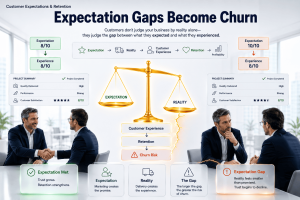
customer expectation gap become churn

A Simple Scenario

Imagine two customers using the same business solution.

Customer A

Expectation:

8/10

Experience:

8/10

Result:

The customer feels satisfied.

The experience matched what they expected.

Trust grows.

Retention becomes easier.

Customer B

Expectation:

10/10

Experience:

8/10

Objectively, the experience is still very good.

But emotionally…

The customer feels disappointed.

Not because the solution failed.

Because reality failed to match the expectation.

Eventually they begin exploring alternatives.

The business sees churn.

The real issue was the expectation gap.

Not the customer experience itself.

This is why managing expectations is just as important as delivering value.

SME Example

A business consulting firm markets its services as delivering “rapid operational transformation.”

Business owners expect dramatic improvements within a few weeks.

The consultants provide valuable recommendations, employee workshops, and implementation support.

Real improvements begin appearing after three months.

The consulting quality is excellent.

But because expectations were set too high, many clients become impatient before seeing the long-term benefits.

The gap between expectation and reality creates dissatisfaction.

Service Business Example

A branding agency promises that a new brand identity will significantly accelerate business growth.

The client assumes new customers will begin arriving immediately after launch.

Instead, the new branding strengthens credibility and improves long-term positioning—but measurable growth takes time.

The agency delivered exceptional work.

The customer expected a different outcome.

The relationship weakens.

SaaS Example

A project management platform promotes itself as “simple enough for any team.”

After purchasing, enterprise customers discover they need structured onboarding, process changes, user training, and system integrations.

The software performs exactly as intended.

But implementation requires more effort than expected.

Adoption slows.

Some customers cancel before realizing the platform’s full value.

D2C Example

A premium nutrition brand showcases dramatic before-and-after transformations.

Customers purchase expecting rapid physical changes.

After several weeks, they realize lasting results require consistency, healthy habits, and lifestyle adjustments.

The product works.

But expectations were unrealistic.

Many customers stop purchasing before experiencing meaningful benefits.

Why Expectation Gaps Are So Dangerous

Expectation gaps create invisible friction.

Customers begin thinking:

  • “This isn’t what I expected.”
  • “I thought it would be easier.”
  • “I expected faster results.”
  • “I thought the process would be different.”

These thoughts gradually reduce:

  • Trust
  • Confidence
  • Engagement
  • Patience

Eventually, customers disengage.

From the business perspective, it appears to be a retention problem.

But the customer’s experience wasn’t necessarily poor.

Their expectations simply exceeded reality.

The Bigger Insight

Retention is rarely determined by reality alone.

It’s determined by how closely reality matches the expectations created before the sale.

Businesses that consistently align expectations with delivery often retain customers longer—even when competitors offer similar products or services.

Because customers appreciate predictability.

They value honesty.

And they stay when businesses consistently deliver what they promised.

Actionable Tips

  1. Review Your Marketing Promises

Look at your advertisements, website, emails, and sales presentations.

Ask:

“Are we creating realistic expectations?”

  1. Measure Customer Expectations

During onboarding, ask new customers:

“What were you expecting before you purchased?”

Their answers often reveal hidden expectation gaps.

  1. Prepare Customers for the Journey

Explain:

  • What success requires
  • Typical timelines
  • Customer responsibilities
  • Common challenges
  • Expected milestones

Prepared customers usually remain more patient and engaged.

  1. Communicate Progress Frequently

Customers become more confident when they understand where they are in the journey.

Even if results take time, visible progress strengthens trust.

  1. Promise Less. Deliver More.

Businesses often believe bigger promises generate more sales.

In reality, realistic promises often generate stronger customer relationships.

Under-promising and over-delivering creates positive expectation gaps.

And positive expectation gaps improve retention.

Key Takeaway

Customers don’t evaluate your business based only on what you deliver.

They evaluate it based on whether your delivery matches the expectations they formed before they became customers.

When expectations and reality stay aligned:

But when the gap becomes too large, even a good product or service can struggle to keep customers.

Because in business, expectations often shape customer loyalty long before the product or service does.


Why High-Converting Marketing Can Still Hurt Growth

At first, this idea sounds completely backward.

Every business wants higher conversions.

More leads.

More customers.

More sales.

And there’s nothing wrong with that.

But here’s the question many businesses never ask:

“Are the customers we’re converting actually the customers who are most likely to stay?”

Because a campaign that generates impressive conversion numbers isn’t automatically creating profitable growth.

In some cases, it can do the opposite.

It can increase customer acquisition while quietly weakening customer retention.

And when that happens, growth becomes expensive.

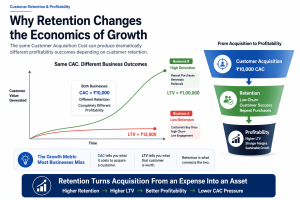
The Hidden Growth Equation

Many businesses measure marketing success like this:

Higher Conversions

More Customers

Business Growth

But the real equation is often much different.

Higher Conversions

Lower Retention

Lower Customer Lifetime Value (LTV)

Lower Profitability

More Pressure to Acquire New Customers

This creates a cycle that feels like growth…

But behaves like survival.

Revenue increases temporarily.

Then customers leave.

Marketing spends more to replace them.

The cycle repeats.

But when customers stay longer, buy again, and become advocates, Customer Lifetime Value (LTV) increases naturally, making growth more sustainable and profitable.
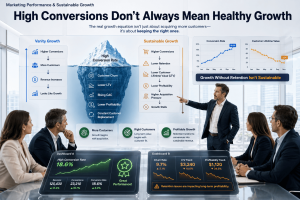
Why high converting marketing can still hurt growth

Why This Happens

Some marketing campaigns are designed to maximize immediate action.

They rely on:

  • Heavy discounts
  • Limited-time offers
  • Clickbait headlines
  • Unrealistic guarantees
  • Aggressive urgency
  • Oversimplified messaging

These tactics often increase conversions.

But they don’t always attract customers who are committed to long-term success.

Instead, they may attract people who are motivated primarily by:

  • Price
  • Urgency
  • Curiosity
  • Short-term expectations

Those customers often leave just as quickly as they arrived.

SME Example

An SME launches a campaign offering extremely deep discounts to attract new customers.

Sales increase rapidly.

But many customers never purchase again after the promotional offer ends.

Revenue spikes.

Then declines.

The campaign succeeded at generating sales.

It failed at building lasting customer relationships.

Service Business Example

A consulting firm promises rapid business growth to encourage more discovery calls.

Many businesses sign contracts.

But once they realize meaningful transformation requires time, collaboration, and implementation, frustration grows.

The agency acquires more clients.

But client retention falls.

SaaS Example

A SaaS company offers a free trial with messaging that makes implementation appear effortless.

Thousands of users sign up.

After onboarding, many discover successful adoption requires training, process changes, and team involvement.

Trial conversions look impressive.

Renewals remain weak.

The marketing campaign optimized sign-ups—not long-term customer success.

D2C Example

An online retailer promotes massive flash sales every month.

Customers become conditioned to purchase only during discounts.

Very few buy at full price.

Brand loyalty weakens.

Profit margins shrink.

Repeat purchases become dependent on continuous promotions.

The business grows revenue…

But sacrifices profitability.

The Bigger Insight

Marketing doesn’t exist to generate the highest possible conversion rate.

Its purpose is to generate profitable customer relationships.

Sometimes that means accepting fewer conversions.

Because fewer well-qualified customers often create:

  • Higher retention
  • Higher LTV
  • Stronger referrals
  • Better margins
  • More predictable revenue

In other words…

Quality often outperforms quantity.

The Revenue Trap

Many businesses proudly celebrate metrics like:

  • More leads
  • Higher click-through rates
  • Lower cost per lead
  • Better conversion rates

Those numbers look impressive.

But they don’t answer an even more important question:

“Did those customers become profitable?”

That’s the metric that matters.

Because marketing should never be judged solely by how many customers it creates.

It should also be judged by how much long-term value those customers generate.

Actionable Tips

  1. Measure Beyond Conversions

Track marketing performance using:

  • Customer Retention Rate
  • Customer Lifetime Value (LTV)
  • Churn Rate
  • Renewal Rate
  • Repeat Purchase Rate
  • Revenue Per Customer

These metrics reveal whether your marketing is creating lasting value.

  1. Optimize for Customer Quality

Ask:

“Will this campaign attract customers who are likely to succeed with our solution?”

Customer fit should be a marketing objective—not just a sales objective.

  1. Be Careful with Aggressive Promotions

Discounts and urgency can increase conversions.

But use them strategically.

Don’t build your entire acquisition strategy around tactics that attract short-term buyers.

  1. Align Marketing Success with Business Success

Marketing KPIs shouldn’t end at conversions.

Include:

  • Retention
  • LTV
  • Profitability
  • Customer Success

When marketing is measured this way, campaigns naturally become more sustainable.

  1. Build Trust Instead of Hype

The strongest marketing doesn’t simply persuade people to buy.

It prepares the right customers to succeed after they buy.

And successful customers almost always become more profitable customers.

Key Takeaway

A campaign that generates the highest conversion rate isn’t necessarily the campaign that creates the most profitable business.

When marketing prioritizes conversions over customer fit, expectation management, and long-term value, businesses often experience:

  • Higher churn
  • Lower customer lifetime value (LTV)
  • Greater dependence on continuous acquisition
  • Reduced profitability

The smartest businesses don’t optimize marketing for the first sale alone.

They optimize it for the entire customer relationship.

Because the true measure of marketing success isn’t how many customers it acquires.

It’s how many customers stay, grow, and create lasting value over time.


The Hidden Cost of Wrong-Fit Customers

Most businesses celebrate every new customer.

After all, more customers usually mean more revenue.

Or so it seems.

But here’s a question that rarely gets asked:

“Are these the right customers for our business?”

Because not every customer contributes to sustainable growth.

Some customers generate revenue.

Others generate problems.

When marketing attracts people who aren’t a good fit for your product or service, the cost goes far beyond a lost sale.

It quietly affects almost every part of the business.

Many of these costs never appear in marketing reports.

But they show up everywhere else.

The Hidden Costs Businesses Often Miss

Wrong-fit customers typically increase:

  • Customer support requests
  • Refunds and cancellations
  • Customer churn
  • Sales pressure to replace lost revenue
  • Difficulty recovering Customer Acquisition Cost (CAC)
  • Employee stress and burnout
  • Negative reviews and poor referrals

Individually, these problems may seem manageable.

Together, they create a growth system that becomes increasingly expensive to maintain.

The business feels busy.

Revenue may even appear to be growing.

But profitability quietly declines.
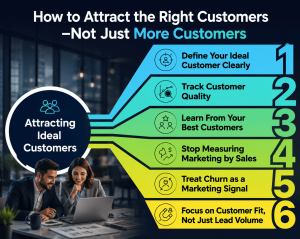
Hidden cost of wrong-fit customers

Why Wrong-Fit Customers Struggle

A customer who isn’t the right fit often experiences challenges such as:

  • Difficulty adopting the product
  • Unrealistic expectations
  • Limited internal resources
  • Different business objectives
  • Misunderstanding the value proposition

Even when your solution performs exactly as intended, these customers are less likely to succeed.

And customers who don’t achieve success rarely become long-term customers.

Service Business Example

Imagine a digital transformation consultancy.

Its ideal clients are medium-sized businesses willing to invest time in long-term operational improvements.

However, the marketing campaigns focus heavily on messages like:

“Fast business growth.”

The campaign attracts companies looking for immediate results.

Sales increase.

The marketing team celebrates.

New contracts are signed every month.

But after about 60 days, a different pattern begins to emerge.

Clients become frustrated because they expected rapid outcomes rather than a structured transformation process.

Projects are cancelled.

Refund requests increase.

The delivery team spends more time managing dissatisfied clients than delivering strategic value.

Customer Success works harder.

Sales works harder to replace lost revenue.

Finance notices that profit margins are shrinking.

Marketing appears successful.

The business becomes less profitable.

The problem wasn’t lead generation.

The problem was customer fit.

SME Example

A manufacturing SME markets its services broadly across multiple industries.

The campaigns attract a high volume of inquiries.

Many companies purchase.

But several customers require solutions outside the company’s expertise.

Projects become difficult.

Implementation takes longer.

Customer satisfaction falls.

The business spends valuable resources serving customers it was never ideally positioned to help.

SaaS Example

A SaaS platform built for enterprise organizations launches campaigns targeting startups and freelancers.

Sign-ups increase dramatically.

However, smaller businesses struggle with:

  • Advanced workflows
  • Complex reporting
  • Multi-user configurations
  • Implementation requirements

Many customers cancel within a few months.

The software wasn’t the problem.

The audience was.

D2C Example

A premium home appliance brand relies heavily on discount-driven advertising.

The campaigns attract bargain hunters looking for the lowest possible price.

Sales rise during promotional periods.

But repeat purchases remain low.

Brand loyalty weakens.

Customers simply wait for the next discount—or buy from competitors.

Revenue grows.

Long-term customer value does not.

The Bigger Reality

Wrong-fit customers create pressure throughout the organization.

Sales teams feel constant pressure to replace lost customers.

Customer Success spends more time solving preventable problems.

Support teams manage more complaints.

Marketing increases acquisition efforts.

Finance struggles to improve profitability.

Leadership wonders why growth feels so difficult.

The answer often isn’t a lack of customers.

It’s a lack of the right customers.

The businesses that grow sustainably don’t simply acquire more customers.

They consistently attract customers who are positioned to succeed.

Because successful customers tend to:

  • Stay longer
  • Buy more
  • Recommend others
  • Generate higher Customer Lifetime Value (LTV)

Customer quality almost always matters more than customer quantity.

Actionable Tips

  1. Define Your Ideal Customer Clearly

Document:

  • Business size
  • Industry
  • Budget
  • Goals
  • Operational maturity
  • Typical challenges

The clearer your Ideal Customer Profile (ICP), the easier it becomes to attract customers who are likely to succeed.

  1. Track Customer Quality—Not Just Lead Volume

Review:

  • Retention rate by customer segment
  • Average Customer Lifetime Value (LTV)
  • Churn by acquisition source
  • Refund rates
  • Customer success metrics

These reveal whether marketing is attracting the right audience.

  1. Learn From Your Best Customers

Ask:

“What characteristics do our longest-retained customers have in common?”

Then build future campaigns around those insights.

  1. Stop Measuring Marketing Only by Sales

Successful marketing doesn’t simply create customers.

It creates customers who remain profitable over time.

  1. Treat Churn as a Marketing Signal

When certain customer groups consistently leave early, investigate whether marketing attracted people who were never an ideal fit.

Improving retention often starts by improving customer selection.

Key Takeaway

The cost of a wrong-fit customer extends far beyond a single lost account.

It increases support costs, refund requests, customer churn, sales pressure, CAC recovery time, employee burnout, and negative reviews.

Businesses that prioritize customer fit instead of customer volume build stronger retention, healthier profit margins, and more sustainable growth.

Because the right customer doesn’t just buy.

They succeed, stay, and continue creating value for both your business and theirs.


Marketing Should Pre-Qualify Customers

One of the biggest misconceptions about marketing is that its primary job is to attract as many customers as possible.

For years, businesses have measured marketing success by asking questions like:

  • How many leads did we generate?
  • How many visitors came to our website?
  • How many people filled out our forms?
  • How many customers converted?

These metrics are useful.

But they don’t answer a much more important question.

“Were these the right customers?”

Because attracting people who are unlikely to succeed with your product or service isn’t growth.

It’s expensive acquisition.

This is where the role of marketing needs to change.

Marketing shouldn’t only attract.

Marketing should also filter.

Great marketing doesn’t try to convince everyone to buy.

It helps the right customers recognize they’re a good fit—and helps the wrong customers recognize they’re not.

That may sound counterintuitive.

After all, why would a business intentionally discourage potential buyers?

Because every wrong-fit customer who doesn’t buy today may prevent future churn, refunds, negative reviews, and wasted resources tomorrow.

In many cases, saying “This solution isn’t right for you” is one of the most profitable marketing decisions a business can make.

What Pre-Qualification Really Means

Pre-qualification begins long before a sales conversation.

It happens through the way your business communicates.

Your website.

Your advertisements.

Your content.

Your case studies.

Your pricing.

Your messaging.

All of these should help prospects answer two important questions:

“Is this solution designed for businesses like mine?”

And just as importantly:

“Am I likely to succeed with this solution?”

When customers can answer those questions before buying, they make better purchasing decisions.

And businesses acquire customers who are more likely to stay.

SME Example

An SME provides supply chain optimization for medium-sized manufacturing businesses.

Previously, its marketing promoted:

“We improve operational efficiency.”

The message attracted manufacturers of every size.

Some businesses lacked the systems, budgets, or internal teams needed to implement the recommendations successfully.

The company refined its messaging to say:

“Designed for growing manufacturers with established operations and dedicated improvement teams.”

Lead volume decreased slightly.

But customer quality improved dramatically.

Projects became smoother.

Retention increased.

Service Business Example

A premium business consulting firm stopped promoting itself as the solution for “every business.”

Instead, its website clearly explained:

  • Who benefits most
  • Who may not be ready
  • What level of commitment is required
  • Typical implementation timelines

Some prospects decided not to proceed.

Those who did were better informed, more committed, and stayed much longer.

The business closed fewer unsuitable clients and retained more ideal ones.

SaaS Example

A SaaS company added a section to its product pages titled:

“Who This Platform Is Best For”

Alongside it, they included another section:

“Who May Need a Different Solution”

Rather than reducing sign-ups, this transparency improved trust.

Customers who subscribed understood what to expect.

Implementation became smoother.

Support tickets declined.

Renewals increased.

D2C Example

A premium mattress brand created a buying guide explaining:

  • Who the mattress was designed for
  • Preferred sleeping positions
  • Firmness levels
  • Who might prefer a softer alternative

Some shoppers chose not to purchase.

But those who did experienced greater satisfaction.

Returns decreased.

Positive reviews increased.

Customer confidence improved before the purchase even happened.

The Bigger Insight

Many businesses believe that excluding prospects means losing revenue.

In reality, attracting the wrong customers often costs far more than declining them.

The strongest marketing doesn’t appeal to everyone.

It speaks clearly to the customers most likely to benefit.

That clarity improves:

  • Customer satisfaction
  • Product adoption
  • Customer success
  • Retention
  • Customer Lifetime Value (LTV)
  • Profitability

Marketing becomes more than a demand-generation function.

It becomes a customer-quality function.

Actionable Tips

  1. Clearly Define Who Your Solution Is For

Don’t make prospects guess.

State your ideal customer profile openly.

  1. Explain Who May Not Be a Good Fit

Being transparent builds credibility.

Customers appreciate honesty.

  1. Educate Before You Persuade

Use content, guides, webinars, FAQs, and case studies to help prospects understand:

  • What success looks like
  • What commitment is required
  • Typical timelines
  • Expected outcomes

Education helps customers self-qualify.

  1. Align Marketing With Customer Success

Ask your Customer Success team:

“Which customers achieve the best long-term results?”

Use those insights to refine your marketing messages and targeting.

  1. Measure Customer Fit as a Marketing KPI

In addition to tracking leads and conversions, monitor:

  • Retention Rate
  • Customer Lifetime Value (LTV)
  • Churn by acquisition source
  • Product Adoption
  • Renewal Rate

These metrics reveal whether your marketing is attracting customers who are built for long-term success.

Key Takeaway

The most effective marketing doesn’t try to convince everyone to become a customer.

It helps the right customers recognize the value of your solution while helping the wrong-fit customers understand that another option may serve them better.

When marketing acts as both an attraction and filtration system, businesses don’t just generate more sustainable growth.

They build stronger customer relationships, improve retention, increase Customer Lifetime Value (LTV), and create a healthier, more profitable business.


Why Honest Marketing Improves Retention

At first, this idea sounds like bad business advice.

Many marketers believe that making bigger promises leads to more sales.

After all, exciting headlines attract attention.

Bold claims generate clicks.

Aggressive offers increase inquiries.

And in the short term, that’s often true.

But there’s a hidden cost that many businesses fail to see.

The more your marketing exaggerates reality, the harder it becomes to meet the expectations it creates.

And when expectations aren’t met, trust begins to fade.

This is why honest marketing is often far more profitable than persuasive marketing.

Not because it generates more immediate sales.

But because it generates better customer relationships.

Honest Marketing Is Not Weak Marketing

Some businesses worry that if they’re completely honest about timelines, effort, or limitations, prospects will lose interest.

In reality, honesty doesn’t reduce value.

It increases credibility.

Customers don’t expect perfection.

They expect transparency.

When a business openly explains:

  • What customers can realistically expect
  • How long results usually take
  • What challenges may arise
  • What role the customer plays in success

Prospects feel more informed.

And informed customers tend to become more committed customers.

The Short-Term vs Long-Term Trade-Off

Honest marketing may reduce:

  • Short-term conversions
  • Impulse purchases
  • Unqualified inquiries
  • Unrealistic expectations

But it often improves:

  • Customer trust
  • Customer retention
  • Customer Lifetime Value (LTV)
  • Referral rates
  • Profitability

That’s because the customers who move forward do so with a clear understanding of the journey ahead.

There are fewer surprises.

Fewer disappointments.

And far fewer reasons to leave early.

Scenario: Two Marketing Agencies

Imagine two digital marketing agencies competing for similar clients.

Agency A

Its website promises:

“Guaranteed leads in just 30 days.”

Prospects become excited.

Sales calls increase.

New clients sign quickly.

But after onboarding, clients discover:

  • Research takes time
  • Campaign testing is required
  • Optimization is ongoing
  • Meaningful results often take several months

Many clients become impatient.

Some request refunds.

Others cancel before the strategy has time to work.

The agency acquires clients quickly.

But struggles to retain them.

Agency B

Its website explains:

“Most businesses begin seeing measurable improvements within 60–90 days, depending on their market, competition, and existing digital presence.”

It also explains:

  • The implementation process
  • Client responsibilities
  • Success milestones
  • Common challenges

Some prospects decide they’re not ready.

Others appreciate the transparency.

Those who become clients understand the journey before it begins.

As a result:

  • Trust starts earlier.
  • Expectations remain realistic.
  • Clients stay longer.
  • Referrals increase.

Agency B may convert fewer prospects initially.

But it builds stronger, more profitable client relationships over time.

The difference wasn’t the quality of the service.

It was the quality of the expectations.

SME Example

An SME selling industrial automation solutions explains that implementation typically takes three to six months and requires collaboration between internal teams.

Some businesses looking for immediate results choose another provider.

Those that proceed understand the commitment involved.

Projects run more smoothly.

Customer satisfaction improves.

Renewals become more common.

Service Business Example

A leadership coaching firm clearly states that meaningful behavioral change requires ongoing coaching and active participation.

Rather than promising instant transformation, it emphasizes consistent progress.

Clients begin the engagement with realistic expectations.

Completion rates increase.

Long-term coaching relationships become more common.

SaaS Example

A SaaS company replaces the message:

“Set up in minutes.”

With:

“Most teams complete implementation within two to four weeks with guided onboarding.”

Trial sign-ups decrease slightly.

But product adoption improves.

Support requests decline.

Renewal rates increase because customers know what success requires.

D2C Example

A skincare brand stops advertising dramatic overnight results.

Instead, it explains:

  • Typical improvement timelines
  • Daily usage recommendations
  • Factors that influence results

Customers begin purchasing with realistic expectations.

Returns decrease.

Repeat purchases increase.

The brand earns stronger customer trust.

The Bigger Insight

Many businesses believe marketing’s job is to persuade people to buy.

But sustainable growth requires something more.

Marketing should prepare customers for success.

Because customers who understand the journey are far more likely to complete it.

And customers who complete the journey are far more likely to stay.

Actionable Tips

  1. Audit Your Marketing Promises

Review every customer-facing message.

Ask:

“Can we consistently deliver what we’re promising?”

If not, refine the message before refining the campaign.

  1. Explain the Journey—Not Just the Destination

Talk about:

  • The process
  • Expected milestones
  • Customer responsibilities
  • Common obstacles
  • Typical timelines

Clarity builds confidence.

  1. Use Real Customer Stories

Highlight not only successful outcomes but also the effort, time, and collaboration involved.

Authentic success stories create healthier expectations than exaggerated claims.

  1. Celebrate Transparency

Instead of fearing honest conversations, position them as a competitive advantage.

Customers remember businesses that tell the truth.

  1. Measure Trust, Not Just Conversions

Track indicators such as:

  • Customer retention
  • Customer Lifetime Value (LTV)
  • Renewal rates
  • Referral rates
  • Customer satisfaction

These metrics often reveal whether your marketing is creating lasting relationships.

Key Takeaway

Honest marketing may not always generate the highest number of immediate conversions.

But it often creates something far more valuable.

Customers who:

  • Trust your business
  • Understand the process
  • Have realistic expectations
  • Stay longer
  • Generate higher lifetime value

Because sustainable growth isn’t built on exciting promises.

It’s built on promises that are consistently fulfilled.


Marketing’s New Job is Setting Customers Up for Success

For many years, marketing has been viewed as the department responsible for attracting attention.

Its objectives were clear:

  • Generate awareness.
  • Increase website traffic.
  • Produce leads.
  • Improve conversion rates.

Those goals are still important.

But today’s businesses need marketing to do something much bigger.

They need marketing to prepare customers for success.

Because acquiring a customer is only the beginning of the relationship.

What happens next determines whether that customer becomes profitable.

This is why marketing’s role is evolving.

It’s no longer just the first stage of the buying journey.

It’s becoming the first stage of customer success.

Once businesses understand why customer retention starts before the sale, they begin treating marketing as the first stage of customer success instead of simply the first stage of customer acquisition.
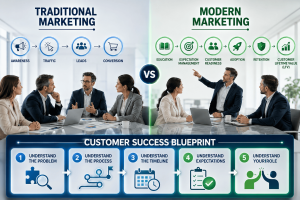
Set customers up for success

What Modern Marketing Should Teach

Before a prospect becomes a customer, they should already understand:

The Problem

Why does the problem exist?

How does it affect the business?

What happens if it isn’t solved?

When customers clearly understand the problem, they appreciate the solution more deeply.

The Process

Many businesses explain what they sell.

Far fewer explain how success is achieved.

Customers should know:

  • What happens first
  • What happens next
  • How implementation works
  • What the overall journey looks like

When the process is clear, uncertainty decreases.

The Timeline

One of the biggest causes of disappointment is unrealistic timing.

Modern marketing should explain:

  • Typical implementation periods
  • When customers usually begin seeing results
  • Why meaningful outcomes often require consistency

Clear timelines create realistic expectations.

Expectations

Customers should understand:

  • What the solution will do
  • What it won’t do
  • What’s included
  • What’s not included

The fewer surprises customers encounter, the stronger retention becomes.

Required Commitment

Success is rarely one-sided.

Customers play an important role too.

Marketing should explain:

  • What participation is required
  • What resources are needed
  • How customers contribute to successful outcomes

When customers understand their role, they become active participants rather than passive buyers.

The strongest Customer Retention Marketing doesn’t focus only on acquiring new customers—it also educates prospects, builds trust, and creates expectations that support long-term loyalty.

SME Example

An SME offering ERP implementation creates educational resources explaining the preparation, training, and internal collaboration required before implementation begins.

Prospective customers enter projects with greater confidence.

Adoption improves.

Projects experience fewer delays.

Customer relationships become stronger.

Service Business Example

A financial advisory firm shares a detailed roadmap showing how financial planning unfolds over the first twelve months.

Clients understand that meaningful wealth creation requires ongoing decisions rather than one-time actions.

Engagement increases.

Retention improves.

SaaS Example

Before asking users to start a free trial, a SaaS company provides an interactive onboarding preview.

Prospects learn:

  • Setup requirements
  • Team responsibilities
  • Expected milestones
  • Best practices

Customers begin their journey already prepared for success.

Activation rates increase.

Renewals improve.

D2C Example

A premium fitness equipment brand creates educational videos demonstrating assembly, maintenance, and realistic fitness expectations.

Customers know exactly what they’re purchasing and how to use it effectively.

Returns decline.

Customer satisfaction rises.

Repeat purchases become more frequent.

The Bigger Insight

Marketing shouldn’t simply persuade people to buy.

It should help people succeed after they buy.

When customers begin their journey with knowledge, clarity, and realistic expectations, every department benefits.

Sales spends less time managing objections.

Customer Success spends less time repairing misunderstandings.

Support receives fewer preventable questions.

Leadership sees stronger retention and healthier profit margins.

Marketing becomes more than a demand-generation function.

It becomes a growth-enablement function.

Actionable Tips

  1. Create Educational Content for Every Stage

Don’t limit your content to promotional messaging.

Help prospects understand:

  • The problem
  • The solution
  • The implementation journey
  • Expected outcomes
  1. Collaborate With Customer Success

Ask your Customer Success team:

“What do customers wish they knew before purchasing?”

Turn those insights into marketing assets.

  1. Build Expectation Management Into Every Campaign

Every advertisement, landing page, webinar, and sales presentation should answer:

  • What should customers expect?
  • What commitment is required?
  • What does success typically look like?
  1. Measure Success Beyond Conversions

Evaluate marketing based on metrics such as:

  • Customer Retention Rate
  • Customer Lifetime Value (LTV)
  • Product Adoption
  • Renewal Rate
  • Customer Satisfaction

These metrics reflect long-term business health.

  1. Think Like the First Customer Success Team

Before launching any campaign, ask:

“Will this help future customers succeed after they buy?”

If the answer is yes, your marketing is contributing to retention—not just acquisition.

Key Takeaway

The role of marketing has evolved.

Its purpose is no longer limited to attracting prospects and increasing conversions.

Modern marketing prepares customers for success by helping them understand:

  • The problem they’re solving
  • The process they’ll follow
  • The timeline they should expect
  • The commitment success requires
  • The role they’ll play in achieving results

When marketing creates clarity before the sale, customer success begins before onboarding.

And businesses that treat marketing as the first stage of customer success build stronger trust, higher retention, greater Customer Lifetime Value (LTV), and more sustainable long-term growth.


Signs Your Marketing Is Creating Future Churn

Marketing teams often celebrate metrics like impressions, clicks, leads, and conversions.

Those numbers matter.

But they don’t always tell the whole story.

A campaign can generate a large number of customers…

…and still create long-term growth problems if those customers don’t stay.

That’s why businesses should evaluate marketing not only by how many customers it acquires, but also by the quality of the customers it brings in.

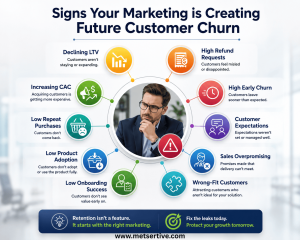
The checklist below can help you identify whether your marketing is quietly creating future retention problems.

If several of these signs sound familiar, it may be time to rethink not just your marketing campaigns—but your entire customer acquisition strategy.

  1. High Refund Requests

Refunds often indicate more than product dissatisfaction.

They can signal that customers purchased with expectations that were never aligned with reality.

SME Example

A business consultancy promotes:

“Transform your business in just 30 days.”

Clients quickly discover meaningful transformation requires several months.

Refund requests increase—not necessarily because the advice lacks value, but because expectations were unrealistic.

Service Business Example

A web development agency promises “launch in two weeks.”

The project requires multiple revisions, approvals, and integrations.

Clients become frustrated and request partial refunds.

SaaS Example

A CRM platform markets itself as “ready in minutes.”

Customers later discover implementation requires team training and data migration.

Many request cancellations before fully adopting the platform.

D2C Example

An online retailer showcases product images that differ significantly from the delivered product.

Return requests increase because expectations weren’t met.

Actionable Tip

Review your refund reasons regularly.

If customers repeatedly mention:

  • “Not what I expected.”
  • “Different from what was advertised.”
  • “Didn’t realize this.”

…the issue may lie in your marketing, not your delivery.

  1. High Early Churn

Customers leave shortly after buying.

This usually means they never experienced enough value to stay.

Often, the reason isn’t poor service.

It’s poor expectation management.

SME Example

Businesses purchase accounting software expecting immediate automation.

When they realize setup requires configuration, many abandon the platform within weeks.

Service Business Example

A consulting firm signs several new clients.

Most terminate within the first two months because they expected implementation—not strategic guidance.

SaaS Example

Users sign up after reading bold productivity claims.

Without understanding the onboarding process, they stop using the software after a few weeks.

D2C Example

A subscription box attracts customers through heavy discounts.

Many cancel immediately after the first shipment.

Actionable Tip

Track churn within the first 30, 60, and 90 days.

Early churn often reflects marketing quality more than customer support quality.
Signs your marketing is creating future customer churn

  1. Customers Frequently Say…

“I Expected Something Different.”

This single sentence is one of the strongest warning signs a business can receive.

When customers consistently express surprise after buying, it usually indicates a disconnect between marketing and reality.

SME Example

Customers expected a fully managed service.

Instead, they purchased software requiring internal effort.

Service Business Example

Clients expected daily communication.

The agency operates with weekly reporting.

SaaS Example

Users assumed every feature was included.

They later discover premium functionality requires an upgrade.

D2C Example

Customers believed a product included accessories shown in advertisements.

It didn’t.

Actionable Tip

Collect post-purchase feedback.

Look specifically for comments related to unmet expectations.

Patterns reveal where messaging needs improvement.

  1. Sales Teams Frequently Overpromise

Marketing creates interest.

Sales reinforces expectations.

If sales consistently promises outcomes beyond what the business can deliver, retention suffers.

SME Example

Sales guarantees implementation timelines that operations cannot realistically achieve.

Service Business Example

An agency promises first-page rankings on search engines within weeks.

Delivery takes months.

SaaS Example

Sales assures prospects that no training will be required.

Customer success later spends weeks helping users get started.

D2C Example

Customer support promises delivery dates during peak seasons that logistics cannot meet.

Actionable Tip

Regularly compare sales conversations with actual delivery experiences.

Alignment reduces disappointment later.

  1. Wrong-Fit Customers Keep Entering

Not every customer should become a customer.

When marketing attracts people who cannot realistically succeed with your solution, churn becomes inevitable.

SME Example

A manufacturing ERP system attracts very small retailers.

The software feels unnecessarily complex.

Service Business Example

A premium consulting firm markets itself to startups with limited budgets and unrealistic expectations.

SaaS Example

Enterprise software attracts freelancers because messaging focuses only on affordability.

D2C Example

Luxury products are promoted primarily through discount messaging.

Price-sensitive buyers rarely become loyal customers.

Actionable Tip

Ask:

“Who are our happiest long-term customers?”

Then build marketing around attracting more people like them.

  1. Low Onboarding Success

Customers purchase.

But never fully adopt.

That often indicates they weren’t adequately prepared before buying.

SME Example

Business owners expect software to replace internal processes instantly.

Instead, onboarding requires collaboration.

Service Business Example

Clients expect agencies to handle everything without their involvement.

Projects stall because responsibilities weren’t explained.

SaaS Example

Users skip onboarding because they don’t understand its importance.

D2C Example

Customers never activate loyalty programs because nobody explained the benefits beforehand.

Actionable Tip

Use marketing to educate customers about what success requires—not just what they’ll receive.

  1. Low Product Adoption

Buying isn’t the same as using.

Marketing can generate purchases.

But adoption determines retention.

Actionable Tip

Monitor feature usage, login frequency, and customer engagement—not just sales.

  1. Low Repeat Purchases

Customers buy once.

Then disappear.

Marketing may be optimized for first-time purchases while ignoring long-term relationships.

Actionable Tip

Evaluate campaigns based on repeat purchase behavior, not only initial conversion rates.

  1. Customer Acquisition Cost (CAC) Keeps Increasing

Businesses often assume rising CAC is purely an advertising problem.

Sometimes it is.

But sometimes poor retention amplifies acquisition costs.

Because customers leave quickly…

Every month starts from zero again.

Actionable Tip

Compare CAC alongside customer lifespan.

Short customer relationships make even efficient acquisition expensive.

  1. Customer Lifetime Value (LTV) Keeps Declining

This is often the final symptom.

Marketing generates customers.

But customers don’t generate lasting value.

Growth becomes increasingly dependent on acquiring new buyers.

Customer Churn Prevention begins with honest marketing, realistic messaging, and attracting customers who are genuinely aligned with your solution

Actionable Tip

Monitor LTV trends by acquisition channel.

Some campaigns may produce many customers—but very little long-term value.

The Big Insight

Marketing isn’t successful simply because it acquires customers.

It’s successful when it acquires customers who stay, succeed, and continue creating value.

The strongest marketing systems don’t just maximize conversions.

They maximize customer quality.

Because customer quality ultimately determines customer retention.


How to Build Retention-First Marketing

Most marketing strategies are built around one question:

“How do we generate more leads?”

Retention-first marketing asks a different question:

“How do we attract customers who are most likely to stay?”

That shift changes everything.

Instead of optimizing only for conversions, businesses begin optimizing for long-term customer success.

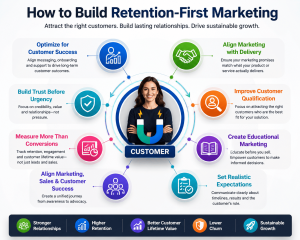
Here are eight practical ways to build marketing that supports retention—not just acquisition.

  1. Align Marketing with Delivery

Your marketing should accurately reflect what your business can consistently deliver.

The more closely promises match reality, the easier it becomes to build trust.

Examples

SME: Promote achievable operational improvements instead of unrealistic transformation timelines.

Service Business: Explain the implementation process before discussing outcomes.

SaaS: Highlight both the platform’s capabilities and the onboarding journey.

D2C: Use authentic product images and realistic demonstrations.

Actionable Tip

Audit your website, ads, and sales materials every quarter.

Ask:

“Can our operations confidently deliver every promise we’re making?”

An effective Customer Retention Strategy begins long before onboarding by ensuring marketing attracts the right customers, sets realistic expectations, and prepares them for long-term success.

  1. Improve Customer Qualification

Not every lead should become a customer.

The goal is customer fit—not customer volume.

Examples

SME: Clearly define company size, industry, and use cases.

Service Business: Explain ideal client profiles before booking consultations.

SaaS: Publish “Who this platform is best suited for.”

D2C: Recommend products based on customer needs rather than promoting every product equally.

Actionable Tip

Introduce qualification questions early in the buying journey.
How to build retention-first marketing

  1. Create Educational Marketing

The best marketing doesn’t just persuade.

It prepares customers for success.

Examples

SME: Publish implementation guides.

Service Business: Share behind-the-scenes project timelines.

SaaS: Offer onboarding webinars before sign-up.

D2C: Create product education videos and usage tutorials.

Actionable Tip

Every marketing asset should answer at least one customer question.

  1. Set Realistic Expectations

Clarity often outperforms exaggeration.

Customers appreciate transparency.

Examples

SME: Explain typical project timelines.

Service Business: Clarify what clients must contribute.

SaaS: Describe realistic adoption periods.

D2C: Communicate shipping times and product limitations honestly.

Actionable Tip

Replace hype-driven claims with outcome-driven education.

  1. Align Marketing, Sales & Customer Success

Customers should experience one consistent message throughout their journey.

Not three different stories.

Examples

SME: Marketing promises exactly what consultants later deliver.

Service Business: Sales proposals match project execution.

SaaS: Product demos reflect actual user experience.

D2C: Product pages match post-purchase support information.

Actionable Tip

Conduct regular alignment meetings across departments.

  1. Measure More Than Conversions

Conversions are only the beginning.

Retention-first businesses measure customer success after the sale.

Track metrics such as:

  • Customer Lifetime Value (LTV)
  • Churn Rate
  • CAC Recovery Period
  • Product Adoption
  • Repeat Purchase Rate
  • Revenue Per Customer

Actionable Tip

Create dashboards that connect marketing campaigns with long-term customer performance.

  1. Build Trust Before You Build Urgency 

Many campaigns focus on creating urgency:

  • Limited-time offers
  • Countdown timers
  • Flash sales
  • Scarcity messaging

Urgency can increase conversions.

But trust is what increases retention.

Customers who buy because they trust you are more likely to stay than customers who buy because they fear missing out.

Examples

SME: Share client success stories and practical insights before asking for a meeting.

Service Business: Publish educational content that demonstrates expertise instead of relying only on promotional messaging.

SaaS: Offer interactive product tours and transparent pricing before encouraging prospects to start a trial.

D2C: Highlight authentic customer reviews, product demonstrations, and care instructions before promoting discounts.

Scenario

Two software companies launch identical products.

  • Company A drives sign-ups with aggressive countdown offers.
  • Company B builds trust through webinars, case studies, and product education.

Company A acquires more users initially.

Company B retains more users over the next 12 months.

The difference isn’t the product.

It’s the trust established before purchase.

Actionable Tip

Ask yourself:

“Does this campaign build confidence—or simply create urgency?”

Retention-first marketing prioritizes confidence.

  1. Optimize Marketing for Customer Success, Not Just Customer Acquisition

Traditional marketing asks:

“How many customers did we acquire?”

Retention-first marketing asks:

“How many customers became successful?”

That’s a very different objective.

When marketing understands what success looks like after the sale, it attracts customers who are more likely to achieve it.

Examples

SME: Feature customer onboarding roadmaps in marketing materials.

Service Business: Explain the collaboration process and expected client involvement before contracts are signed.

SaaS: Showcase product adoption milestones rather than only feature lists.

D2C: Provide clear usage guidance, maintenance tips, and post-purchase education before checkout.

Scenario

An agency stops promoting “fast results” and instead explains its strategic process, realistic timelines, and client responsibilities.

Lead volume decreases slightly.

But client retention improves significantly because expectations are aligned from the start.

Actionable Tip

Work backward from your most successful long-term customers.

Identify:

  • What they understood before buying.
  • What expectations they had.
  • Why they succeeded.

Then build your marketing to help future prospects develop the same understanding.

The Big Shift

The future of marketing isn’t about generating the maximum number of leads.

It’s about generating the right customers with the right expectations.

Because the businesses that grow sustainably don’t just optimize for acquisition.

They optimize for customer success before the sale even happens.

And when marketing consistently attracts well-informed, well-qualified customers, retention stops feeling like a separate function.

It becomes the natural outcome of a better customer journey.

Key Takeaway

Retention-first marketing recognizes that every advertisement, landing page, sales conversation, and piece of educational content shapes the kind of customer your business acquires.

When marketing:

  • Attracts the right audience
  • Sets realistic expectations
  • Educates prospects before they buy
  • Aligns with sales and delivery
  • Builds trust instead of hype
  • Measures long-term customer success—not just conversions
  • Optimizes for customer outcomes instead of lead volume
  • Continuously refines messaging based on retention insights

…it doesn’t just generate more customers.

It generates customers who stay longer, achieve better outcomes, increase lifetime value, and become advocates for your business.

That’s when marketing stops being just a lead-generation function and becomes one of the most powerful drivers of long-term profitability.


The Revenue Architecture Perspective

Throughout this guide, we’ve explored an idea that many businesses overlook:

Marketing doesn’t stop influencing the customer after the first purchase.

It continues shaping the customer experience long after the sale.

That realization leads to a much bigger strategic shift.

Marketing should no longer be evaluated only by the number of leads it generates.

It should also be evaluated by the quality of customers it brings into the business.

The Traditional Marketing Dashboard

Many businesses measure marketing using metrics such as:

  • Website traffic
  • Click-through rates
  • Cost per lead
  • Lead volume
  • Conversion rate
  • Cost per acquisition (CAC)

These metrics are useful.

But they tell only part of the story.

Imagine two marketing campaigns.

Campaign A generates 500 new customers.

Campaign B generates 300 new customers.

At first glance, Campaign A appears more successful.

But now look deeper.

Campaign A customers:

  • Cancel quickly
  • Request refunds
  • Require heavy support
  • Rarely buy again
  • Leave poor reviews

Campaign B customers:

  • Stay longer
  • Spend more
  • Renew consistently
  • Refer other customers
  • Become advocates

Which campaign actually created more value?

The answer is obvious.

The campaign that attracted better customers—not simply more customers.

That is the difference between measuring lead quantity and measuring revenue quality.

Revenue Quality Is the Metric That Matters

A customer is more than a conversion.

A customer is a future revenue stream.

Their value depends on what happens after they buy.

High-quality customers often:

  • Stay longer
  • Achieve better outcomes
  • Purchase again
  • Upgrade over time
  • Recommend your business to others
  • Cost less to support
  • Generate higher lifetime value

Low-quality customers often:

  • Leave early
  • Demand refunds
  • Create support challenges
  • Increase churn
  • Reduce profitability

The number of customers may look impressive.

But the quality of those customers determines the health of the business.

Businesses that want to Improve Customer Retention should evaluate not only what happens after the sale, but also how marketing influences customer expectations before conversion.

The Revenue Architecture Mindset

At Metsertive, we believe growth should never be viewed as isolated activities.

Marketing.

Sales.

Customer success.

Retention.

Each one influences the next.

They are all connected parts of a single revenue system.

That means every marketing decision affects more than acquisition.

It also affects:

  • Customer fit
  • Customer expectations
  • Product adoption
  • Customer satisfaction
  • Retention
  • Customer Lifetime Value (LTV)
  • Profitability

When these elements work together, growth becomes easier to sustain.

When they work against one another, businesses experience hidden revenue leakage.

This is why we refer to growth as Revenue Architecture.

It’s about designing every stage of the customer journey so that each one strengthens the next.

What Revenue-First Marketing Looks Like

Instead of asking:

“How many leads did we generate this month?”

High-performing businesses ask:

  • Did we attract the right customers?
  • Did they understand what success requires?
  • Are they adopting the product or service?
  • Are they renewing?
  • Are they becoming more valuable over time?
  • Are they referring others?

Those questions connect marketing directly to business performance.

Not just campaign performance.

Examples Across Different Business Types

SME Example

An SME launches two marketing campaigns.

The first campaign offers steep discounts and attracts price-sensitive buyers.

The second campaign focuses on educating businesses that genuinely need the solution.

The first campaign generates more sales.

The second campaign generates customers who stay longer and buy repeatedly.

The second campaign produces higher revenue quality.

Service Business Example

A consulting firm shifts its messaging from:

“Guaranteed rapid business growth.”

to:

“A strategic partnership focused on sustainable, long-term growth.”

Although fewer prospects enquire initially, the clients who do engage have more realistic expectations.

Projects run more smoothly.

Client retention improves.

Referrals increase.

SaaS Example

A SaaS company replaces feature-heavy advertisements with educational content explaining:

  • Who the platform is for
  • What implementation involves
  • Typical timelines for success
  • The commitment required from customers

Trial sign-ups decline slightly.

But activation rates, renewals, and customer lifetime value increase significantly.

The company attracts fewer—but far better—customers.

D2C Example

An online retailer stops promoting unrealistic “instant transformation” claims.

Instead, it highlights authentic customer experiences, product benefits, and realistic outcomes.

Purchase volume remains steady.

Returns decrease.

Customer reviews improve.

Repeat purchases become more frequent.

Trust becomes a competitive advantage.

Actionable Tips

If you want marketing to contribute to long-term revenue—not just short-term conversions—consider these steps:

  1. Measure customer quality, not just customer quantity.
  2. Track metrics such as LTV, retention, and repeat purchases alongside lead generation.
  3. Align marketing goals with long-term business outcomes rather than monthly campaign targets.
  4. Regularly review whether your messaging is attracting customers who are most likely to succeed.
  5. Treat marketing as the beginning of the customer relationship—not the end of the sales process.

The Big Insight

Marketing should never be judged solely by the number of customers it acquires.

It should also be judged by the value those customers create over time.

Because businesses don’t become more profitable simply by acquiring more customers.

They become more profitable by acquiring customers who stay, grow, and contribute to long-term revenue.


Conclusion

For many years, businesses have viewed marketing through a narrow lens.

Its primary purpose was to generate awareness, attract leads, and drive conversions.

Once the customer made a purchase, responsibility shifted to customer support, onboarding, or customer success.

But as we’ve explored throughout this guide, that perspective is incomplete.

Marketing influences far more than the first transaction.

It shapes the expectations customers carry into the relationship.

It influences whether the right people choose your business.

It builds—or weakens—trust before the first conversation even begins.

And those early impressions often determine whether customers remain loyal months or years later.

The most effective marketing strategies to reduce customer churn focus on building trust, setting realistic expectations, and preparing customers for long-term success rather than chasing short-term conversions.

The Customer Journey Is One Continuous Experience

Customers don’t experience your business in disconnected departments.

They don’t separate:

  • Marketing
  • Sales
  • Onboarding
  • Customer Success
  • Retention

They experience one continuous journey.

Every promise they hear before purchasing influences how they evaluate your business afterward.

When that journey is consistent, customers gain confidence.

When it’s inconsistent, trust begins to erode.

This is why marketing has a lasting impact on customer retention.

Great Marketing Prepares Customers for Success

The most effective marketing doesn’t simply persuade people to buy.

It prepares them to succeed after they buy.

It helps prospects understand:

  • The problem they’re solving
  • The solution you’re providing
  • What the implementation process involves
  • The expected timeline for results
  • Their own role in achieving success

As a result, customers begin the relationship with clarity rather than confusion.

And clarity creates confidence.

The Businesses That Retain Customers Best Rarely Rely on Luck

Strong retention isn’t usually the result of exceptional customer support alone.

It starts much earlier.

The businesses that consistently retain customers are often the ones that:

  • Attract the right audience instead of everyone
  • Communicate honestly and consistently
  • Set realistic expectations from the beginning
  • Educate prospects before asking them to buy
  • Build trust through transparency
  • Align marketing, sales, and delivery around the same message

These businesses don’t simply acquire customers.

They create relationships designed to last.

The Strategic Shift

Instead of asking:

“How can marketing generate more leads?”

Ask:

“How can marketing attract customers who are most likely to succeed—and stay?”

That single shift changes how businesses think about growth.

Marketing becomes more than a lead generation function.

It becomes the first stage of customer success.

And customer retention becomes a natural outcome of a well-designed customer journey.

Final Takeaway

Great marketing doesn’t end when a prospect becomes a customer.

In many ways, that’s where its true impact begins.

Because the messages customers hear before they buy shape the expectations they carry after they buy.

And those expectations influence trust, adoption, satisfaction, and long-term loyalty.

Businesses that recognize this don’t just generate more customers.

They generate better customers.

Customers who stay longer.

Spend more.

Refer others.

And contribute to predictable, profitable growth.

At Metsertive, we believe sustainable growth isn’t created by optimizing isolated marketing campaigns.

It’s created by designing a Revenue Architecture where marketing, sales, customer experience, and retention work together as one connected system.

Because great marketing doesn’t just acquire customers.

It helps keep them.
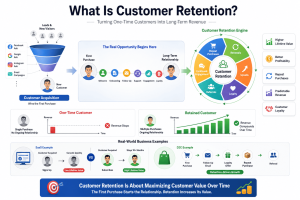
 

Why Customer Retention Is More Profitable Than Acquisition

Most businesses believe growth comes from one thing:

Acquiring more customers.

So they invest in:
• More ads
• More lead generation
• More sales activity
• More marketing campaigns

And while new customers do drive growth…

There’s a question many businesses never stop to ask:

What happens after the customer buys?

Because this is where a surprising amount of revenue is either created—or lost.

Many businesses work hard to acquire customers only to watch them disappear after the first purchase, cancel after a few months, or slowly disengage without realizing the long-term impact on profitability.

The result?

  • Rising acquisition costs
    • Constant pressure to generate more leads
    •  Revenue that feels unpredictable
    •  Growth that becomes harder and more expensive to sustain

Meanwhile, other businesses seem to grow with less pressure.

Not because they’re acquiring dramatically more customers.

But because they’re keeping customers longer, increasing customer value, and generating more revenue from relationships they’ve already earned.

That’s the power of customer retention.

In this guide, you’ll discover:

✔ Why customer retention is often more profitable than customer acquisition

✔ The hidden revenue leaks that occur after conversion

✔ How retention impacts Customer Acquisition Cost (CAC), Customer Lifetime Value (LTV), and profitability

✔ Why many businesses have a retention problem disguised as a lead generation problem

✔ Practical ways to increase customer value and create more sustainable growth

Because long-term growth isn’t just about getting more customers.

It’s about maximizing the value of the customers you already have.

And the businesses that understand that distinction often outperform competitors who are trapped in the endless cycle of chasing the next lead.

What Is Customer Retention?

Let’s simplify this.

What is customer retention?

Customer retention means:
Keeping customers engaged, satisfied, and buying over time.

That’s the core idea.

It’s about building relationships that continue after the first sale.

Because the first purchase is not the finish line.

It’s the beginning of the customer relationship.

Retention Is About Long-Term Customer Value

Most businesses focus heavily on this question:

“How do we get customers?”

But fewer ask:

“How do we keep them?”

That second question is where retention lives.

Retention includes things like:

  • Repeat purchases
    • Renewals
    • Upsells
    • Continued engagement
    • Customer loyalty
    • Reduced churn
    • Long-term relationships

In simple terms:

Retention measures how long customers continue doing business with you.

Simple Example

Let’s say two businesses each acquire 100 customers.

Business A

  • Most customers buy once
    • Few return
    • Revenue resets every month

Business B

  • Customers come back repeatedly
    • Some upgrade
    • Some refer others
    • Revenue compounds over time

Both acquired customers.

But only one maximized customer value.

That’s retention in action.

What is customer retention?

Acquisition Gets the Customer Once

Retention keeps generating revenue from the same customer repeatedly.

This is the key distinction.

Acquisition creates the first transaction.

Retention increases:
The total value of that relationship.

And that’s where profitability improves dramatically.

Why Retention Matters Financially

Every new customer costs money to acquire.

Through:
• Ads
• SEO
• Content marketing
• Sales calls
• Outreach
• Lead nurturing

So when a customer leaves quickly…

You may never fully recover your acquisition cost.

But when customers stay longer:
• Profit margins improve
• Revenue becomes more predictable
• Marketing becomes more efficient

Because now:
One customer generates multiple revenue opportunities.

SaaS Example

A SaaS company acquires a customer for ₹10,000 CAC.

Scenario 1

Customer cancels after 1 month.

Result:
Low profitability

Scenario 2

Customer stays for 18 months.

Result:
Much higher lifetime value

Same acquisition cost.

Completely different business outcome.

D2C Example

An ecommerce brand acquires a customer through Instagram ads.

Without retention:

  • Customer buys once
    • Never returns

With retention:

  • Follow-up emails
    • Loyalty offers
    • Product recommendations
    • Personalized engagement

Now the customer:
• Buys again
• Spends more
• Becomes loyal

That’s retention-driven growth.

The Big Insight

Here’s what many businesses miss:

Revenue becomes more efficient when customers stay longer.

Because retaining customers often costs less than constantly replacing them.

That creates:
• Better margins
• Lower pressure on acquisition
• More predictable growth

Building long-term customer relationships creates trust, increases loyalty, and generates additional revenue opportunities over time.

Retention Is Not Passive

Many businesses assume retention happens automatically.

It doesn’t.

Retention requires:
• Consistent customer experience
• Communication
• Follow-up
• Onboarding
• Value delivery
• Trust-building

Without those systems:
Customers slowly disengage.

Actionable Tip

Track these simple retention indicators:

  • Repeat purchase rate
    • Renewal rate
    • Churn rate
    • Customer engagement
    • Average customer lifespan

These metrics reveal whether your business is building customers…
Or simply collecting transactions.

Key Takeaway

Customer retention is the process of keeping customers engaged and valuable over time.

Because real growth doesn’t happen only when customers buy.

It happens when they stay.

Understanding the customer retention importance is critical because long-term profitability often depends more on keeping customers than constantly replacing them.

Why Most Businesses Obsess Over Customer Acquisition

Let’s be honest.

Acquisition feels exciting.

You launch ads.
You generate leads.
You see traffic increasing.
New customers start coming in.

It feels like growth is happening.

So naturally, most businesses focus heavily on:
• More leads
• More campaigns
• More traffic
• More ad spend

And on the surface…
It makes sense.

Because acquisition is visible.

You can measure:
• Clicks
• Impressions
• Cost per lead
• Conversion numbers

It creates activity.

And activity often feels like progress.

But here’s where many businesses quietly struggle:

Acquisition creates constant pressure.

Every month becomes:
• “We need more leads”
• “Increase the ad budget”
• “Launch another campaign”
• “Push harder”

The business starts depending on continuous customer acquisition just to maintain growth.

And that becomes expensive.

The Hidden Problem Most Businesses Miss

Here’s what often happens:

A business increases ad spend.
More leads come in.
Sales increase temporarily.

But profits barely improve.

Why?

Because customers don’t stay long enough.

So while the business keeps filling the top of the funnel…
Revenue keeps leaking from the bottom.

It’s like pouring water into a bucket with holes.

Real-World Scenario

Imagine two SaaS companies.

Business A

Focuses almost entirely on acquisition.

Every month:
• Runs more ads
• Generates more trials
• Pushes sales aggressively

But:
• Customers churn quickly
• Users don’t stay engaged
• Retention is weak

Result?

Growth becomes expensive.

To maintain revenue:
• They must continuously spend more money acquiring new customers.

Now look at:

Business B

Acquires customers too.

But also focuses on:
• Onboarding
• Customer education
• Support experience
• Product adoption
• Relationship building

Customers stay longer.
Renew more often.
Upgrade more frequently.

Result?

Revenue compounds over time.

Business B doesn’t need to chase acquisition as aggressively because existing customers continue generating value.

That’s the difference.

The Big Insight

Acquisition creates spikes.

Retention creates stability.

Acquisition helps you grow faster temporarily.
Retention helps you grow sustainably.

And sustainable growth is what builds profitable businesses.

Why This Matters More Than Ever

Today:
• Ad costs are rising
• Competition is increasing
• Attention spans are shrinking

Which means:
Acquiring customers is becoming harder and more expensive.

If businesses focus only on acquisition:
Profit margins get squeezed.

But businesses with strong retention systems can:
Recover CAC faster
• Increase LTV
• Improve profitability
• Reduce dependency on ads

That’s why retention is becoming one of the biggest competitive advantages.

Actionable Tip

Ask yourself these questions:

• How many customers buy more than once?
• How long do customers stay?
• Where do customers disengage?
• Are we maximizing value after conversion?

Because growth doesn’t stop at acquisition.

That’s where profitability actually begins.

Key Takeaway

Acquisition gets attention.

But retention builds efficient revenue.

Businesses that focus only on getting customers:
Constantly chase growth.

Businesses that focus on keeping customers:
Build compounding growth.

And over time…

Compounding always wins.

Why Customer Retention Is More Profitable Than Acquisition

Now let’s get to the real question:

Why is retention often more profitable?

Because profitability is not just about getting customers.

It’s about:
• How long they stay
• How often they buy
• How much value they generate over time

And that’s exactly where retention changes the economics of growth.

Let’s break this down clearly.

1. Retaining Customers Costs Less Than Acquiring New Ones

Acquisition is expensive.

Think about everything involved:
• Ads
• Content creation
• Sales calls
• Follow-ups
• Marketing tools
• Lead generation systems

Every new customer requires effort and cost.

But existing customers?

They already know you.

Which changes everything.

You don’t need to:
• Build trust from scratch
• Explain your value repeatedly
• Convince them you’re legitimate

That reduces:
• Sales effort
• Marketing pressure
• Conversion friction

Scenario

Imagine an e-commerce brand.

New Customer

To acquire them, the business spends:
• Paid ads
• Influencer campaigns
• Retargeting
• Discounts

Result:
High CAC.

Now compare that to an existing customer.

The brand sends:
• A personalized email
• A product recommendation
• A loyalty offer

And the customer purchases again.

Much lower cost.
Faster conversion.

That’s retention efficiency.

Key Insight

Existing customers are already warm.

And warm customers convert cheaper than cold audiences.

Many business owners underestimate how customer retention improves profitability, but retained customers typically generate more revenue while requiring less selling effort.

Why Customer retention more profitable than acquisition

2. Existing Customers Buy More Easily

This is one of the most overlooked advantages of retention.

Existing customers:
• Open emails more often
• Respond faster
• Trust recommendations quicker
• Need fewer objections handled

Why?

Because familiarity reduces resistance.

Simple Comparison

New Customer

Needs:
• Education
• Trust-building
• Social proof
• Multiple touchpoints

Existing Customer

Already understands:
• Your brand
• Your product
• Your process

So the buying journey becomes shorter and easier.

Example

A SaaS company launches a new feature.

Cold audience:

Needs:
• Demo
• Education
• Comparisons
• Sales calls

Existing customers:

Already trust the platform.

So they:
• Try the feature faster
• Upgrade more easily
• Require less convincing

Same offer.
Different conversion difficulty.

Understanding how repeat customers increase profitability helps businesses recognize why retention often delivers a higher return on investment than acquisition alone.

Insight

Retention reduces friction.

And lower friction usually means:
Higher profitability.

A strong repeat purchase strategy encourages customers to buy more frequently, increasing customer lifetime value without increasing acquisition costs.

3. Retention Increases Customer Lifetime Value (LTV)

This is where retention becomes extremely powerful.

Because retention doesn’t just create repeat purchases.

It increases customer lifetime value.

LTV means:
The total revenue a customer generates over time.

And small improvements in retention can massively increase profitability.

Scenario

Let’s compare two customers.

Customer A

Buys once
• Never returns

Customer B

Buys repeatedly for 3 years
• Upgrades services
• Refers others

Both customers had:
The same acquisition cost.

But their profitability is completely different.

Why This Matters

If customers stay longer:
• Revenue increases
• CAC becomes easier to recover
• Profit margins improve

That’s why high-retention businesses often outperform competitors even without aggressive acquisition.

Key Insight

The real value of a customer is rarely in the first purchase.

It’s in the relationship that follows.

If you’re wondering how to increase customer lifetime value, start by improving customer retention, reducing churn, and creating opportunities for repeat purchases.

4. Retention Improves Marketing Efficiency

Most businesses try to solve growth problems by increasing marketing spend.

But retention changes the equation.

Because when customers stay longer:
You don’t need to replace them constantly.

That reduces acquisition pressure.

Scenario

Business A:

Loses customers quickly.

So every month:
Must acquire large numbers of new customers just to maintain revenue.

Business B:

Retains customers longer.

Result:
Can grow without constantly increasing ad spend.

That creates:
• Better budget efficiency
• More predictable revenue
• Healthier profit margins

Why This Matters

Retention improves:
• CAC recovery
• Revenue predictability
• Marketing ROI

And businesses with efficient retention systems can scale more sustainably.

5. Loyal Customers Become Growth Channels

This is where retention becomes even more valuable.

Because satisfied customers don’t just buy again.

They help you grow.

They become:
• Referrals
• Advocates
• Review sources
• Word-of-mouth marketers

And this type of growth is incredibly powerful because:
Trust transfers faster between people than through ads.

Example

A service business delivers an exceptional experience.

The client:
• Renews the contract
• Refers two other businesses
• Leaves a positive testimonial

Now one retained customer creates:
Multiple new acquisition opportunities.

Without additional ad spend.

That’s compounding growth.

Insight

Retention creates organic momentum.

And organic momentum reduces dependency on paid acquisition.

The Bigger Reality Most Businesses Miss

Acquisition creates customers.

Retention creates profitability.

And businesses that ignore retention often experience:
• High churn
• Rising CAC
• Unstable revenue
• Growth pressure

While businesses focused on retention build:
• Predictable revenue
• Stronger customer relationships
• Better margins
• Sustainable growth systems

That’s why retention is not just a support function.

It’s a revenue strategy.

Actionable Tip

Start measuring:
• Repeat purchase rate
• Renewal rate
• Customer churn
• Average customer lifespan
• Revenue per customer over time

Because what gets measured:
Gets improved.

And improving retention often produces faster profitability gains than increasing acquisition.

Key Takeaway

Customer retention is more profitable because:

  • Existing customers cost less to convert
    • They buy more easily
    •  They increase lifetime value
    •  They improve marketing efficiency
    •  They create organic growth opportunities

And over time…

Businesses that maximize customer value outperform businesses that only chase new customers.

The Hidden Revenue Leak: What Happens After Conversion

This is where many businesses lose profitability without realizing it.

Most companies spend enormous effort optimizing:

  • Ads
  • Funnels
  • Landing pages
  • Lead generation
  • Conversion rates

But after the customer buys…

The system becomes weak.

And that’s where the real revenue leak begins.

Revenue leaks looks like after customer conversion

The Biggest Mistake Businesses Make

Many businesses think:

“The sale is the finish line.”

But in reality:

The sale is the beginning of the customer relationship.

If customers buy once and disappear…

You constantly need:

  • More traffic
  • More leads
  • More ad spend
  • More sales effort

That creates pressure.

And over time:
Growth becomes expensive.

What Revenue Leaks Look Like After Conversion

Retention problems usually don’t look dramatic.

They happen quietly.

1. Poor Onboarding

This is extremely common in:

  • SaaS
  • Service businesses
  • D2C brands

Customers buy…

But don’t fully understand:

  • How to use the product
  • What to do next
  • How to get value quickly

Example:

A SaaS company gets:

  • 500 trial signups

But users:

  • Never complete setup
  • Never activate core features
  • Stop using the platform after a few days

The company thinks:
“We need more signups.”

But the real issue is:
Existing users are not succeeding.

2. Weak Customer Experience

Customers remember experiences more than promises.

If the experience feels:

  • Confusing
  • Slow
  • Inconsistent
  • Frustrating

Retention drops quickly.

Scenario:

An e-commerce brand:

  • Delivers products late
  • Sends unclear shipping updates
  • Responds slowly to support tickets

Customers may still receive the product…

But trust weakens.

Result?

  • Fewer repeat purchases
  • Lower loyalty
  • More churn

3. Lack of Follow-Up

Many businesses disappear after conversion.

No:

  • Check-ins
  • Helpful guidance
  • Usage reminders
  • Relationship-building

The customer feels forgotten.

Insight:

Silence after conversion often signals:
“We only cared about the sale.”

4. No Customer Education

Customers stay longer when they achieve outcomes.

But many businesses assume:
“Customers will figure it out.”

They don’t.

Example:

A software company launches powerful features.

But customers:

  • Don’t know they exist
  • Don’t understand benefits
  • Never adopt them

Result:
1. Customers underuse the product
2. Perceived value drops
3. Churn increases

Valuable Tip:

Customer Education is retention.

The more customers understand:
The more value they experience.

5. No Retention System

Many businesses have:

  • Sales systems
  • Marketing systems
  • Lead generation systems

But no retention system.

There’s no structured process for:

  • Engagement
  • Renewals
  • Upsells
  • Customer success
  • Long-term relationship building

So retention becomes reactive instead of intentional.

6. Inconsistent Communication

Customers don’t want constant messaging.

But they do want:
Consistent presence.

If communication becomes random:

  • Customers disengage
  • Brand recall weakens
  • Relationships fade

Example:

A service business sends:

  • Frequent messages during sales
  • Almost nothing after onboarding

Customers slowly lose connection with the brand.

Real-World Scenario: The Revenue Leak Most Businesses Ignore

Let’s say a SaaS company gets:

  • 500 signups per month

Sounds great.

But then:

  • 60% stop using the platform within 14 days
  • 25% never activate key features
  • Only 10% become long-term paying users

The company keeps focusing on:
Getting more signups.

But the real problem is:
Customers are leaking out after acquisition.

This is why some businesses:

  • Grow revenue temporarily
  • But struggle with profitability long-term

The Important Shift Most Businesses Need

Most companies focus on:
“How do we acquire more customers?”

Smarter companies ask:
“How do we keep customers longer?”

That shift changes everything.

Because:

  • Longer retention increases LTV
  • Higher LTV improves profitability
  • Better profitability reduces acquisition pressure

Actionable Tips to Reduce Revenue Leaks

Start simple.

1.    Improve onboarding

Help customers achieve a quick win early.

2.    Create follow-up systems

Don’t disappear after the sale.

3.    Educate consistently

Teach customers how to maximize value.

4.    Track customer behavior

Identify where engagement drops.

5.    Build retention touchpoints

Emails, onboarding guides, check-ins, reminders, customer success content.

The Big Insight

Here’s the truth many businesses miss:

Revenue leaks don’t only happen before conversion.

They happen after conversion too.

And often:
The biggest profitability opportunity is not acquiring more customers…

It’s keeping more of the customers you already acquired.

Key Takeaway

Acquisition creates customers.

Retention creates profitability.

Businesses that ignore post-conversion experience:
Constantly replace lost customers.

Businesses that optimize retention:
Compound customer value over time.

And that’s where sustainable growth begins.

Why Retention Creates Sustainable Growth

Now let’s connect the bigger picture.

Because this is where retention becomes more than:

  • A customer success metric
  • A support metric
  • A loyalty metric

It becomes a growth strategy.

Retention creates sustainable growth

The Difference Between Linear Growth and Compounding Growth

Most businesses grow linearly.

Meaning:

Spend more → get more customers

The moment spending slows:
Growth slows too.

This creates constant pressure.

You always need:

  • More leads
  • More traffic
  • More campaigns
  • More acquisition spend

That’s acquisition-driven growth.

Why Acquisition-Only Growth Becomes Expensive

Acquisition works.

But there’s a problem:
It resets every month.

Example:

A company spends heavily on ads.

Every month:

  • New leads come in
  • New customers convert

But many customers leave quickly.

So next month:
They must spend again just to maintain revenue.

That’s exhausting growth.

Retention Creates Compounding Revenue

Retention changes the equation.

Instead of constantly replacing customers:
Existing customers continue generating revenue.

That creates momentum.

Example:

Month 1:

  • 100 customers

Month 2:

  • 80 stay
  • 30 new customers added

Now revenue compounds.

Instead of rebuilding from zero every month:
Growth stacks over time.

Why This Changes Profitability

When customers stay longer:

  • CAC becomes easier to recover
  • Marketing efficiency improves
  • Revenue becomes more predictable
  • Profit margins improve

This is why high-retention businesses often scale faster:
Even without aggressively increasing acquisition spend.

Unlike acquisition campaigns that prioritize new leads, retention-focused marketing is designed to strengthen customer relationships and encourage long-term engagement.

The Retention Flywheel (Powerful Growth Concept)

Retention creates a compounding system.

Here’s what happens:

Better customer experience
→ Higher retention
→ Higher LTV
→ More referrals
→ Better profitability
→ Lower CAC pressure
→ More stable growth
→ Better ability to reinvest

And the cycle continues.

Let’s Break This Down Simply

1. Higher Retention → Higher LTV

When customers stay longer:
Each customer becomes more valuable.

Instead of:

  • One purchase

You create:

  • Repeat purchases
  • Renewals
  • Upsells
  • Long-term relationships

2. Higher LTV → Better Profitability

Same acquisition cost.

But more revenue generated per customer.

Example:

Customer A:

  • Buys once for ₹5,000

Customer B:

  • Buys repeatedly for 3 years worth ₹75,000

Same CAC.
Completely different profitability.

3. Better Profitability → Lower CAC Pressure

When retention improves:
You don’t need constant aggressive acquisition.

You can:

  • Spend smarter
  • Scale sustainably
  • Recover CAC faster

This reduces growth pressure significantly.

4. Loyal Customers Create Organic Growth

Retention also creates:

  • Referrals
  • Reviews
  • Recommendations
  • Advocacy

Satisfied customers often become:
Your most effective marketing channel.

Scenario:

A service business delivers exceptional customer experience.

Clients:

  • Refer peers
  • Share testimonials
  • Return for additional services

Now growth becomes partially self-sustaining.

Why Predictable Revenue Matters

Retention also improves stability.

Businesses with strong retention often experience:

  • More recurring revenue
  • Better forecasting
  • Less volatility

That makes decision-making easier.

You can:

  • Invest confidently
  • Hire strategically
  • Scale more predictably

The Strategic Shift Smart Businesses Make

Average businesses ask:
“How do we get more customers?”

Growth-focused businesses ask:
“How do we maximize customer value over time?”

That shift changes:

  • Profitability
  • Efficiency
  • Sustainability

Actionable Tips to Improve Retention-Driven Growth

1.    Improve onboarding

Help customers succeed early.

2.    Stay visible after conversion

Use nurturing, education, and follow-ups.

3.    Track retention metrics

Measure:

  • Churn
  • Repeat purchase rate
  • Renewal rate
  • LTV

4.    Build customer success systems

Don’t leave retention to chance.

5.    Focus on customer outcomes

Customers stay when they achieve results.

The Big Insight

Most businesses think growth is about:
Acquiring more customers.

But sustainable growth comes from:
Increasing the value of the customers you already have.

Because:
Retention compounds revenue over time.

And compounding is where scalable profitability happens.

Key Takeaway

Acquisition can grow revenue.

But retention builds sustainable growth.

Why?

Because retained customers:

  • Buy again
  • Stay longer
  • Refer others
  • Increase profitability
  • Reduce growth pressure

And over time:
Customer value compounds into predictable, scalable revenue.

Businesses that retain customers effectively often experience stronger recurring revenue growth, making revenue more predictable and easier to scale.

The Real Relationship Between Retention, CAC, and Profitability

This is where many businesses misunderstand growth economics.

They focus heavily on:

  • CAC (Customer Acquisition Cost)
  • Lead generation
  • Ad performance

But ignore the metric that changes everything:

Customer Lifetime Value (LTV)

And that creates a dangerous blind spot.

Relationship between Retention, CAC and Profitability

Why CAC Alone Doesn’t Tell the Full Story

Most businesses ask:

“How much does it cost to acquire a customer?”

That’s important.

But the smarter question is:

“How much value does that customer generate over time?”

Because CAC only makes sense relative to:
Customer Lifetime Value.

Let’s Simplify This

Imagine two businesses.

Both spend:

₹10,000 to acquire one customer

At first glance:
Same CAC.

But now look deeper.

Business A

  • Customers buy once
  • Churn quickly
  • Rarely return
  • Low engagement
  • No retention system

Customer value:
₹12,000 total revenue

Profit margin becomes extremely thin.

Now the business must:

  • Acquire more customers constantly
  • Spend more on ads
  • Replace lost customers every month

Growth becomes stressful and expensive.

Business B

  • Customers stay longer
  • Buy repeatedly
  • Renew subscriptions
  • Refer others
  • Engage consistently

Customer value:
₹1,00,000 over time

Same CAC.
Completely different business economics.

Why?

Retention multiplied customer value.

How retention changes the economics of growth

The Real Insight Most Businesses Miss

Acquisition gets the customer.

Retention determines:
Whether the customer becomes profitable.

That’s the shift.

Because if customers leave quickly:

  • CAC becomes harder to recover
  • Profitability drops
  • Growth pressure increases

But when customers stay longer:

  • CAC becomes easier to justify
  • Profit margins improve
  • Growth becomes more sustainable

Why Strong Retention Improves Acquisition Economics

This is one of the most important growth concepts businesses should understand.

Retention doesn’t replace acquisition.

It improves the efficiency of acquisition.

Here’s how:

1. Higher LTV Offsets CAC

If customers stay longer:
You earn more revenue per acquisition.

This means you can:

  • Spend more confidently on marketing
  • Scale sustainably
  • Recover acquisition costs faster

2. Reduced Churn Lowers Growth Pressure

When customers stay:
You don’t need to constantly replace lost revenue.

That reduces:

  • Marketing pressure
  • Sales pressure
  • Ad dependency

Growth becomes less reactive.

3. Better Retention Improves Profit Margins

Acquiring customers repeatedly is expensive.

Retaining existing customers is usually far more efficient.

Why?

Because existing customers:

  • Already trust you
  • Require less persuasion
  • Convert faster
  • Need lower acquisition effort

That improves profitability significantly.

Real-World Scenario

Let’s take two SaaS companies.

SaaS Company A

  • Gets 1,000 signups monthly
  • High churn after 30 days
  • Low renewals

Result:
Constant acquisition pressure.

They keep spending more just to maintain revenue.

SaaS Company B

  • Gets fewer signups
  • But retains customers longer
  • Uses onboarding and education
  • Builds customer success systems

Result:

  • Higher renewals
  • Higher LTV
  • Lower CAC pressure
  • Better profitability

Business B often grows more sustainably—even with fewer leads.

The Dangerous Trap Businesses Fall Into

When profits drop…

Most businesses immediately think:
“We need more leads.”

So they:

  • Increase ad spend
  • Launch more campaigns
  • Chase more traffic

But sometimes:
The real issue is retention.

Because acquiring more customers into a leaking system:
Only increases inefficiency.

The Smarter Growth Mindset

Instead of asking:
“How do we acquire more customers?”

Ask:
“How do we maximize the value of each customer we acquire?”

That’s where:

  • Retention
  • LTV
  • Profitability
  • Sustainable growth

all connect together.

Actionable Tips to Improve Retention Economics

1.    Track LTV alongside CAC

Never evaluate CAC alone.

2.    Reduce churn aggressively

Even small retention improvements can dramatically improve profitability.

3.    Improve onboarding

Customers who succeed early tend to stay longer.

4.    Build post-purchase nurturing

Retention starts immediately after conversion.

5.    Focus on customer outcomes

Customers stay when they consistently experience value.

Tips to improve customer retention

The Big Insight

Here’s the truth many businesses miss:

Acquisition creates revenue opportunities.

But retention determines:
Whether those opportunities become profitable.

And that’s why:
Retention improves the economics of acquisition itself.

Key Takeaway

CAC alone doesn’t determine business success.

What matters is:
How much value customers generate after acquisition.

Businesses with:

  • High retention
  • High LTV
  • Lower churn

almost always build:
More profitable and sustainable growth systems.

Because:
Retention turns acquisition from an expense into an asset.

The debate around customer retention vs customer acquisition is not about choosing one over the other—it is about understanding which activity contributes more efficiently to long-term profitability.

Signs Your Business Has a Retention Problem

Here’s the difficult part about retention problems:

They often hide behind acquisition metrics.

Many businesses think:

  • “We need more traffic”
  • “We need more leads”
  • “We need better ads”

But sometimes:
The real issue is customers are not staying.

And when that happens:
Growth becomes unstable.

Quick Retention Problem Checklist

Let’s make this practical.

If several of these feel familiar…
Your business may have a retention problem.

1. Customers Buy Once and Disappear

This is one of the clearest warning signs.

Customers:

  • Purchase once
  • Engage briefly
  • Never return

Example:

An e-commerce brand gets:

  • Strong first-time purchases

But repeat purchase rates remain extremely low.

The business keeps spending aggressively on acquisition…
just to replace lost customers.

2. Repeat Purchase Rates Are Low

Retention-driven businesses generate:
Ongoing revenue from existing customers.

If repeat purchases rarely happen:
Customer value remains limited.

Scenario:

A D2C brand spends heavily on ads.

But most customers:

  • Never reorder
  • Never subscribe
  • Never return

Result:
Profit margins stay weak despite growing sales.

3. Churn Keeps Increasing

This is especially important for:

  • SaaS
  • Membership businesses
  • Subscription models
  • Service retainers

Example:

A SaaS company acquires:

  • 200 new users monthly

But loses:

  • 180 existing users monthly

Technically:
Growth exists.

But practically:
The business keeps running in circles.

4. Customer Engagement Drops Quickly

Customers may initially engage…

Then disappear.

Examples:

  • Emails stop getting opened
  • Product usage declines
  • Website visits decrease
  • Messages go ignored

This usually signals:
Customers are losing perceived value.

5.Revenue Growth Feels Unstable

This is a major hidden sign.

If revenue constantly feels:

  • Unpredictable
  • Volatile
  • Difficult to maintain

Retention may be weak.

Because stable growth usually comes from:
Existing customers continuing to generate revenue.

6.Acquisition Costs Keep Rising

This often surprises businesses.

They think:
“Ads are getting expensive.”

Sometimes that’s true.

But often:
Poor retention is amplifying the problem.

Why?

Because if customers leave quickly:
You must constantly reacquire revenue.

That increases acquisition pressure dramatically.

7.You Constantly Need More Leads

This is one of the biggest signs.

If your business always feels dependent on:

  • More traffic
  • More campaigns
  • More leads
  • More acquisition spend

Retention may be weak underneath.

Scenario:

A business says:
“Every month feels like starting from zero.”

That usually indicates:
Customers are not staying long enough.

The Insight That Changes Everything

Many businesses think:
They have a lead generation problem.

But often:
They actually have a retention problem.

Because:

  • Leads are entering the system
  • Customers are converting

But customer value is not compounding.

And without compounding:
Growth becomes expensive.

Why This Matters So Much

Businesses with poor retention often experience:

  • Higher CAC pressure
  • Lower profitability
  • Revenue instability
  • Slower scaling
  • Constant marketing dependency

Meanwhile businesses with strong retention:

  • Recover CAC faster
  • Improve LTV
  • Build predictable revenue
  • Grow more sustainably

Actionable Tips to Diagnose Retention Problems

1.Track repeat customer behavior

Don’t only measure first purchases.

2. Monitor churn trends

Retention problems often worsen gradually.

3. Analyze customer drop-off points

Where are customers disengaging?

4.Measure engagement after conversion

Retention starts after the sale.

5.Review onboarding experience

Poor onboarding often causes silent churn.

The Strategic Shift Smart Businesses Make

Instead of focusing only on:
“How do we get more customers?”

They also focus on:
“How do we keep customers longer?”

That shift improves:

  • Profitability
  • Efficiency
  • Predictability
  • Sustainable growth

Key Takeaway

Retention problems often disguise themselves as:

  • Lead problems
  • Traffic problems
  • Marketing problems

But the real issue is:
Customers are not staying long enough to maximize value.

And when retention improves:
Growth becomes more stable, scalable, and profitable.

How Businesses Can Improve Customer Retention

A well-designed customer retention strategy helps businesses maximize revenue from existing customers instead of relying solely on acquiring new ones.

Now let’s make this practical.

Because many businesses understand:
Retention matters.

But the real question is:
How do you actually improve it?

The good news?

You don’t need:

  • Complex systems
  • Massive teams
  • Enterprise-level tools

You need:
Consistent customer value after conversion.

That’s where retention starts.

 1. Improve Onboarding

This is one of the biggest retention opportunities most businesses overlook.

First impressions matter.

When customers buy:
They immediately ask themselves:

  • “Did I make the right decision?”
  • “How do I use this?”
  • “What happens next?”

If onboarding feels:

  • Confusing
  • Slow
  • Overwhelming
  • Unclear

Customers disengage quickly.

SaaS Scenario

A SaaS company gets:

  • Hundreds of trial signups

But users:

  • Never complete setup
  • Don’t activate core features
  • Leave after a few days

The problem isn’t acquisition.

It’s onboarding friction.

Simple Retention Insight

Customers stay longer when they experience:
Quick wins early.

The faster customers see value:
The higher retention usually becomes.

Actionable Tips

  • Simplify onboarding steps
  • Guide customers clearly
  • Use welcome emails or walkthroughs
  • Help customers achieve one meaningful result quickly

One of the biggest benefits of retention-focused initiatives is customer churn reduction, which helps businesses preserve revenue and improve profitability.

2. Build Post-Purchase Communication

Many businesses communicate heavily before conversion…

Then disappear after the sale.

That’s a mistake.

Retention depends on:
Ongoing relationship-building.

Customers want to feel:

  • Supported
  • Guided
  • Valued

Not abandoned.

Example

An e-commerce customer buys a product.

After purchase:

  • No follow-up
  • No usage guidance
  • No recommendations
  • No engagement

The relationship ends immediately.

Now compare that to a brand that sends:

  • Helpful product tips
  • Usage ideas
  • Follow-up emails
  • Personalized recommendations

The customer stays connected longer.

Valuable Insight

Retention often improves simply because:
The business stays present after conversion.

Actionable Tips

Use post-purchase communication for:

  • Education
  • Check-ins
  • Upsells
  • Cross-sells
  • Relationship nurturing

The most effective customer retention strategies for SMEs often focus on better follow-up communication, customer education, and improving the post-purchase experience.

3. Educate Customers Continuously

Customers retain products and services longer when they:
Understand how to maximize value.

Education reduces:

  • Confusion
  • Frustration
  • Underutilization

And increases:

  • Engagement
  • Confidence
  • Retention

Scenario

A software platform has powerful features.

But users:

  • Don’t know they exist
  • Never adopt them
  • Fail to experience full value

Result?
Customers leave thinking the product is “not useful.”

The issue wasn’t the product.

It was lack of customer education.

Key Insight

Education is not just marketing.

Education is retention.

Actionable Tips

Create:

  • Tutorials
  • Guides
  • Email tips
  • Webinars
  • FAQs
  • Case studies

Help customers continuously discover value.

Some of the most effective ways to improve customer retention and loyalty include personalized communication, proactive support, and continuous customer education.

4. Use Multi-Channel Follow-Ups

Customers don’t engage the same way.

Some:

  • Open emails
  • Respond to WhatsApp
  • Notice ads
  • Engage on social media

If communication happens in only one channel:
Many customers disengage silently.

Example

A service business:

  • Sends only emails after onboarding

Many customers ignore them.

Now they add:

  • WhatsApp reminders
  • Educational content on LinkedIn
  • Check-in calls

Engagement improves significantly.

Insight

Multi-channel retention increases:
1. Visibility
2. Familiarity
3. Consistency

And consistency strengthens customer relationships.

Actionable Tips

Start simple:

  • Email + WhatsApp
  • Email + retargeting ads
  • Email + customer success calls

You don’t need every channel.
You need connected touchpoints.

5. Personalize Customer Experience

Customers stay longer when experiences feel relevant.

Generic communication creates distance.

Personalized communication creates:
Connection.

Scenario

Two businesses send follow-ups.

Business A:

Sends the same generic email to everyone.

Business B:

Sends recommendations based on:

  • Customer behavior
  • Interests
  • Usage patterns
  • Purchase history

Which business feels more valuable?

Business B.

Important Insight

Personalization doesn’t always require advanced AI.

Even simple personalization:

  • Using customer names
  • Recommending relevant products
  • Sending targeted content

can improve retention significantly.

Actionable Tips

Personalize:

  • Recommendations
  • Follow-ups
  • Educational content
  • Offers
  • Onboarding sequences

6. Collect and Act on Feedback

Retention improves when customers feel:
Heard.

Many businesses collect feedback…

But never act on it.

That weakens trust.

Example

Customers repeatedly mention:
“The onboarding process is confusing.”

A business that ignores this:
Continues losing customers.

A business that improves onboarding:
Reduces churn.

Valuable Insight

Feedback reveals:
Hidden retention leaks.

Actionable Tips

Ask customers:

  • What confused them?
  • What nearly made them leave?
  • What would improve their experience?

Most importantly:
Act on patterns.

 7. Create Retention-Focused Customer Journeys

Most businesses map:

  • Marketing journeys
  • Sales funnels
  • Acquisition touchpoints

But never map:
The post-conversion journey.

That’s where retention systems become powerful.

Example Journey

Customer buys product →
Gets onboarding email →
Receives tutorial →
Gets follow-up check-in →
Receives usage tips →
Gets personalized recommendation →
Renews or purchases again

That’s intentional retention design.

Insight

Retention rarely happens accidentally.

Strong retention is usually system-driven.

Actionable Tips

Map:

  • What customers experience after purchase
  • Where engagement drops
  • Where confusion happens
  • Where trust weakens

Then optimize those moments.

The Most Important Starting Point

If you want to improve retention:
Start by identifying where customers disengage after conversion.

Ask:

  • Where do customers stop engaging?
  • When does usage decline?
  • What causes churn?
  • Where does communication weaken?

That’s where your biggest retention opportunities exist.

Final Insight

Most businesses focus heavily on:
Getting customers.

But the more profitable businesses focus equally on:
Keeping customers.

Because:
Retention compounds customer value over time.

And customer value is what creates sustainable profitability.

Key Takeaway

Improving retention doesn’t require:

  • More complexity
  • More aggressive marketing
  • More acquisition spend

It requires:
Better post-conversion experiences.

Businesses that:

  • Improve onboarding
  • Stay connected
  • Educate customers
  • Personalize experiences
  • Build retention systems

almost always create:
Higher LTV, lower churn, and more sustainable growth.

The most successful businesses implement multiple customer retention strategies, including onboarding, customer education, personalized communication, and loyalty initiatives.

Real-World Retention Scenarios

Now let’s make this real.

Because retention is easier to understand when you see:
How it impacts actual businesses.

The important thing to remember:

Retention strategies may look different across industries…

But the goal is always the same:
Increase customer value over time.

 SaaS Example

Better Onboarding → Lower Churn → Higher LTV

This is one of the clearest examples of retention-driven growth.

Scenario

A SaaS company gets:

  • 1,000 trial signups monthly

At first:

  • Many users sign up
  • Few become long-term customers

Why?

Because users:

  • Feel overwhelmed
  • Don’t understand the platform
  • Never experience value quickly

So the company improves onboarding.

They introduce:

  • Guided walkthroughs
  • Welcome emails
  • Product tutorials
  • Setup checklists
  • Customer success support

What Happens?

Users:

  • Activate features faster
  • Understand value sooner
  • Stay engaged longer

Result:

  • Lower churn
  • Higher retention
  • Higher LTV

And suddenly:
Acquisition becomes more profitable.

Insight

In SaaS:
Retention often improves more through onboarding than marketing.

D2C Example

Post-Purchase Emails + Loyalty Offers → Repeat Purchases

Many D2C brands focus heavily on:

  • Ads
  • Influencer campaigns
  • Customer acquisition

But profitability often comes from:
Repeat purchases.

Scenario

A skincare brand gets:

  • Strong first-time sales from Instagram ads

But customers rarely reorder.

So the brand introduces:

  • Post-purchase email flows
  • Product usage tips
  • Loyalty rewards
  • Personalized offers
  • Replenishment reminders

What Happens?

Customers:

  • Stay engaged longer
  • Return more frequently
  • Buy additional products

Result:

  • Repeat purchases increase
  • LTV improves
  • Ad dependency decreases

Insight

For D2C brands:
Retention often matters more than first-purchase volume.

Service Business Example

Consistent Follow-Up → Recurring Clients

Service businesses often rely heavily on:
Constant lead generation.

But recurring relationships usually create:
More stable profitability.

Scenario

A consulting business:

  • Completes projects successfully
  • But rarely follows up afterward

Clients disappear.

Now the business introduces:

  • Quarterly check-ins
  • Helpful email insights
  • Strategy updates
  • Relationship nurturing

What Happens?

Past clients:

  • Return for additional services
  • Refer others
  • Stay connected longer

Revenue becomes more predictable.

Valuable Insight

Many service businesses lose repeat revenue simply because:
They stop communicating after delivery.

SME Example

Retention-Focused Communication → Referrals + Repeat Business

SMEs often believe growth depends entirely on:
Acquiring new customers.

But retention can become a major competitive advantage.

Scenario

A local business starts:

  • Following up consistently
  • Checking customer satisfaction
  • Sending helpful updates
  • Offering loyalty incentives

Customers begin:

  • Returning more often
  • Recommending the business
  • Referring friends and peers

What Happens?

The business experiences:

  • Stronger customer loyalty
  • Lower acquisition pressure
  • More word-of-mouth growth

Insight

For SMEs:
Retention often creates the most cost-efficient growth.

The Bigger Pattern Across All Industries

Whether it’s:

  • SaaS
  • D2C
  • Service businesses
  • SMEs

The principle remains the same:

Businesses grow more sustainably when customers stay longer.

Because retention improves:

  • LTV
  • Profitability
  • Predictability
  • Growth efficiency

Actionable Takeaways

Ask yourself:

  • What happens after customers buy?
  • Where do customers disengage?
  • Are we nurturing relationships after conversion?
  • Are we maximizing customer value over time?

Those answers reveal:
Your biggest retention opportunities.

Key Takeaway

Retention is not industry-specific.

It’s a universal growth advantage.

Businesses that:

  • Improve onboarding
  • Stay connected
  • Educate customers
  • Build long-term relationships

almost always create:
Higher profitability and more sustainable growth over time.


The Big Shift: Stop Thinking Only About Acquisition

Most businesses think growth comes from:
1.More traffic
2.More ads
3.More leads

So naturally, their strategy becomes:
“How do we acquire more customers?”

At first, this feels logical.

More customers should mean more growth.

But over time, many businesses start noticing something frustrating:
• Revenue feels unstable
• Profit margins stay thin
• Acquisition costs keep increasing
• Growth becomes harder to sustain

Why?

Because they’re only focusing on:
Customer acquisition

And ignoring what happens after conversion.

The Smarter Perspective Shift

The businesses that grow sustainably think differently.

Instead of asking:
“How do we get more customers?”

They ask:
“How do we increase value from every customer?”

That changes everything.

Because growth is not only about:
• How many customers you acquire
It’s also about:
• How long they stay
• How often they buy
• How much value they generate over time

That’s where retention becomes powerful.

Why This Shift Matters So Much

Acquisition creates activity.

Retention creates efficiency.

And efficient revenue is what builds profitable businesses.

Example:

Two businesses acquire 100 customers.

Business A

• Focuses only on acquisition
• Customers buy once and disappear
• Constantly spends more on ads

Business B

• Focuses on retention
• Customers buy again
• Refers others
• Stays longer

After one year:
Business B usually becomes far more profitable

Even if both acquired the same number of customers initially.

Why?

Because retained customers continue generating value.

Retention Changes the Quality of Revenue

This is an important shift many businesses miss.

Not all revenue is equal.

Revenue from constantly replacing lost customers is:
• Expensive
• Unstable
• Hard to scale

But revenue from retained customers becomes:
• More predictable
• More profitable
• More sustainable

Insight:
Retention improves revenue quality

Because repeat customers:
• Need less persuasion
• Convert faster
• Trust more easily
• Cost less to retain than new customers cost to acquire

Retention Improves Profitability

This is where the financial impact becomes significant.

Most acquisition strategies involve costs like:
• Ads
• Sales calls
• Lead nurturing
• Content creation
• Follow-ups

But existing customers already know you.

That means:
• Lower selling effort
• Lower acquisition pressure
• Higher profitability per customer

Scenario:

A SaaS company spends heavily acquiring trial users.

Without retention:
• Users churn quickly
• CAC becomes difficult to recover

With better onboarding and retention:
• Users stay longer
• Subscription revenue compounds
• Profit margins improve significantly

Same acquisition.
Completely different outcome.

Retention Creates Predictable Growth

Acquisition-only growth often feels stressful.

Why?

Because every month starts from zero.

1.More leads needed
2.More campaigns needed
3.More ad spend needed

But retention changes the equation.

When customers stay longer:
Revenue becomes more stable

Businesses can forecast growth more confidently because:
• Renewals continue
• Repeat purchases happen
• Existing customers keep generating revenue

That predictability reduces pressure.

Retention Makes Growth Sustainable

This is the biggest long-term advantage.

Acquisition-driven growth is often linear:
Spend more → get more customers

But retention-driven growth compounds.

Because retained customers can:
• Buy repeatedly
• Upgrade
• Refer others
• Increase lifetime value

Over time:
Growth becomes easier and more efficient

That’s the real power of retention.

It creates momentum instead of constant replacement.

The goal of retention is not simply to keep customers longer but to achieve ongoing customer value optimization throughout the customer journey.

Real-World Example

Imagine two D2C brands.

Brand A

Focuses only on ads.

Result:
• Constant acquisition pressure
• Rising CAC
• Low repeat purchases

Brand B

Focuses on:
• Post-purchase emails
• Loyalty offers
• Personalized follow-ups
• Customer experience

Result:

• Higher repeat orders
• Better retention
• Lower dependency on ads

Brand B becomes more profitable over time.

Not because they acquired more customers…
But because they kept customers longer.

Actionable Tip

Start asking better growth questions.

Instead of:
“How do we get more leads?”

Ask:
“How do we increase value from the customers we already have?”

Then evaluate:
• Repeat purchase rate
• Churn points
• Customer engagement after purchase
• Retention touchpoints
• Customer lifetime value (LTV)

Because often:
The fastest path to growth is improving retention—not only increasing acquisition.

Key Takeaway

The biggest growth shift businesses can make is this:

Stop viewing customers as:
One-time conversions

Start viewing them as:
Long-term revenue relationships

Because retention transforms:
• Revenue quality
• Profitability
• Predictability
• Growth sustainability

And businesses that understand this stop chasing short-term growth…

They start building compounding growth systems.

One reason why businesses should focus on retention is that retained customers generate compounding revenue while reducing dependence on expensive acquisition channels.

Conclusion

Let’s bring everything together..

Most businesses believe growth comes from:
• More traffic
• More leads
• More customer acquisition

And while acquisition is important…
Acquisition alone does not create sustainable growth.

Because acquiring customers creates:
Opportunity

But retaining customers creates:
Profitability

That’s the difference most businesses overlook.

The Real Growth Shift

The businesses that grow sustainably are not always:
The ones acquiring the most customers

Very often, they are:
• The ones keeping customers longer
• Increasing customer value over time
• Reducing revenue leakage after conversion

Why?

Because retention changes the economics of growth.

When customers stay longer:
• Customer Lifetime Value (LTV) increases
• CAC becomes easier to recover
• Revenue becomes more predictable
• Profit margins improve
• Growth becomes more stable

That’s what creates long-term business momentum.

The Bigger Insight Most Businesses Miss

Many companies spend enormous effort optimizing:
• Ads
• Funnels
• Lead generation
• Conversion rates

But after conversion…
The customer journey weakens

And that’s where hidden revenue loss happens.

Because growth is not just about:
Winning customers

It’s also about:
• Keeping them engaged
• Delivering continued value
• Building long-term relationships

Businesses that ignore retention often experience:
• Rising acquisition pressure
• Higher churn
• Unstable revenue
• Lower profitability

While businesses focused on retention build:
Compounding revenue systems

Real-World Perspective

Imagine two businesses.

Business A

Constantly spends more on acquisition.

Every month:
• New ads
• New campaigns
• New leads needed

Growth feels stressful and expensive.

Business B

Focuses on:
• Customer experience
• Retention systems
• Follow-up communication
• Repeat purchases
• Long-term customer value

Over time:
Business B usually becomes more profitable

Not because they acquired more customers…
But because they maximized the value of existing ones.

That’s the power of retention.

Actionable Next Steps

If you want to improve retention, start simple.

  1. Audit Your Retention Journey

Ask:
• What happens after conversion?
• Where do customers disengage?
• Where does communication stop?

  1. Identify Churn Points

Look for:
• Drop-offs
• Reduced engagement
• Cancellation patterns
• Low repeat purchases

These reveal hidden revenue leaks.

  1. Improve the Post-Purchase Experience

Focus on:
• Better onboarding
• Follow-up communication
• Customer education
• Support experience

Because:
First impressions after purchase matter significantly.

  1. Build Retention Touchpoints

Stay connected through:
• Emails
• WhatsApp
• Loyalty offers
• Educational content
• Customer check-ins

Consistent engagement builds long-term value.

  1. Track Retention Metrics

Monitor:
• Customer Lifetime Value (LTV)
• Repeat purchase rate
• Churn rate
• Retention rate
• Revenue per customer

Because:
What gets measured gets improved.

Key Takeaway

Customer retention is not just about:
• Loyalty
• Customer support
• Sending follow-up emails

It’s about:
• Revenue efficiency
• Profitability
• Predictable growth
• Long-term business sustainability

Because sustainable growth does not come from:
Constantly replacing customers

It comes from:
1.Keeping customers longer
2.Increasing customer value
3.Building revenue that compounds over time

And businesses that understand this stop chasing short-term growth…

They start building durable growth systems.

Customer Experience Audit for Fixing Broken Touchpoints Across Channels

Customer experience audit is the fastest way to uncover where customers feel friction, confusion, or frustration—often in places businesses don’t realize are costing them conversions, retention, and trust.

Let’s get one thing straight.

Customer experience is no longer a “nice-to-have.”
It’s not a branding bonus.
And it’s definitely not just a support team problem.

Customer experience is a growth lever.

Today, customers don’t just compare prices.
They compare how easy, fast, and reassuring it feels to do business with you.

Two brands can sell the same product at the same price—
and the one with the smoother experience wins.

Where Most Businesses Get It Wrong

Here’s the uncomfortable truth:

Most businesses believe they’re delivering a great customer experience.
But very few actually audit it.

They assume:

  • “Our product is good.”
  • “Our support replies eventually.”
  • “Our website looks fine.”

Meanwhile, revenue quietly leaks through broken touchpoints:

  • A slow checkout
  • Confusing pricing pages
  • Cold automated emails
  • Late or robotic support responses

No alarms go off.
No angry emails come in.

Customers don’t complain.
They just… leave.

That’s what makes CX problems so dangerous.
They create silent churn.

What a CX Audit Really Uncovers

A proper customer experience audit doesn’t just tell you what’s broken.
It shows you where trust is being lost without you noticing.

Specifically, it uncovers:

  • Silent churn risks
    Customers who stop engaging long before they cancel or disappear.
  • Conversion friction
    Moments where customers hesitate, abandon carts, or delay decisions.
  • Trust-breaking moments
    Inconsistent messaging, slow responses, or confusing handoffs between channels.

According to PwC, 32% of customers will walk away from a brand they love after just one bad experience.
That’s how unforgiving modern CX has become.

Why This Guide Exists

The good news?

You don’t need to:

  • Rebuild your website
  • Change your entire tech stack
  • Hire a CX consultant immediately

A CX audit helps you:

  • Identify the biggest experience gaps
  • Prioritize fixes that actually impact revenue
  • Improve retention and conversions step by step

Small changes at the right touchpoints compound fast.

Think of this guide as a flashlight—not a bulldozer.
It helps you see what’s leaking before you try to fix everything.

Customer Experience Explained to Boost Retention, Revenue & Loyalty

What Is a Customer Experience Audit? (Simple, Practical Definition)

Let’s simplify this—because CX jargon often overcomplicates things.

Simple Definition

A customer experience audit is a structured review of every interaction a customer has with your brand, to identify:

  • Friction
  • Inconsistency
  • Missed opportunities

That’s it.

No buzzwords.
No complicated frameworks.

It’s about seeing your business through your customer’s eyes.

What a CX Audit Is Not

This part matters, because many businesses think they’re auditing CX—but they’re not.

A CX audit is not:

  • ❌ A one-time customer survey
  • ❌ Just checking your NPS score
  • ❌ Limited to customer support interactions

Surveys and scores are signals, not the full picture.

Example:
A customer might give you a “7/10” on NPS.
But:

  • They struggled at checkout
  • Got confused after purchase
  • Never came back

The score didn’t show the story.
The journey did.

What a CX Audit Actually Includes

A real CX audit looks at how customers feel and move, not just what they say.

It evaluates:

  • Emotional experience
    Do customers feel confident or anxious?
  • Speed & clarity
    Are responses fast? Are next steps obvious?
  • Consistency across channels
    Does WhatsApp say one thing while the website says another?

Tip: Customers don’t experience departments.
They experience one brand.

If marketing sounds friendly but support sounds cold, CX breaks.

When Should You Run a CX Audit?

You don’t need to wait for a crisis.

Strong signals it’s time to audit your CX:

  • Falling conversions
  • Rising churn or drop-offs
  • Increasing support complaints
  • Growth that has plateaued despite traffic

Scenario:
A SaaS company sees strong trial sign-ups—but low trial-to-paid conversions.
The product isn’t the issue.
The experience during onboarding is.

A CX audit reveals:

  • Confusing setup steps
  • No follow-up guidance
  • Slow support replies during trial

Problem found.
Revenue saved.

Key takeaway so far:
Customer experience problems rarely scream.
They whisper—until revenue disappears.

A CX audit helps you listen before it’s too late.

Before You Start: Set Clear Goals for Your CX Audit

Before you map journeys.
Before you analyze touchpoints.
Before you open spreadsheets.

You need to answer one question:

“What are we actually trying to fix?”

Because auditing customer experience without clear goals is how businesses fall into analysis paralysis.

Why Auditing Without Goals Backfires

When there’s no clear outcome, teams:

  • Audit everything
  • Fix nothing
  • Argue over priorities
  • Drown in data

You end up with:

  • 50 screenshots
  • 20 observations
  • 0 real improvements

A CX audit isn’t about perfection.
It’s about progress in the right direction.

Common CX Audit Goals (Pick What Matters Most)

Most CX audits usually aim to improve one (or two) of these outcomes:

  • Improve conversion rate
    (More visitors → buyers)
  • Reduce churn
    (Fewer customers leaving quietly)
  • Shorten response time
    (Especially on WhatsApp, chat, or email)
  • Increase repeat purchases
    (Turning one-time buyers into loyal customers)

According to Bain & Company, increasing customer retention by just 5% can boost profits by 25–95%.
That’s why clarity matters.

Choose 1–2 Primary Outcomes (Not Everything at Once)

This is critical.

Trying to fix:

  • Conversions
  • Retention
  • Support
  • Mobile UX
  • Personalization
  • Automation
    …all in one audit is a recipe for burnout.

Instead, choose one main goal and one supporting goal.

Practical Examples

SaaS

  • Primary goal: Reduce trial drop-offs
  • Supporting goal: Improve onboarding clarity

eCommerce

  • Primary goal: Lower cart abandonment
  • Supporting goal: Improve checkout trust signals

SME / Local Business

  • Primary goal: Improve WhatsApp response experience
  • Supporting goal: Reduce missed inquiries

Tip:
Write your audit goal as a sentence, not a keyword.

Bad: “Improve CX”
Good: “Reduce trial drop-offs by identifying friction in onboarding and support touchpoints.”

That sentence becomes your decision filter.

If a finding doesn’t support that goal?
Park it for later.

Step 1: Map Your Real Customer Journey (Not the Ideal One)

This is where most CX audits go wrong.

Businesses map the journey they wish customers followed.
Not the one they actually do.

Why Customer Journeys Are No Longer Linear

The old model looked neat:

Awareness → Consideration → Purchase → Done

Reality looks like this:

Social → Website → WhatsApp → Exit → Email → Pricing → Exit → SMS → Checkout → Support → Repeat Purchase

Messy.
Looping.
Unpredictable.

And completely normal.

Today’s customers:

  • Switch devices
  • Jump channels
  • Pause decisions
  • Re-enter weeks later

Google reports that over 90% of users switch between devices to complete a task.
Your CX must survive those switches.

Mapping customer journey

Map How Customers Actually Move

Start by mapping real behavior, not assumptions.

Ask:

  • Where do customers enter from?
  • Where do they leave?
  • Where do they come back?

Example Journey

A real-world SaaS journey might look like:

  1. Sees a LinkedIn post (mobile)
  2. Visits website (desktop)
  3. Clicks pricing
  4. Leaves
  5. Receives email nurture
  6. Books demo
  7. Asks question on WhatsApp
  8. Converts days later

That’s not chaotic.
That’s modern CX.

How to Create a Realistic Journey Map

You don’t need a fancy framework.
You need honesty.

Step 1: Identify Entry Points

  • Social media posts or ads
  • Blog content
  • Referrals
  • WhatsApp inquiries
  • Google search

Step 2: Identify Exit Points

  • Pricing page
  • Checkout page
  • Long forms
  • Slow-loading pages
  • No-response moments

Exits aren’t failures.
They’re signals.

Step 3: Identify Re-Entry Loops

  • Email follow-ups
  • Retargeting ads
  • WhatsApp reminders
  • Promotional SMS
  • Support conversations

Many conversions happen on the second or third loop.

Include These 3 Critical Layers

Most journey maps miss this—and it costs them.

1️⃣ Devices

  • Mobile vs desktop vs tablet
  • Where does friction increase?

2️⃣ Channels

  • Website
  • WhatsApp
  • Email
  • SMS
  • Support chat

Does the conversation continue—or restart every time?

3️⃣ Time Gaps

  • Same-day actions
  • 3–7 day pauses
  • Weeks of silence before re-engagement

Tip:
Time gaps often hide the biggest CX opportunities.

Tools You Can Use (Simple to Advanced)

You don’t need enterprise software to start.

  • Whiteboard or sticky notes
    Great for team alignment
  • Miro / FigJam
    Visual, collaborative, easy to iterate
  • CRM journey data
    Actual behavior beats opinions

Start rough.
Refine later.

The Modern Customer Journey Is Not Linear

Key takeaway:
You can’t improve customer experience if you don’t see the journey clearly.

Map the real path.
Not the pretty one.

Step 2: List and Categorize All Customer Touchpoints

Once you’ve mapped the real customer journey, the next step is simple—but powerful:

List every place where a customer interacts with your brand.

This is where most CX problems hide in plain sight.

What Are Customer Touchpoints? (Simple Definition)

Customer touchpoints are every interaction between your business and your customer.

Not just:

  • Support chats
  • Sales calls

But also:

  • Ads
  • Emails
  • Checkout pages
  • Follow-up messages
  • Delivery updates
  • Even silence

If a customer sees, reads, clicks, or waits—that’s a touchpoint.

And customers don’t separate departments.
They experience one brand.

mapping all customer touchpoints

The 4 Core Categories of Customer Touchpoints

To keep things organized, group your touchpoints into these four buckets:

1️⃣ Marketing Touchpoints (First Impressions Live Here)

These shape expectations before customers ever talk to you.

Examples:

  • Social media posts
  • Paid ads
  • Blog content
  • Landing pages
  • Email newsletters

Risk:
Over-promising here creates disappointment later.

2️⃣ Sales Touchpoints (Decision Moments)

These help customers decide whether to trust you.

Examples:

  • Pricing pages
  • Demo booking pages
  • WhatsApp sales conversations
  • Proposal emails
  • Trial onboarding

Risk:
Confusion or slow responses kill momentum.

3️⃣ Product Experience Touchpoints (Reality Check)

This is where customers experience what they paid for.

Examples:

  • App onboarding
  • Feature walkthroughs
  • In-product messages
  • Setup emails
  • Usage reminders

Risk:
A great sales experience followed by a confusing product = churn.

4️⃣ Support & Post-Purchase Touchpoints (Trust Builders)

This is where loyalty is earned—or lost.

Examples:

  • Order confirmation emails
  • Delivery updates
  • WhatsApp support chats
  • Help center articles
  • Renewal reminders

Risk:
Silence after purchase creates anxiety.

High-Risk vs Low-Risk Touchpoints

Not all touchpoints carry the same weight.

High-risk touchpoints (small issues = big damage):

  • First interaction
  • Checkout
  • Support response
  • Post-purchase communication
  • Renewals or cancellations

Low-risk touchpoints (important, but less critical):

  • Social likes
  • Blog comments
  • Passive content consumption

During a CX audit, prioritize high-risk touchpoints first.

Example CX Audit Touchpoint Checklist

Here’s a simple starter list you can adapt:

  • Ads (message vs landing page match)
  • Landing pages (speed + clarity)
  • Pricing page (transparency)
  • Checkout (steps, fees, trust)
  • Emails (tone, timing, relevance)
  • WhatsApp messages (speed + personalization)
  • Support replies (response time + empathy)
  • Post-purchase updates (confirmation, tracking, onboarding)

Tip:
If it touches revenue or trust, it goes on the list.

Customer Touchpoints Where CX Is Won or Lost

Step 3: Evaluate Each Touchpoint for Friction, Clarity, and Emotion

Now comes the most important part of your CX audit:

Put yourself in the customer’s shoes—at every touchpoint.

Don’t ask, “Does this work?”
Ask, “How does this feel?”

The 5 Questions to Ask at Every Touchpoint

For each touchpoint, ask:

  1. Is it fast?
  2. Is it clear?
  3. Is it consistent?
  4. Is it human?
  5. Does it build confidence—or doubt?

If you hesitate on any answer, you’ve found friction.

A Practical CX Evaluation Framework

Use this simple framework to audit each interaction:

Speed

  • Page load time
  • Response time on WhatsApp/email
  • Time to resolution

Studies show that customers expect replies within minutes on messaging channels—not hours.

Clarity

  • Is the next step obvious?
  • Are prices, actions, and outcomes clear?
  • Are expectations set properly?

Confusion = hesitation = drop-off.

 Tone

  • Does it sound human or robotic?
  • Is the language warm or transactional?
  • Does it match your brand voice?

Customers can feel scripted responses.

Effort

  • Is it easy to complete the task?
  • Too many steps?
  • Too many fields?
  • Too many clicks?

High effort = high abandonment.

Emotion

  • Does this touchpoint reassure the customer?
  • Or does it create anxiety?

Emotion decides loyalty more than logic.

Evaluating customer touchpoints

Real-World Examples of CX Breakdown

Checkout Page with Hidden Fees

  • Customer feels tricked
  • Trust drops instantly
  • Abandonment skyrockets

✔ Fix:
Show full pricing early. Transparency beats persuasion.

Slow WhatsApp Replies

  • Customer is ready to buy
  • Waits hours for a response
  • Buys from a competitor instead

✔ Fix:
Use auto-acknowledgments + response SLAs.

Cold Post-Purchase Email
“Your order has been processed.”

✔ Fix:
Add reassurance:
“What happens next,” delivery timelines, and support access.

Tip: Score Each Touchpoint

Give each touchpoint a simple score (1–5) for:

  • Speed
  • Clarity
  • Tone
  • Effort
  • Emotion

Anything scoring 3 or below becomes a priority fix.

Key takeaway:
CX isn’t improved by guesswork.
It’s improved by systematically removing friction and anxiety.

Step 4: Audit Omnichannel Consistency (Where CX Often Breaks)

Customers don’t think in channels.
They think in conversations.

If they talk to you on Instagram today and WhatsApp tomorrow, they expect:
The conversation to continue—not restart.

This is where CX often quietly breaks.

Why Omnichannel Consistency Matters

Today’s customers:

  • Discover you on social media
  • Research on your website
  • Ask questions on WhatsApp
  • Buy later from email or SMS

And they expect:

  • The same tone
  • The same pricing
  • The same promises

When that doesn’t happen, trust erodes—even if your product is good.

According to Salesforce, 76% of customers expect consistent interactions across departments and channels—but most businesses still fail here.

Common CX Gaps That Hurt Trust

These inconsistencies don’t just confuse customers—they slow conversions.

Website says one thing, WhatsApp says another

  • Website: “Free shipping on all orders”
  • WhatsApp: “Free shipping above ₹999 only”

Customer reaction:
“Which one is true?”

Marketing tone ≠ Support tone

  • Instagram: friendly, fun, conversational
  • Support email: stiff, robotic, cold

Customer reaction:
“This doesn’t feel like the same brand.”

Different answers from different people

  • Sales says refunds are easy
  • Support says refunds take 14 days and approvals

Customer reaction:
“I was misled.”

What to Audit for Omnichannel Consistency

Use this checklist across every channel:

Brand Voice

  • Is the tone consistent?
  • Friendly vs formal
  • Helpful vs transactional

Tip:
Create a simple brand voice guide—1 page is enough.

Pricing Consistency

  • Same prices everywhere?
  • Same discounts?
  • Same shipping and tax rules?

Hidden differences = broken trust.

Policy Clarity

  • Refund policy
  • Cancellation rules
  • Delivery timelines
  • SLA commitments

Customers shouldn’t have to “hunt” for clarity.

Real-World Example

Instagram Ad:
“Start in 5 minutes. No setup fees.”

Landing Page:
Long form. Complex setup. Pricing hidden.

Result:
High ad clicks → low conversions.

Fix:
Align ad promises with landing page reality.

Quick Self-Test

Ask yourself:
“If a customer screenshots a message from one channel and shares it on another—would it still make sense?”

If not, CX is breaking.

Key takeaway:
Consistency isn’t about perfection.
It’s about removing contradictions.

Step 5: Review Support Experience Like a Customer Would

Support isn’t a cost center.
It’s where trust is tested under pressure.

Customers usually contact support when:

  • Something broke
  • Something is unclear
  • Something feels risky

How you respond decides:

  • Retention
  • Reviews
  • Referrals

What to Audit in Your Support Experience

Look beyond “ticket closed.”
Focus on how it felt.

First Response Time

Speed signals respect.

Example:

  • 2-minute reply = “They care”
  • 2-day reply = “They don’t value me”

Studies show fast first response increases customer satisfaction by over 30%, even if resolution takes longer.

Resolution Clarity

Does the customer know:

  • What happened?
  • What was fixed?
  • What happens next?

Vague answers create anxiety.

Tone & Empathy

This matters more than policies.

Compare:

  • “As per our policy, refunds are not allowed.”
    vs
  • “I understand how frustrating this is. Let me explain the best option available.”

Same outcome. Very different experience.

Test Your Own Support (This Is Powerful)

Don’t assume.
Experience it yourself.

Step-by-step test:

  1. Send a real query (email, WhatsApp, chat)
  2. Track response time
  3. Read the tone
  4. Check clarity
  5. Ask: “Would I feel reassured?”

Tip:
Test at different times—working hours, evenings, weekends.

Real Scenario Comparison

Cold Experience

  • Response after 48 hours
  • Generic template
  • No name
  • No empathy

Customer thinks:
“They don’t care. I’ll leave.”

Great Experience

  • Response in 2 minutes
  • Uses customer name
  • Acknowledges frustration
  • Clear next steps

Customer thinks:
“Mistakes happen. I trust them.”

Support Audit Red Flags

Watch out for:

  • No auto-acknowledgment
  • Long silences
  • Copy-paste replies
  • Passing customers between agents
  • Asking for the same info repeatedly

Each one chips away at loyalty.

Key takeaway:
Customers don’t remember perfect products.
They remember how you helped when it mattered.

Step 6: Analyze Post-Purchase and Retention Touchpoints

Most businesses treat conversion as the finish line.

It’s not.

It’s the starting line for retention.

This is where CX quietly decides whether:

  • Customers come back
  • Customers refer others
  • Or customers disappear after one purchase

Why CX Doesn’t End at Conversion

After a customer pays, emotions peak.

They feel:

  • Excited
  • Anxious
  • Hopeful
  • Curious

If you go silent at this moment, doubt creeps in.

According to PwC, 32% of customers leave a brand after just one bad experience—and many of those experiences happen after purchase.

What to Audit in Post-Purchase CX

Review these touchpoints as if you were the customer:

Order Confirmations

Ask:

  • Is it instant?
  • Is it clear?
  • Does it confirm what they bought and what happens next?

❌ Weak CX:
“Thanks for your order.” (No details)

✔ Strong CX:
“Thanks, Sarah! Your order #4567 is confirmed. Here’s what happens next…”

Delivery Updates

Silence creates anxiety.

Customers want to know:

  • Has it shipped?
  • When will it arrive?
  • Who do I contact if there’s an issue?

Tip:
Proactive updates reduce “Where is my order?” tickets dramatically.

Onboarding Emails (Critical for SaaS & Services)

Buying doesn’t equal understanding.

Audit:

  • Do customers know how to start?
  • Is there a simple “first win” guide?

❌ Example:
SaaS tool sends login credentials only.

✔ Better:
“Welcome! Here’s how to get value in your first 10 minutes.”

No onboarding = churn risk.

Follow-Ups and Check-Ins

This is where relationships form.

Examples:

  • “How’s it going so far?”
  • “Need help setting this up?”
  • “Here’s a tip to get more value.”

These small moments create loyalty.

Signs of Weak Post-Purchase CX

Watch for these red flags:

  • Long silence after payment
  • Customers asking basic “what next?” questions
  • High refund or cancellation rates
  • Support tickets asking for clarity, not issues

Example:
A customer buys software and hears nothing for a week.
They assume it’s complicated—or not worth it.

Result:
Churn before real usage.

Quick Post-Purchase CX Checklist

Ask:

  • Do we communicate immediately?
  • Do we reduce anxiety?
  • Do we guide next steps?
  • Do we stay present after payment?

Key takeaway:
Retention is built after the sale, not before it.

Step 7: Use Data and Feedback to Validate Your CX Audit

CX audits shouldn’t rely on gut feelings.

Opinions lie.
Patterns don’t.

This step helps you validate what’s actually broken—using data.

Quantitative Data: What Customers Do

Start with numbers.

Conversion Rates

  • Which pages convert?
  • Where do customers drop off?

Example:
High traffic, low checkout conversion = friction problem.

Drop-Off Points

Look for:

  • Pricing page exits
  • Checkout abandonment
  • Trial signup drop-offs

Each drop-off is a CX signal.

Response Times

Audit:

  • Average first response time
  • Resolution time by channel (email vs WhatsApp vs chat)

Slow = frustrating.
Fast = confidence.

Qualitative Feedback: What Customers Say

Numbers show where.
Feedback explains why.

CSAT (Customer Satisfaction Score)

Best for:

  • Support interactions
  • Post-purchase experiences

Ask:
“How satisfied were you with this interaction?”

NPS (Net Promoter Score)

Best for:

  • Overall experience
  • Loyalty and advocacy

Follow up with:
“What’s the main reason for your score?”

That answer is gold.

Support Transcripts & Chat Logs

Often overlooked—and incredibly valuable.

Read:

  • Common complaints
  • Repeated confusion
  • Emotional language

Tip:
Look for phrases like:

  • “I’m confused”
  • “I didn’t know”
  • “No one told me”

Those point directly to broken touchpoints.

Tools That Make CX Audits Easier

You don’t need fancy tools—just the right ones.

  • Google Analytics → Behavior flows, exits, conversions
  • Hotjar / Clarity → Heatmaps, session recordings
  • CRM → Customer history, lifecycle stages
  • Survey tools → CSAT, NPS, feedback forms

What to Look For (This Matters)

Don’t chase single complaints.

Look for:

  • Repeated issues
  • Recurring drop-offs
  • Consistent delays
  • Patterns across channels

Example:
If 30% of users abandon checkout and support chats mention “pricing confusion”—you’ve found a real CX issue.

Key takeaway:
Great CX decisions come from patterns, not opinions.

Step 8: Identify CX Gaps That Hurt Revenue the Most

After auditing touchpoints, many teams feel overwhelmed.

You’ll find:

  • Dozens of small issues
  • Conflicting opinions
  • Limited time and resources

Here’s the truth:
Not all CX problems deserve equal attention.

Your job now is to find the few issues that are quietly draining revenue.

Why Prioritization Matters

Trying to fix everything at once leads to:

  • No real progress
  • Team fatigue
  • Endless CX decks that never turn into action

Great CX teams focus on impact, not perfection.

The Simple CX Prioritization Framework

Use this lens:

High Impact × High Frequency

Ask two questions for every issue:

  1. How many customers does this affect? (frequency)
  2. How much revenue or trust does it impact? (impact)

Issues that score high on both go to the top.

High-Impact CX Gaps to Watch For

Checkout Friction

One of the biggest revenue killers.

Common issues:

  • Hidden fees
  • Too many steps
  • Forced sign-ups
  • Slow page load

Impact:
High intent + high abandonment = lost revenue.

Example:
If 1,000 people reach checkout and 400 abandon due to friction, even a 10% improvement can unlock serious growth.

Slow Lead Follow-Up

Speed matters more than polish.

Studies show leads contacted within 5 minutes are 9x more likely to convert than those contacted after 30 minutes.

Common CX gap:

  • WhatsApp messages unanswered for hours
  • Demo requests followed up next day

Impact:
Lost deals, not lost leads.

Confusing Pricing Pages

Pricing confusion = trust erosion.

Signs:

  • High pricing page exits
  • Support tickets asking “What’s included?”
  • Customers shocked at checkout

Example:
A SaaS pricing page lists features but hides usage limits.
Customers churn later due to “unexpected charges.”

Create a Simple CX Gap List (This Is Powerful)

Keep it brutally simple:

CX Problem

Impact

Fix

Hidden checkout fees

High cart abandonment

Show total cost upfront

Slow WhatsApp replies

Lost leads

Auto-acknowledge + SLA

Confusing onboarding

Trial drop-offs

Add first-use checklist

This list becomes your CX action roadmap.

Tip: If You Fix Just 3 Things…

Focus on:

  1. First interaction
  2. Checkout or conversion moment
  3. Post-purchase clarity

These three touchpoints influence most revenue outcomes.

Step 9: Fix, Test, and Improve (CX Is Iterative)

A CX audit without action is just a report.

Real CX improvement happens when:

  • You test
  • You learn
  • You improve continuously

CX is not a one-time project.
It’s an ongoing system.

Why CX Audits Must Lead to Action

Customers don’t feel your intentions.
They feel your execution.

Even:

  • 1 confusing page
  • 1 slow reply
  • 1 unclear message

can undo months of marketing.

Fixing CX is about momentum, not massive overhauls.

Start Small (This Is Key)

You don’t need a full redesign.

Start with:

  • One checkout improvement
  • One response-time fix
  • One onboarding clarification

Example:
Instead of redesigning checkout:

  • Add a progress bar
  • Remove one unnecessary field
  • Show delivery cost earlier

Small fixes compound fast.

Test Improvements Before Rolling Out

CX improvements should be tested—not guessed.

A/B Testing

Test:

  • Two checkout versions
  • Two onboarding emails
  • Two CTA messages

Measure:

  • Conversion
  • Completion
  • Drop-offs

Pilot Flows

Before changing everything:

  • Test with a small user group
  • Try it for one week
  • Measure impact

Example:
Send proactive WhatsApp delivery updates to 20% of customers.
Compare support tickets vs control group.

Measure Improvement Over Time

Track before vs after:

  • Conversion rates
  • Response times
  • Support volume
  • Retention or repeat purchase rate

If metrics move in the right direction—double down.

If not—adjust and test again.

CX Improvement Loop (Simple Formula)

Audit → Prioritize → Fix → Test → Measure → Improve → Repeat

This loop is how:

  • Retention grows
  • Revenue stabilizes
  • CX becomes a competitive advantage

Final Thought for This Section

You don’t win CX by being perfect.

You win by being:

  • Intentional
  • Consistent
  • Customer-first—every iteration

Step 10: How AI Can Accelerate CX Audits (Smartly)

AI doesn’t replace good customer experience.
It reveals where your experience is breaking—faster than humans alone ever could.

Used well, AI turns CX audits from:

  • Slow
  • Manual
  • Opinion-driven

into:

  • Fast
  • Insight-led
  • Actionable

The key is using AI as an assistant, not a decision-maker.

How AI Helps During a CX Audit

Conversation Analysis at Scale

AI can analyze:

  • WhatsApp chats
  • Email threads
  • Support tickets
  • Live chat transcripts

And instantly surface patterns like:

  • Repeated complaints
  • Confusing product questions
  • Emotional spikes (frustration, confusion, urgency)

Scenario:
You think customers are upset about pricing.
AI analysis shows most complaints are actually about delivery delays.

That’s a CX blind spot uncovered.

Tip:
Look for repeating phrases, not isolated complaints.

Response-Time Monitoring (Where Trust Is Won or Lost)

Customers equate speed with care.

AI can track:

  • First response time
  • Resolution time
  • Channel-wise delays (email vs WhatsApp vs SMS)

Example:
Email replies average 18 hours.
WhatsApp replies average 4 minutes.

That insight tells you:

  • WhatsApp is a trust-builder.
  • Email is a CX risk zone.

Tip:
Set response-time benchmarks per channel—and monitor deviations automatically.

Behavioral Triggers That Reveal CX Gaps

AI identifies behaviors humans miss:

  • Cart abandonment patterns
  • Trial inactivity
  • Drop-offs after specific pages
  • Silent churn signals

Scenario:
Customers abandon checkout only after selecting shipping.
AI flags that moment repeatedly.

You discover:

  • Confusing delivery messaging
  • Unexpected fees

Tip:
Don’t just fix the symptom (abandonment).
Fix the trigger moment.

Where AI Delivers the Most Value

AI is excellent at:

  • Speed (analyzing thousands of interactions)
  • Pattern detection (spotting trends humans miss)
  • Objectivity (data over opinions)

This makes CX audits:

  • Faster
  • More accurate
  • Less biased

Where Humans Still Matter (Deeply)

AI cannot replace:

  • Empathy
  • Contextual judgment
  • Emotional intelligence
  • Nuanced problem-solving

Scenario:
AI flags a negative sentiment spike.
A human review reveals:
Customers are anxious—not angry—due to lack of updates.

Only a human can interpret that emotional nuance correctly.

The Right Balance: Automation + Experience Quality

The winning formula:

  • AI handles detection
  • Humans handle decisions

Use AI to:

  • Surface issues
  • Prioritize problems
  • Monitor improvements

Use humans to:

  • Rewrite messages
  • Redesign flows
  • Handle sensitive moments

Automation supports CX.
Humans create loyalty.

CX Metrics to Track After Your Audit

A CX audit without measurement is guesswork.

Once you fix touchpoints, these metrics tell you:

  • What’s improving
  • What’s still broken
  • Where to double down

CX metrics to track after customer experience audit

1. Customer Retention Rate

Retention tells you if CX changes are working long-term.

Why it matters:

  • Retention is cheaper than acquisition
  • Loyal customers forgive small mistakes

Example:
You improve onboarding clarity.
Retention rises from 70% to 78%.

That’s CX paying dividends.

Tip:
Track retention before vs after CX fixes—not in isolation.

2. Repeat Purchase Rate

Repeat purchases signal:

  • Trust
  • Convenience
  • Satisfaction

Scenario:
After adding proactive delivery updates, repeat purchases increase.

Customers aren’t buying more because of discounts.
They’re buying because they feel confident.

Tip:
CX improvements often raise repeat purchases quietly—watch this metric closely.

3. Customer Effort Score (CES)

CES answers one question:
“How easy was it to get what you wanted?”

Low effort = high loyalty.

Example:
Customers struggle to find support.
You add WhatsApp quick replies.
CES improves dramatically.

Tip:
High effort drives churn—even when customers like your product.

4. Response Time Across Channels

Speed is perceived as care.

Track:

  • First response time
  • Resolution time
  • Channel-wise differences

Scenario:
WhatsApp replies in minutes.
Email replies in hours.

That tells you:

  • Which channels build trust
  • Which need fixing

Tip:
Customers expect different speeds per channel—set realistic SLAs.

5. Engagement Across WhatsApp, Email, and SMS

Engagement shows relevance.

Track:

  • Open rates
  • Clicks
  • Replies
  • Completion actions

Example:
WhatsApp messages get 5x replies vs email.
That’s not a coincidence—that’s preference.

Tip:
Let engagement guide channel strategy—not assumptions.

Final Insight for This Section

CX metrics aren’t vanity numbers.
They’re signals of trust.

When:

  • Retention rises
  • Effort drops
  • Response time improves

Your customer experience is working—even before revenue spikes.

Common CX Audit Mistakes to Avoid

A CX audit can unlock growth—or waste time.
The difference comes down to how you approach it.

Here are the most common mistakes businesses make—and how to avoid them.

❌ 1. Auditing Once and Forgetting

Many teams treat CX audits like:

  • A one-time project
  • A quarterly checkbox
  • A “we’ll revisit this later” task

But customer expectations change constantly.

Scenario:
You audit CX in January.
By June, you add new channels, run new campaigns, and launch new offers.
Your CX map is already outdated.

Fix:
Turn CX audits into a routine:

  • Light audits monthly
  • Deep audits quarterly
  • Micro-checks after major changes

CX is a living system—not a static report.

❌ 2. Fixing Symptoms, Not Root Causes

It’s easy to react to visible problems:

  • Low conversions
  • High churn
  • Poor NPS

But those are outcomes, not causes.

Example:
Problem: High cart abandonment
Quick fix: Add discounts

Real cause:

  • Hidden fees
  • Confusing checkout
  • No delivery clarity

Fix:
Always ask “Why did this happen?” before fixing anything.

Solve friction, not just metrics.

common customer experience audit mistakes


❌ 3. Over-Automating the Experience

Automation feels efficient.
But over-automation feels cold.

Scenario:

  • Chatbot answers everything
  • No human option
  • Generic responses during emotional moments

Customers feel processed—not cared for.

Fix:
Use automation for:

  • Speed
  • Repetitive tasks
  • Information retrieval

Use humans for:

  • Objections
  • Complaints
  • Emotional or complex issues

Automation supports CX. Humans create trust.

❌ 4. Ignoring the Mobile Experience

Most CX audits are done on desktops.
Most customers are not.

Scenario:
Your website looks perfect on a laptop.
On mobile:

  • Buttons are hard to tap
  • Checkout fields misalign
  • Pages load slowly

That’s silent conversion loss.

Fix:
Audit CX on:

  • Mobile phones
  • Tablets
  • Different screen sizes

Especially:

  • Checkout
  • Forms
  • CTAs
  • WhatsApp flows

If mobile CX breaks, the journey ends.

❌ 5. Measuring Vanity Metrics Only

High traffic.
High impressions.
Low complaints.

None of these guarantee good CX.

Example:
Your ads get clicks.
Your site gets visits.
But conversions stay flat.

The problem isn’t visibility—it’s experience.

Fix:
Focus on experience metrics, not surface metrics:

  • Retention
  • Repeat purchases
  • Effort score
  • Response time
  • Engagement depth

What customers do matters more than what they see.

Final Takeaway: 

Most customers won’t complain when something feels off—they simply disengage and leave.
A customer experience audit uncovers this silent friction hiding across touchpoints, journeys, and channels.
When you fix the right gaps, small improvements compound into higher retention, stronger trust, and better conversions.
In today’s competitive market, the businesses that listen beyond words—and act on experience—are the ones that win.

Here’s the uncomfortable truth:
Most unhappy customers never complain.

They:

  • Leave
  • Stop engaging
  • Quietly choose a competitor

No angry email.
No bad review.
Just silence.

CX Audits Expose Silent Friction

A CX audit helps you see:

  • Where customers hesitate
  • Where trust breaks
  • Where effort increases
  • Where clarity disappears

These moments don’t show up in dashboards easily—but they destroy growth quietly.

Example:
Customers drop off after pricing.
No feedback.
No complaints.

A CX audit reveals:

  • Confusing plans
  • Unclear value
  • No reassurance at the decision point

Small Improvements Compound Into Big Wins

CX isn’t about perfection.
It’s about progress.

Even small fixes can lead to:

  • Higher retention
  • Better conversions
  • Stronger loyalty
  • More referrals

Scenario:

  • Faster WhatsApp replies
  • Clearer checkout steps
  • Better post-purchase communication

Together, these changes transform how customers feel—without rebuilding your business.

Final Thought

CX audits don’t just fix problems.
They reveal opportunities.

They help you:

  • See your business through your customer’s eyes
  • Prioritize what truly matters
  • Build trust at every touchpoint

Customers won’t always tell you what’s wrong.
A CX audit will.