Posts

Why Customer Retention Starts Before the First Purchase

Most businesses assume customer retention begins after a customer makes a purchase.

They believe retention is something that happens during:

• Onboarding
• Customer support
• Account management
• Loyalty programs
• Post-purchase communication

But the reality is often very different.

Customer retention frequently starts long before the first transaction takes place.

In many cases, customers decide whether they will stay or leave before they ever become customers.

Why?

Because retention is heavily influenced by the expectations people develop before buying.

The messages they see.

The promises they hear.

The content they consume.

The conversations they have with your sales team.

All of these factors shape how customers perceive your business and what they expect after purchasing.

When expectations and reality align, customers are more likely to stay.

When expectations and reality conflict, dissatisfaction and churn often follow.

This is why many retention problems are not created after conversion.

They are created before conversion.

In this guide, you’ll discover:

• Why customer retention starts before the first purchase
• How marketing directly influences retention outcomes
• Why expectation management is one of the most overlooked retention strategies
• How businesses unintentionally create future churn before a prospect becomes a customer

Understanding this shift can completely change how you think about customer retention, customer experience, and sustainable growth.

Because retention is not simply a post-sale activity.

It is the result of everything a customer experiences before and after they buy.


What Does “Retention Starts Before the First Purchase” Actually Mean?

Let’s simplify this.

When most businesses think about retention, they think about what happens after the sale.

They focus on:

• Customer onboarding
• Follow-up communication
• Support systems
• Loyalty programs
• Customer success initiatives

Those things matter.

But retention actually begins earlier than that.

Retention starts the moment a prospect begins forming expectations about your business.

Before someone buys from you, they are already evaluating:

• Your messaging
• Your promises
• Your positioning
• Your content
• Your website
• Your sales conversations

Every interaction helps them create a mental picture of what working with your business will be like.

And that picture influences whether they stay after they buy.
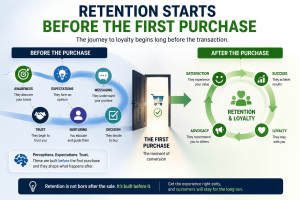
Customer retention starts before the first purchase

The Expectations Effect

Think about it this way.

Customers don’t simply purchase products or services.

They purchase expectations.

If those expectations are met or exceeded:

  • Trust grows.
  • Satisfaction increases.
  • Retention becomes easier.

But when expectations don’t match reality:

  • Frustration appears.
  • Confidence drops.
  • Churn becomes more likely.

This is why retention and acquisition are more connected than most businesses realize.

Simple SaaS Example

Imagine a SaaS company running ads that promise:

“Double your productivity in just 7 days.”

The prospect signs up expecting immediate results.

But after purchasing, they discover:

• The platform requires training
• Team adoption takes time
• Results typically take 60–90 days

The software itself may be excellent.

The customer may still achieve success.

But because expectations were set incorrectly, disappointment appears long before results do.

Eventually the customer cancels.

The company sees it as a retention problem.

In reality:

The retention problem started during marketing.

Service Business Example

Consider a digital marketing agency.

During sales conversations they suggest:

“We’ll generate leads almost immediately.”

The client signs the contract expecting rapid growth.

However, the actual process involves:

• Market research
• Strategy development
• Content creation
• Campaign optimization

Results may take several months.

Again, the service may be valuable.

But expectations and reality are misaligned.

The client becomes impatient.

Trust declines.

Retention suffers.

The churn didn’t start after delivery.

It started before the client signed.

Why the Buying Decision and Retention Decision Are Connected

Many businesses separate acquisition and retention into different departments.

Marketing acquires customers.

Customer success retains customers.

Support keeps customers happy.

But customers don’t experience your business in separate departments.

They experience one continuous journey.

From the first advertisement they see…

To the first conversation…

To the purchase…

To onboarding…

To long-term engagement.

Every stage influences the next.

That’s why the buying decision and the retention decision are often connected.

A customer who enters with realistic expectations is far more likely to stay.

A customer who enters with unrealistic expectations is far more likely to leave.

The Big Insight

Retention is not something you “start” after a customer buys.

Retention is something you influence before they buy.

The strongest retention systems don’t begin with customer support.

They begin with:

• Honest messaging
• Clear positioning
• Proper qualification
• Expectation management
• Trust-building communication

Because customers who understand what to expect are usually easier to retain.

Actionable Tip

Review your current customer journey and ask:

What expectations are prospects forming before they buy?

Look at:

• Your website copy
• Landing pages
• Ads
• Sales conversations
• Lead nurturing emails

Then compare those expectations with the actual customer experience.

If there is a gap between promise and reality, that gap may be creating future churn.

And fixing it could improve retention before a customer ever makes their first purchase.

Key Takeaway

Customer retention doesn’t begin after conversion.

It begins when prospects start forming expectations about your business.

Because the experience customers expect often determines whether they stay long enough to experience the value you deliver.


The Hidden Link Between Acquisition and Retention

One of the biggest misconceptions businesses have about growth is how they think about acquisition and retention.

Most treat them as completely separate activities.

Marketing focuses on generating leads and acquiring customers.

Sales focuses on converting prospects.

Customer success focuses on retaining customers.

Support focuses on solving problems.

On paper, that structure seems logical.

But from the customer’s perspective, none of these functions are separate.

They experience one continuous journey.

And that’s where many businesses get into trouble.
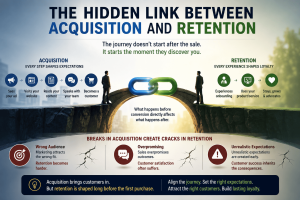
Hidden Link between Customer Retention and Acquisition

The Common Business Mindset

Ask a leadership team where retention responsibility begins.

Many will say:

After the sale

Or:

Once onboarding starts

Or:

When customer success takes over

This mindset creates a dangerous blind spot.

Because it assumes retention begins only after a customer enters the business.

But customers start forming opinions much earlier.

Long before they buy.

Long before onboarding.

Long before customer success gets involved.

And those early impressions often determine whether customers stay or leave later.

Why This Thinking Is Wrong

The customer journey doesn’t reset after a purchase.

It continues.

Every interaction builds on the one before it.

Think about the journey:

• A prospect sees your ad
• Visits your website
• Reads your content
• Speaks with your sales team
• Becomes a customer
• Experiences onboarding
• Uses your product or service

Each stage influences the next.

If unrealistic expectations are created during acquisition…

Customer success inherits the consequences.

If marketing attracts the wrong audience…

Retention becomes harder.

If sales overpromises outcomes…

Customer satisfaction often suffers.

This is why acquisition and retention are deeply connected.

What happens before conversion directly affects what happens after conversion.

A Simple SaaS Example

Imagine a SaaS company running advertisements that say:

“Get results in just 7 days.”

The message generates attention.

Signups increase.

The acquisition campaign appears successful.

But there’s one problem.

The software typically requires:

• Team setup
• User training
• Workflow adoption
• Data collection

Meaning most customers don’t see meaningful results until 60 days later.

Now imagine what happens.

The customer buys expecting immediate outcomes.

Seven days pass.

Results don’t appear.

Fourteen days pass.

Still no significant improvement.

The customer begins questioning the purchase.

Not because the software is poor.

Not because the company failed.

But because expectations and reality don’t match.

Eventually:

  • Satisfaction drops
  • Trust declines
  • Churn increases

The business sees a retention problem.

But the root cause started during acquisition.

The Service Business Version

The same thing happens in service businesses.

Imagine a consulting firm promising:

“We’ll double your revenue quickly.”

A client signs the contract expecting rapid transformation.

However, real growth requires:

• Strategy development
• Market testing
• Process improvements
• Team execution

Results may take months.

The service itself may be excellent.

The consultant may deliver significant value.

But the client’s expectations were set incorrectly from the beginning.

Now frustration appears.

Not because the service lacks value.

Because the timeline didn’t match the promise.

Again:

Acquisition created the retention problem.

The Cost of Misalignment

When acquisition and retention are disconnected, businesses often experience:

• Higher churn
• Lower customer satisfaction
• More support issues
• Increased refund requests
• Poor reviews
• Lower lifetime value

And often they respond by trying to generate even more leads.

Which only feeds the cycle.

Because acquiring more customers into a system that creates disappointment doesn’t solve the problem.

It simply scales the problem.

The Strategic Shift

The smartest businesses understand something many competitors miss:

Retention starts influencing growth before retention officially begins.

That’s why they focus on:

• Honest positioning
• Clear messaging
• Accurate expectations
• Better customer qualification
• Realistic promises

Because attracting the right customer with the right expectations makes retention dramatically easier later.

Actionable Tip

Review your marketing and sales messaging.

Ask:

Are we attracting the right customers?

Are we setting realistic expectations?

Could a new customer reasonably expect something we cannot consistently deliver?

If the answer is yes, you may already be creating future churn without realizing it.

Fixing retention sometimes starts by fixing acquisition.

Key Takeaway

Most businesses view acquisition and retention as separate growth activities.

But customers experience them as one continuous journey.

And when expectations created before the sale don’t align with reality after the sale:

Retention suffers.

Because poor acquisition strategies often create future retention problems long before a customer decides to leave


Expectations Drive Retention

If there is one factor that quietly influences retention more than most businesses realize, it’s expectations.

Not pricing.

Not features.

Not even customer support.

Expectations.

Because customers rarely judge your business based on reality alone.

They judge reality compared to what they expected to experience.

And that difference often determines whether they stay or leave.
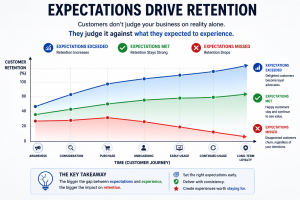
Expectations drive customer retention

Why Expectations Matter More Than Most Businesses Realize

Most businesses focus heavily on delivering value.

And that’s important.

But value alone doesn’t guarantee retention.

Why?

Because customer satisfaction isn’t based only on what you deliver.

It’s based on the gap between:

What customers expected

And

What customers experienced

This is where many businesses unintentionally create churn.

Not because they fail to deliver.

But because they create expectations they can’t consistently meet.

A Simple Way to Think About It

Imagine a customer rates their actual experience as:

8 out of 10.

That’s a strong experience.

Most businesses would consider that a success.

But now let’s compare two different expectation levels.

Scenario A

Customer expectation:

8 out of 10

Actual experience:

8 out of 10

Result:

The customer feels satisfied.

The promise matched the reality.

Trust remains intact.

Retention becomes more likely.

Scenario B

Customer expectation:

10 out of 10

Actual experience:

8 out of 10

The actual experience is identical.

Nothing changed.

But now the customer feels disappointed.

Why?

Because reality failed to match expectations.

The customer doesn’t evaluate the experience objectively.

They evaluate the gap.

And that gap creates dissatisfaction.

How Businesses Accidentally Create Expectation Gaps

This often happens through:

• Overpromising in marketing
• Exaggerated sales claims
• Unrealistic timelines
• Vague positioning
• Misleading case studies
• Poor qualification processes

Businesses usually do this with good intentions.

They want to attract attention.

Generate leads.

Increase conversions.

But when promises become bigger than reality, future retention becomes harder.

Real-World Example

Imagine a business software company promoting:

“Set up in minutes.”

A prospect signs up expecting a quick and effortless experience.

After purchasing, they discover:

• Data migration is required
• Team training is needed
• Internal approvals slow implementation

The software may still solve the customer’s problem.

But the setup process doesn’t match what was promised.

Now frustration begins.

Not because the product failed.

Because expectations were inaccurate.

The Hidden Relationship Between Expectations and Churn

Many businesses see churn as a customer success issue.

But often churn starts much earlier.

When expectations are inflated:

• Satisfaction decreases faster
• Trust erodes quicker
• Patience disappears sooner
• Perceived value drops

And customers become far more likely to leave.

In many cases, churn is simply disappointment in disguise.

The Smarter Retention Strategy

The goal isn’t to lower expectations.

The goal is to create accurate expectations.

The best businesses don’t promise perfection.

They promise clarity.

They help customers understand:

• What success looks like
• How long it takes
• What effort is required
• What challenges may appear
• What outcomes are realistic

This creates confidence.

And confidence strengthens retention.

Actionable Tip

Review your customer journey and identify:

Where expectations are being created.

Look at:

• Ads
• Landing pages
• Sales calls
• Discovery meetings
• Proposals
• Onboarding materials

Then ask:

Does the experience consistently match the promise?

Any gap you find today may become a retention problem tomorrow.

Key Takeaway

Retention problems often begin as expectation problems.

Because customers don’t judge your business based on reality alone.

They judge reality against what they expected.

And when expectations and experiences align:

  1. Trust increases.
  2. Satisfaction improves.
  3. Retention becomes much easier.


How Businesses Accidentally Create Churn Before the Sale

Most businesses assume churn starts when customers become unhappy after buying.

But often, churn begins much earlier.

In fact, many retention problems are unknowingly created during marketing and sales activities.

The customer simply doesn’t feel the consequences until after they buy.
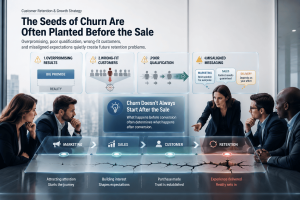
How Businesses accidentally create churn

Let’s look at some of the most common ways businesses accidentally create future churn before the sale ever happens.

1. Overpromising Results

This is one of the biggest causes of future retention problems.

To generate more leads or close more deals, businesses often make promises that sound exciting but are difficult to deliver consistently.

Examples include:

  • “Get results in 7 days.”
  • “Double your revenue in 30 days.”
  • “Guaranteed success.”
  • “Completely automated growth.”

These messages attract attention.

But they also create expectations.

And expectations become dangerous when reality cannot match them.

Scenario

A business purchases a marketing service because they were promised rapid growth.

They expect meaningful results within a week.

But in reality:

  • Strategy takes time
  • Testing takes time
  • Optimization takes time

After a month, the customer starts feeling frustrated.

Not necessarily because the service is bad.

But because the outcome doesn’t match what they expected.

The problem wasn’t delivery.

The problem was expectation creation.

The Hidden Cost

Overpromising may improve short-term conversions.

But it often increases:

  • Refund requests
  • Customer dissatisfaction
  • Negative reviews
  • Early churn

Actionable Tip

Make your promises aspirational but realistic.

Instead of saying:

“Results in 7 days.”

Try:

“Most businesses begin seeing measurable improvements within 60–90 days, depending on their starting point.”

Realistic expectations often create better retention than exciting promises.

2. Attracting the Wrong Customers

Not every prospect is the right customer.

Yet many businesses try to appeal to everyone.

At first, this seems like a growth strategy.

More people.

More leads.

More opportunities.

But it often creates the opposite effect.

Scenario

Imagine a SaaS platform built specifically for large enterprise organizations.

The product is designed for:

  • Multiple departments
  • Complex workflows
  • Advanced reporting

However, the marketing focuses on attracting freelancers and solo entrepreneurs.

Many sign up.

Many purchase.

But shortly afterward:

  • Adoption is low
  • Features feel overwhelming
  • Customers struggle to find value

Result?

High churn.

Not because the product is poor.

But because the wrong customers entered the system.

The Bigger Insight

Customer retention improves when customer fit improves.

The better the fit:

  • The easier adoption becomes
  • The faster value is realized
  • The longer customers stay

Actionable Tip

Review your messaging and ask:

“Are we attracting the customers most likely to succeed with our solution?”

The goal isn’t more customers.

The goal is better-fit customers.

3. Poor Qualification

Many sales teams are rewarded for closing deals.

As a result, conversations often focus on getting a “yes.”

But sometimes the better outcome is helping the prospect realize they are not a fit.

That may seem counterintuitive.

But it’s often better for both sides.

Scenario

A company purchases software because a salesperson convinced them it could solve a specific challenge.

After implementation they discover:

  • The software isn’t designed for that use case
  • Internal resources are missing
  • Expectations were misunderstood

The deal closes.

But the customer struggles.

Eventually they leave.

What Really Happened?

The sale succeeded.

The qualification failed.

The Bigger Insight

Retention becomes difficult when customers buy solutions that don’t align with their needs.

A qualified customer is far more likely to become a long-term customer.

Actionable Tip

During sales conversations, spend as much time evaluating fit as you do selling.

Ask:

  • Is this customer ready?
  • Is this the right solution?
  • Can they realistically achieve success?

Sometimes protecting retention means saying “not yet.”

4. Misaligned Messaging

This is surprisingly common.

Marketing says one thing.

Sales says another.

The product delivers something different.

And the customer is left trying to figure out what is actually true.

Scenario

Marketing promotes:

“Easy setup in minutes.”

Sales says:

“Our team will guide you through implementation.”

After purchase, the customer discovers:

Setup requires significant internal resources and training.

Now confusion begins.

Trust starts eroding.

And trust is extremely difficult to rebuild.

Why This Matters

Customers expect consistency.

When messaging changes throughout the journey, customers begin questioning credibility.

Even small inconsistencies can create doubt.

The Bigger Insight

Retention is heavily influenced by trust.

And trust is built through consistency.

The message customers hear before the sale should closely match the experience they receive afterward.

Actionable Tip

Audit your customer journey regularly.

Compare:

  • Marketing messages
  • Sales conversations
  • Onboarding experience
  • Product delivery

Ask:

“Are we telling the same story at every stage?”

Consistency reduces disappointment and strengthens retention.

The Key Takeaway

Many businesses think churn is caused by what happens after the sale.

But often, the seeds of churn are planted before the customer ever buys.

When businesses:

  • Overpromise
  • Attract the wrong customers
  • Skip qualification
  • Create inconsistent expectations

They unintentionally create future retention problems.

Because retention isn’t only about keeping customers happy after conversion.

It’s also about making sure the right customers buy for the right reasons in the first place.


Why Customer Experience Begins Before Conversion

Most businesses think customer experience starts after the purchase.

When onboarding begins.

When implementation starts.

When support gets involved.

But that’s not actually where customer experience begins.

Customer experience starts much earlier.

It begins the very first time someone interacts with your business.

Before the sale.

Before the contract.

Before the transaction.

Because every interaction shapes perception.

And perception shapes trust.

Customer Experience Starts Before Someone Becomes a Customer

Think about the journey a prospect takes before buying.

They may:

  • Visit your website
  • Read your content
  • Watch your videos
  • Attend a webinar
  • Speak with your sales team
  • Request a demo
  • Download a resource

Every one of these interactions contributes to the customer experience.

The customer may not have purchased yet.

But they are already forming opinions.

Questions like:

  • Can I trust this company?
  • Do they understand my problem?
  • Are they transparent?
  • Will they be easy to work with?

Are being answered long before money changes hands.

Example: Two Different Experiences

Imagine two businesses selling similar services.

Business A

A prospect visits the website.

The messaging is vague.

Contact forms receive delayed responses.

Sales conversations feel rushed.

Questions are answered inconsistently.

The prospect eventually buys.

But uncertainty remains.

Business B

A prospect visits the website.

The messaging is clear.

Educational content answers key questions.

Responses are timely.

Sales conversations are consultative and transparent.

The prospect buys.

But trust already exists.

Both businesses made the sale.

But one started building the customer experience much earlier.

And that difference often influences retention later.

Trust Begins Before Conversion

One of the biggest drivers of retention is trust.

And trust rarely appears overnight.

It develops gradually.

Every helpful interaction strengthens it.

Every confusing interaction weakens it.

Scenario

Imagine a prospect researching a SaaS solution.

Over several weeks they encounter:

  • Helpful educational content
  • Honest expectations
  • Transparent pricing
  • Valuable onboarding guidance before purchase

By the time they become a customer:

Trust already exists.

Now adoption becomes easier.

Engagement improves.

Retention becomes more likely.

Because confidence was built before conversion.

Why This Matters for Retention

Customers who enter the relationship with trust and realistic expectations tend to:

  • Stay longer
  • Engage more
  • Experience less frustration
  • Give businesses more opportunities to solve problems

Meanwhile customers who enter with uncertainty often leave faster when challenges appear.

The difference is rarely the product alone.

It’s often the experience that preceded the purchase.

The Strategic Insight

Many businesses try to improve retention by focusing only on post-purchase activities:

  • Better onboarding
  • More support
  • Additional follow-up

Those initiatives matter.

But retention improvements often start much earlier.

Because customers don’t suddenly become customers.

They transition into customer relationships.

And every interaction during that transition influences what happens next.

Actionable Tips

If you want stronger retention, improve the pre-purchase experience.

Start by evaluating:

  1. Is your messaging clear and realistic?
  2. Does your content educate rather than simply promote?
  3. Are sales conversations focused on fit and expectations?
  4. Is the buying journey easy and transparent?
  5. Are prospects receiving value before they purchase?

The better the experience before conversion, the easier retention becomes after conversion.

The Key Takeaway

Customer experience doesn’t begin after the sale.

It begins the moment a prospect interacts with your business.

Every piece of content.

Every conversation.

Every promise.

Every expectation.

Contributes to the relationship you’re building.

And in many cases, retention is simply the outcome of the experience customers had before they ever became customers.

Because customers are far more likely to stay when trust, clarity, and realistic expectations are established before the first purchase.


The Psychology Behind Long-Term Customer Relationships

At its core, customer retention is not just a business concept.

It’s a human behavior concept.

Because customers don’t stay simply because you sold them something.

They stay because they continue to believe the relationship is valuable.

And that belief is influenced by psychology far more than most businesses realize.

Many companies focus heavily on:

  • Features
  • Pricing
  • Promotions
  • Sales tactics

But long-term customer relationships are usually built on something deeper:

Trust.

And trust doesn’t happen automatically.

It develops over time through consistent experiences.

Why People Stay

Think about the relationships you have with brands, products, or service providers you continue using.

Why do you stay?

Usually not because of a single transaction.

You stay because:

  • Expectations were met
  • Trust was earned
  • Value continued to be delivered
  • The experience remained positive

The same psychology applies to customers.

When these factors exist consistently, customers become comfortable continuing the relationship.

When they disappear, customers begin looking elsewhere.

The Four Drivers of Long-Term Retention

1. Expectations Are Met

Customers enter every purchase with expectations.

Some are created by marketing.

Some by sales conversations.

Some by previous experiences.

Retention becomes much easier when reality aligns with those expectations.

Scenario

A SaaS company tells prospects:

“Most customers see meaningful improvements within 60–90 days.”

After implementation, the customer experiences exactly that.

Result:

  • Expectations were met
  • Trust increases
  • Satisfaction grows

Now compare that to unrealistic promises that never materialize.

Retention becomes significantly harder.

2. Trust Is Built

Trust is one of the strongest retention drivers.

Customers stay longer when they believe:

  • You are honest
  • You are reliable
  • You consistently act in their best interest

Trust reduces uncertainty.

And people naturally prefer staying with businesses they trust rather than starting over with unknown alternatives.

Example

A service business encounters a delay in a client project.

Instead of hiding the issue, they communicate proactively.

They explain:

  • What happened
  • What is being done
  • What the revised timeline looks like

The client may not love the delay.

But transparency strengthens trust.

And trust often strengthens retention.

3. Value Is Consistent

Customers don’t evaluate value once.

They evaluate it continuously.

This is especially important for:

  • SaaS businesses
  • Membership businesses
  • Subscription services
  • Retainer-based service businesses

The question customers repeatedly ask themselves is:

“Is this still worth it?”

If the answer remains yes, they stay.

If the answer becomes uncertain, retention risk increases.

Scenario

A customer subscribes to a software platform.

Initially, they’re excited.

But over time:

  • Product usage declines
  • Communication disappears
  • New value isn’t highlighted

Eventually the customer wonders:

“Why am I still paying for this?”

Retention begins declining long before cancellation occurs.

4. Outcomes Are Achieved

Customers rarely buy products.

They buy outcomes.

They buy progress.

They buy transformation.

The closer customers get to the outcome they want, the longer they tend to stay.

Example

A fitness coaching client joins to lose weight.

If they begin seeing measurable progress:

  • Motivation increases
  • Trust increases
  • Retention improves

The same principle applies across industries.

Customers stay when they feel they are moving toward their desired result.

The Trust Equation

One of the simplest ways to understand retention psychology is through this progression:

Visibility → Credibility → Trust → Loyalty

Let’s break that down.

Visibility

Customers must see you consistently.

Through:

  • Content
  • Communication
  • Customer support
  • Product engagement

You can’t build relationships if customers rarely hear from you.

Credibility

Visibility alone isn’t enough.

Customers must also believe you know what you’re talking about.

Credibility is built through:

  • Expertise
  • Proof
  • Consistency
  • Results

Trust

When visibility and credibility accumulate over time, trust develops.

Customers begin thinking:

“This company understands my needs.”

“They consistently deliver value.”

“I can rely on them.”

Loyalty

Loyalty is the outcome.

Not the starting point.

Customers become loyal because trust was built repeatedly over time.

The Big Insight

Many businesses assume retention is mostly transactional.

They think customers stay because of:

  • Discounts
  • Contracts
  • Pricing
  • Features

Those things matter.

But they’re rarely the entire reason.

Because retention is often emotional before it becomes transactional.

People stay with businesses they trust.

Businesses that consistently deliver value.

Businesses that make them feel confident in their decision.

And that’s why retention is ultimately a relationship-building exercise—not just a revenue strategy.

Actionable Tips

To strengthen retention psychology:

  • Set realistic expectations early
  • Communicate consistently
  • Demonstrate credibility regularly
  • Focus on customer outcomes, not just product usage
  • Look for trust-building opportunities at every stage of the customer journey

Because customers don’t stay simply because they bought.

They stay because they continue believing they made the right choice.


Why Lead Nurturing Plays a Major Role in Retention

Most businesses view lead nurturing through a very narrow lens.

They see it as a conversion tool.

Something designed to:

  • Generate sales
  • Increase conversions
  • Move prospects through the funnel

And while that’s true…

It’s only part of the story.

Because effective lead nurturing does something much bigger.

It improves customer retention.

This surprises many businesses.

After all, how can something that happens before the sale influence whether customers stay after the sale?

The answer is simple.

Lead nurturing shapes expectations, understanding, trust, and customer fit.

All of which influence retention later.

Lead Nurturing Is More Than Follow-Up

When people hear the term lead nurturing, they often think:

  • Email sequences
  • Follow-up messages
  • Retargeting ads
  • Sales reminders

But great nurturing is really about education.

It’s about helping prospects understand:

  • The problem
  • The solution
  • The process
  • The expected outcomes

The more clarity prospects have before buying, the fewer surprises they encounter afterward.

And fewer surprises usually mean stronger retention.

Why Poorly Nurtured Customers Often Churn Faster

Let’s imagine two prospects.

Both eventually become customers.

But they arrive through very different journeys.

Customer A

Sees an advertisement.

Books a call.

Purchases quickly.

Little education.

Limited understanding.

Unclear expectations.

After purchase they discover:

  • More work is required than expected
  • Results take longer than expected
  • Their role is bigger than expected

Frustration appears.

Retention becomes difficult.

Customer B

Goes through a nurturing journey.

They consume:

  • Educational content
  • Case studies
  • Webinars
  • Emails
  • Helpful resources

Before purchasing they understand:

  • How the solution works
  • What success requires
  • Realistic timelines
  • Expected outcomes

After becoming a customer:

There are fewer surprises.

Trust already exists.

Retention becomes much easier.

Lead Nurturing Creates Better-Fit Customers

One of the most overlooked benefits of nurturing is qualification.

Good nurturing doesn’t just attract prospects.

It helps prospects determine whether they’re a good fit.

Scenario

A SaaS company creates educational content explaining:

  • Who the platform is for
  • Who it is not for
  • Required resources
  • Expected implementation process

Some prospects realize:

“This isn’t the right fit.”

And they don’t buy.

At first this might seem like a lost opportunity.

But it’s actually a retention win.

Because poor-fit customers often become future churn.

Lead Nurturing Builds Trust Before the Sale

Think about how trust develops.

Rarely through a single interaction.

Trust grows through repeated exposure and consistent value.

This is exactly what nurturing does.

Through content, communication, and education, prospects gradually become familiar with your business.

By the time they purchase:

  • Trust already exists
  • Expectations are clearer
  • Confidence is higher

And customers who trust you before the sale are often more likely to stay after the sale.

The Connection Between Nurturing and Retention

This is the important shift many businesses miss.

They think:

Lead nurturing improves conversion.

But nurturing also improves:

  • Customer quality
  • Expectation management
  • Product adoption
  • Customer success
  • Retention

Because retention doesn’t begin after conversion.

As we’ve discussed throughout this blog:

Retention often starts before the first purchase.

And nurturing is one of the most powerful ways to influence that process.
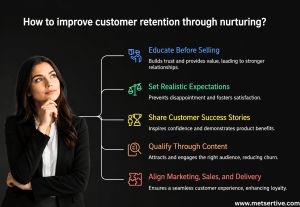
Improving Retention Through Lead Nurturing

Actionable Tips

If you want nurturing to improve retention—not just conversions—focus on these areas:

1. Educate Before Selling

Help prospects understand:

  • The problem
  • The solution
  • The process

Not just the offer.

2. Set Realistic Expectations

Avoid:

Overpromising

Focus on:

Clarity

  • Transparency
  • Realistic outcomes

3. Share Customer Success Stories

Use real examples that demonstrate:

  • Results
  • Timelines
  • Challenges
  • Outcomes

This helps prospects develop accurate expectations.

4. Qualify Through Content

Create content that explains:

  • Who your solution is for
  • Who it is not for

Better-fit customers generally retain longer.

5. Align Marketing, Sales, and Delivery

The message prospects hear before purchase should match the experience they receive afterward.

Consistency strengthens retention.

The Big Insight

Many businesses treat lead nurturing as a conversion activity.

But the smartest businesses recognize something deeper.

Lead nurturing is also a retention strategy.

Because when prospects:

  • Understand the product
  • Understand the process
  • Understand expected outcomes

They become better customers.

And better customers tend to stay longer.

Key Takeaway

Lead nurturing doesn’t just help customers buy.

It helps the right customers buy for the right reasons.

And when that happens:

  • Expectations improve
  • Trust improves
  • Customer success improves
  • Retention improves

Which is why well-nurtured customers often become long-term customers.


The SaaS, D2C, SME, and Service Business Examples

By now, the idea should be becoming clear:

Retention does not magically begin after the sale.

It is influenced by everything that happens before the sale.

The messaging prospects see.

The expectations they develop.

The promises they hear.

The trust they build.

Let’s look at how this plays out across different business models.

SaaS Example: Retention Starts Before Signup

Many SaaS companies focus heavily on acquiring users.

They optimize:

  • Landing pages
  • Free trials
  • Demos
  • Sign-up flows

But retention often depends on something much simpler:

Whether customers understood what they were signing up for.

Scenario

A SaaS company promotes its platform as:

“Easy to implement in just one day.”

New customers sign up expecting immediate success.

But after purchase they discover:

  • Setup takes several weeks
  • Team involvement is required
  • Data migration is needed

Result:

  • Frustration
  • Lower adoption
  • Increased churn

Now compare that to a company that clearly explains:

  • Setup requirements
  • Learning curve
  • Expected timelines
  • Success milestones

Customers arrive with realistic expectations.

They know what success looks like.

They know what is required.

Result:

Better onboarding

  • Higher adoption
  • Lower churn

Key Insight

Many SaaS churn problems are not onboarding problems.

They are expectation-setting problems that started before signup.

Actionable Tip

Audit your website, demos, and sales conversations.

Ask:

“Are we creating realistic expectations before customers buy?”

D2C Example: Retention Starts Before the First Order

For D2C brands, retention often begins with product expectations.

Customers decide whether they trust your brand based on what they see before purchasing.

Scenario

An online brand uses heavily edited product images.

The product appears:

  • Larger
  • Higher quality
  • More luxurious

than it actually is.

The customer purchases.

When the product arrives:

Reality does not match expectations.

Result:

  • Returns increase
  • Negative reviews increase
  • Repeat purchases decline

Now compare that to a brand that uses:

  • Accurate product photography
  • Honest descriptions
  • Clear specifications
  • Transparent communication

Customers know exactly what they’re buying.

When the product arrives:

Expectation and reality align.

Result:

  • Higher satisfaction
  • Fewer returns
  • Stronger trust
  • More repeat purchases

Key Insight

Retention often starts with accurate representation.

Because disappointed customers rarely become loyal customers.

Actionable Tip

Review product pages regularly.

Ask:

“Are we helping customers make informed buying decisions—or simply trying to maximize conversions?”

Service Business Example: Retention Starts During the Sales Process

Service businesses frequently create retention problems without realizing it.

Why?

Because sales conversations often focus on winning the client instead of preparing the client.

Scenario

An agency promises:

  • Fast results
  • Immediate improvements
  • Quick turnaround times

The client signs the contract.

But once the project begins:

  • Deliverables take longer
  • Results require testing
  • Progress happens gradually

The client begins questioning the decision.

Not because the service is poor.

But because expectations were unrealistic.

Now compare that to a service provider that communicates:

  • Realistic timelines
  • Clear deliverables
  • Expected responsibilities
  • Potential challenges

The client understands the journey before it begins.

Result:

  • Higher trust
  • Better communication
  • Stronger retention

Key Insight

Many service-business retention problems begin in the sales process—not in service delivery.

Actionable Tip

Review your proposals and sales presentations.

Look for places where expectations may be unintentionally inflated.

SME Example: Retention Starts During Lead Nurturing

Many SMEs focus on generating leads.

Far fewer focus on educating leads.

And that’s where future retention opportunities often get lost.

Scenario

An SME sells business consulting services.

Instead of pushing for an immediate sale, they nurture prospects through:

  • Educational content
  • Case studies
  • Industry insights
  • Success frameworks

Prospects gradually learn:

  • How the process works
  • What results are realistic
  • What commitment is required

By the time they become customers:

They are informed.

They are qualified.

They are aligned.

Result:

1.Better customer fit

2.Higher engagement

3.Stronger retention

4.Higher Customer Lifetime Value (LTV)

Key Insight

Educational nurturing doesn’t just improve conversions.

It improves customer quality.

And better customers tend to stay longer.

The Bigger Pattern

Notice what all four examples have in common.

The retention outcome was influenced before the transaction occurred.

Not after.

Whether you’re:

  • SaaS
  • D2C
  • SME
  • Service business

The principle remains the same:

Better expectations create better retention.

Because customers stay when reality matches what they believed they were buying.

Key Takeaway

Retention isn’t owned by customer success alone.

It’s influenced by:

  • Marketing
  • Sales
  • Positioning
  • Messaging
  • Lead nurturing
  • Expectation setting

Which means retention begins much earlier than most businesses think.

Often before the first purchase ever happens.


The Retention Flywheel Starts Before Conversion

Most businesses think retention looks like this:

Customer Purchase

Customer Experience

Retention

But the reality is much bigger.

Retention is not a single stage.

It’s the result of an entire chain of events.

Let’s visualize it.

The Retention Flywheel

Marketing Messaging

Expectation Setting

Customer Acquisition

Customer Experience

Retention

Customer Lifetime Value (LTV)

Referrals

Profitability

Growth

And then the cycle starts again.

Step 1: Marketing Messaging

Everything starts here.

Your marketing creates the first impression.

It tells prospects:

  • What you do
  • Who you help
  • What outcomes they can expect

This messaging becomes the foundation of future expectations.

If messaging creates clarity:

Retention becomes easier.

If messaging creates unrealistic expectations:

Retention becomes harder.

Step 2: Expectation Setting

This is one of the most overlooked growth activities.

Because expectations act like a lens.

Customers evaluate every future experience through that lens.

When expectations and reality align:

Trust grows.

When expectations and reality diverge:

Disappointment appears.

And disappointment is often the first step toward churn.

Step 3: Customer Acquisition

This is where most businesses focus.

Leads become customers.

Contracts get signed.

Subscriptions begin.

But acquisition is not the finish line.

It’s merely the transition point.

Step 4: Customer Experience

Now the customer begins interacting with your business.

They experience:

  • Onboarding
  • Product usage
  • Service delivery
  • Support
  • Communication

This is where expectations are either validated or broken.

Step 5: Retention

If expectations were realistic and value is consistently delivered:

Customers stay.

They continue buying.

They continue engaging.

They continue trusting.

Retention becomes the natural outcome.

Step 6: Customer Lifetime Value (LTV)

When customers stay longer:

Value accumulates.

Revenue compounds.

Profitability improves.

The relationship becomes significantly more valuable than the initial transaction.

Step 7: Referrals

Satisfied customers often become advocates.

They:

  • Recommend you
  • Refer others
  • Leave reviews
  • Share experiences

Now retention begins influencing acquisition.

The flywheel starts accelerating.

Step 8: Profitability

At this stage:

  • CAC becomes easier to recover
  • Marketing efficiency improves
  • Revenue quality improves

Because customer value continues growing.

Step 9: Growth

This is where sustainable growth emerges.

Not from constantly replacing customers.

But from maximizing customer value over time.

Growth becomes:

  • More predictable
  • More profitable
  • More sustainable

The Big Insight

Many businesses view retention as a post-sale activity.

Something managed by:

  • Customer success
  • Support teams
  • Account managers

But this flywheel reveals a different reality.

Retention is the outcome of the entire customer journey.

Marketing influences it.

Sales influences it.

Positioning influences it.

Expectation setting influences it.

Customer experience influences it.

By the time retention becomes visible, many of the factors affecting it have already been in motion for weeks or months.

Actionable Tip

Map your customer journey from:

First touchpoint
→ First purchase
→ First success moment

Then ask:

“Where might we be creating expectations that we can’t consistently fulfill?”

The answer often reveals hidden retention opportunities.

Key Takeaway

Retention doesn’t begin after conversion.

It begins before conversion.

Because every stage of the customer journey contributes to whether customers stay, leave, expand, refer, and generate long-term value.

And that’s why the strongest retention systems are built long before the first purchase ever happens.


Signs You’re Creating Future Churn Before Customers Buy

One of the biggest misconceptions about retention is that churn begins when customers become unhappy after the purchase.

But in many businesses, churn begins much earlier.

Sometimes months earlier.

Often during:

  • Marketing campaigns
    • Lead nurturing
    • Sales conversations
    • Product positioning
    • Customer acquisition

The reality is simple:

Many businesses unknowingly create future churn before customers ever buy.

Let’s make this practical.

If several of the following signs sound familiar, your retention challenges may actually be starting before conversion.

1. Marketing Promises More Than Delivery

This is one of the most common causes of future churn.

Marketing creates expectations.

But if delivery cannot consistently match those expectations, disappointment follows.

SaaS Example

Marketing message:

“Get results in 7 days.”

Reality:

Implementation takes 15 days.

Customers feel misled.

D2C Example

Product advertisements show dramatic transformations.

Customers receive the product.

Results are far less dramatic than expected.

Returns increase.

Service Business Example

An agency promises explosive growth within weeks.

Actual results require months of testing and optimization.

Clients become frustrated.

SME Example

A business consultant promises “guaranteed growth.”

Client expectations become unrealistic.

Trust begins eroding almost immediately.

Actionable Tip

Review your marketing messages.

Ask:

“Can our delivery team consistently fulfill this promise?”

If not, adjust the promise before it becomes future churn.

2. Wrong-Fit Customers Keep Entering

Not every lead is a good customer.

Yet many businesses focus on maximizing volume instead of improving fit.

SaaS Example

Enterprise software is marketed to freelancers.

Customers purchase.

Product complexity overwhelms them.

Churn rises.

D2C Example

Premium products attract bargain shoppers through discount-heavy promotions.

Customers purchase once.

Never return.

Service Business Example

An agency specializes in long-term strategic growth.

Marketing attracts businesses seeking instant results.

Mismatch occurs.

Relationships end quickly.

SME Example

A specialized B2B solution attracts businesses outside the ideal customer profile.

Customers struggle to implement recommendations.

Retention suffers.

Actionable Tip

Stop asking:

“How do we get more customers?”

Start asking:

“How do we attract better-fit customers?”

3. Customers Frequently Misunderstand the Offer

If customers regularly say:

• “I thought this included more.”
• “I didn’t know that.”
• “This isn’t what I expected.”

You may have an expectation-setting problem.

SaaS Example

Customers assume a feature is included.

It isn’t.

Disappointment follows.

D2C Example

Customers misunderstand product specifications.

Returns increase.

Service Business Example

Clients assume ongoing support is included.

It wasn’t part of the agreement.

Trust declines.

SME Example

Customers misunderstand implementation requirements.

Adoption suffers.

Actionable Tip

Look for recurring questions from prospects and customers.

Those questions often reveal unclear messaging.

4. Expectations Are Unclear

Unclear expectations create uncertainty.

And uncertainty creates dissatisfaction.

Even when the product itself performs well.

Scenario

A customer doesn’t know:

  • What success looks like
    • How long results take
    • What their responsibilities are
    • What happens next

The experience feels confusing.

Confusion eventually becomes frustration.

Actionable Tip

Clearly communicate:

  • Timeline
    • Deliverables
    • Expected outcomes
    • Customer responsibilities

The clearer the expectations, the stronger the retention.

5. Early Churn Is Common

Early churn is often one of the clearest warning signs.

Because customers are leaving before they fully experience value.

SaaS Example

Users cancel within the first 30 days.

D2C Example

Customers buy once and disappear.

Service Business Example

Clients leave after the initial engagement.

SME Example

Customers stop engaging shortly after implementation.

Actionable Tip

Investigate what customers expected before purchasing.

Compare it with what they actually experienced.

The gap often reveals the root cause.

6. Refund Requests Are Increasing

Refund requests often reveal expectation misalignment.

Not necessarily product failure.

Example

A product works exactly as designed.

But customers expected something completely different.

Result:

Refund request.

The issue wasn’t performance.

The issue was expectation.

Actionable Tip

Review refund reasons quarterly.

Patterns often reveal retention problems long before churn data does.

7. Customers Say:

“I Thought This Would Be Different.”

This single sentence contains more retention insight than many analytics dashboards.

Because it usually means:

Reality failed to match expectations.

And expectations were often shaped before the purchase.

Actionable Tip

Collect this feedback.

Don’t ignore it.

Use it to improve:

• Marketing
• Positioning
• Sales conversations
• Onboarding

The Insight That Changes Everything

Most businesses assume retention problems begin after conversion.

But many actually begin before conversion.

Because:

• Marketing influences expectations
• Expectations influence experience
• Experience influences retention

Which means:

Many retention problems are actually acquisition problems in disguise.


How to Build Retention Before the First Purchase

If retention starts before conversion…

Then improving retention starts before conversion too.

The goal isn’t simply to acquire customers.

The goal is to acquire customers who:

• Understand your offer
• Fit your solution
• Have realistic expectations
• Are positioned for success

Here’s how to make that happen.

  1. Align Marketing and Delivery

One of the most important retention strategies is simple:

Promise only what can be delivered.

When marketing, sales, and delivery operate independently:

Problems emerge quickly.

SaaS Example

Marketing promotes simplicity.

Product onboarding feels complex.

Trust declines.

D2C Example

Advertising highlights premium quality.

Customer experience feels average.

Repeat purchases decline.

Service Business Example

Sales promises aggressive timelines.

Delivery teams struggle to meet expectations.

Client satisfaction falls.

SME Example

Marketing communicates one outcome.

Operations deliver something different.

Customers become confused.

Actionable Tip

Bring marketing, sales, and delivery teams together regularly.

Review customer promises.

Ensure everyone is communicating the same reality.
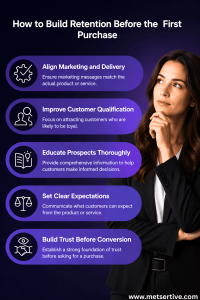
Building Customer Retention before first purchase

  1. Improve Customer Qualification

Not every lead should become a customer.

This can feel counterintuitive.

But stronger qualification often improves retention dramatically.

SaaS Example

A company rejects customers who lack technical resources.

Result:

Better adoption.

Lower churn.

Service Business Example

An agency declines clients seeking unrealistic outcomes.

Result:

Stronger long-term relationships.

D2C Example

A premium brand focuses on ideal customers rather than discount seekers.

Result:

Higher loyalty.

SME Example

A consultant works only with businesses ready to implement recommendations.

Result:

Better customer success.

Actionable Tip

Define:

  • Ideal customer profile
    • Customer fit criteria
    • Success requirements

Then qualify prospects against those standards.

  1. Educate Prospects Thoroughly

Education improves retention.

Because educated customers make better decisions.

Help prospects understand:

What They’ll Get

Clarify:

  • Features
    • Benefits
    • Deliverables

What They Won’t Get

This is equally important.

Transparency builds trust.

What Success Requires

Many customers underestimate their role in achieving results.

Explain:

  • Time commitment
    • Resources required
    • Responsibilities

Actionable Tip

Create educational content that prepares prospects for success before they buy.

  1. Set Clear Expectations

Retention problems often begin when expectations remain vague.

Clear expectations reduce surprises.

And fewer surprises usually lead to stronger retention.

Example

Instead of saying:

“You’ll see results quickly.”

Say:

“Most customers begin seeing measurable improvements within 60–90 days.”

One creates excitement.

The other creates trust.

Trust usually wins long-term.

Actionable Tip

Document your:

  • Timelines
    • Milestones
    • Success metrics
    • Customer responsibilities

Then communicate them repeatedly.

  1. Build Trust Before Conversion

Trust is one of the strongest predictors of retention.

And trust rarely appears overnight.

It develops gradually.

Through:

  • Helpful content
    • Consistent communication
    • Transparency
    • Authenticity
    • Delivering on small promises

SaaS Example

Educational webinars build credibility before signup.

D2C Example

Honest product reviews build confidence.

Service Business Example

Thought leadership content establishes expertise.

SME Example

Case studies and customer stories reduce uncertainty.

Actionable Tip

Focus on helping prospects make better decisions—not just faster decisions.

Trust formed early often lasts longer.

The Strategic Shift

Most businesses focus on:

“How do we acquire more customers?”

The smarter question is:

“How do we acquire customers who are more likely to stay?”

Because retention is rarely created by luck.

It’s created by:

  • Clear expectations
    • Strong qualification
    • Honest communication
    • Better-fit customers
    • Early trust

Key Takeaway

Customer retention doesn’t begin after the first purchase.

It begins long before it.

The strongest retention systems are built through:

1.Better marketing

2.Better qualification

3.Better expectation setting

4.Better education

5.Better trust-building

Because when customers know exactly what they’re buying, what success requires, and what to expect…

They are far more likely to stay.

And that’s where sustainable growth begins.


The Big Shift: Stop Thinking of Retention as a Post-Sale Activity

Most businesses think about retention the wrong way.

They assume retention begins after the sale.

After onboarding.

After implementation.

After customer success gets involved.

After support starts interacting with the customer.

And on the surface, that seems logical.

After all, retention is often measured after someone becomes a customer.

But here’s the perspective shift that changes everything:

Retention is measured after the sale.

But it often begins before the sale.

That distinction is important.

Because by the time a customer decides to stay or leave, many of the factors influencing that decision have already been set in motion.

Why This Matters

Think about a customer who cancels after 60 days.

Most businesses investigate:

• Product issues
• Support tickets
• Onboarding problems
• Service delivery challenges

Those are all important.

But sometimes the real cause started much earlier.

The customer purchased with expectations that were never realistic.

And when reality failed to match those expectations, churn became almost inevitable.

The problem wasn’t necessarily the product.

The problem was the expectation.

The Traditional View of Retention

Many businesses see retention as the responsibility of:

• Customer support
• Customer success
• Account management
• Operations teams

In this model:

Marketing acquires customers.

Sales closes customers.

Then retention becomes someone else’s responsibility.

But customer behavior doesn’t work that way.

Customers experience your business as one continuous journey.

They don’t separate:

• Marketing
• Sales
• Onboarding
• Delivery
• Support

To them, it’s all one experience.

Which means every stage contributes to retention.

SaaS Example

A SaaS company invests heavily in customer success.

They hire onboarding specialists.

They improve support.

They launch educational resources.

Yet churn remains high.

Why?

Because marketing promised:

“Instant results.”

Customers expected success immediately.

But actual adoption requires:

• Training
• Team alignment
• Implementation

Customer success teams are now trying to recover from expectations created before signup.

The retention problem started before onboarding ever began.

D2C Example

A D2C brand launches an aggressive advertising campaign.

The ads create enormous excitement.

Customers purchase.

But the actual product experience feels ordinary compared to what was promised.

Returns increase.

Repeat purchases decline.

Customer service works hard to solve complaints.

But the root issue wasn’t customer service.

It was expectation management.

Retention challenges were created before the first order was placed.

Service Business Example

A consulting firm promises transformational outcomes during sales conversations.

The client signs.

But after engagement begins, the client discovers:

• Results take time
• Internal execution is required
• Success depends on collaboration

The client feels disappointed.

Not because the service lacks value.

But because expectations were unrealistic.

The retention issue began during the sales process.

SME Example

An SME focuses heavily on lead generation.

Marketing campaigns perform well.

Customers convert.

But engagement quickly declines after purchase.

When leadership investigates, they discover many customers:

• Didn’t fully understand the solution
• Didn’t understand implementation requirements
• Had unrealistic expectations

The acquisition process attracted customers.

But it didn’t prepare customers.

And that preparation gap eventually became a retention problem.

The Insight Most Businesses Miss

The strongest retention strategies often begin inside:

• Marketing
• Positioning
• Lead nurturing
• Sales conversations
• Expectation setting

Not inside customer support.

Not inside onboarding.

Not inside customer success.

Because by the time those teams become involved, expectations already exist.

And expectations strongly influence whether customers stay.

The Strategic Shift

Instead of asking:

“How do we improve retention after customers buy?”

Start asking:

“How do we improve retention before customers buy?”

That question changes everything.

Because it forces businesses to think about:

• Customer fit
• Messaging accuracy
• Sales alignment
• Expectation management
• Customer education

And all of those factors influence retention long before churn becomes visible.

Actionable Tip

Review your customer journey from the prospect’s perspective.

Ask:

• What expectations are we creating?
• Are those expectations realistic?
• Can we consistently deliver what we’re promising?
• Are we attracting the right customers?

The answers often reveal retention opportunities hiding inside acquisition.

Key Takeaway

Strategic businesses understand something many competitors miss:

Retention begins when expectations are formed.

And expectations are usually formed long before the first purchase.

Which means one of the most powerful retention strategies often starts in marketing—not customer support.


Conclusion

For years, businesses have viewed retention as a post-sale activity.

Something managed through:

• Follow-ups
• Loyalty programs
• Customer support
• Account management
• Customer success initiatives

And while all of those matter, they only tell part of the story.

Because retention begins much earlier than most businesses realize.

Long before:

• The first purchase
• The signed contract
• The onboarding process
• The welcome email

Retention begins when a prospect starts forming expectations about your business.

And those expectations influence everything that follows.

What We’ve Learned

Throughout this discussion, we’ve seen that retention is connected to far more than post-sale communication.

It’s influenced by:

• Marketing messaging
• Positioning
• Lead nurturing
• Sales conversations
• Customer qualification
• Expectation setting
• Trust-building

All of these factors shape how customers perceive your business before they buy.

And perception often influences retention more than businesses realize.

The Businesses That Win Retention Early

The businesses with the strongest retention often gain an advantage before customers ever become customers.

They don’t simply focus on generating more leads.

They focus on creating better-fit customers.

They:

1.Attract the right customers

2.Set realistic expectations

3.Educate prospects thoroughly

4.Build trust early

5.Deliver consistent value

As a result, customers arrive better informed, better prepared, and more likely to succeed.

And customers who succeed tend to stay.

SaaS Perspective

The best SaaS companies don’t just optimize onboarding.

They optimize expectation setting before signup.

Because informed users adopt faster and churn less.

D2C Perspective

The strongest D2C brands don’t just focus on acquiring buyers.

They focus on ensuring customers know exactly what they’re purchasing.

Because trust drives repeat purchases.

Service Business Perspective

The most successful service providers don’t simply close deals.

They qualify clients carefully and communicate honestly.

Because aligned expectations create stronger long-term relationships.

SME Perspective

Growing SMEs don’t just invest in lead generation.

They invest in customer education.

Because educated customers often become more profitable customers.

The Final Insight

Most businesses ask:

“How do we improve retention?”

But a more powerful question is:

“What expectations are we creating before customers buy?”

Because expectations influence:

• Trust
• Satisfaction
• Engagement
• Loyalty
• Churn
• Lifetime Value

And ultimately:

Profitability.

Actionable Next Steps

If you want to improve retention, start here:

  1. Audit your marketing promises
  2. Review customer expectations
  3. Improve customer qualification
  4. Align marketing, sales, and delivery
  5. Educate prospects more thoroughly
  6. Identify where expectation gaps occur
  7. Track early churn patterns

Often, the biggest retention opportunities are hiding before conversion.

Key Takeaway

Customer retention doesn’t start after the first purchase.

It starts the moment a prospect begins deciding whether they can trust you.

And businesses that understand this build:

  • Higher retention
  • Higher Customer Lifetime Value (LTV)
  • Lower churn
  • More predictable growth
  • More profitable customer relationships

Because the first sale doesn’t start retention.

Expectations do.
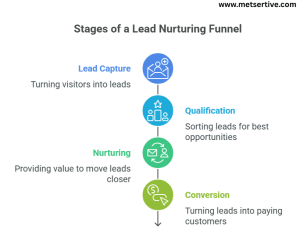
 

How to Create a Lead Nurturing Funnel That Converts

If you’re tired of leads ghosting you after they download a freebie or attend a webinar, you’re not alone.

Most businesses think getting a lead’s email is the finish line. In reality, it’s just the starting point.

A lead nurturing funnel is your system for turning “sort-of-interested” prospects into ready-to-buy customers—without nagging or spamming. It’s the bridge between interest and decision.

And it works: Forrester reports that companies with effective lead nurturing generate 50% more sales-ready leads at a 33% lower cost. A clear lead nurturing strategy helps you systematically build trust while moving leads through your funnel.

In this guide, you’ll learn:

  1. What a lead nurturing funnel actually is (without the fluff)
  2.  How to build a lead nurturing funnel
  3.  The stages you need to guide leads toward buying
  4.  Content to use at each step
  5.  Tools to automate your funnel without overwhelm
  6.  Mistakes to avoid so you don’t waste leads

Whether you’re running a B2B SaaS, e-commerce, or coaching business, you’ll walk away knowing how to build a funnel that doesn’t just collect emails—it converts them.

What Is a Lead Nurturing Funnel?

Imagine you walk into a store just to browse, and immediately, a salesperson says, “Want to buy this right now?”

You’d back away, right?

That’s what happens when you skip nurturing and go straight for the sale.

A lead nurturing funnel is your structured system to build trust and readiness across these stages:

  1. Awareness – Leads discover you through a blog, social post, or ad.
  2. Interest – They download a guide, sign up for a webinar, or engage with your content.
  3.  Consideration – They evaluate if you’re the right fit, reading case studies or testimonials.
  4.  Decision – They’re ready to take action: book a call, start a trial, or purchase.

Real-World Scenario:

A small HR SaaS platform was getting webinar signups but zero demo bookings. They realized their “follow-up” was a single email: “Book a demo now.”

They shifted to a nurturing funnel:

  1. Post-webinar thank-you email with a key takeaway.
  2.  Follow-up email with a customer success story.
  3.  A value email addressing a common HR pain point.
  4.  Personalized email inviting them to book a call.

Result? Demo bookings increased by 47% within two months, and leads came into calls already warmed up.

Quick Tip:

Think of your funnel as dating, not speed dating. If your funnel asks for commitment before building trust, leads will bounce.

Lead Nurturing Funnel vs. Sales Funnel

While a sales funnel is the entire journey from stranger to customer, a lead nurturing funnel focuses on the “middle” stage—the critical period after someone opts in but before they purchase.

Your nurturing funnel’s job is to:

  1. Educate
  2.  Overcome objections
  3.  Build trust
  4.  Keep your brand top-of-mind

so that when the moment is right, your lead says, “Yes, I’m ready.”

Why This Matters:

Without a structured lead nurturing funnel:

  • Leads go cold because they don’t know what to do next.
  •  You lose potential customers to competitors who keep in touch.
  •  You waste ad spend on leads who drop off without converting.

With a nurturing funnel in place:

  • You warm leads systematically.
  •  You convert higher-quality customers.
  •  You reduce your sales cycle.

Next:

Now that you know what a lead nurturing funnel is and why it’s the missing piece for your business, let’s dive into the core stages you need and how to build them step-by-step.

Core Stages of a Lead Nurturing Funnel

A lead nurturing funnel isn’t a one-email wonder. It’s a structured journey guiding your leads toward readiness without pressure. A nurturing funnel should be designed to convert marketing leads into sales qualified leads, ready for your sales team

stages of a lead nurturing funnel

Here’s how to break it down:

1️. Lead Capture

What it is: The moment you turn a visitor into a lead.

How:

  • Lead magnets (eBooks, checklists)
  • Webinar signups
  • Free trials
  • Newsletter opt-ins

Scenario:
A marketing consultant offers a “10-Step LinkedIn Content Checklist” in exchange for email addresses, turning visitors into warm leads.

Tip: Keep forms simple. More fields = fewer signups.

2️. Qualification

What it is: Sorting leads to focus on the best opportunities. Before nurturing leads, implementing a lead qualification process ensures you focus on the right prospects

How:

  • Use lead scoring to track behavior (opens, clicks, visits).
  • Segment based on interests or industry.

Scenario:
A SaaS company assigns +10 points when a lead visits the pricing page and +20 when they attend a webinar, indicating high interest.

Tip: Use CRM tools like HubSpot or Zoho to automate scoring

3️. Nurturing

What it is: Consistently providing value to move leads closer to a decision.

How:

  • Email drip campaigns with education and social proof.
  • Retargeting ads to re-engage website visitors.
  • Social media touchpoints.

Scenario:
An HR software sends a 5-email drip campaign post-webinar:

  1. Thank you + webinar replay
  2. Related blog/resource
  3. Customer success story
  4. Overcoming a common objection
  5. Invite to book a call

Tip: Don’t rush to sell. Educate first, then offer solutions.

4️. Conversion

What it is: Turning leads into paying customers.

How:

  • Personalized demo invites
  • Free trial upgrades
  • Consultation calls
  • Clear CTAs on emails and landing pages

Scenario:
After nurturing, a lead books a call through a personalized invite that says, “Let’s map out your HR automation plan.”

 Tip: Add a time-limited incentive (e.g., “Get your first month free if you book this week”) to encourage action.

Recap:

Your funnel stages should flow:
Lead Capture → Qualification → Nurturing → Conversion

When built intentionally, this funnel moves leads from “just curious” to “ready to buy” systematically.

Crafting Content for Each Funnel Stage

Now that you know the funnel structure, it’s time to feed it with the right content at each stage. Customer journey mapping allows you to align your funnel stages with your leads’ actual needs and questions at each step.”

1. Awareness (Top of Funnel)

Goal: Attract and educate.

Content:

  • Blog posts
  • Social media content
  • Infographics
  • Educational videos

Example:
A B2B SaaS company writes a blog, “5 Signs You Need Automated HR Processes,” to attract HR managers.

Tip: Add CTAs like “Download our HR Automation Checklist” to capture leads.

2. Interest (Mid Funnel)

Goal: Deepen engagement.

Content:

  • Lead magnets (guides, checklists)
  • Webinars
  • Quizzes

Example:
A quiz, “How Efficient Is Your Hiring Process?”, collects emails while providing value.

Tip: Use quizzes to segment leads based on their needs automatically.

3. Consideration (Lower Mid Funnel)

Goal: Build trust and address objections.

Content:

  • Case studies
  • Testimonials
  • Comparison guides
  • Email drips with social proof

Example:
A SaaS sends an email with a mini-case study: “How Company X Reduced Turnover by 32% Using Our Software.”

Tip: Use client logos and testimonials in retargeting ads for credibility.

4. Decision (Bottom of Funnel)

Goal: Prompt action.

Content:

  • Free trials
  • Demo offers
  • Consultations
  • Time-sensitive offers

Example:
An HR tool sends a “Your Personalized Demo Awaits” email with a one-click booking link.

Tip: Use urgency carefully—pair it with value, not pressure.

Crafting the best email sequences for lead nurturing involves understanding your audience’s pain points and aligning content with funnel stages.

Putting It All Together:

Scenario:
1. A lead reads your blog → downloads your HR checklist (Awareness → Interest).
2. They receive a 5-part drip sequence with case studies and resources (Consideration).
3.  They are invited to a free demo with a personalized CTA (Decision).
4.  They convert and enter your customer onboarding flow.

Next Up:

You now know how to structure your lead nurturing funnel and feed it with content that matches your buyer’s journey.

Next, we will cover the best tools to automate your funnel so you can scale without dropping the ball.

Tools to Automate and Manage Your Lead Nurturing Funnel

Building a lead nurturing funnel is one thing. Running it manually? Impossible as you scale.

That’s where automation tools come in—Automated lead nurturing workflows save you time, maintain consistency, and ensure leads don’t slip through the cracks.

Here’s what you need in your tech stack:

1. CRM Platforms

Your CRM (Customer Relationship Management) tool is the brain of your funnel. It tracks leads, segments them, scores them, and aligns your sales and marketing teams. CRM lead tracking is critical for monitoring where each lead is within your funnel and tailoring your nurturing efforts.”

Examples:

  • HubSpot: User-friendly, great for SMEs, integrates email, forms, and landing pages.
  • Zoho CRM: Affordable, customizable, solid for small businesses.
  • Salesforce: Best for advanced customization and larger teams.

Scenario:
A B2B SaaS uses HubSpot to automatically move leads who download a guide into a mid-funnel nurturing drip, while notifying sales when they visit the pricing page.

Tip: Use CRM tags to segment leads by funnel stage automatically.

2. Email Marketing Automation

Email is still your lead nurturing backbone. Use automation to send drip email sequences, segment lists, and personalize communication at scale. Well-timed drip email campaigns are the backbone of a high-converting lead nurturing funnel. Automated email follow-ups ensure your leads receive consistent value while freeing up your time.”

Examples:

  • ActiveCampaign: Powerful automation workflows with CRM and lead scoring.
  • Mailchimp: Great for simpler drips and broadcast emails.
  • ConvertKit: Ideal for creators and coaches.

Scenario:
After a lead attends a webinar, ActiveCampaign sends a 5-part email series with case studies and a CTA to book a demo.

Tip: Use personalized subject lines (“Hey Sam, ready to simplify HR?”) to boost open rates.

3. Lead Scoring & Behavioral Tracking

Assign points for actions like:
+10 for webinar signup
+20 for pricing page visit
-5 for inactivity

This helps you prioritize hot leads and trigger workflows when leads are ready.

Tools: HubSpot, ActiveCampaign, Zoho CRM.

Scenario:
When a lead hits 50 points, your system automatically notifies sales to follow up with a personalized invite.

 Tip: Review your scoring every 6 months to match current lead behavior.

4. Retargeting Platforms

Retargeting keeps your brand top-of-mind by showing ads to leads who’ve visited your site but haven’t converted.

Platforms: Google Ads, Facebook/Instagram Ads, LinkedIn Ads.

Scenario:
An e-commerce brand uses Facebook retargeting ads to offer a 10% discount to visitors who abandoned their cart.

Tip: Use testimonial or product demo video ads for warm retargeting audiences.

5. Chatbots & Conversational Tools

AI chatbots can answer FAQs, qualify leads, and book calls while you sleep.

Examples: Drift, Intercom, ManyChat.

Scenario:
A chatbot on your demo page asks, “Want to see how this works for your business?” and books a calendar slot directly.

Tip: Combine chatbots with human handoff for complex queries.

Summary:

To automate your funnel:
1. Use a CRM as your central hub.
2.  Automate email nurturing and behavioral tracking.
3.  Retarget non-converting leads.
4.  Use chatbots for real-time engagement.

Start simple—layer in tools as your funnel scales.

Measuring Funnel Performance

If you can’t measure it, you can’t improve it.

Tracking key metrics will help you see where leads drop off, what’s working, and how to refine your funnel for more conversions.

Here’s what to track:

 1. Email Metrics

  • Open Rates: Are your subject lines grabbing attention?
  • Click-Through Rates (CTR): Is your content engaging?
  • Reply Rates: Are leads interacting?

Scenario:
Your welcome email has a 55% open rate but a 2% CTR. Test a new CTA or reposition your offer to increase clicks.

Tip: A/B test subject lines with and without personalization.

 2. Conversion Metrics

  • Lead-to-customer conversion rates.
  • Time taken from lead capture to conversion (sales cycle length).
  • Funnel drop-off points.

Scenario:
You notice leads drop after email 3 in your drip. Refine that email with a customer story or clearer CTA.

Tip: Use Google Analytics or your CRM’s funnel reports to visualize where drop-offs occur.

3. Lead Score Movements

Track how leads progress through your scoring system. Are they engaging, or going cold? Using lead scoring in your lead nurturing funnel helps prioritize hot leads and improves conversion rates.

Scenario:
A lead’s score increases rapidly after a webinar and pricing page visit—automatically trigger a sales follow-up.

 Tip: Use lead decay to subtract points for inactivity, keeping your pipeline clean.

 4. Retargeting & Ad Metrics

  • CTR on retargeting ads.
  • Conversion rate from retargeting campaigns.
  • Cost per conversion.

Scenario:
Retargeting testimonial video ads have a 2.4x higher ROAS than static ads—scale what works.

How to Use These Metrics:

1. Identify which stage of your funnel needs attention.
2. Test and tweak emails, CTAs, or ad creatives.
3.  Prioritize hot leads for personalized outreach.

Recap:

  • Your funnel isn’t “set and forget.”
  • Measure consistently to optimize performance.
  • Small tweaks compound into big conversion lifts.

Integrating your lead nurturing funnel with your sales pipeline management ensures that leads transition seamlessly from interest to purchase. Regular marketing funnel optimization helps you improve conversion rates and reduce lead drop-offs.

Next:

Now that you know how to automate and measure your lead nurturing funnel, we’ll dive into:

Common Mistakes to Avoid in Your Lead Nurturing Funnel

Even the best-intentioned funnels can leak leads if you’re not careful. Here are the most common pitfalls to watch for—and how to fix them.

Mistakes in Lead Nurturing Funnel

Mistake 1: Overcomplicating the Funnel

If your funnel has 15 emails, 6 retargeting stages, and 10 lead score triggers… you’re likely confusing your audience and yourself.

Scenario:
A coaching business had a 12-email drip but only 2 emails were consistently getting replies.

Fix:
Start simple: 3–5 core emails, clear CTAs, and retargeting only for warm leads.

Tip: You can always layer complexity later—simplicity scales.

Mistake 2: Skipping Personalization

Sending generic emails like “Hi there, check out our product” will get you ignored.

Scenario:
A SaaS company improved its open rates by 28% simply by adding “Hi [First Name]” and tailoring content based on lead behavior.

Fix:
Use merge tags, segmentation, and behavior-based triggers to personalize.

Mistake 3: Misaligned Sales & Marketing

If marketing is nurturing one way while sales is pitching another, you’re sending mixed signals.

Scenario:
A lead receives nurturing emails focusing on education, then a sales rep cold calls with aggressive closing lines.

Fix:
Have a shared lead scoring system and regular meetings between sales and marketing teams to align messaging.

Mistake 4: Ignoring Engagement Data

If you’re not checking open rates, CTRs, or drop-offs, you’re flying blind.

Scenario:
An e-commerce brand kept sending promo emails to leads who never opened them, damaging deliverability.

Fix:
Clean your list regularly and adjust content based on what your audience engages with.

Mistake 5: Using Weak or Vague CTAs

Saying “Learn More” everywhere won’t move leads forward.

Scenario:
A consulting firm switched from “Learn More” to “Book Your Free Strategy Session” and saw a 32% increase in conversions.

Fix:
Make CTAs specific, clear, and aligned with the funnel stage.

Mistake 6: Not Segmenting Leads

Sending the same content to cold leads and warm leads will lower engagement.

Scenario:
A SaaS was sending trial extension offers to leads who had never signed up for a trial.

Fix:
Segment based on actions (e.g., content download, demo request) to tailor messaging.

Mistake 7: Neglecting Mobile Optimization

Half of your leads open emails on mobile. If your emails aren’t mobile-friendly, you’re losing them.

Scenario:
A lead clicks your email on mobile, but the landing page is cluttered, causing them to drop off.

Fix:
Test your funnel on mobile devices and simplify designs for easy reading and CTA clicks.

Recap:

Avoid these pitfalls, and your lead nurturing funnel will work with you, not against you.

  1. Keep it simple
  2. Personalize
  3. Align sales and marketing
  4. Track and optimize
  5. Use clear CTAs
  6. Segment
  7. Optimize for mobile

Real-World Examples of Lead Nurturing Funnels That Convert

Nothing beats seeing how a lead nurturing funnel works in practice.

Here are lead nurturing funnel examples for small businesses you can model to generate conversions efficiently:

Example 1: B2B SaaS – Webinar to Demo Funnel

Business: A HR SaaS platform.
Goal: Convert webinar signups into demo bookings.

Workflow:
1. Lead attends webinar (Lead Capture).
2. Automated thank-you email with replay (Nurturing).
3. Follow-up email with customer case study (Nurturing).
4. Personalized demo invite email (Conversion).
5. Retargeting ad to warm leads with testimonial video.

Result: 47% increase in demo bookings within 2 months.

Takeaway: Combine education (webinars) with post-event nurturing and clear CTAs.

Example 2: E-commerce – Cart Abandonment Funnel

Business: An online sustainable fashion store.
Goal: Recover abandoned carts.

Workflow:
1. Cart abandonment detected (Lead Capture).
2.  SMS reminder 30 minutes later (Nurturing).
3. Email with “You left these behind” + social proof (Nurturing).
4. Retargeting ad offering 10% off for 48 hours (Conversion).

Result: 21% cart recovery rate increase.

Takeaway: Use multi-channel, time-sensitive touchpoints to reclaim lost revenue.

Example 3: Coaching Service – Free Resource to Strategy Call Funnel

Business: A business coach.
Goal: Turn freebie downloads into paid coaching calls.

Workflow:
1. Visitor downloads “10-Step LinkedIn Content Checklist” (Lead Capture).
2. Welcome email with checklist and quick tip video (Nurturing).
3. Email sharing a client success story (Nurturing).
4. Email with a CTA to book a free strategy session (Conversion).
5. Reminder SMS a day before the booked call.

Result: 37% lead-to-call conversion rate.

Takeaway: Free resources paired with storytelling and clear CTAs warm leads effectively.

Pro Tips for Implementing Your Funnel:

1.Map your funnel on a whiteboard before building it.
2. Start small—add complexity as you see results.
3. Use tools like HubSpot or ActiveCampaign to automate steps.
4. Test one funnel at a time to refine before scaling.

Conclusion:

A lead nurturing funnel is your ticket to predictable, scalable growth. By aligning your content, channels, and tools, you convert warm leads without being pushy.

Start with:

  1. Simple funnel stages
  2. Personalized, relevant content
  3. Automation tools to save time
  4. Tracking and refining consistently

Your lead nurturing funnel is a key part of your overall customer conversion funnel, ensuring prospects transition seamlessly to becoming customers. When you’re ready to deepen your nurturing strategy, explore our Nurturing Lead: The Complete Guide and related advanced cluster pieces to build a system that keeps working while you sleep.

What Is Lead Scoring and How to Use It Effectively

Let’s face it—no matter how many leads your business attracts, not all of them are ready to buy. Some are curious window shoppers, some are doing early research, and a few are hot and ready to make a decision. So, how do you know who to follow up with, and who to hold off on?

That’s where lead scoring comes in.

Lead scoring is a simple, powerful way to rank your leads based on how likely they are to become paying customers. It’s like having a compass that tells you which prospects are worth your time, and which ones need more nurturing.

For small and medium-sized businesses (SMEs), this is game-changing. When resources are limited, lead scoring helps you prioritize the leads that matter most, so your sales team isn’t wasting time chasing people who just aren’t ready.

And here’s the kicker: lead scoring is the missing link between lead generation and lead nurturing. It tells you who to nurture—and when. Without it, you’re guessing. With it, you’re strategic. Implementing an effective lead scoring system is crucial for small and medium businesses aiming to streamline their sales funnel optimization and enhance customer segmentation.

What Is Lead Scoring?

At its core, lead scoring is a system that assigns points to your leads based on certain criteria—like their behavior, engagement, and fit for your product or service. The higher the score, the more qualified the lead is.

Imagine this:

  • A lead visits your pricing page (+10 points)
  • They download an eBook (+5)
  • They open three emails in a row (+3)
  • They’re from your target industry (+7)

Total score = 25 points.
You can now compare that to your internal “sales-ready” threshold (say, 30 points) and decide what kind of follow-up makes sense.

🎯 Types of Lead Scoring Criteria

  1. Demographic data – e.g., job title, location, age
  2. Firmographic data – e.g., company size, industry, revenue
  3. Behavioral actions – e.g., email clicks, website visits, downloads
  4. Engagement history – e.g., webinar attendance, social media interaction

These signals help you paint a fuller picture of each lead’s potential.

🧠 Tip: Use both “explicit” and “implicit” data

  • Explicit data is what the lead tells you directly—like their company size or budget.
  • Implicit data is what you observe based on their behavior—like how many times they visited your case study page.

Both are essential for accurate scoring.

✅ Real-World Example:

Let’s say you’re selling CRM software. A lead who:

  • Works as a sales director at a 200-person company (explicit fit)
  • Attended your webinar and downloaded your ROI calculator (implicit behavior)

…is much more likely to convert than someone who just visited your homepage once.

That’s the power of scoring—it filters out the noise and keeps your pipeline focused.

By leveraging behavioral analytics, companies can assign scores to leads, distinguishing between marketing qualified leads (MQL) and sales qualified leads (SQL).

Why Lead Scoring Matters for SMEs

If you’re running a small or medium business, you know the struggle: not all leads are created equal, but they all demand your attention.

So how do you decide who gets a follow-up call today—and who’s better off in a long-term nurture sequence?

That’s where lead scoring earns its keep.

1. It Helps You Focus on High-Potential Leads

You probably don’t have a 20-person sales team. That means your time—and your team’s time—is precious. Lead scoring shows you who’s hot, who’s warm, and who’s just browsing.

Example:
A lead that watched your demo video, opened three emails, and requested pricing info should get your immediate attention. One that visited your homepage once? Maybe not just yet.

2. It Aligns Sales and Marketing (Finally)

Sales says, “We need better leads.”
Marketing says, “We gave you 200 this week.”

Sound familiar?

With a shared lead scoring model, everyone speaks the same language. Sales knows which leads are truly qualified. Marketing knows what it takes to move a lead from cold to warm.

✔️ Tip: Sit both teams down and define what a “sales-ready” lead actually looks like.

3. It Increases Conversion Rates

When you prioritize the right leads and engage them at the right time, you close more deals—without burning out your team or budget.

According to a study by MarketingSherpa, companies that use lead scoring see a 77% increase in lead generation ROI.

Now that’s a stat worth paying attention to.

Common Lead Scoring Models (and Which One You Should Use)

Lead scoring isn’t one-size-fits-all. In fact, there are several ways to do it—and the right model depends on your business goals, tools, and buyer journey.

Let’s break them down:

1. The Point-Based Model (Most Common)

This is the classic approach.
You assign points based on specific actions or attributes.

  • +10 for visiting your pricing page
  • +5 for opening an email
  • +15 for booking a demo
  • -10 for unsubscribing from your newsletter

You set a threshold (say, 50 points), and once a lead hits it, they’re passed to sales.

Tip: Use your CRM or marketing automation platform to auto-score leads. Tools like HubSpot, Zoho, and ActiveCampaign make this easy.

2. Fit + Interest Model

This model blends:

  • Fit = how well a lead matches your ideal customer (job title, industry, company size)
  • Interest = how engaged they are (website visits, downloads, webinar signups)

It helps you separate:

  • Good fit + high interest = hot lead
  • Good fit + low interest = nurture more
  • Bad fit + high interest = may not be worth chasing

3. Predictive Lead Scoring (Advanced)

Predictive Lead Scoring uses machine learning and AI to analyze patterns in your data and predict which leads are most likely to convert. It’s powerful—but often overkill for SMEs just starting out.

✅ Best for: companies with large lead volumes and data teams.
❌ Not ideal if you’re new to lead scoring or don’t have a CRM packed with historical data.

4. Demographic-Based Lead Scoring

Not every lead fits your ideal customer profile—and that’s okay. But the ones who do should score higher.

This model focuses purely on the attributes of the lead or company—things like industry, job title, location, or company size. It works well for businesses that sell to specific niches (e.g., SaaS companies targeting HR managers in tech firms).

✔️ Example:

  • +10 for job title = “Marketing Director”
  • +8 for company size = 50–200 employees
  • +5 for location = North America
  • -5 for job title = “Student” or “Intern”

Tip: Use this model when your product is highly tailored to specific roles, industries, or regions.

 5. Negative Scoring Model

Scoring shouldn’t just reward good signals—it should also detect when a lead is cooling off.

The negative scoring model subtracts points for behaviors that suggest disinterest or poor fit. It’s especially helpful for keeping your pipeline clean and preventing “false positives” (leads that seem active but aren’t serious buyers).

✔️ Example:

  • -10 for email bounce
  • -5 for visiting careers page (job seekers, not buyers)
  • -7 for no engagement in 30 days
  • -10 for unsubscribing from email list

Tip: Combine this with your existing scoring system to balance out the hype and bring more accuracy to lead readiness.

6. Time-Decay Lead Scoring Model

Interest fades. If your scoring system doesn’t account for time, you’re treating yesterday’s news like a breaking story.

Time-decay scoring gradually reduces a lead’s score if they haven’t engaged in a while. This model helps you focus only on active, high-intent leads and avoid wasting sales resources.

✔️ Example:

  • -5 after 14 days of inactivity
  • -10 after 30 days
  • -15 after 45+ days without engagement

Tip: Automate decay logic in your CRM so leads naturally drop in priority unless they re-engage.

How to Build a Simple Lead Scoring System

You don’t need fancy AI or a data science team to get started with lead scoring. In fact, many high-converting businesses begin with a basic, spreadsheet-based system.

Lead Scoring System Cycle

Here’s a simple, step-by-step framework to get you rolling:

🔹 Step 1: Define Your Ideal Customer Profile (ICP)

Start by identifying what a “perfect-fit” customer looks like for your business.

✔️ Example Criteria:

  • Industry: SaaS or service-based
  • Job Title: Marketing Manager or CEO
  • Company Size: 10–100 employees
  • Region: North America or EU

Tip: Interview your top customers or analyze your CRM to find patterns.

🔹 Step 2: Identify High-Intent Behaviors

What actions tell you someone is truly interested? These are the “conversion clues” you’ll score.

✔️ Examples of High-Intent Behavior:

  • Downloading a lead magnet (+5)
  • Visiting your pricing page (+10)
  • Signing up for a webinar (+7)
  • Returning to your website 3+ times in a week (+8)

Tip: Start with 5–7 behaviors and refine as you gather data.

🔹 Step 3: Assign Point Values

Now assign point values to each behavior and attribute.

Action

Points

Opened an email
+2
Clicked a CTA in an email
+3
Downloaded a guide
+5
Attended a webinar
+7
Visited pricing page
+10
Filled out contact form
+15

Tip: You can also assign negative points for low engagement (e.g., -5 for unsubscribing).

🔹 Step 4: Determine a Sales-Readiness Score

Set a score threshold that tells you when a lead is “ready for sales.” For many SMEs, this might be 30–50 points.

✔️ Example: Once a lead hits 40 points, they’re sent to a rep for a discovery call.

Tip: Adjust the threshold based on your average sales cycle and conversion rates.

🔹 Step 5: Use a CRM or Spreadsheet to Track

If you’re just starting out, a Google Sheet will do the trick. But to scale, use CRM platforms like HubSpot, Zoho, or ActiveCampaign to automate tracking and scoring.

Pro Tip: Set up email alerts or Slack notifications when leads cross your sales-readiness threshold.

🔹 Step 6: Test Your Model with Historical Data

Before going live, validate your scoring system against past leads.

✔️ Example: Look at leads who converted last quarter. Do their behaviors match your current scoring values? If top customers consistently scored lower than your “sales-ready” threshold, it may need adjusting.

Tip: This helps fine-tune point weights and ensures your model reflects real buyer behavior.

🔹 Step 7: Set Up Alerts and Automations

Scoring is most powerful when it’s automated and actionable.

✔️ Use your CRM or marketing platform to:

  • Send alerts to your sales team when a lead crosses the readiness threshold
  • Trigger tailored email sequences based on score brackets
  • Notify marketing if a lead cools off and drops below a threshold

Tip: Automations help move leads through your funnel faster—and more efficiently.

🔹 Step 8: Review and Optimize Monthly

Lead scoring isn’t “set it and forget it.” Your business—and buyer behavior—evolves.

✔️ Schedule a monthly or quarterly review to:

  • Analyze conversion rates by score range
  • Adjust point values based on new insights
  • Add new behaviors as your marketing channels grow (e.g., webinar replays, chatbot engagement)

Tip: Collaborate with both sales and marketing in this review to keep alignment sharp.

Utilizing CRM software like HubSpot or Zoho can simplify the process of setting up a predictive lead scoring model tailored to your business needs.

Tools and CRMs for Lead Scoring

Choosing the right CRM can simplify lead scoring and make it easier to scale. Here are four platforms that work well for SMEs and mid-size teams:

1. HubSpot

✅ Built-in lead scoring
✅ Drag-and-drop automation workflows
✅ Easy to integrate with email and sales pipelines

Why it’s great: HubSpot’s free CRM is user-friendly and powerful enough for growing teams. It also lets you create scoring rules based on both behavior and contact properties.

2. Zoho CRM

✅ Custom scoring rules
✅ Strong contact management features
✅ Affordable for small businesses

Why it’s great: Zoho lets you automate scoring based on specific actions like website visits or email opens—ideal for SMEs looking for customization on a budget.

3. Salesforce Pardot

✅ Advanced lead scoring and grading
✅ AI-powered insights
✅ Deep integration with Salesforce Sales Cloud

Why it’s great: Pardot is best suited for B2B companies with complex sales cycles. If you’re already using Salesforce, it’s a natural extension.

4. ActiveCampaign

✅ Easy-to-use automation builder
✅ Behavioral-based scoring
✅ Integrated email marketing & CRM

Why it’s great: ActiveCampaign is great for marketing-first teams who want email + scoring + nurturing all in one dashboard.

🧩 Tip: Look for CRM Integration

Selecting the right CRM tools for lead scoring is essential; platforms like Salesforce Pardot offer robust features for tracking and evaluating lead interactions.

Make sure your chosen tool integrates smoothly with your website forms, email platform, and sales pipeline. This ensures lead scoring happens in real-time—not manually.

Real-World Examples

Let’s bring all this theory to life. Here are few examples of how lead scoring works in practice—and how it helps businesses focus where it matters most.

Scenario 1: A B2B SaaS Company Using Webinar Engagement

Webinar attendance isn’t just a sign of interest—it’s a strong buying signal.

A B2B SaaS company hosts monthly product webinars. They assign lead scores like this:

  • +10 for registering
  • +15 for attending live
  • +5 for asking a question
  • +20 for booking a demo afterward

One attendee, Jane, signs up, attends, asks two detailed questions, and books a call—earning 50 points in total. Their CRM (HubSpot) automatically flags her as “sales-ready,” and a rep follows up within hours.

Takeaway:
Engagement-based scoring can help you identify high-intent leads faster and close warmer deals.

Scenario 2: E-commerce Store Prioritizing Cart Abandoners

Not all window shoppers are worth chasing—but some are almost at checkout.

An e-commerce brand selling eco-friendly skincare uses lead scoring to track site behavior:

  • +5 for viewing 3+ product pages
  • +10 for adding items to the cart
  • +15 for abandoning the cart
  • +10 for clicking on a retargeting email

When a lead reaches 40 points, they automatically receive a personalized SMS:
“Hey! You left something behind. Here’s 10% off your first order—just for you.”

Result: A 17% recovery rate on abandoned carts and a 20% lift in email open rates from warm leads.

Scenario 3: An Online Course Business Qualifying Signups

Not every email subscriber is ready to enroll—but some are already halfway there.

An online course creator tracks behaviors that indicate genuine learning intent:

  • +5 for signing up for a free course
  • +10 for watching 75% of a video lesson
  • +7 for joining a live Q&A session
  • +10 for visiting the checkout page

A lead who completes two free lessons and joins the live webinar gets flagged at 32 points, triggering a limited-time discount email sequence.

Tip: Educational businesses can use video completion and content depth as powerful engagement signals.

Scenario 4: A Healthcare SaaS Provider Targeting Medical Practices

Healthcare buyers are cautious—scoring helps spot the ones ready to move.

A B2B healthcare platform assigns points based on both role relevance and compliance needs:

  • +8 for job title “Operations Director” or “Practice Manager”
  • +10 for downloading a HIPAA compliance checklist
  • +12 for attending a product webinar
  • +5 for revisiting the pricing page within a week

Once a lead crosses 35 points, they’re routed to a sales specialist who offers a tailored compliance walkthrough.

Tip: Niche industries should focus on role-specific content and pain-point behaviors.

Scenario 5: A B2B Services Agency Targeting Mid-Market Clients

The right company size and the right engagement combo equals a hot lead.

A digital marketing agency uses fit + behavior scoring:

  • +10 for company size over 50 employees
  • +8 for downloading their case study
  • +6 for scheduling a free consultation
  • +5 for visiting the blog 3+ times in a week

A lead from a 75-person company books a call and reviews two service pages, reaching 29 points—just above the sales-readiness line. A custom proposal is sent within 48 hours.

Tip: For agencies, blend firmographic filters (company size, industry) with engagement signals for precision targeting.

Mistakes to Avoid

Even the best systems can go off track if you’re not careful. Here are four common lead scoring mistakes—and how to avoid them.


Lead Scoring Mistakes to Avoid

Mistake 1: Overcomplicating the Scoring Model

Trying to score every possible detail usually leads to confusion—not clarity.

When your model has 50+ scoring rules, it becomes harder to manage and trust. Focus on 5–10 core actions that best predict buying behavior.

✔️ Tip: Start simple. You can always refine your model later based on performance data.

Mistake 2: Not Aligning with the Sales Team

If marketing thinks a lead is hot, but sales disagrees—you have a misfire.

Lead scoring should be a shared framework between sales and marketing. Define what “sales-ready” means together and revisit the criteria often.

✔️ Tip: Use feedback from sales calls to improve your scoring logic (e.g., “Leads from webinars close faster”).

Mistake 3: Failing to Update the Model Regularly

What worked last quarter may not reflect your current buyer behavior.

If your content or strategy changes, so should your scoring rules. Leads that convert today may follow different paths than six months ago.

✔️ Tip: Review scoring rules quarterly and adjust based on funnel conversion trends.

Mistake 4: Ignoring Lead Decay

A lead who clicked your email three months ago isn’t “hot” anymore.

Without lead decay (subtracting points over time), your system may keep old leads looking artificially active.

✔️ Example: Subtract 5 points if a lead hasn’t visited your site or opened an email in 30 days.

Mistake 5: Using Only Marketing Data

Relying solely on website or email behavior gives you half the picture.

If your scoring model ignores sales input or offline conversations, you’re missing critical signals. For instance, a verbal confirmation during a discovery call may indicate a higher readiness than a click ever could.

✔️ Tip: Combine marketing data with sales insights to create a well-rounded scoring system.

Mistake 6: Not Testing and Validating the Model

If you’re not testing your scores against actual conversions, you’re guessing.

Lead scoring should evolve through data. What you think signals purchase intent might not reflect what’s happening in your funnel.

✔️ Tip: Review top converting leads each month—do their scores align with your expectations?

Mistake 7: Treating All Leads the Same Post-Scoring

Scoring is just the start—what you do with that score matters even more.

Some businesses score leads but still send all of them the same content or offers. That defeats the purpose.

✔️ Tip: Create different nurture paths for hot, warm, and cold leads—each with tailored messages.

Mistake 8: Setting the Sales Threshold Too High (or Low)

If your threshold is off, you’ll either miss out or overload sales with poor fits.

Some teams set unrealistic thresholds that most leads never hit, while others flood sales reps with weak leads.

✔️ Tip: Revisit the scoring threshold monthly. Track which score ranges actually convert into paying customers.

Neglecting to define clear lead qualification criteria can result in misaligned sales efforts and missed opportunities.

Conclusion

Lead scoring isn’t just for big brands with massive CRMs—it’s one of the most effective, low-cost ways for SMEs to qualify leads, prioritize follow-ups, and boost close rates without wasting time or effort.

When done right, lead scoring helps you:
✅ Focus on the right leads
✅ Align sales and marketing
✅ Build scalable, automated nurturing funnels
✅ Improve your ROI from every campaign

Understanding various lead scoring models and techniques empowers businesses to prioritize leads effectively, ultimately improving sales conversions

Now that you know who to prioritize, here’s how to nurture leads effectively


Nurturing Lead to Close More Deals With Less Effort

In a world flooded with ads, emails, and “free” offers, getting someone’s attention is tough. But keeping it—and turning that interest into revenue? That’s where nurturing leads becomes the secret sauce for success.

If you’re a small or medium-sized business owner, chances are you’re working with limited time, budget, and resources. That’s why a smart, streamlined lead nurturing strategy isn’t just nice to have—it’s a must.

Let’s walk through what lead nurturing really means today, why it matters more than ever, and how to do it right (without needing a team of 10 marketers).

What Is Lead Nurturing and Why Does It Matter?

Lead nurturing is all about building trust. Instead of pushing a sale right away, you’re guiding potential customers through their journey—answering questions, solving problems, and giving them every reason to choose you when they’re ready.

And here’s the kicker:
Nurtured leads make 47% larger purchases and convert 50% more often than non-nurtured leads (Salesmate).

So if you’re not nurturing your leads, you’re leaving serious money on the table.

The Core Building Blocks of a Nurturing Strategy

Before you dive into email campaigns or content calendars, make sure you’ve got a solid foundation. Here’s what that looks like:

1.Understand Your Ideal Buyer

Start with buyer personas—detailed profiles of your target audience based on real data and behavior. The more specific, the better.

Pro tip: Use surveys, CRM insights, and past sales data to find out:

  • What challenges your leads face
  • Where they hang out online
  • How they prefer to communicate

2. Know Your Sales Cycle

For some, it’s a week. For others, it’s months. Either way, you need to know how long it typically takes for someone to go from “just browsing” to “take my money.” This helps you time your messages and content perfectly.

Modern Lead Nurturing is not a one-size-fits-all journey—integrating the right timing with the right message transforms casual interest into high-converting engagement.

3. Build a Segmented Lead Database

Why it matters:
Grouping leads by attributes like industry, behavior, stage in the sales funnel, or engagement level enables you to send more personalized and relevant messaging.

How to do it:
Use your CRM integration to automatically assign leads to segments based on actions (e.g., downloading a guide or visiting your pricing page).

CRM Integration helps you deliver more relevant messaging and ensures your Sales Funnel stays optimized for conversion.

✔️ Pro Tip: Start with three basic segments—cold, warm, and hot leads—then refine based on engagement or persona type.

4. Create Multi-Channel Touchpoints

Why it matters:
Your leads don’t live in one place—they check email, scroll social, watch videos, and maybe even read texts. A good nurturing strategy meets them across platforms.

How to do it:
Design campaigns that integrate email drip campaigns, social media posts, SMS messages, and retargeting ads—each aligned with the buyer’s journey.

✔️ Pro Tip: Use tools like Mailchimp + Facebook Ads Manager for unified multi-channel outreach.

5. Establish a Content Delivery Timeline

Why it matters:
Even the best content won’t perform if it’s sent at the wrong time. You need a cadence that builds trust without overwhelming your leads.

How to do it:
Create a nurturing calendar that schedules touches based on activity and time gaps. Use marketing automation tools to set sequences for different stages.

✔️ Pro Tip: Trigger a new sequence if a lead hasn’t engaged in 30 days—offer fresh content or a special incentive.

By combining Email Marketing, behavioral data, and  Marketing Automation, you can build nurturing workflows that feel personal—even at scale.

Powerful Lead Nurturing Strategies That Actually Work


Lead Nurturing Strategies

  1. Personalized Email Campaigns

No more one-size-fits-all emails. Use segmentation and behavior data to tailor your emails to what each lead cares about most.

✔️ Try this: Use automation to send different follow-ups based on what a lead downloads or clicks.

  1. Content That Guides, Not Sells

Blog posts, whitepaper, case studies, guides, webinars and videos—these contents build authority and gently lead prospects to a decision.

✔️ Try this: Map your content to the buyer’s journey:

  • Awareness: Blogs, explainer videos
  • Consideration: Case studies, webinars
  • Decision: Free trials, testimonials
  1. Engage on Social Where They Are

Don’t just post—listen. Join conversations, answer questions, and stay relevant.

✔️ Try this: Use tools like Hootsuite or Sprout Social to monitor social media mentions and jump in with helpful info.

  1. Follow-Up Calls That Add Value

Calls don’t have to be cold. If a lead downloaded something or asked a question—call them!

✔️ Try this: Call with a specific reason like “I saw you checked out our case study. Want to dive into how we could help your team?”

  1. Smart Retargeting Ads

Remind visitors of what they left behind. Show them testimonials or free trials based on past behavior.

Retargeting leads based on their behavior and pairing it with tailored messaging is a powerful way to support your broader Inbound Marketing and Content Marketing strategy.

✔️ Try this: Retarget leads who visited your pricing page with a special offer.

  1. Prioritize with Lead Scoring

Not every lead is ready to buy. Use CRM and automation tools to assign scores based on actions like email opens, website visits, and content downloads.

✔️ Try this: Assign scores based on actions (opens, clicks, downloads) and set up alerts for high scorers.

  1. Run Educational Webinars

Position yourself as the expert. Webinars are a great way to educate and build trust. Hosting webinars and live Q&A sessions provides leads with in-depth knowledge about your products or industry while building trust and authority. These events also allow direct interaction with potential customers.

✔️ Try this: End each session with a low-pressure CTA like “Want help applying this to your business?”

  1. SMS Marketing (Yes, Really!)

People check their texts more than email. Use it wisely. Email isn’t the only channel for nurturing leads—SMS marketing allows for quick, direct, and personal communication. With high open rates, SMS can be a powerful tool for sending reminders, special offers, and follow-ups

✔️ Try this: Send a short, personalized message after a missed follow-up: “Hi Jamie, still interested in that free demo?”

  1. Use Customer Proof Like a Boss

People trust people. Show off those glowing reviews and case studies.

✔️ Try this: Add a “Real Results” or “Customer Stories” section to your site and include case studies in nurturing emails.

  1. Exclusive Offers and Discounts to Move the Needle

Providing special incentives for leads who have been engaging with your brand can push them toward making a purchase. Exclusive discounts, free trials, or early access to new features create urgency.

✔️ Try this: Segment leads based on engagement and offer tailored discounts (e.g., “As a valued subscriber, here’s 10% off your first purchase!“). Use countdown timers in emails to increase urgency.

These tactics, especially when fueled by Lead Generation and personalized nurture tracks, help push high-potential leads across the finish line.

Measure What Matters: Lead Nurturing Metrics to Track

To ensure your lead nurturing strategies are effective, it’s crucial to track and analyze key performance indicators (KPIs).

1. Conversion Rates

Monitor the percentage of nurtured leads that convert into customers. An increase indicates the effectiveness of your nurturing efforts.

2. Engagement Metrics

Assess open rates, click-through rates, and content engagement levels to gauge how well your audience is responding to your nurturing tactics.

3. Sales Cycle Length

A shorter sales cycle often results from effective lead nurturing, as prospects receive the information they need to make decisions faster.

4. Customer Lifetime Value (CLV)

Nurtured leads tend to become loyal customers. Tracking Customer Lifetime Value helps you understand the long-term value of your nurturing strategies.

Tracking and optimizing Lead Nurturing performance helps align your content, campaigns, and Customer Journey for predictable revenue growth.

Common Challenges in Lead Nurturing and How to Fix It

Even with the best intentions, lead nurturing can hit roadblocks. Here’s how to recognize them and tackle each one head-on—with practical examples and tools you can actually use.

Common mistakes in Lead Nurturing

1: No Clear Strategy

What’s happening:
Without a structured plan, your messages might be inconsistent or misaligned with where the lead is in the sales funnel. This leads to confusion and lost opportunities.

How to fix it:

  • Map out the buyer’s journey: Awareness → Consideration → Decision.
  • Create a simple workflow that outlines what content or action happens at each stage.

Example:
Use a tool like HubSpot to visualize your funnel. If a lead downloads a guide (awareness), follow up with a case study (consideration), then offer a free consultation (decision).

Pro Tip: Integrate this with your CRM for a seamless experience (CRM integration).

2: Overusing Automation

What’s happening:
Yes, marketing automation is powerful—but overdoing it makes your communication feel robotic and impersonal.

How to fix it:

  • Use automated email drip campaigns, but personalize subject lines, content, and even timing.
  • Mix automation with real human interactions—especially for warm or high-value leads.

Example:
If a lead completes a webinar, don’t just send a templated follow-up. Add a personal note like, “Hey Sarah, I saw you attended our session on growing B2B pipelines. Curious if you’d like a 1:1 strategy call?”

Remember: the right balance between Email Drip Campaigns and human connection can keep your nurturing efforts feeling genuine and results-driven.

3: Sales and Marketing Aren’t Synced

What’s happening:
Misalignment leads to missed follow-ups, redundant communication, or even pitching the wrong solution to the wrong lead.

How to fix it:

  • Create a Service Level Agreement (SLA) that defines when a lead becomes “sales-ready.”
  • Sync both teams on a shared CRM to track lead stages, notes, and activity logs.

Example:
If marketing scores a lead as hot (based on lead scoring), sales should get an automated alert for immediate follow-up with a tailored pitch.

4: Content Overload

What’s happening:
Your leads are overwhelmed with content—and if it’s not relevant, they tune out.

How to fix it:

  • Focus on value-driven, stage-specific content. Don’t flood inboxes with every new blog post.
  • Use behavioral triggers (like clicks or downloads) to guide what you send next.

Example:
Instead of a general newsletter, send a targeted email: “You downloaded our eBook on lead generation—here’s a quick video that shows how it works in action.”

5: Leads Drop Off Over Time

What’s happening:
Sometimes leads just go cold. Life gets busy. Interest fades. But that doesn’t mean they’re gone forever.

How to fix it:

  • Launch re-engagement campaigns using exclusive content, surveys, or offers.
  • Use analytics to pinpoint where drop-off is happening.

Example:
Send a message like, “Still thinking about streamlining your funnel? Here’s a 20% discount just for you—expires in 3 days!”

Pro Tip: A/B test subject lines and offers to see what reactivates leads fastest.

6: Not Using Data to Personalize the Journey

What’s happening:
Many businesses send the same message to all leads, regardless of where they are in the sales funnel or what actions they’ve taken. This results in disengagement and lost trust.

How to fix it:

  • Tap into CRM data and analytics tools to personalize every touchpoint—emails, follow-ups, offers.
  • Use lead behavior (pages visited, content consumed) to tailor next steps.

Example:
If a lead has opened your emails but hasn’t clicked through, send a follow-up message with a different format—like a short video or infographic.

✔️ Tip: Combine CRM integration with tools like Hotjar or HubSpot’s tracking to create dynamic, behavior-based workflows.

Using behavioral insights from your CRM Integration and #Analytics tools lets you create dynamic nurturing flows tailored to each lead’s journey.

7: Weak or Generic Calls to Action (CTAs)

What’s happening:
Your emails or landing pages might be missing a clear next step—or worse, have CTAs that feel boring or irrelevant.

How to fix it:

  • Make CTAs ultra-specific and contextual. Every CTA should help the lead move one step closer to purchase.
  • Use action-driven phrases tied to value (“Get Your Free Funnel Audit” vs. “Learn More”).

Example:
In a lead scoring system, when a lead hits a certain threshold, trigger an email with the CTA: “Based on your recent interest, here’s your custom quote ready to review.”

✔️ Tip: A/B test CTAs in your email drip campaigns to optimize click-through rates.

Strong CTAs tied to user behavior within your Sales Funnel can dramatically improve engagement and lead velocity.

8: Ignoring Mobile Optimization

What’s happening:
A huge chunk of your audience is viewing emails and landing pages on mobile—but if the design is clunky or slow, they bounce.

How to fix it:

  • Ensure all your emails, landing pages, and lead magnets are fully responsive and optimized for mobile.
  • Compress images, shorten copy, and make CTAs easily tappable.

Example:
If you’re running an SMS campaign or email drip sequence, link to a mobile-optimized landing page with a one-click sign-up form or calendar integration.

✔️ Tip: Use tools like Google’s Mobile-Friendly Test or Mailchimp’s mobile preview to catch issues before launch.

Tech Tools That Supercharge Lead Nurturing

Using the right tools doesn’t just save time—it helps you deliver the right message to the right person at exactly the right moment. Here’s a breakdown of the best tech tools to power your lead nurturing engine:

  1. Customer Relationship Management (CRM) Integration

CRMs like HubSpot, Zoho, or Salesforce help you organize and track every interaction with your leads. They serve as the central brain of your lead nurturing efforts.

Actionable Tip:
Set up automated alerts for your sales team when a lead hits a specific lead scoring threshold.

Example:
When a lead downloads a pricing sheet and watches a demo, your CRM notifies a sales rep to follow up within 24 hours.

      2. Marketing Automation Platforms

These tools (like ActiveCampaign or Mailchimp) automate repetitive tasks such as email sends, behavior tracking, and campaign management, helping you scale your outreach.

Actionable Tip:
Use behavioral triggers to personalize your outreach—for example, send a case study if a lead viewed your services page twice in a week.

Example:
A new sign-up triggers a welcome sequence that includes three emails over five days, tailored to the user’s interests.

    3. Analytics and Tracking Tools

Tools like Google Analytics, Hotjar, or Crazy Egg show you how leads interact with your site—where they drop off, what they click, and what keeps them engaged.

Actionable Tip:
Track which blog posts or landing pages generate the most conversions and use them in your email drip campaigns.

Example:
You find that your “Free Tools” page gets the most visits. You now include it in all awareness-stage nurturing emails.

     4. AI-Powered Chatbots and Conversational Tools

Tools like Drift, ManyChat, and Intercom use AI to answer questions, qualify leads, and even book meetings—24/7, without human intervention.

Actionable Tip:
Script your chatbot to ask qualifying questions and route hot leads directly to a live rep when needed.

Example:
A chatbot asks, “What’s your biggest marketing challenge?” and based on the answer, offers a downloadable guide or books a strategy call.

   5. Interactive Content Platforms

Platforms like Outgrow, Typeform, or SurveyMonkey let you create calculators, quizzes, and surveys that collect data and drive engagement.

Actionable Tip:
Use interactive lead magnets to both capture and qualify leads based on their responses.

Combining Interactive Content with Lead Scoring and segmentation helps you not only capture more leads—but qualify and nurture them smarter.

 Final Word: Keep It Personal, Keep It Consistent

Lead nurturing isn’t about sending more emails. It’s about building relationships at scale with genuine value, smart timing, and tailored messages. For SMEs, this isn’t just effective—it’s essential.

So take a step today. Audit your current funnel, segment your list, or just send one personal check-in to a warm lead. Every small effort counts.

Effective Lead Nurturing isn’t just about communication—it’s about delivering value at every stage of the Customer Journey. With the right mix of Marketing Automation, Content Marketing, and CRM Integration, you can turn passive leads into loyal customers.

📞 Need help building a lead nurturing system that actually converts? Reach out—we’ll walk you through

Difference Between Marketing and Sales How SMEs Can Use Both to Grow

Understanding the difference between marketing and sales is crucial for small and medium-sized enterprise (SME) owners aiming to enhance business growth. While both functions drive revenue, they operate differently and serve unique purposes. This article explores these differences with real-world examples and actionable strategies to help SMEs integrate both effectively.

Defining Marketing and Sales

What is Marketing?

Marketing refers to the strategies and activities used to attract, engage, and nurture potential customers before they make a purchase. It involves market research, branding, advertising, and content creation to generate awareness and interest.

Example of Marketing:
A bakery launches an Instagram ad campaign showcasing its freshly baked cakes, encouraging people to visit its store.

What is Sales?

Sales is the process of directly converting potential customers into paying customers through personal interaction, negotiations, and relationship-building.

Example of Sales:
A salesperson at the bakery talks to a customer, answers their questions about custom cakes, and finalizes an order for a wedding cake.

Key Differences Between Marketing and Sales

  1. Scope and Objectives

  • Marketing: Aims to attract a broad audience and create brand awareness. It focuses on educating potential customers and building trust.
  • Sales: Focuses on individual customers who are ready to buy. It involves one-on-one interactions to close deals.

Example:

Marketing
A digital marketing agency runs a free webinar on “How to Rank Higher on Google” to attract business owners looking to improve SEO.

Sales
A sales representative from the agency calls an attendee from the webinar and offers them a paid SEO consultation service.

  1. Strategies and Activities

  • Marketing: Uses long-term strategies like content marketing, SEO, social media, and ads to engage potential customers.
  • Sales: Uses direct communication, such as phone calls, emails, meetings, and product demos, to close a deal.

Example:

Marketing
A fashion brand posts styling tips on TikTok to showcase its new collection and drive website traffic.

Sales
A sales associate at the brand’s store helps a customer choose the right outfit based on their preferences and makes a sale.

  1. Metrics of Success

  • Marketing: Success is measured by website traffic, lead generation, engagement rates, and brand awareness.
  • Sales: Success is measured by revenue, conversion rates, and the number of closed deals.

Example:

Marketing
A SaaS company tracks the number of downloads for its free eBook on “Productivity Hacks for Small Businesses.”

Sales
The company tracks how many people who downloaded the eBook signed up for a paid software subscription.

  1. Customer Interaction Approach

  • Marketing: Uses indirect communication to reach a larger audience through content, social media, email campaigns, and ads.
  • Sales: Involves direct interaction with potential customers through calls, meetings, live demos, and negotiations.

Example:

Marketing:
A skincare brand runs a blog titled “How to Get Glowing Skin Naturally” (marketing) to educate potential customers.

Sales:
A sales representative reaches out via chat to recommend specific products based on the customer’s skin type (sales).

  1. Customer Journey Stage

  • Marketing: Focuses on the awareness and consideration stages, attracting and nurturing leads before they are ready to buy.
  • Sales: Works on the decision and purchase stages, converting warm leads into paying customers.

Example:

Marketing:
A travel agency creates an Instagram video on “Top 10 Budget-Friendly Destinations” (marketing).

Sales:
Later, when a prospect expresses interest in booking, the sales team reaches out with a personalized vacation package (sales).

  1. Timeline of Impact

  • Marketing: A long-term process that builds brand equity and generates leads over time.
  • Sales: A short-term process focused on immediate revenue generation through direct conversions.

Example:

Marketing
A SaaS company invests in SEO and content marketing, generating steady traffic over months.

Sales

Meanwhile, its sales team works on closing deals with leads who are ready to purchase this week.

  1. Emotional vs. Logical Influence

  • Marketing: Appeals to emotions and storytelling, creating a connection with potential customers.
  • Sales: Uses logic and personalized solutions to address specific needs and objections.

Example:

Marketing
A luxury watch brand runs an ad campaign featuring celebrities and success stories to create emotional appeal.

Sales
The sales team then highlights the watch’s craftsmanship, resale value, and exclusive features to persuade customers logically.

  1. Scalability

  • Marketing: Scalable and reaches thousands or millions of potential customers simultaneously.
  • Sales: Limited by time and resources since it involves one-on-one interactions.

Example:

Marketing
A digital course creator runs Facebook ads that reach 500,000 potential learners .

Sales
Meanwhile, the sales team only has time to personally follow up with 50 high-intent leads.

The Importance of Aligning Marketing and Sales for SMEs

For SMEs, aligning marketing and sales ensures a smooth customer journey and higher revenue growth.

Benefits of Alignment:

  1. Improved Lead Quality

  • When marketing and sales align, marketing generates higher-quality leads that are well-informed and more likely to convert.
  • Example: A B2B software company implements a lead scoring system where only prospects who engage with multiple marketing touchpoints (e.g., webinars, case studies, pricing pages) are passed to sales. As a result, the sales team closes 40% more deals with less effort.
  1. Consistent Messaging Across Customer Journey

  • When marketing and sales share the same messaging, prospects receive a clear and cohesive brand experience, increasing trust and conversion rates.
  • Example: A financial consulting firm ensures that its marketing content promotes the same value propositions as its sales team. This avoids confusion and ensures that when a lead speaks to a sales rep, they hear a reinforcement of the benefits already advertised, making them more confident in their decision.


Benefits of aligning marketing and sales

  1. Enhanced Customer Experience

  • A seamless transition from marketing content to sales conversations makes the buying journey smoother, improving customer satisfaction and reducing drop-offs.
  • Example: An online education platform offers a free course preview through marketing emails. When a prospect completes the preview, the sales team follows up with personalized recommendations for full courses based on the topics they engaged with. This leads to a 20% increase in course enrollments.
  1. Increased Revenue and Faster Sales Cycles

  • When marketing delivers high-quality leads, sales teams spend less time convincing and more time closing deals.
  • Example: A SaaS company that aligns marketing and sales sees a 30% reduction in the time it takes to close a deal because leads are already educated and interested.
  1. Better Use of Marketing Budget

  • Sales teams provide feedback on which marketing efforts generate the best leads, allowing for smarter ad spend and content creation.
  • Example: If sales notices that leads from webinars convert 2x better than paid ads, the marketing team can shift more budget to webinars for better ROI.
  1. Higher Customer Retention and Loyalty

  • A smooth transition from marketing to sales ensures customers receive a cohesive experience, increasing satisfaction and long-term loyalty.
  • Example: An e-commerce brand that aligns messaging across ads, product pages, and customer service sees a higher repeat purchase rate.
  1. Stronger Brand Reputation

  • When marketing and sales tell the same story, customers trust the brand more and recommend it to others.
  • Example: A real estate firm ensures that the pricing and offers advertised in marketing campaigns match what sales agents discuss, avoiding confusion and building credibility.
  1. More Accurate Business Forecasting

  • With shared data and reporting, SMEs can predict revenue trends more accurately and make better business decisions.
  • Example: A fitness coaching business that tracks lead conversion rates can estimate future sign-ups, helping them plan staffing and resources efficiently.

Aligning marketing and sales isn’t just about better communication—it directly impacts growth, efficiency, and customer relationships, making it a game-changer for SMEs.

Insights to Align Your Marketing and Sales Efforts

  1. Develop a Unified Strategy

  • Marketing: Creates educational content to attract leads.
  • Sales: Uses the content to build credibility during sales conversations.

Example:
A fitness coach offers a free meal plan as a lead magnet. Sales then follows up with an offer for a one-on-one coaching program.

  1. Implement Integrated Technologies

  • Marketing: Uses tools like email marketing and CRM to capture leads.
  • Sales: Uses CRM data to follow up with personalized offers.

Example:
An online furniture store sends automated emails about new arrivals to leads who browsed a specific category.

  1. Establish a Continuous Feedback Loop

  • Marketing: Collects and analyzes customer feedback for campaign improvements.
  • Sales: Shares common customer objections with marketing to refine messaging.

Example:
A software company learns from sales team that users hesitate due to pricing. Marketing then creates a blog post on “How Our Software Saves You Money” to address concerns.

  1. Create a Content Strategy That Supports Sales Conversations

  • Why? Marketing content should educate potential buyers and address common sales objections, making the sales process easier.
  • How? Develop content like blog posts, case studies, and FAQs based on real questions sales teams receive from leads.

Example:
A cybersecurity company notices that potential customers hesitate due to concerns about implementation complexity. Marketing creates a blog titled “How to Set Up Our Cybersecurity Solution in Just 3 Steps” to reassure them.


Insights to align marketing and sales

  1. Train Sales Teams on Marketing Campaigns and Messaging

  • Why? If sales teams are unaware of marketing efforts, they may miss opportunities to connect with leads effectively.
  • How? Regularly update sales teams on new marketing campaigns, promotions, and key messages through training sessions or internal newsletters.

Example:
A SaaS company launches a limited-time “Get 2 Months Free” offer but notices sales reps are unaware of it. After internal training, sales start mentioning the offer on calls, leading to a 20% increase in conversions. 🚀

  1. Implement Lead Nurturing Workflows for Non-Ready Prospects

  • Why? Not every lead is ready to buy immediately. A lead nurturing system ensures they stay engaged until they are.
  • How? Use email sequences, remarketing ads, and personalized follow-ups to stay in touch with potential customers over time.

Example:
A real estate agency captures leads from an online form but notices that only 10% are ready to buy. Instead of dropping the rest, they send bi-weekly emails with market updates and home-buying tips. After 3 months, many “cold leads” turn into serious buyers!

  1. Use Retargeting Ads to Bring Leads Back into the Funnel

  • Why? Many prospects visit websites but don’t take action immediately. Retargeting ads remind them and encourage conversion.
  • How? Show personalized ads to users who interacted with your website, downloaded a lead magnet, or engaged with an email.

Example:
A furniture store notices that many visitors browse their “Luxury Sofa Collection” but don’t buy. They run retargeting ads showing the same sofas with “Limited-Time 10% Discount”, bringing back 15% of lost prospects to complete their purchase.

  1. Leverage Customer Testimonials and Case Studies in Sales Conversations

  • Why? Trust is crucial for closing deals, and social proof makes potential customers feel more confident.
  • How? Use video testimonials, written case studies, or before-and-after results in both marketing materials and sales pitches.

Example:
A fitness coach’s marketing team publishes a case study on how a client lost 20 lbs in 3 months. The sales team then shares this case study in emails and sales calls, leading to a 25% increase in sign-ups.

By applying these 8 actionable insights, SMEs can bridge the gap between marketing and sales, leading to higher-quality leads, smoother conversions, and increased revenue.

 Conclusion

Understanding the difference between marketing and sales is essential for SMEs. By aligning both functions, businesses can create a cohesive strategy that attracts, nurtures, and converts customers efficiently.

Want to take your business to the next level? Let’s discuss how digital marketing can help you generate quality leads and drive sales. Contact us today!