
How to Build a Customer Journey That Increases Retention Naturally
Customer Retention Journey is not just about keeping customers after they buy. It is about designing an experience that gives them more reasons to stay, continue buying and trust your business over time.
Think about it. A SaaS company may attract customers with an impressive product demonstration, but what happens when customers struggle with onboarding? A consulting company may deliver excellent recommendations, but what happens when clients cannot see progress? An SME may provide a quality service, but what happens when customers feel forgotten after payment? A D2C brand may deliver a great product, but what encourages customers to purchase again?
In each case, the problem may not be the product or service itself. It may be the customer journey surrounding it.
Many businesses invest heavily in acquiring customers but pay less attention to what happens after the sale. Customers encounter unclear expectations, unnecessary effort, delayed results or inconsistent communication. Over time, their confidence declines, the perceived value weakens, and staying becomes less attractive.
The result? Businesses keep spending to replace customers they might have retained.
But what if you could approach retention differently?
Instead of waiting for customers to disengage or complain, you could design each stage of their journey to deliver value, reduce friction and strengthen confidence.
In this guide, we’ll explore how businesses can build a Customer Retention Journey that connects acquisition, onboarding, customer experience and ongoing value delivery.
Because sustainable retention doesn’t begin when customers consider leaving. It begins with the experience you design from the very first interaction.
What Is a Customer Retention Journey?
A Customer Retention Journey is the complete experience customers go through after discovering your business, making a purchase and continuing their relationship with you. It includes every interaction that influences whether they recognize value, trust your business, achieve their goals and decide to stay.
Think of it this way. Getting a customer to buy is one achievement. Giving that customer enough reasons to buy again, renew a subscription or continue working with you is a different challenge.
Many businesses focus heavily on the first achievement but overlook the second.
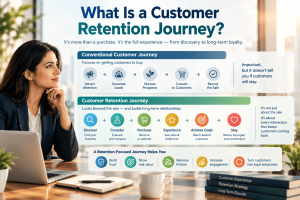
Conventional Customer Journey vs. Customer Retention Journey
A conventional customer journey often focuses on moving prospects towards a purchase.
The business attracts attention, generates leads, nurtures prospects, converts them into customers and records the sale. These activities are important, but they don’t tell you whether customers will remain satisfied or continue buying.
A retention-focused customer journey looks beyond the sale. It asks what happens next, whether customers receive the value they expected, how easily they can achieve their goals and what encourages them to continue the relationship.
Consider a SaaS company.
Its marketing team runs campaigns, demonstrates the software and converts prospects into paying subscribers. From an acquisition perspective, the journey looks successful.
But after subscribing, customers struggle to configure the software. They cannot find the right features, onboarding takes longer than expected, and they see little immediate benefit. Some stop logging in. Others cancel when renewal approaches.
The company succeeded in acquiring customers but failed to design an experience that helped them become successful customers.
Now imagine the company improves its journey. New subscribers receive a welcome message, guided onboarding, clear milestones and practical instructions. The customer success team monitors adoption and reaches out when users encounter difficulties.
The product hasn’t necessarily changed. The experience surrounding the product has changed—and that can influence retention.
Every Interaction Shapes the Decision to Stay
Customers don’t evaluate your business only when they make a purchase or renew a contract. They continuously form opinions based on what happens throughout the relationship.
Consider these interactions:
- First contact: Does your business understand the customer’s needs?
- Purchase: Are the marketing promises and expectations clear?
- Onboarding: Can customers get started without unnecessary effort?
- Value delivery: Are customers seeing meaningful progress?
- Communication: Do they know what’s happening and what comes next?
- Problem resolution: Does your business respond when something goes wrong?
- Renewal or repeat purchase: Do customers have a compelling reason to continue?
Each interaction can strengthen or weaken confidence. A smooth onboarding experience may reinforce a customer’s buying decision, while repeated delays or unclear communication may gradually undermine it.
Research supports the importance of customer experience. PwC’s 2025 Customer Experience Survey reported that 52% of surveyed consumers had stopped buying from a brand after a bad product or service experience. This is a reminder that the experience customers receive can affect their willingness to continue buying. Source: PwC, 2025 Customer Experience Survey.
How This Applies to Different Businesses
- Consulting companies: Clients need more than a strategy presentation. They need clear next steps, progress visibility and confidence that the recommendations are helping their business.
- SMEs and service businesses: Customers are more likely to return when service is consistent, communication is reliable and problems are handled effectively.
- D2C brands: A successful first delivery matters, but product quality, post-purchase support, ease of reordering and relevant follow-ups can influence repeat purchases.
- SaaS businesses: Customers need to adopt the product, experience its benefits and continue receiving value—not simply maintain an active subscription.
The details differ, but the principle remains the same: customers need a reason to continue receiving value from the relationship.
Actionable Tips
- Map your journey from the first interaction to repeat purchase or renewal.
- Identify what customers expect at each stage.
- Check whether the actual experience matches those expectations.
- Find the points where customers experience confusion, delays or unnecessary effort.
- Measure outcomes such as activation, repeat purchases, renewals and customer churn—not just initial conversions.
- Ask customers what helps them stay and what makes continuing difficult.
The key takeaway: A successful customer journey doesn’t end when someone buys. That’s when the retention journey begins.
Why Customer Journeys Often Fail to Create Customer Retention
A business can have a good product, a capable team and satisfied customers at the point of purchase—and still struggle to retain them.
Why?
Because delivering a good product is not the same as designing a good customer journey.
Customers experience everything surrounding the product or service, from the promises made during marketing to the support they receive months after purchasing. When these experiences don’t connect, customers can become frustrated, lose confidence or struggle to recognize the value they’re receiving.
Let’s examine where businesses commonly go wrong.
1. Marketing Promises More Than Delivery Can Consistently Provide
Marketing aims to attract customers. But when the promises made during acquisition exceed what the business can realistically deliver, the customer journey starts with a gap.
Imagine a consulting company promising clients dramatic business improvements within 30 days. The client signs the contract expecting rapid results, but meaningful progress requires several months of analysis, implementation and adjustment.
Even if the consultant delivers excellent work, the client may feel disappointed.
The problem isn’t necessarily the service. It’s the mismatch between expectations and reality.
Actionable tip:
Review your advertisements, sales presentations, proposals and delivery commitments. Make sure they communicate realistic outcomes, timelines, responsibilities and the effort customers must contribute.
2. Customers Don’t Know What Happens Next
After making a purchase, customers naturally want to know what happens next.
When should they expect an update? Who will contact them? How do they get started? When should they expect the first results?
If these questions remain unanswered, uncertainty grows.
For example, a SaaS customer subscribes to a platform but receives no onboarding guidance. A week later, the customer still hasn’t configured the software properly. The subscription is active, but the customer isn’t experiencing meaningful value.
Actionable tip:
Create a clear next-step process for every important stage. Tell customers what happens next, when it happens and who is responsible.
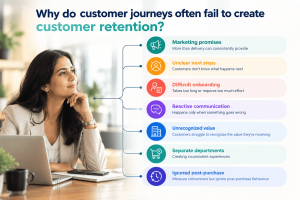
3. Onboarding Takes Too Long or Requires Too Much Effort
Customers purchase products and services to solve problems, not to create additional work for themselves.
Complicated setup processes, unclear instructions, repetitive information requests and delayed assistance can prevent customers from experiencing the benefits they expected.
For a D2C brand, this might mean confusing product instructions. For a consulting business, it might mean an unnecessarily complicated client onboarding process. For SaaS, it could mean customers struggling to complete essential setup tasks.
Actionable tip:
Identify the steps customers must complete before receiving their first meaningful benefit. Remove unnecessary steps, simplify instructions and provide help where customers commonly get stuck.
4. Communication Happens Only When Something Goes Wrong
Some businesses contact customers when they need information, receive a complaint or approach a renewal date. Between those moments, communication becomes inconsistent.
Customers may interpret that silence as a lack of interest.
A service company might be working hard on a client’s project, but if the client receives no progress updates, they may assume nothing is happening.
Actionable tip:
Establish a communication rhythm appropriate to the relationship. Share progress, upcoming milestones, useful recommendations and potential delays before customers have to ask.
5. Customers Struggle to Recognize the Value They’re Receiving
A business may deliver genuine improvements without making those improvements visible to the customer.
Consider a consulting firm that improves a client’s sales process. Response times improve, fewer leads are lost and the sales team becomes more efficient. But nobody compares the results with the starting position or explains the improvement.
The client sees the monthly invoice but struggles to see what has changed.
Over time, the service may feel less valuable—even when it is producing benefits.
Actionable tip:
Establish a baseline, track meaningful outcomes and communicate progress in terms customers care about. Connect your activities to their goals rather than simply reporting tasks completed.
6. Departments Operate Separately, Creating Inconsistent Experiences
Your marketing team makes one promise. Sales communicates another detail. The delivery team follows a different process. Customer support has limited information about what was agreed.
Each department may be doing its job, yet the overall experience feels disconnected.
This matters because customers experience one business, even when that business operates through several departments.
Harvard Business Review’s research on B2B relationships highlights the importance of customers realizing the benefits promised during the sales process. When customers fail to capture those benefits quickly, they may be more likely to terminate the relationship.
Harvard Business Review
Actionable tip:
Connect marketing, sales, delivery and customer support around a shared understanding of customer expectations, commitments and desired outcomes. Ensure important customer information follows the relationship instead of remaining trapped within individual teams.
7. Businesses Measure Conversions but Ignore Post-Purchase Behaviour
A business might celebrate increasing leads, conversion rates and new customers while overlooking declining product usage, fewer repeat purchases, poor onboarding completion or falling renewal rates.
These are different parts of the customer journey, and success at one stage doesn’t guarantee success at the next.
PwC’s Customer Experience Survey found that 52% of surveyed consumers had stopped using or buying from a brand because of a bad product or service experience, while 29% cited poor customer experience online or in person.
The findings reinforce an important point: acquiring customers is not enough if their post-purchase experiences give them reasons to leave.
Actionable tip:
Track customer behaviour after purchase. Monitor activation, time-to-first-value, repeat purchases, engagement, retention and churn. Investigate changes before they become larger problems.
How to Start Fixing These Gaps
Start by mapping the journey from the first customer interaction to renewal or repeat purchase.
At each stage, ask three questions:
- What does the customer expect?
- What experience are we actually delivering?
- What could prevent the customer from receiving or recognizing value?
Prioritize the gaps that have the greatest impact on customer outcomes and retention. You don’t need to redesign everything at once.
The key takeaway:
Customer journeys often fail not because one department performs badly, but because the experiences between departments don’t connect. Fixing those gaps helps customers move from purchase to value, confidence and continued engagement.
Map the Customer Journey Around Value, Not Just Touchpoints
Customer Journey Mapping helps businesses understand what customers experience from their first interaction through purchase, onboarding, continued use and renewal. But an effective customer journey map does more than list emails, meetings, website visits and support conversations. It reveals what customers are trying to achieve, what they expect at each stage, what obstacles they encounter and whether they receive the value they came for.
This distinction matters because a business can have many customer touchpoints and still deliver a frustrating experience.
For example, a consulting firm might send welcome emails, schedule monthly meetings, share reports and conduct quarterly reviews. On paper, the customer journey looks well managed. However, if the client still doesn’t understand what progress has been made or what to do next, those touchpoints aren’t creating enough value.
The real question isn’t how often you interact with customers. It’s whether each interaction helps them move closer to their goals.
1. Start by identifying the main stages of the customer lifecycle
Before mapping individual interactions, identify the major stages customers move through in your business.
A typical lifecycle might include:
- Discovery: The customer recognizes a problem and searches for a solution.
- Evaluation: The customer compares providers, explores options and assesses risk.
- Purchase: The customer commits money, time and trust to your business.
- Onboarding: The customer learns how to begin and what to expect.
- Value realization: The customer experiences the first meaningful benefit.
- Ongoing relationship: The customer receives continuing value, support and guidance.
- Renewal, repeat purchase or expansion: The customer decides whether to continue, buy again or deepen the relationship.
These stages will differ depending on your business model. A SaaS company may focus on account activation, product adoption and subscription renewal. A D2C brand may concentrate on delivery, product use, repeat purchase and loyalty. A consulting firm may prioritize implementation, progress reviews, measurable outcomes and contract renewal.
The objective isn’t to create a complicated map. It’s to understand the journey your customers actually experience.
2. Understand what customers are trying to achieve at each stage
Once you’ve identified the stages, examine the customer’s perspective at each one.
Ask four questions:
- What is the customer trying to achieve?
- What questions or concerns might they have?
- What could delay, confuse or discourage them?
- What evidence would convince them that they’re moving in the right direction?
Consider a SaaS business selling project management software.
During evaluation, the customer may want to know whether the software will reduce missed deadlines. After purchase, the customer wants to set up a workspace and get the team using it. A few weeks later, the customer wants evidence that projects are becoming easier to manage.
The business might consider a product tour, onboarding email and monthly newsletter sufficient. But the customer may care far more about successfully setting up the first project and getting colleagues to use it.
The difference is important: the business sees completed activities; the customer looks for progress.
If your journey map records only what your company does, it can overlook what the customer needs to accomplish.
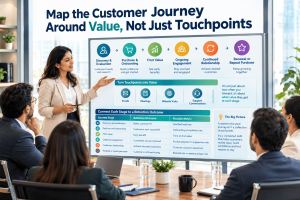
3. Identify touchpoints—and examine the friction behind them
Customer touchpoints include website pages, advertisements, sales conversations, welcome emails, product interfaces, delivery notifications, support requests, account reviews and renewal discussions.
List the important touchpoints at each stage. Then investigate what happens during and between them.
For example, a consulting client might receive a proposal, sign an agreement and attend a kickoff meeting. Yet the client may wait two weeks for the first action plan because the internal handoff between sales and delivery is unclear.
The kickoff meeting itself may be excellent. The delay that follows can still damage confidence.
Look for four common sources of friction:
- Effort: How much work must customers do before receiving value?
- Delay: How long do they wait for an answer, solution or meaningful result?
- Uncertainty: Do they understand what happens next and who is responsible?
- Disconnect: Do different departments provide conflicting information or repeat requests for the same details?
These problems often hide between touchpoints rather than inside a particular interaction. A customer may not complain about a confusing handoff or slow response. They may simply become less engaged.
4. Compare expected value with actual value
This is where journey mapping becomes especially useful for retention.
At every stage, record what customers expect to receive and compare it with what they actually experience. The difference reveals a potential value gap.
Example: Mapping a consulting client’s journey
Customer expectation
Understand why revenue growth has stalled and receive clear priorities for improvement.
Potential value gap
The client receives a lengthy report but no clear explanation of the main bottleneck, its financial impact or which action should come first.
Retention-focused improvement
Present the most important findings, explain their business implications, prioritize the next actions and establish how progress will be reviewed.
Notice that the solution isn’t necessarily more meetings or more reports. It is helping the client understand the value of the work and act on it.
This principle applies across business models. A D2C customer may expect a product to solve a specific problem but receive inadequate usage guidance. A SaaS customer may expect faster team collaboration but struggle to get colleagues to adopt the software. A service-business client may expect reliable delivery but be left guessing about progress.
In each case, retention can suffer when the customer cannot access, recognize or realize the expected value.
Research reinforces why these gaps matter. PwC’s 2025 Customer Experience Survey reported that 52% of consumers had stopped buying from a brand after a bad experience with its products or services. That finding is a reminder that the experience customers receive can directly affect their willingness to continue buying.
5. Connect each stage to a retention outcome
A customer journey map should ultimately help you make better decisions. For every stage, identify the outcome you want to improve and choose a metric that helps you evaluate it.
Journey stage |
Retention-related outcome |
Possible metric |
Discovery and evaluation |
Better customer fit |
Qualified lead rate |
Purchase and onboarding |
Customers start successfully |
Onboarding completion rate |
First value |
Customers experience an early benefit |
Time-to-first-value |
Ongoing engagement |
Customers remain involved |
Product adoption or meaningful engagement rate |
Continued relationship |
Customers achieve intended outcomes |
Customer outcome attainment |
Renewal or repeat purchase |
Customers continue buying |
Renewal rate or repeat purchase rate |
Choose metrics that reflect customer progress, not just internal activity. The number of emails sent, meetings held or reports produced can tell you what your team did. It doesn’t necessarily tell you whether customers benefited.
Actionable tip:
Interview a few recent customers, long-standing customers and customers who left. Ask what they expected at each stage, what helped them most, where they experienced difficulty and when they first recognized value. Compare their answers with your mapped journey. This often reveals gaps that internal teams overlook.
You don’t need an expensive journey-mapping platform to start. A spreadsheet with five columns—stage, customer goal, touchpoints, friction or value gap, and retention metric—is enough to uncover useful improvements.
The key is to map the journey from the customer’s point of view. When you understand what customers are trying to achieve, you can redesign the experience around their progress rather than simply increasing the number of interactions.
A retention-focused customer journey isn’t a collection of touchpoints. It’s a connected path that helps customers realize value, build confidence and find continuing reasons to stay.
Build Your Customer Retention Journey in Seven Stages
Once you understand where customers experience friction and where value gaps exist, the next step is to design a journey that helps customers succeed from the beginning.
A strong Customer Retention Strategy doesn’t start when a customer is considering cancellation. It begins before the purchase and continues throughout the relationship.
The following seven-stage framework gives your business a practical way to build a Customer Retention Journey around customer needs, measurable outcomes and long-term value.
Stage 1 — Right-Fit Acquisition: Attract Customers Who Can Succeed
Retention begins with the customers you attract.
If your marketing promises something your business cannot consistently deliver, you may acquire customers who are unlikely to stay. Even an excellent customer success team will struggle to retain people whose needs, budgets or expectations don’t match your offering.
Imagine a consulting firm that advertises rapid revenue growth without explaining the conditions required to achieve it. It attracts a founder expecting immediate results, although the business has weak conversion processes, limited data and insufficient resources to implement recommendations.
The relationship may begin enthusiastically, but disappointment becomes likely when the founder discovers the actual requirements.
Customer objective: Find a solution that fits their needs, budget, expectations and business goals.
Common friction points:
- Marketing attracts people who are unlikely to benefit from the offering.
- Sales focuses on closing rather than assessing suitability.
- Pricing or implementation requirements are unclear.
- Customers buy based on unrealistic expectations.
Recommended business actions:
- Define your ideal customer profile and the problems your business can realistically solve.
- Explain who your product or service is best suited for—and who may not benefit.
- Qualify prospects based on needs, budget, readiness and expected outcomes.
- Use real examples to clarify what customers can reasonably expect.
For a SaaS company, this might mean assessing whether a prospect has the team, workflow and internal support needed to adopt the platform. For a D2C brand, it might mean helping customers choose the right product instead of pushing the most expensive option.
Metric to monitor:
Qualified lead rate, customer fit rate or early-stage churn by acquisition channel.
Retention connection: When customers understand what they’re buying and are genuinely suited to the solution, the relationship starts with a stronger foundation.
Stage 2 — Expectation Alignment: Make Sure Promises Match Delivery
The next stage is ensuring that what marketing promises, what sales communicates and what delivery provides are consistent.
Customers form expectations long before they experience your product or service. If those expectations are unrealistic, even competent delivery may feel disappointing.
Consider a digital marketing agency that tells a client to expect a dramatic increase in leads within 30 days. The client signs the contract, but the campaign requires research, tracking corrections, testing and optimization before reliable results emerge.
The problem isn’t necessarily the work. It’s the gap between the promised timeline and the actual process.
Customer objective: Understand what they will receive, what results are realistic, how long progress may take and what is expected of them.
Common friction points:
- Sales promises outcomes without explaining dependencies.
- Different teams provide conflicting timelines.
- Responsibilities and limitations are unclear.
- Customers cannot distinguish early progress from final results.
Recommended business actions:
- Document agreed outcomes, timelines, responsibilities and assumptions.
- Align marketing, sales, onboarding and delivery around the same promises.
- Explain what the business controls and what depends on customer participation or external factors.
- Agree on milestones and how success will be measured.
For a SaaS business, this could mean explaining that installing the software is only the first step; meaningful results also depend on team adoption and workflow changes. For a consulting business, it could mean separating the delivery of a strategic roadmap from the time required to implement it and produce measurable business outcomes.
Research from Harvard Business Review on B2B relationships highlights the importance of customers realizing the benefits they were promised during the sales process. If those benefits fail to materialize, the relationship is at risk.
Metric to monitor:
Early-stage churn, expectation-related complaints, customer satisfaction after onboarding or the percentage of customers meeting agreed initial milestones.
Retention connection: Clear expectations reduce avoidable disappointment and help customers judge progress more fairly.
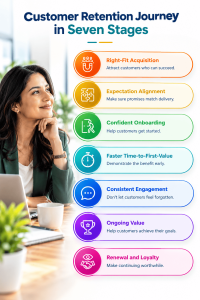
Stage 3 — Confident Onboarding: Help Customers Get Started
After purchase, customers need to know what to do next. Leaving them to figure everything out themselves creates unnecessary uncertainty at precisely the moment when they need reassurance.
Imagine a small business subscribing to accounting software. The owner logs in but doesn’t know how to import records, configure reports or invite the accountant. After several unsuccessful attempts, the owner returns to the old system.
The customer didn’t necessarily reject the software’s capabilities. They struggled to get started.
Customer objective: Understand the next steps and begin using the product or service without unnecessary confusion.
Common friction points:
- Too many steps, forms or setup requirements.
- Instructions that assume prior knowledge.
- Unclear ownership of next steps.
- Slow responses when customers need help.
Recommended business actions:
- Create a clear welcome process with immediate next steps.
- Break onboarding into manageable tasks rather than overwhelming customers with everything at once.
- Provide relevant checklists, demonstrations, templates or guided setup.
- Assign a clear contact for questions where appropriate.
- Identify customers who haven’t completed important onboarding activities and offer timely help.
A consulting firm might send a kickoff summary identifying the required data, the first deliverables, important dates and each person’s responsibilities. A D2C brand might provide simple setup or product-use instructions immediately after delivery.
Metric to monitor:
Onboarding completion rate, setup abandonment rate, time to activation or the percentage of customers completing essential first steps.
Retention connection: Customers who know what to do and feel supported are better positioned to experience value instead of becoming frustrated before they begin.
Stage 4 — Faster Time-to-First-Value: Demonstrate the Benefit Early
Customers don’t buy products, subscriptions or consulting services simply to participate in a process. They buy because they want something to improve.
Time-to-first-value (TTFV) measures how long it takes a customer to experience their first meaningful benefit after starting the relationship.
The exact definition of value depends on your business. It could be completing a task more efficiently, receiving a useful diagnosis, solving a customer problem or experiencing the first successful product use.
For example, a SaaS company may spend weeks explaining every feature while the customer still hasn’t completed a single useful task. A better approach is to help the customer complete one meaningful task early, then introduce additional capabilities as needed.
Similarly, a revenue consulting firm could provide an early, evidence-based finding about a significant conversion bottleneck rather than requiring the client to wait until the end of a lengthy engagement to understand what the analysis reveals.
Customer objective: Experience a meaningful benefit that confirms the purchase was worthwhile.
Common friction points:
- Too much setup before customers see a result.
- Training focuses on features rather than outcomes.
- Early milestones are missing or difficult to achieve.
- Customers cannot tell whether they’re making progress.
Recommended business actions:
- Define the first meaningful value milestone for each customer segment.
- Remove unnecessary steps between purchase and that milestone.
- Provide templates, guided workflows or expert assistance where useful.
- Track customers who take too long to reach the milestone and investigate why.
Don’t confuse speed with rushing. Some services need time to produce reliable results. The goal is to deliver an appropriate early benefit—such as clarity, confidence, a completed setup or a useful initial result—without compromising quality.
Metric to monitor:
Median time-to-first-value, percentage of customers reaching the first-value milestone and early disengagement rate.
Retention connection: Early evidence of value reinforces the customer’s buying decision and provides a reason to continue investing effort in the relationship.
Stage 5 — Consistent Engagement and Communication: Don’t Let Customers Feel Forgotten
Customer relationships weaken when communication disappears after the sale.
This doesn’t mean sending more emails simply to remain visible. It means communicating when customers need information, guidance, reassurance or help moving forward.
Imagine a service business managing a client’s website. Work continues behind the scenes, but the client receives no updates for several weeks. Even if the team is doing good work, the client may begin wondering whether anything is happening.
Regular, relevant communication can prevent this uncertainty.
Customer objective: Stay informed, understand progress and know where to turn when questions or problems arise.
Common friction points:
- Communication stops after the purchase.
- Updates arrive only when something goes wrong.
- Messages are generic or irrelevant.
- Customers must repeatedly chase the business for answers.
Recommended business actions:
- Establish a communication rhythm appropriate to the relationship.
- Share progress against agreed goals, not just lists of completed activities.
- Provide useful guidance based on customer behaviour or changing needs.
- Tell customers about delays and corrective actions before they have to ask.
- Make it easy to request help and receive a clear response.
For a SaaS business, useful communication might include a relevant feature tutorial when a customer struggles with a task. For a D2C brand, it might include delivery updates and practical product-care guidance. For a consulting firm, it could be a short progress update highlighting completed work, emerging findings, outstanding decisions and next steps.
Metric to monitor:
Meaningful engagement rate, response time, unresolved support issues or the percentage of customers participating in scheduled reviews.
Retention connection: Consistent communication keeps customers informed and involved while reducing uncertainty that can quietly erode trust.
Stage 6 — Ongoing Value and Customer Success: Help Customers Achieve Their Goals
A customer may have a good onboarding experience and still leave later if the solution stops delivering meaningful value.
This is why retention requires more than initial activation. Businesses need to understand whether customers continue making progress, whether their needs are changing and whether recurring obstacles are preventing them from achieving their goals.
Consider a consulting firm that initially helps a client improve lead generation. Six months later, the client is generating more leads, but sales conversion remains weak and acquisition costs are rising. If the consultant continues reporting lead volume without addressing the client’s changing business problem, the relationship may lose relevance.
Customer objective: Continue receiving benefits that justify the time, money and effort invested.
Common friction points:
- The business measures activity rather than customer outcomes.
- Product adoption declines without intervention.
- Recurring problems remain unresolved.
- Customer needs change, but the service remains the same.
- The business cannot clearly demonstrate accumulated value.
Recommended business actions:
- Define success measures with customers and review them regularly.
- Monitor adoption, performance and recurring support issues.
- Investigate declining engagement or missed milestones early.
- Identify opportunities to improve the customer’s results, not merely sell additional services.
- Demonstrate progress using agreed baselines and evidence.
A D2C brand might identify customers who struggle to use a product and offer relevant guidance. A SaaS company could notice that a customer has stopped using an important feature and investigate whether training, workflow changes or product limitations are responsible.
For a consulting firm, regular reviews might compare the original baseline with current performance, explain what has improved and identify the next bottleneck to address.
Metric to monitor:
Customer outcome attainment, active adoption, repeat purchase rate, customer health indicators, retention rate or churn rate.
Retention connection: Customers have stronger reasons to continue when the relationship keeps helping them achieve meaningful outcomes.
Stage 7 — Renewal, Loyalty and Expansion: Make Continuing Worthwhile
Renewal should not be the first time a business asks whether a customer is satisfied.
If concerns have accumulated for months, a last-minute renewal discount may not repair the relationship. A stronger approach is to demonstrate value throughout the journey, identify concerns early and discuss what the customer needs next.
For example, a SaaS company shouldn’t wait until a subscription is about to expire to discover that the customer has barely used the platform. It should identify adoption problems earlier, help the customer achieve the intended outcomes and review whether the solution still fits.
Customer objective: Decide whether continuing, purchasing again or expanding the relationship will help achieve their goals.
Common friction points:
- Renewal discussions begin too late.
- Customers cannot see the value received.
- Unresolved concerns emerge near the end of the contract.
- Upselling is prioritized over customer needs.
- The business assumes loyalty without checking customer satisfaction.
Recommended business actions:
- Begin renewal preparation well before the decision deadline.
- Summarize outcomes achieved, problems resolved and value demonstrated.
- Ask about changing priorities, concerns and future requirements.
- Address outstanding issues before presenting renewal options.
- Recommend expansion only when additional products or services genuinely fit the customer’s needs.
- For repeat-purchase businesses, make replenishment or reordering convenient when appropriate.
A consulting firm might review the client’s progress against agreed goals, identify remaining opportunities and recommend whether further support is justified. A D2C brand might offer a relevant complementary product based on the customer’s previous purchase rather than promoting unrelated products to everyone.
Metric to monitor:
Renewal rate, repeat purchase rate, customer retention rate, expansion revenue or net revenue retention for applicable recurring-revenue businesses.
Retention connection: Customers are more likely to continue when they understand what they’ve gained, trust the relationship and can see a credible path to future value.
Bring the Seven Stages Together
These stages work best as one connected system, not seven separate campaigns.
A customer attracted through misleading promises may struggle during onboarding. Poor onboarding may delay the first meaningful result. Delayed value can reduce engagement, making it harder to demonstrate success at renewal.
Likewise, improving onboarding alone won’t solve retention problems if customers later stop receiving value.
Use this simple implementation process:
- Map the current journey: Document how customers actually move from acquisition to renewal or repeat purchase.
- Find the biggest value gap: Identify where customers experience the most friction, uncertainty or delay.
- Choose one improvement: Focus on the gap most likely to affect customer outcomes and retention.
- Assign ownership: Decide who will make the change and how it will be implemented.
- Measure the result: Compare the relevant metric before and after the improvement.
- Repeat: Address the next important bottleneck using the evidence you collect.
Avoid trying to improve all seven stages at once. Start with the part of the journey where customers are struggling most.
When these stages are connected, customers don’t have to work so hard to understand your business, access its value or justify staying. You begin designing a relationship in which continuing to buy from you becomes a logical decision—not a decision you must repeatedly persuade customers to make.
Identify the Moments That Matter Most for Retention
Not every customer interaction has the same influence on whether someone stays with your business. A routine email may have little impact on the relationship, while a confusing onboarding experience, an unresolved problem or a missed promise can significantly weaken customer confidence.
This is why an effective Customer Retention Strategy focuses not only on the entire customer journey but also on the moments that can change how customers feel about the relationship.
Think about a customer who buys a product or service. The purchase itself is only one decision. After buying, the customer begins asking different questions:
Did I make the right choice? Am I getting what I paid for? Can I trust this business when something goes wrong? Is continuing to buy from it worth my money and effort?
The answers often emerge through a handful of important experiences.
1. The first interaction after purchase
The period immediately after a purchase can shape the customer’s first impression of what the ongoing relationship will feel like.
Imagine a founder purchasing a business consulting package. Before payment, the sales team responds quickly, explains everything and answers every question. After payment, communication suddenly stops. The founder doesn’t know when work will begin, what information is needed or whom to contact.
Even before the consulting work starts, confidence may begin to decline.
What to do:
Send a clear welcome message, confirm the agreed deliverables, explain the next steps and provide a realistic timeline. Make sure customers know who is responsible for helping them.
For a D2C business, this might mean providing reliable order updates and clear delivery information. For a SaaS company, it could mean guiding new users through their first setup task.
The goal is simple: reassure customers that their decision has started a well-managed relationship, not a communication vacuum.
2. The first meaningful result
Customers need evidence that the purchase is moving them towards their intended goal. The first meaningful result can reinforce their confidence and make the effort required to continue feel worthwhile.
Consider a customer who subscribes to project management software to reduce missed deadlines. If the company helps the customer successfully organize the first project and assign tasks to the team, the benefit becomes tangible. If the customer spends weeks configuring settings without completing a useful task, the value remains theoretical.
What to do:
Identify the first meaningful result customers should reasonably achieve. Remove unnecessary steps that delay it, provide guidance and monitor whether customers reach that milestone.
Don’t measure success only by whether customers have logged in, attended a meeting or received a report. Ask whether they’ve accomplished something they actually value.
3. The first support problem
A problem doesn’t automatically destroy customer loyalty. In many cases, the way a business responds can determine whether the customer loses confidence or feels reassured.
Imagine a customer receiving a damaged product. A prompt apology, a clear replacement process and regular updates can demonstrate that the business takes responsibility. An automated response followed by days of silence can turn a manageable problem into a reason never to buy again.
The same applies to service businesses. A project delay may be unavoidable, but leaving the client uninformed makes the delay more frustrating.
What to do:
Make support accessible, acknowledge problems quickly, explain what happens next and provide updates until the issue is resolved. Track recurring problems so the business fixes their underlying causes rather than repeatedly treating the symptoms.
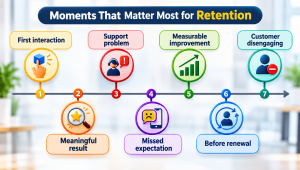
4. The first missed expectation
A missed expectation can be more damaging than a minor operational mistake because it challenges the customer’s understanding of what was promised.
For example, a marketing agency tells a client to expect campaign results within a specific period without clarifying the assumptions involved. When results take longer, the client may interpret the delay as poor performance—even if the agency is carrying out the agreed work.
What to do:
Set realistic expectations before delivery begins. When something changes, explain the reason, the likely impact and the corrective action. Avoid making promises simply because they help close a sale.
The important distinction is between a business that encounters a problem and a business that leaves customers confused about the problem.
5. The first measurable improvement
A customer may enjoy the experience of working with your business but still question whether the investment is worthwhile. Measurable improvement helps connect the experience to an outcome.
Suppose a consulting firm helps a client improve its sales process. Rather than simply reporting that workshops have been completed, the firm shows that response times have improved, more qualified prospects are reaching sales conversations, or a specific bottleneck has been addressed.
The improvement may not yet translate into higher revenue, but evidence of progress helps the client understand what is changing.
What to do:
Establish a baseline, agree on meaningful indicators and communicate progress honestly. Distinguish completed activities from actual outcomes, and explain when more time is needed to assess the financial impact.
6. The period before renewal or the next purchase
Renewal decisions are rarely made in isolation. Customers draw on their accumulated experiences, unresolved concerns and perception of the value they’ve received.
A SaaS company that contacts a customer only when the subscription is about to expire may discover too late that the customer has barely used the product. A consulting firm that waits until the final meeting to discuss results may find that the client has already decided not to continue.
What to do:
Review customer progress well before the decision point. Ask about changing needs, address unresolved concerns and demonstrate the value already delivered. Recommend renewal or expansion when it genuinely serves the customer’s goals.
7. The moment a customer begins disengaging
Reduced engagement is often an opportunity to investigate a problem before it becomes a cancellation or lost sale.
A SaaS customer who previously used the platform every day may stop using an important feature. A consulting client who once participated actively may begin missing review meetings. A D2C customer may stop making repeat purchases.
These behaviours do not automatically mean a customer will leave. Their significance depends on the business model, customer history and reason for the change. However, they can indicate that the experience or perceived value needs attention.
What to do:
Define meaningful warning signals, monitor changes against normal customer behaviour and reach out with relevant help rather than generic sales messages. Ask what has changed before assuming you know the cause.
Research supports the importance of these experiences. PwC’s Customer Experience Survey reported that 52% of consumers had stopped buying from a brand because of a bad product or service experience. The finding reinforces a practical lesson: poor experiences can influence future purchasing decisions, even when a business has successfully acquired the customer.
How to prioritize the moments that matter
You don’t need to redesign every interaction at once. Start by identifying the moments where customer confidence or perceived value is most vulnerable.
For each important moment, ask:
- What does the customer expect to happen?
- What could cause confusion, frustration or doubt?
- What would demonstrate that the business is reliable?
- What evidence would show that the customer is receiving value?
- Which metric would reveal whether the experience is improving?
Then prioritize moments based on their likely impact on customer outcomes, how frequently the problem occurs and how confidently you can identify the cause.
Design the Journey Around Customer Expectations and Effort
Customers don’t expect every experience to be perfect. They do expect to understand what happens next, receive what was promised and get help without unnecessary difficulty.
This is where many businesses overlook an important retention problem: customers may value the outcome but become frustrated by the effort required to achieve it.
A SaaS platform may offer excellent features, but if setting it up requires complicated instructions and repeated support requests, customers may struggle to experience its benefits. A consulting firm may deliver valuable recommendations, but if the client has to chase updates, repeat information and clarify responsibilities at every stage, the relationship becomes harder to maintain.
Your product or service might be good. But if the journey surrounding it is confusing, slow or unnecessarily demanding, customers may question whether continuing is worth the effort.
1. Set clear expectations at every stage
Customers feel more confident when they know what will happen, when it will happen and what they need to do.
Imagine a consulting company promising a revenue diagnostic. The client signs the agreement but receives no clear timeline, data requirements or explanation of the process. The client starts wondering whether the project has begun and what the team needs.
A simple project-start document could prevent much of this uncertainty by explaining the information required, the key milestones, expected delivery dates and the client’s responsibilities.
Apply the same principle to other businesses:
- SaaS: Explain setup requirements, essential first steps and what successful adoption looks like.
- D2C: Communicate delivery timelines, product-use instructions and how to resolve common problems.
- Service businesses: Explain the process, responsibilities, milestones and how customers will receive updates.
- SMEs: Make pricing, availability, service conditions and after-purchase support easy to understand.
Actionable tip:
At each stage of your customer journey, ask: What might the customer be uncertain about right now? Provide the answer before that uncertainty becomes a complaint or delay.
2. Remove unnecessary steps and repetitive requests
Every extra step demands something from the customer: time, attention, information or patience.
Some steps are essential. Others exist because internal processes haven’t been designed around the customer’s experience.
For example, a service business may ask customers to provide the same company details to sales, onboarding and delivery because the teams use separate systems. Each team may see this as a small request. The customer experiences it as repeated effort and poor coordination.
A D2C checkout process might ask for unnecessary information, while a SaaS onboarding flow may require customers to complete several configuration tasks before they can try the main feature.
Actionable tips:
- Remove form fields that aren’t necessary at that stage.
- Reuse information customers have already provided when appropriate.
- Reduce avoidable handoffs between teams.
- Allow customers to complete essential tasks in a logical order.
- Explain why information is needed when the request isn’t obvious.
- Review frequently repeated support questions to identify confusing steps.
Don’t simplify a process by removing safeguards or information that customers genuinely need. The objective is to eliminate unnecessary effort, not essential quality checks.
3. Make instructions and support easy to access
Customers shouldn’t have to search through multiple pages, contact different departments or repeatedly explain a problem just to get help.
Suppose a customer using accounting software cannot generate a financial report. If the help documentation is difficult to find and support takes several days to respond, the customer may lose confidence in the platform.
A short guide, an in-product explanation or a clear route to knowledgeable support could resolve the problem much faster.
Actionable tips:
- Create simple instructions for common customer tasks.
- Make support contact details easy to find.
- Provide relevant help at the point where customers encounter difficulty.
- Ensure customers don’t have to repeat their issue unnecessarily.
- Explain what happens after a support request is submitted.
- Escalate complex or sensitive issues to a person when automated assistance isn’t enough.
A useful question for every business is: Can customers solve common problems without unnecessary searching, waiting or repeating themselves?
4. Align delivery timelines with realistic expectations
A delay becomes especially damaging when the customer has no idea why it is happening or when the situation will improve.
Consider a website development agency that discovers a technical problem and needs another week to finish the project. The additional time may be reasonable, but remaining silent until the original deadline passes creates avoidable frustration.
A better approach is to inform the client early, explain the issue, describe its impact and provide a revised timeline.
The same principle applies when a SaaS implementation requires additional configuration or when a D2C delivery is delayed.
Actionable tips:
- Build realistic timelines around the actual work involved.
- Identify dependencies and potential delays before committing to dates.
- Communicate changes as soon as they become clear.
- Explain what is still progressing while the final result is delayed.
- Avoid promising certainty when outcomes depend on factors outside your control.
Customers can often accommodate reasonable delays more easily when they understand the situation and trust the business to manage it.
5. Reduce the effort required to receive value
One of the most useful ways to improve retention is to examine how much work customers must do before they experience the benefit they purchased.
Harvard Business Review’s 2010 article Stop Trying to Delight Your Customers, based on research involving more than 75,000 customer interactions, argued that reducing customer effort is a more effective route to loyalty in service interactions than simply trying to delight customers. The research introduced the Customer Effort Score (CES) as one way to assess how difficult customers find resolving their needs.
The lesson isn’t that customers never appreciate exceptional service. It’s that businesses shouldn’t overlook the basics while trying to impress people.
For instance, a SaaS company doesn’t necessarily need to offer more features to improve retention. It may need to make the existing features easier to adopt. A consulting firm may not need more meetings; it may need clearer recommendations that the client can act on without extensive clarification.
Actionable tips:
- Identify the most important customer task at each stage.
- Measure how long it takes customers to complete that task.
- Observe where customers abandon, repeat steps or ask for help.
- Simplify the process and test whether customers reach the intended result more easily.
- Ask customers how much effort they needed to get their problem solved.
6. Close the gap between promised and experienced outcomes
Even when the process is smooth, retention can suffer if the actual experience falls short of what the customer expected.
Suppose a consulting firm promises to help a client improve profitability. The team provides reports and completes the agreed meetings, but the client still doesn’t understand which changes could improve profitability or how progress will be measured.
The business may believe it has delivered the service. The customer may feel that the expected outcome remains out of reach.
To prevent this gap, distinguish between three things:
- What was promised: The outcome, deliverable or experience the customer was led to expect.
- What was delivered: The actual product, service, support or work completed.
- What the customer achieved: The benefit the customer was able to realize.
These are related, but they are not interchangeable.
Actionable tips:
- Compare actual delivery with the original agreement.
- Ask customers whether the experience is meeting their expectations.
- Explain the difference between completed work and measurable business outcomes.
- Investigate why promised benefits have not materialized.
- Agree on corrective actions when the gap is within your ability to address.
PwC’s Customer Experience Survey found that 52% of surveyed US consumers had stopped buying from a brand because of a bad product or service experience, while 29% had stopped because of poor customer experience online or in person. Although these figures describe US consumers rather than every business market, they reinforce the commercial importance of delivering a reliable experience.
The retention relationship: From clarity to confidence
The principles in this section work together:
1. Clear Expectations
Customers know what will happen and what is required.
2. Lower Friction
Fewer unnecessary steps, delays and unanswered questions.
3. Better Experience
Customers can navigate the journey and access value more easily.
4. Greater Confidence
Customers have stronger reasons to trust the business.
5. Stronger Retention
Continuing the relationship becomes easier to justify.
This is a reinforcing relationship, not an automatic guarantee. Customers can still leave because of price, changing needs, poor product performance or stronger alternatives. But reducing avoidable friction and making value easier to realize removes common reasons for dissatisfaction.
When expectations are clear, processes are easier to navigate and problems are handled reliably, customers spend less energy managing the relationship—and more time benefiting from it. That is how you design a Customer Retention Journey that supports trust, confidence and long-term business growth.
Personalize the Customer Journey Without Overwhelming Customers
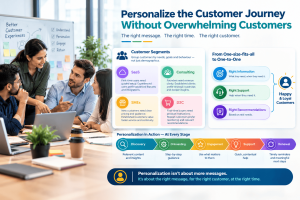
Every customer wants an experience that feels relevant to their needs. But personalization doesn’t mean sending more emails, automating every interaction or adding a customer’s name to every message. It means helping each customer get the right information, support and recommendations at the right time.
This matters because customers differ in their goals, experience, budgets and expectations. A journey that works for one customer may frustrate another.
Effective personalization makes the customer journey more useful—not simply more automated.
Segment customers by needs, goals and behaviour
Start by grouping customers according to differences that genuinely affect their experience. Consider their goals, lifecycle stage, experience level, product usage and support requirements.
Here is how this might work across four business types:
- SaaS: A first-time user may need guided setup, while an experienced user may prefer advanced features, integrations and shortcuts.
- Consulting companies: A founder seeking revenue clarity may need help identifying growth bottlenecks, while a client with an experienced internal team may prefer prioritized recommendations and a strategic roadmap.
- SMEs: A small business purchasing a service for the first time may need clear pricing, practical guidance and reassurance. An established customer may value faster service, continuity and recommendations based on previous purchases.
- D2C: A first-time skincare buyer may need product-use instructions, while a repeat customer may prefer convenient reordering or relevant complementary products.
The important point is that customer segments should reflect meaningful differences—not just demographic categories or whatever data happens to be available.
Actionable tip:
Begin with three or four useful segments, such as new customers, active customers, customers needing support and established customers. Define what each group needs and adapt the journey accordingly.
Adjust onboarding and education to experience levels
Imagine a SaaS company sending every new subscriber the same lengthy training course. Beginners may find it overwhelming, while experienced users may become frustrated by information they already know.
A better approach is to provide a simple starting path, then make advanced guidance available when relevant.
The same principle applies to consulting. A founder unfamiliar with customer lifetime value may need a simple explanation of how it relates to acquisition costs and profitability. A more experienced client may need a deeper analysis of retention, conversion and revenue leakage rather than introductory definitions.
For SMEs, onboarding could mean explaining how a service works, what information is required and what customers should do next. For D2C brands, it might mean giving customers simple product instructions without overwhelming them with unrelated promotions.
Actionable tips:
- Offer beginner and advanced guidance where appropriate.
- Break complex processes into manageable steps.
- Provide help at the point where customers need it.
- Use onboarding progress to identify where assistance may be useful.
- Let customers access more detail when they want it.
The objective is to help customers reach value without forcing everyone through the same experience.
Make recommendations based on genuine needs
Personalization becomes valuable when it helps customers achieve something important.
For example, a SaaS company may recommend a reporting feature because a customer needs better visibility into project delays. A consulting firm may suggest a focused conversion analysis after identifying that a client’s lead volume is healthy but sales performance is weak.
An SME offering business services might recommend a more suitable service package when a customer’s requirements grow. A D2C brand might suggest a compatible refill or complementary product based on a customer’s previous purchase.
In each case, the recommendation is connected to a real need. By contrast, repeatedly promoting upgrades or unrelated products can make customers feel that the business cares more about selling than helping.
Actionable tip:
Before making a recommendation, ask: What customer need does this address, and what evidence suggests this recommendation is relevant?
Recognize changing needs without making assumptions
Customer requirements change. A SaaS customer’s usage may decline because their workflow has changed. A consulting client may shift its focus from acquisition to profitability. An SME may experience seasonal demand, while a D2C customer’s buying frequency may change depending on product consumption.
These changes don’t automatically mean the customer is dissatisfied.
Actionable tips:
- Monitor meaningful behaviour over time rather than reacting to isolated events.
- Ask customers about changing priorities during reviews.
- Adapt guidance and recommendations when their goals change.
- Validate behavioural signals with feedback before taking action.
- Avoid sending increasingly frequent messages just because engagement has declined.
Personalize without overwhelming customers
McKinsey’s 2021 personalization research reported that 71% of surveyed consumers expected personalized interactions, while 76% expressed frustration when they did not receive them. These findings underline the importance of relevance, not the need to automate every possible interaction.
A SaaS customer doesn’t need repeated reminders after completing onboarding. A consulting client doesn’t need daily updates when a weekly summary is more appropriate. An SME’s customers shouldn’t receive multiple messages about the same service. A D2C customer shouldn’t receive irrelevant product promotions simply because they made one purchase.
Respect communication preferences, limit unnecessary messages, use customer information responsibly and make it easy for customers to get help or change their preferences.
Recognize Customer Churn Signals Before They Become Cancellation Decisions
Customers don’t always announce that they are becoming dissatisfied. Sometimes they gradually stop using a product, delay implementation, disengage from communication or struggle to achieve the results they expected.
By the time they cancel a subscription, end a consulting engagement or stop buying from a brand, the underlying problem may have existed for weeks or months.
This is why Customer Churn Prevention should begin before a customer decides to leave.
The key is to recognize meaningful changes, investigate their causes and respond while there is still an opportunity to improve the experience.
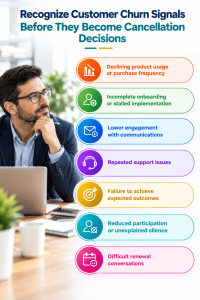
Seven churn signals to watch across different businesses
-
Declining product usage or purchase frequency
- SaaS: A customer who regularly uses the platform stops using important features.
- Consulting: A client stops implementing recommendations or reviewing performance reports.
- SMEs: A regular business customer places fewer orders or requests fewer services than usual.
- D2C: A repeat customer who normally reorders a consumable product doesn’t return within their typical purchasing window.
Action:
Compare behaviour with the customer’s normal pattern. Investigate whether the customer has lost value, changed needs or simply has a valid reason for the change.
-
Incomplete onboarding or stalled implementation
- SaaS: A customer subscribes but never completes account setup or invites their team.
- Consulting: A client delays providing the data needed for a revenue diagnostic.
- SMEs: A customer purchases a service but doesn’t complete the required registration or setup steps.
- D2C: A customer struggles to understand how to use a product and never experiences its intended benefit.
Action:
Identify the blocked step and provide targeted guidance. Don’t assume the customer needs another promotional message when the real problem is difficulty getting started.
-
Lower engagement with communications
- SaaS: Users stop responding to relevant onboarding or product guidance.
- Consulting: A client who previously participated actively becomes less involved in review meetings.
- SMEs: A regular customer stops responding to service updates or enquiries.
- D2C: A customer’s engagement with promotional messages declines.
Action:
Review whether the communication is relevant, timely and useful. Remember that lower email engagement alone is not proof of churn risk.
-
Repeated support issues
- SaaS: Customers repeatedly report the same technical problem.
- Consulting: A client repeatedly asks for clarification because recommendations aren’t actionable.
- SMEs: Customers repeatedly experience delays, incorrect orders or inconsistent service.
- D2C: A buyer repeatedly receives damaged products or struggles with returns.
Action:
Investigate the root cause and fix recurring problems. Repeated apologies without operational improvement rarely restore confidence.
-
Failure to achieve expected outcomes
- SaaS: The customer uses the platform but doesn’t achieve the expected productivity improvement.
- Consulting: A client receives reports but cannot see progress towards agreed business goals.
- SMEs: A business customer pays for a service but continues experiencing the same unresolved problem.
- D2C: A customer finds that the product doesn’t meet the expectations created by the product description or sales messaging.
Action:
Compare actual outcomes with the customer’s original expectations. Determine whether the gap comes from the product, implementation, communication, unrealistic promises or changing customer needs.
-
Reduced participation or unexplained silence
- SaaS: A customer stops attending implementation sessions.
- Consulting: A founder becomes unavailable for important decisions.
- SMEs: A previously active customer stops engaging with account managers.
- D2C: A repeat buyer disappears from their usual purchasing pattern.
Action:
Reach out with a relevant, low-pressure question. Ask whether priorities have changed or whether the customer needs help. Avoid assuming silence means dissatisfaction.
-
Difficult renewal conversations
- SaaS: A customer questions the subscription’s value or delays renewal.
- Consulting: A client challenges the return on investment or hesitates to extend the engagement.
- SMEs: A business customer begins comparing alternative suppliers.
- D2C: A customer who previously bought repeatedly no longer chooses the brand.
Action:
Review the value delivered, unresolved concerns and changing requirements before presenting a renewal or repeat-purchase offer.
Use a simple process: Detect → Diagnose → Intervene → Measure
-
Detect
Identify a meaningful change in behaviour, engagement or customer outcomes.
-
Diagnose
Find out why the change occurred. Use customer feedback, usage data, support history or performance reviews.
-
Intervene
Take action that addresses the actual problem, such as improving onboarding, resolving a recurring issue or clarifying expectations.
-
Measure
Check whether the problem has been resolved and whether customer engagement, outcomes or retention improve.
For example, suppose a consulting client stops attending monthly reviews. The firm detects the change, discovers that the client has shifted priorities, agrees on a more suitable review schedule and then checks whether participation and project progress recover.
The goal isn’t to pressure the client into continuing. It’s to understand whether the relationship can still deliver meaningful value.
Measure warning signals without jumping to conclusions
Useful metrics include product adoption, onboarding completion, time-to-first-value, repeat support issues, customer outcome attainment, renewal rate and churn rate.
Use a combination of signals rather than relying on one behaviour. A customer using a SaaS product less frequently may still be achieving excellent results. A D2C customer may not need another purchase yet. Context matters.
Research from PwC’s Customer Experience Survey found that 52% of surveyed US consumers had stopped buying from a brand following a bad product or service experience. Although this figure doesn’t predict the likelihood of an individual customer leaving, it reinforces why unresolved experience problems deserve attention.
Measure Whether Your Customer Journey Is Actually Improving Retention
Redesigning a Customer Retention Journey is only the beginning. The real question is whether those changes help customers achieve results, continue buying and stay with your business longer.
You might simplify onboarding, improve customer support or introduce personalized follow-ups. These changes may make the experience feel better, but are they actually helping you Improve Customer Retention? Without the right measurements, it is easy to mistake activity for progress.
A strong Customer Retention Strategy connects customer experience improvements to measurable business outcomes. It helps you understand not only whether customers are staying, but also why they stay, where they struggle and which changes make a meaningful difference.
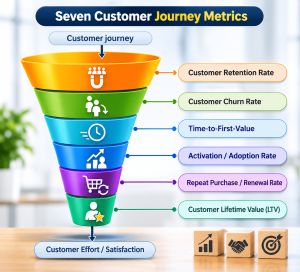
The seven metrics that reveal whether your customer journey is working
Metric |
What it helps reveal |
Customer Retention Rate |
The proportion of customers who remain customers over a defined period. |
Customer Churn Rate |
The proportion of customers lost during that period. |
Time-to-First-Value |
How quickly customers experience their first meaningful benefit. |
Activation / Adoption Rate |
Whether customers begin using essential features, services or capabilities. |
Repeat Purchase / Renewal Rate |
Whether customers return to buy again or renew their relationship. |
Customer Lifetime Value (LTV) |
The economic value generated over the customer relationship. |
Customer Effort / Satisfaction |
Whether customers find the experience easy, useful and aligned with their expectations. |
Let’s explore how to use these metrics to make better decisions.
1. Measure retention and churn together
Customer Retention Rate shows how effectively your business keeps its existing customers, while Customer Churn Rate reveals how many leave.
For a subscription business, if you start a month with 500 customers and lose 25 of them, your customer churn rate is 5%, assuming you are measuring customer losses against the opening customer base. Your retention rate for that same starting cohort is 95%, provided there are no other adjustments to the cohort definition.
However, these figures do not explain why customers stayed or left.
- SaaS: If churn increases after a product update, investigate whether customers are struggling with the new interface or failing to get the value they expected.
- Consulting companies: If clients do not renew after a project, review whether the work delivered measurable outcomes and whether the next steps were clear.
- SMEs: If customers stop returning to a local service business, examine service consistency, follow-up quality and whether the original problem was resolved.
- D2C: If repeat orders decline, investigate product satisfaction, delivery experience, perceived value and whether replenishment reminders arrive at the right time.
Actionable tip:
Track retention and churn by customer segment, acquisition channel, product, service or customer cohort. An overall rate may hide the fact that one group stays while another leaves.
2. Measure how quickly customers experience value
Time-to-First-Value (TTFV) measures the time between a defined starting point and the first meaningful outcome a customer experiences. The starting point might be signup, purchase, onboarding or project kickoff, depending on the business.
A customer may complete every onboarding step without achieving anything useful. That is why completing tasks is not the same as receiving value.
Consider these examples:
- SaaS: A customer signs up for project management software but does not successfully create a project and collaborate with their team for ten days. Simplifying setup could shorten the time to value.
- Consulting companies: A client receives a detailed strategy presentation but waits several weeks for clear priorities and actionable recommendations. A short early diagnostic review may demonstrate value sooner.
- SMEs: A customer books a repair service but remains uncertain whether the problem has been fixed. A clear explanation, completed work and follow-up confirmation can make the value more visible.
- D2C: A customer buys a skincare product but does not know how to use it correctly. Simple usage instructions can help the customer experience the intended benefit.
Actionable tip:
Define one meaningful first-value event for each product or service. Measure how long customers take to reach it, then identify the steps causing delays.
3. Measure activation and adoption—not just engagement
Activation Rate measures the proportion of eligible customers who complete a predefined action associated with initial value. Adoption measures whether customers use important features, services or capabilities over time.
A high login rate, email open rate or app visit count can look impressive. But engagement does not necessarily mean customers are making progress.
For example, SaaS customers may log in frequently because they cannot find the feature they need. Consulting clients may attend every meeting but struggle to implement the recommendations. An SME may receive positive feedback after a purchase without seeing repeat business. D2C customers may follow a brand on social media but never buy again.
Actionable tip:
Identify the customer behaviour that demonstrates progress—not simply activity. Track activation, meaningful adoption and the outcomes that follow.
4. Connect repeat purchases and renewals to customer value
Repeat Purchase Rate and Renewal Rate indicate whether customers choose to continue their relationship with your business. They are particularly useful for understanding whether the customer journey supports loyalty beyond the first transaction.
A D2C customer who buys once may have liked the product, but repeat purchases provide stronger evidence of continued demand. A SaaS customer who renews may still be under using the product, so renewal alone does not prove that the relationship is healthy.
Similarly, a consulting client may renew because switching providers is difficult—not necessarily because the engagement is delivering sufficient value.
Actionable tip:
Pair repeat purchases or renewals with customer feedback, product adoption, outcome achievement and reasons for leaving. Look for patterns that explain the behaviour.
5. Understand how retention influences Customer Lifetime Value
Customer Lifetime Value (LTV) estimates the economic value generated by a customer over the relationship. Retaining suitable customers for longer can increase their cumulative contribution, especially when they continue purchasing without requiring disproportionate service or acquisition costs.
For example, a D2C brand may increase repeat purchases through relevant replenishment reminders. A consulting firm may retain clients by helping them achieve measurable improvements. A SaaS company may increase LTV by improving adoption and reducing preventable churn.
However, longer relationships do not automatically mean greater profitability. Discounts, support costs, delivery expenses and the cost of serving complex accounts can reduce the economic benefit.
Actionable tip:
Monitor LTV alongside acquisition cost, gross margin, retention and the cost of serving customers. Prioritize improvements that strengthen customer value and business economics together.
6. Measure customer effort and satisfaction
Customer feedback helps explain what numerical metrics alone cannot. Customer Effort Score (CES) can reveal how easy it is for customers to complete a task or resolve a problem, while satisfaction measures indicate how customers perceive their experience.
Harvard Business Review’s article Stop Trying to Delight Your Customers argues that reducing customer effort can be more useful for loyalty than trying to exceed expectations through unnecessary gestures.
For a SaaS business, this may mean resolving setup problems without repeated support requests. For a consulting firm, it may mean giving clients one clear point of contact. For an SME, it could mean transparent pricing and simpler booking. For a D2C brand, it could mean straightforward returns and clear delivery updates.
Actionable tip:
Ask customers about specific moments—onboarding, support, delivery, renewal or project handover—instead of relying only on a general satisfaction score.
Interpret the metrics together
No single metric tells the complete story. A SaaS company might see higher engagement but unchanged retention because customers are active without achieving their goals. A D2C brand might increase repeat purchases through discounts while reducing margins. A consulting company might improve satisfaction scores without improving renewal rates.
To determine whether Customer Journey Optimization is working:
- Record a baseline before changing the journey.
- Choose a specific friction point and define the expected outcome.
- Compare similar customer cohorts over appropriate periods.
- Track both leading indicators, such as activation and time-to-first-value, and lagging indicators, such as retention, churn and LTV.
- Investigate other factors, including seasonality, pricing changes, acquisition quality and product changes.
- Keep, adjust or reverse the intervention based on the evidence.
How Different Businesses Can Build a Retention-Focused Customer Journey
There is no single Customer Retention Strategy that works for every business. A SaaS company may lose customers because they never adopt the product. A consulting firm may lose clients because the value of its work is unclear. An SME may struggle with inconsistent service, while a D2C brand may find that customers never return after their first purchase.
The principle is the same: design the customer journey around what customers need to achieve at each stage, not simply what your business wants them to do next.
Here is how different businesses can build a Customer Retention Journey that encourages customers to stay, return and continue buying.
For SMEs: Make every interaction consistent
For small and medium-sized businesses, retention often depends on the quality and consistency of everyday interactions. Customers want to know what to expect, receive what was promised and feel confident returning.
Imagine a customer visits a local home maintenance company for an electrical repair. The technician completes the work, but nobody explains what was fixed or checks whether the problem has returned. Even if the repair was technically successful, the customer may hesitate to call the company again.
A retention-focused journey would include:
- Before purchase: Explain pricing, service scope, availability and expected timelines.
- During delivery: Keep customers informed about delays or changes.
- After delivery: Explain the work completed and provide relevant maintenance guidance.
- Before the next need: Follow up appropriately and make repeat booking easy.
Actionable tip:
Map the journey from the first enquiry to the next purchase. Identify one point where customers experience uncertainty, delay or unnecessary effort, and improve it first.
Track repeat booking rates, complaints, customer retention and referrals to determine whether the changes are helping.
For consulting and service businesses: Make value visible throughout the engagement
Consulting firms and other service businesses often deliver valuable expertise, but clients may struggle to recognize progress when outcomes are not communicated clearly.
Consider a consulting company hired to improve a client’s customer acquisition and retention. If the consultant delivers a strategy document but does not establish priorities, explain expected outcomes or review implementation progress, the client may question the engagement’s value—even when the recommendations are sound.
A stronger Customer Journey Mapping approach would include:
- Onboarding: Agree on objectives, responsibilities, deliverables and success measures.
- Early engagement: Identify an initial opportunity where the client can see tangible progress.
- Ongoing delivery: Provide concise progress updates linked to agreed business outcomes.
- Review meetings: Discuss what has improved, what remains blocked and what should happen next.
- Renewal or project completion: Summarize results and recommend relevant next steps without forcing an unnecessary extension.
Actionable tip:
Create a simple client progress scorecard covering agreed objectives, completed milestones, measurable results, outstanding issues and next actions. Review it regularly with the client.
This helps transform a service relationship from a series of meetings and deliverables into a visible journey toward results. It also gives the business earlier opportunities to address dissatisfaction before renewal discussions begin.
For SaaS businesses: Help customers reach value faster
SaaS companies can attract customers through effective marketing and still struggle with retention if users cannot understand, adopt or benefit from the product.
Imagine a company purchases a customer relationship management platform. Its team completes registration but never configures the sales pipeline or uses reporting features. The subscription remains active, but the team gains little value. When renewal approaches, cancelling may seem like the obvious decision.
To improve the journey:
- Simplify onboarding: Guide users through only the essential setup steps first.
- Define activation: Identify the specific action that demonstrates initial value, such as successfully tracking a sales opportunity.
- Support adoption: Offer relevant tutorials, contextual guidance and practical examples.
- Monitor behaviour: Detect incomplete setup, declining usage or repeated difficulties with important features.
- Intervene early: Offer targeted help when customers show signs of struggling.
Actionable tip:
Identify the three most important behaviours associated with customers achieving their intended outcomes. Measure how many new customers complete them, how long they take and whether those customers subsequently retain at higher rates.
Do not assume that frequent logins equal success. Meaningful adoption and achieved outcomes matter more than activity alone.
For D2C businesses: Turn the first purchase into a valuable ongoing relationship
For direct-to-consumer brands, the customer journey should not end when the payment is processed or the product is delivered.
Imagine a customer purchases a skincare product online. The delivery arrives, but the customer receives no useful instructions, has questions about product usage and does not know which products are suitable for their needs. Even if the product is good, a disappointing post-purchase experience may prevent a second order.
A retention-focused journey connects the stages naturally:
- After purchase: Confirm the order and provide clear delivery updates.
- After delivery: Share useful product instructions and answer common questions.
- During use: Offer relevant guidance that helps customers get the intended benefit.
- Before replenishment: Send reminders based on realistic product usage cycles, where appropriate.
- For returning customers: Make repeat ordering convenient and offer relevant recommendations.
Actionable tip:
Segment customers by product purchased, purchase frequency and likely replenishment needs. Test relevant follow-ups against a comparable group that does not receive the intervention. Measure repeat purchase rate, time between orders, returns and profitability—not just email clicks.
Personalization should make the experience more useful, not create unnecessary messages.
McKinsey’s research on personalization reported that 71% of consumers expected personalized interactions, while 76% felt frustrated when these were absent. These findings support making interactions relevant, although they do not guarantee that any particular personalization tactic will improve retention.
The common principle across all four business types
Although the tactics differ, effective Customer Journey Optimization follows the same logic:
- Understand what customers want to achieve.
- Identify where the journey creates confusion, delay or disappointment.
- Remove friction and make the next step clear.
- Help customers experience value as early as practical.
- Measure whether those improvements lead to better retention and business outcomes.
That is how businesses can build a customer journey that improves retention—not by adding more communication or more marketing, but by making every important stage of the relationship more useful, consistent and valuable for the customer.
Common Mistakes to Avoid When Designing a Customer Journey
A business can invest in better onboarding, personalized emails, customer support and loyalty programs—and still struggle to retain customers.
Why? Because improving individual interactions does not necessarily fix the reasons customers leave.
An effective Customer Retention Journey is not simply a sequence of touchpoints. It is a connected experience that helps customers achieve what they came for, recognize the value they receive and feel confident continuing the relationship.
Here are eight common mistakes that can weaken your Customer Retention Strategy, along with practical ways to avoid them.
1. Designing the journey around departments instead of customer needs
Customers do not experience your business as separate departments. They experience one relationship.
Imagine a SaaS customer who contacts sales about a feature, explains the same requirement again during onboarding and then repeats it to customer support. Each department may be doing its job, but the customer experiences unnecessary effort and disconnection.
The same problem affects other businesses. A consulting client may receive conflicting information from sales and delivery teams. An SME customer may have to call repeatedly to confirm a booking. A D2C customer may need to contact different teams about delivery and returns.
How to avoid it:
Use Customer Journey Mapping to understand the entire experience from the customer’s perspective. Identify handoff problems, repeated questions and gaps in communication. Give someone responsibility for ensuring that important customer information follows the relationship across teams.
2. Treating the purchase as the end of the journey
Winning a customer is not the same as keeping one.
A business may celebrate a new sale while overlooking what happens next. Customers may struggle to use the product, wait too long for results or feel abandoned after payment.
For example, a SaaS company may spend heavily on acquiring subscribers but provide weak onboarding. A consulting firm may deliver a report without helping the client understand the next steps. An SME may complete a service without checking whether the issue was resolved. A D2C brand may deliver an order without offering useful product guidance.
How to avoid it:
Design the post-purchase experience deliberately. Define what customers should understand, experience and achieve after buying. Measure activation, time-to-first-value, satisfaction and repeat purchases—not just conversions.
3. Making promises that delivery teams cannot consistently meet
Marketing may promise fast results, sales may suggest ambitious timelines and delivery teams may be unable to meet those expectations.
The resulting gap damages trust.
Imagine a consulting company promising substantial growth within a month without explaining the dependencies involved. Or a D2C brand advertising rapid delivery without accounting for its actual fulfilment capacity. Even when the underlying product or service is good, the experience can disappoint.
How to avoid it:
Align marketing messages, sales conversations and delivery processes. Communicate realistic timelines, limitations, responsibilities and expected outcomes. Where results depend on customer participation or external factors, explain those dependencies before purchase.
A sustainable Customer Experience begins with promises the business can credibly support.
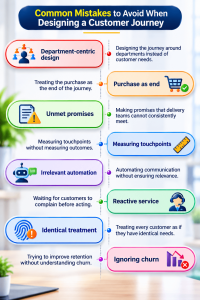
4. Measuring touchpoints without measuring outcomes
Sending emails, conducting onboarding calls and publishing tutorials can make a retention program look busy. But activity is not proof of value.
A SaaS company might celebrate high email engagement while customers fail to adopt key features. A consulting firm might conduct every scheduled review without improving client outcomes. An SME might collect positive feedback but still experience declining repeat business. A D2C brand might generate clicks on promotional messages without increasing profitable repeat orders.
How to avoid it:
Connect each important touchpoint to a customer outcome and a business metric. Ask what the interaction should help the customer accomplish and how you will know whether it worked.
For instance, measure whether an onboarding guide increases successful activation, not merely how many customers open it.
5. Automating communication without ensuring relevance
Automation can make communication timely and consistent. But irrelevant messages can turn a helpful experience into an irritating one.
A SaaS customer who has already completed setup should not keep receiving beginner instructions. A consulting client should not receive generic updates unrelated to their project. An SME should not send repeat-booking reminders immediately after a customer’s issue has been resolved. A D2C brand should not send replenishment reminders for a product the customer has barely started using.
How to avoid it:
Trigger communications based on customer behaviour, needs and lifecycle stage. Suppress messages that no longer apply, provide a clear way to manage preferences and review whether each message genuinely helps.
The purpose of automation is not to send more messages. It is to deliver the right support at the right moment.
6. Waiting for customers to complain before acting
Many customers do not explain why they are becoming disengaged. They simply stop using the product, decline to renew or purchase elsewhere.
A SaaS customer may gradually stop using essential features. A consulting client may become less involved in meetings. An SME may notice fewer repeat bookings. A D2C customer may stop purchasing after a disappointing delivery.
How to avoid it:
Monitor early warning signals, including declining adoption, repeated support issues, missed milestones and falling purchase frequency. Investigate the cause before assuming the customer is ready to leave.
Treat these signals as reasons to ask questions, not proof of dissatisfaction. A drop in activity may reflect seasonality, a completed task or a change in customer needs.
7. Treating every customer as if they have identical needs
Customers can buy the same product for different reasons, have different levels of experience and need different forms of support.
A new SaaS user may need guided setup, while an experienced user wants advanced capabilities. One consulting client may need implementation support, while another needs strategic direction. SME customers may differ in urgency and service requirements. D2C customers may purchase the same product for different use cases.
How to avoid it:
Segment customers by relevant factors such as goals, behaviour, lifecycle stage and product usage. Adapt the journey where the difference matters. You do not need a separate journey for every individual; start with the needs that materially affect value and retention.
8. Trying to improve retention without understanding churn
Perhaps the most expensive mistake is treating a retention problem as a communication problem when its real cause lies elsewhere.
A SaaS company may send more emails when the product lacks an essential capability. A consulting firm may introduce loyalty discounts when clients actually need clearer results. An SME may offer promotions when inconsistent service is driving customers away. A D2C brand may invest in rewards while product quality or delivery remains unreliable.
PwC’s US Customer Experience Survey reported that 52% of surveyed consumers had stopped buying from a brand after a bad product or service experience. This is a useful reminder that the experience itself can influence purchasing decisions; it does not mean every business will experience the same rate of customer loss.
How to avoid it:
Analyse cancellation reasons, customer feedback, behavioural patterns, support records and retention by cohort. Distinguish between customers who were a poor fit from the beginning and customers who left because the experience failed to deliver expected value.
Actionable Steps to Build Your Customer Retention Journey
Use Customer Journey Mapping to outline the key stages customers experience: discovery, evaluation, purchase, onboarding, value delivery, ongoing engagement and renewal or repeat purchase.
Keep the first version simple. A SaaS company might map signup through renewal. A consulting firm might map the journey from the initial discussion to project completion and a follow-on engagement. An SME could map enquiry through service delivery and repeat booking. A D2C brand could map product discovery through delivery, product use and the next order.
Action:
Sketch the journey on one page before adding more detail.
2. Identify the customer’s goal at each stage
At every stage, ask: What is the customer trying to accomplish right now?
A new SaaS user may want to complete a task, not learn every feature. A consulting client may want confidence that the engagement is solving the right problem. An SME customer may want a reliable solution without repeated follow-ups. A D2C buyer may want to receive and use the product successfully.
Action:
Write down one primary customer goal for each stage. If your journey does not help customers achieve it, reconsider what belongs there.
3. Record the promises and expectations you create
Customers form expectations through advertisements, sales conversations, pricing pages, proposals and product descriptions. If delivery does not match those expectations, trust can weaken.
For example, a SaaS product should clearly communicate setup requirements. A consulting company should define scope and responsibilities. An SME should provide realistic service timelines. A D2C brand should communicate product details, delivery estimates and return conditions accurately.
Action:
Compare what marketing and sales promise with what the delivery experience can consistently provide. Close any significant gaps before adding retention campaigns.
4. Locate friction and gaps in perceived value
Look for moments when customers become confused, wait too long, repeat information or struggle to achieve the intended outcome.
A SaaS customer may abandon onboarding. A consulting client may not understand a report’s practical implications. An SME customer may have to chase a service update. A D2C buyer may not know how to use a product or resolve a delivery issue.
Action:
Review customer feedback, support requests, drop-off points and behavioural data. Prioritize the friction that affects important customer outcomes—not just the issues that are easiest to fix.
5. Define the desired outcome at each stage
A completed touchpoint is not necessarily a successful one. Decide what progress should look like from the customer’s perspective.
For SaaS, it could be successfully using a key feature. For consulting, it could be agreeing on priorities and acting on recommendations. For an SME, it could be resolving the customer’s problem. For D2C, it could be receiving the right product and understanding how to use it.
Action:
Define one observable outcome for each critical stage. This makes Customer Journey Optimization more practical because your team can evaluate whether the experience is working.
6. Assign an owner to every critical touchpoint
A journey can fail when everyone assumes someone else is responsible for the customer experience.
A SaaS product team may own onboarding while customer success owns adoption. A consulting firm’s sales team may promise something the delivery team has not confirmed. An SME may have no clear owner for post-service follow-up. A D2C brand may separate fulfilment and customer support without a clear process for resolving delivery problems.
Action:
Assign one accountable owner to each important touchpoint. The owner does not need to perform every task, but should ensure the customer receives a consistent experience and that unresolved issues reach the right person.
7. Establish relevant communication and follow-up
Customers need information when it helps them move forward—not simply because your automation schedule says it is time to send a message.
A SaaS company can guide users who have not completed setup. A consulting firm can share progress updates before clients need to ask. An SME can confirm that a service issue has been resolved. A D2C brand can provide useful product instructions or a relevant replenishment reminder.
Action:
For every planned communication, define its purpose, trigger and intended customer benefit. Remove messages that are repetitive, irrelevant or poorly timed.
Research from McKinsey found that 71% of surveyed consumers expected personalized interactions, while 76% reported frustration when they did not receive them. This supports making communication relevant, rather than merely increasing its frequency.
8. Choose metrics that measure meaningful progress
Select a small set of metrics connected to the outcomes you want to improve. These might include Customer Retention Rate, churn, activation, Time-to-First-Value, repeat purchase rate, renewal rate and Customer Lifetime Value (LTV).
Choose metrics that fit your business model. SaaS companies may focus on activation and subscription retention; consulting firms on client outcomes and renewals; SMEs on repeat business and customer retention; and D2C brands on repeat purchase behaviour and contribution margin.
Action:
Establish a baseline before changing the journey. Compare similar customer groups over suitable periods so that you can distinguish genuine improvements from seasonal changes or differences in customer mix.
9. Monitor behavioural changes and intervene early
Do not wait until a customer cancels, declines a proposal or stops buying to investigate what went wrong.
Declining product adoption, missed project milestones, repeated service complaints and falling purchase frequency can indicate that customers are struggling. However, these are warning signals to investigate, not definitive proof that a customer intends to leave.
Action:
Define a few meaningful warning signals and agree on what your team should do when they appear. Contact customers with a relevant question or offer practical help instead of automatically sending a discount or generic reminder.
10. Review results and improve continuously
Your first journey design will not be perfect. Customer expectations change, products evolve and different customer segments experience different problems.
Review what changed, whether customers achieved the intended outcomes and whether retention-related metrics improved. If an intervention produces more engagement but no improvement in meaningful outcomes, investigate why before expanding it.
This approach is consistent with PwC’s US customer experience research, which reported that 52% of surveyed consumers had stopped buying from a brand after a bad product or service experience. The finding reinforces the importance of addressing experience problems, although results will vary across businesses and markets.
Action:
Schedule a regular review, identify the most significant journey bottleneck and choose one improvement to test next.
Where should founders begin?
You do not need a large transformation project to get started. Begin with one customer segment and one important stage where value is delayed, expectations are missed or customers are most likely to disengage.
Map the experience, identify the cause, assign responsibility, make a focused improvement and measure the result. Then repeat the process.
That is how businesses can improve customer retention through customer journey mapping—by replacing assumptions with evidence, disconnected activities with coordinated systems, and short-term retention campaigns with a repeatable approach to sustainable growth.
Conclusion
A successful Customer Retention Journey does not happen because a business sends more emails, offers bigger discounts or launches another loyalty campaign. It happens when customers consistently experience the value they expected—and have good reasons to continue the relationship.
When you attract the right customers, set clear expectations, simplify onboarding, deliver value quickly and provide relevant support, Customer Retention becomes a natural outcome of a well-designed customer experience.
The progression is straightforward:
Right-Fit Customers → Clear Expectations → Smooth Onboarding → Faster Value → Consistent Engagement → Customer Success → Stronger Retention
For SaaS companies, this means helping customers adopt the product and achieve meaningful results. For consulting firms, it means making progress and business outcomes visible. For SMEs, it means delivering consistent service that earns repeat business. For D2C brands, it means creating a post-purchase experience that encourages customers to return because they trust the product and the brand.
The opportunity for businesses is to look beyond individual touchpoints and understand how the entire journey influences revenue. Where are customers losing confidence? Where does friction delay value? Where are expectations not being met? And where could a small improvement prevent a customer from leaving?
This is where Customer Journey Mapping, Customer Experience and Customer Journey Optimization become more than marketing activities. They become essential parts of a stronger Customer Retention Strategy—one designed to improve customer outcomes, strengthen Customer Lifetime Value (LTV) and support more sustainable growth.
The strongest customer retention strategy isn’t about convincing customers to stay after they become dissatisfied. It’s about designing a journey that continually reminds them why staying makes sense.
Is Your Customer Journey Designed to Retain—or Just to Convert?
Your business may be attracting customers successfully while losing opportunities through poor expectation alignment, difficult onboarding, delayed value delivery or inconsistent engagement.
Metsertive helps businesses examine the connections between acquisition, conversion, monetization and retention to identify potential revenue bottlenecks and prioritize opportunities for improvement.
Assess your customer journey. Identify where customers may be losing confidence, experiencing friction or failing to realize value—before those gaps affect retention and revenue.
Diagnose My Customer Journey.

