Posts

Personalizing Customer Touchpoints To Improve Conversions

Every time a customer interacts with your brand—whether it’s opening an email, chatting with your support, or scrolling your site—you have a tiny window to make that moment feel personal.

These moments, your customer touchpoints, can be your biggest asset… or your biggest missed opportunity. This guide will walk you through how to personalize customer touchpoints in a way that feels authentic and drives measurable growth.”

Today, personalization isn’t just a nice touch; it’s an expectation. According to Epsilon, 80% of consumers are more likely to make a purchase when brands offer personalized experiences. And yet, too many businesses still push generic emails, static web pages, and cookie-cutter follow-ups.

The result? Higher bounce rates. Lower conversions. And lost loyalty.

In this guide, you’ll see why personalization should be woven into every touchpoint—and exactly how to do it in a way that’s realistic, scalable, and actually converts.

By the end, you’ll know:

  • Where personalization has the most impact.
  • How to map and apply it at every stage.
  • Real examples and tools that make it doable—no big team required.

Ready to make your touchpoints feel like they were built just for your best customers? Let’s get into it.

Why Personalization Matters Across Customer Touchpoints

Your customers crave relevance. They’re bombarded by generic ads, identical emails, and cold, transactional experiences every day.

But when you get personalization right—across all your touchpoints—you show your customer:
“Hey, we see you. We know what you care about. And we’re here to make your experience easier.”

That builds trust faster than any fancy sales pitch.

Stat to remember: A Salesforce report found that 66% of customers expect companies to understand their unique needs and expectations—yet more than half feel brands fall short.

Personalization fixes that gap.

Why does this matter so much for SMEs and B2B brands?

Because your prospects are weighing their options every minute. If your emails feel robotic, your website suggestions miss the mark, or your follow-ups sound generic… they’ll find someone who “gets them” better.

The good news? Personalization doesn’t have to be complex or creepy. A simple personalized product recommendation, a “Hey [Name], noticed you were checking this out…” email, or a chatbot that knows what page your visitor is on can be the small nudge that closes a deal—or keeps them coming back. Before launching personalization campaigns, customer journey mapping ensures you understand each interaction point that matters most to your audience.

Quick win: If you haven’t mapped your customer touchpoints yet, do that first—it’s the foundation for smart personalization.

When every touchpoint feels tailored, you don’t just boost engagement—you build loyalty that lasts.

Personalization is a key pillar of customer experience optimization, ensuring every interaction feels relevant and valuable.”

Mapping Personalization Opportunities in Your Touchpoints

Personalization isn’t about slapping a first name in an email and calling it a day. It’s about delivering relevance at every stage of your customer’s journey—without overwhelming your team or your systems.

Here’s where to start:

1. Identify Where Personalization Can Happen

Think beyond emails. You have opportunities across:

  • Website – personalized greetings, product recommendations, dynamic banners.
  • Emails – behavior-based sends, segmented offers.
  • SMS & Chatbots – quick nudges with relevance (“Hey, still thinking about [Product Name]?”).
  • Retargeting Ads – dynamic ads based on browsing or cart activity.

Example: An eCommerce brand noticing a customer viewed sneakers twice this week can show those sneakers (or similar ones) in a retargeting ad with a subtle discount.

2. Segment Using Your Data

Customized interactions thrive on data. The good news? You don’t need a massive data warehouse to start. With effective customer segmentation, you can deliver relevant messages across touchpoints, making every interaction more precise and impactful.

Segment by:

  • Behavioral (pages visited, cart abandoned, emails opened).
  • Demographic (location, age, job role).
  • Psychographic (interests, purchase drivers).

Scenario: A B2B SaaS company segments leads who have downloaded a pricing guide vs. those who attended a webinar, tailoring follow-up emails accordingly.

Tip: Use your CRM (HubSpot, ActiveCampaign) to create dynamic segments that update automatically as customers take actions.

3. Map Personalization by Customer Journey Stage

Layer your personalization efforts to match where your customer is:

  • Awareness: Recommend blog posts based on the page they entered from.
  • Consideration: Send case studies or comparison guides related to what they viewed.
  • Purchase: Personalized checkout experience (saved shipping details, relevant upsells).
  • Post-Purchase: Thank-you emails with product tips or loyalty invitations based on purchase type.

Example: A coaching business sending a post-session SMS: “Hi [Name], here’s your quick guide to keep momentum after our call.”

4. Start Small, Scale Smart

Personalization can feel big, but you don’t need to personalize everything on day one.

Start by:

  • Personalizing your welcome email sequence.
  • Adding product recommendations to your thank-you page.
  • Using dynamic retargeting ads for cart abandoners.

Once these work, expand personalization into other high-impact touchpoints.

Quick Win: Review your highest-traffic pages or most-used email sequences first—personalizing these often delivers the fastest ROI.

When you map personalization opportunities intentionally, you turn your customer touchpoints from generic moments into tailored experiences that convert and retain customers.

Personalization Strategies for Each Stage of the Customer Journey

Tailored messaging isn’t a one-size-fits-all sprint. It’s about delivering the right message, to the right person, at the right time—aligned with where your customer is in their journey. Let’s explore actionable customer journey strategies you can implement without complex setups.

Here’s how to execute personalization stage by stage:

1️. Awareness Stage: Warmly Introduce Yourself

At this stage, customers are discovering you. They’re not ready for a hard sell but need to feel seen.

How to personalize:

  • Dynamic Content on Landing Pages: Use UTM parameters to adjust copy based on ad source.
  • Personalized Blog Recommendations: “Since you’re reading about [Topic], here’s another resource you’ll find useful.”
  • Geo-based Content: Surface location-specific case studies or testimonials.

Example: If a visitor lands via a Google ad about “email marketing tips,” your blog sidebar can recommend your “Advanced Email Automation Guide.”

Tip: Use tools like OptinMonster or ConvertFlow to personalize lead magnet pop-ups by referral source or page visited.

Personalization Strategies acroos customer touchpoints

2️. Consideration Stage: Build Trust and Solve Their Specific Problems

Now your leads are evaluating options and need to know why you’re the best fit. Behavioral targeting helps align personalized offers based on real customer actions across your digital touchpoints.”

How to personalize:

  • Behavior-Based Email Sequences: If a user downloads a comparison guide, send a follow-up email with a customer success story related to that topic.
  • Retargeting with Context: Serve ads that align with what they browsed (e.g., viewed your “pricing” page → retarget with a testimonial about ROI).
  • Chatbot Personalization: If returning visitors land on your pricing page, trigger a chatbot: “Have questions about which plan is right for you?”

Scenario: A SaaS platform notices a lead downloaded a “CRM Integration Checklist.” The follow-up email offers a mini-case study of how a similar business boosted efficiency with the software.

Tip: Incorporate personalized CTAs in your blogs (e.g., “Book your free CRM audit here” for leads consuming CRM content).

3️. Purchase Stage: Personalize the Checkout and Conversion Experience

This stage is critical; even small friction can lose the sale. Personalization here builds confidence.

How to personalize:

  • Pre-Fill Forms: Use cookies to remember returning customers’ details.
  • Smart Upsells: Suggest complementary products/services based on what’s in the cart.
  • Checkout Progress Nudges: “Hi [Name], your cart is waiting—complete checkout to access your personalized onboarding.”

Example: An eCommerce brand notices a user added a camera to their cart. On checkout, they recommend an SD card and tripod with a bundle discount.

Tip: Use exit-intent popups with personalized offers (“Still thinking it over, [Name]? Here’s 10% off if you checkout today.”)


4️. Post-Purchase Stage: Retain and Delight

Your job isn’t over after the purchase; personalization here builds loyalty and turns customers into advocates.

How to personalize:

  • Personalized Thank You Emails: “Thanks for your purchase, [Name]! Here’s a quick guide to get the most out of your [Product].”
  • Usage-Based Check-ins: If using SaaS, send progress reports or personalized tips based on feature usage.
  • Feedback Requests: Tailor surveys to the product/service purchased, showing you value their input.

Scenario: A coaching service sends a personalized email post-session: “Hi [Name], here are your key takeaways and next steps from our call.”

Tip: Use birthday or anniversary emails with exclusive offers to keep customers engaged and feeling valued.

5️. Advocacy Stage: Encourage Sharing and Referrals

Happy customers can be your best marketers. Personalize your outreach to encourage referrals and UGC (User-Generated Content).

How to personalize:

  • Referral Program Invitations: “You’ve been with us for 6 months, [Name]. Want to share us with a friend and get [Reward]?”
  • Review Requests: “Hi [Name], you’re one of our top customers! We’d love your feedback on [Product].”
  • Social Engagement: Tag customers when showcasing their testimonials or UGC with their permission.

Example: A D2C skincare brand emails customers who’ve purchased twice: “We noticed you’re loving [Product]. Share your review for 15% off your next order.”

Tip: Use tools like ReferralCandy or Smile.io to automate personalized referral experiences.

Key Takeaway:

Making your customer journey relevant isn’t about complexity—it’s about connection. When your touchpoints align with where the customer is, you build trust, reduce friction, and keep them coming back..

When you layer these stage-specific personalization strategies across your mapped customer touchpoints, you move from generic interactions to moments that feel tailored, thoughtful, and conversion-driven—even with a small team.

Leverage personalized marketing automation to deliver the right message at the right time across your customer touchpoints.

Integrating personalization into your lead nurturing strategies increases engagement and moves prospects through your funnel with trust.

Tools and Platforms for Personalizing Customer Touchpoints

Tailoring the customer experience can feel overwhelming for many SMEs, but the right tools make it both practical and scalable—even for lean teams.

Here’s a breakdown of the best tools to personalize your customer journey, channel by channel:

1️. CRM Platforms: Your Personalization Brain

A CRM isn’t just a contact database; it’s where personalization starts. Using CRM for customer personalization allows you to segment effectively and deliver relevant content across your customer journey.

Recommended Tools:

  • HubSpot: Great for SMEs with robust email, segmentation, and automation.
  • Zoho CRM: Affordable with strong customization.
  • ActiveCampaign: Combines CRM with advanced email personalization.

How it helps:

  • Track lead interactions (page visits, downloads).
  • Segment customers by behavior, stage, interests.
  • Trigger personalized follow-ups automatically.

Example: A lead downloads your “Email Drip Guide.” Your CRM tags them as “Interested in Email Marketing,” triggering a tailored drip campaign with advanced email strategies.

Tip: Start simple by tagging customers by product interest or content consumed before building advanced automation.

2️. Email Marketing Platforms: Delivering Personalized Content at Scale

Email is still the workhorse of personalization. Email personalization best practices, such as dynamic content and personalized subject lines, can significantly boost your email touchpoint performance.

Recommended Tools:

  • Mailchimp: Beginner-friendly, segment-based campaigns.
  • ConvertKit: Excellent for creator and service businesses.
  • Klaviyo: Advanced personalization for eCommerce.

How it helps:

  • Send personalized product recommendations based on past purchases.
  • Trigger emails based on customer behavior (cart abandonment, page visits).
  • A/B test personalized subject lines and content.

Scenario: An eCommerce brand uses Klaviyo to automatically email customers who abandon carts with the exact products they left behind, plus a testimonial from another buyer.

Tip: Use merge tags to include first names and product references in your emails for a personal touch.

3️. On-Site Personalization Tools: Tailor the Website Experience

Your website is a core touchpoint. Personalizing it can reduce bounce rates and increase conversions.

Recommended Tools:

  • OptinMonster: Shows targeted popups based on behavior.
  • RightMessage: Personalizes headlines and CTAs based on user attributes.
  • Dynamic Yield: Advanced on-site personalization for product recommendations.

How it helps:

  • Greet returning visitors with tailored messages (“Welcome back, [Name]!”).
  • Change CTAs based on referral source or location.
  • Recommend content or products based on browsing history.

Example: A coaching website uses RightMessage to display different CTAs based on whether visitors are business owners or marketers.

Tip: Start by personalizing your homepage hero or exit-intent popups to match the visitor’s journey stage.

4️. SMS and Messaging Tools: Personalize Real-Time Engagement

Fast, direct, and personal—SMS and messaging apps increase touchpoint immediacy.

Recommended Tools:

  • Twilio / SimpleTexting: SMS campaigns with segmentation.
  • ManyChat / MobileMonkey: Personalized chatbot flows on Facebook, WhatsApp, and Instagram.

How it helps:

  • Send cart abandonment reminders.
  • Offer personalized support via chatbots.
  • Share event reminders or delivery updates with customer names and relevant details.

Scenario: A D2C brand sends a personalized SMS: “Hi Sarah, your skincare kit is ready to ship! Track your order here.”

Tip: Use SMS sparingly for high-intent moments (cart abandonment, reminders) to avoid fatigue.

5️. Analytics and Personalization Insights Tools: Measure What Matters

Personalization without measurement is guessing. Use analytics tools to see what resonates. A customer data platform (CDP) can unify your touchpoint data, helping you deliver consistent, personalized experiences across channels.

Recommended Tools:

  • Google Analytics with Segments: Track personalized campaign performance.
  • Hotjar: Session recordings and heatmaps to see behavior.
  • Segment: Unified customer data for advanced personalization.

How it helps:

  • Identify which touchpoints convert best.
  • Find where visitors drop off and tailor solutions.
  • Attribute personalization efforts to actual ROI.

Example: Hotjar reveals visitors drop off on your pricing page. You add a chatbot offering a free call, improving engagement.

Tip: Set up goals in Google Analytics for personalized campaigns to track conversions from your efforts.

Quick Personalization Stack for SMEs:

  • CRM: HubSpot or ActiveCampaign
  • Email: Mailchimp or Klaviyo
  • On-Site: OptinMonster or RightMessage
  • SMS/Chat: Twilio or ManyChat
  • Analytics: Google Analytics + Hotjar

Key Takeaway:

You don’t need 20 tools to personalize effectively. Pick 2–3 tools that integrate well, start small (name, behavior-based tags, simple automations), and expand as you see results.

When layered over your mapped customer journey, these tools transform generic customer experiences into relevant, engaging touchpoints that drive conversions and loyalty.

Real-World Examples of Personalization Across Touchpoints

Theory is great, but seeing personalization in action helps you understand how it drives conversions and loyalty. We’ll explore practical examples of personalized customer experiences across touchpoints to inspire your own strategy.

Here are real-world examples across industries to inspire your own strategy.

Example 1: SaaS Company Personalizing Onboarding Emails

Problem: Low trial-to-paid conversions due to generic onboarding emails.

What They Did:

  • Used ActiveCampaign to segment new trial users by business size.
  • Sent personalized onboarding sequences:
    • Small businesses: “5 ways to automate your workflow with [tool]”
    • Mid-size teams: “How to train your team on [tool] in 7 days”

Results:

  • Email open rates increased by 38%.
  • Trial-to-paid conversions improved by 22% in 3 months.

Takeaway:
Tailoring onboarding content to user context can accelerate activation and increase paid conversions.

Example 2: eCommerce Brand Using Dynamic Product Recommendations

Problem: High cart abandonment and low repeat purchases.

What They Did:

  • Implemented Klaviyo for personalized product recommendation emails.
  • Used on-site personalization (Dynamic Yield) to display “You might also like” based on past browsing and purchase behavior.

Results:

  • Abandoned cart recovery emails with personalized product images drove 19% more recoveries.
  • Repeat purchase rate increased by 26% within 6 months.

Takeaway:
Product personalization keeps your brand relevant and encourages customers to return and complete purchases.

Example 3: Coaching Service Leveraging Chatbot Personalization

Problem: Leads dropped off after initial interest, reducing booked consultations.

What They Did:

  • Added a ManyChat chatbot to the website with personalization flows:
    • Visitors choosing “I’m a business owner” received different questions than “I’m a marketing manager.”
    • Offered a personalized free resource based on answers before prompting for a consultation booking.

Results:

  • Chatbot engagement rates increased by 47%.
  • Consultation bookings grew by 33%.

Takeaway:
Personalized chatbot flows match customer intent and improve funnel progression.

Example 4: Retail Brand Personalizing SMS Campaigns

Problem: Low engagement with promotional SMS blasts.

What They Did:

  • Used SimpleTexting to segment customers by purchase history and location.
  • Sent personalized messages like:
    • “Hi Alex, your favorite running shoes are back in stock at [local store]. Grab them before they sell out!”

Results:

  • SMS open rates of 94%.
  • In-store purchases attributed to SMS increased by 18%.

Takeaway:
Personalizing SMS with names, past purchases, and location makes messages feel relevant, not spammy.

Example 5: B2B Company Personalizing LinkedIn Outreach

Problem: Low connection acceptance and poor engagement on cold outreach.

What They Did:

  • Sales team used LinkedIn Sales Navigator to research leads.
  • Personalized connection requests:
    • “Hi Sarah, noticed you’re leading digital strategy at [Company]. Loved your post on content funnels. Would love to connect.”

Results:

  • Connection acceptance rates improved by 44%.
  • Conversations from LinkedIn doubled within 2 months.

Takeaway:
Even manual personalization in outreach can significantly improve engagement, especially in B2B.

Personalization Doesn’t Need to Be Complex

These examples prove:

  • Use data you already have (behavior, preferences, history).
  • Start with one channel and expand as you grow.
  • Focus on relevance over volume.

Every personalized touchpoint turns a generic experience into a memorable one, driving loyalty and higher lifetime value.

Measuring the Impact of Personalization on Customer Touchpoints

Customizing your customer experience feels great—but you need to prove it’s delivering real results. Measuring impact ensures your efforts translate into revenue, retention, and loyalty gains.

Here’s how to track what matters without overcomplicating it:

1️. Define Clear KPIs for Each Touchpoint

Personalization goals differ by touchpoint:

  • Email campaigns: Open rate, CTR, conversion (e.g., purchases or demo bookings).
  • SMS campaigns: Delivery rate, click-throughs, opt-out rates.
  • Chatbots: Engagement rate, lead capture, bookings.
  • Website: Time on page, bounce rate reduction, personalized CTA clicks.
  • Social: Engagement on personalized content, DMs leading to inquiries.

Example:
If you personalize cart abandonment emails, your KPI might be “recovered cart rate” vs. generic email benchmarks.

Tip: Track baseline metrics before personalization to compare impact easily.

2️. Use Cohort and A/B Testing

Test personalized vs. non-personalized experiences to quantify results.

  • Cohort Testing: Segment customers receiving personalized touchpoints vs. a control group.
  • A/B Testing: Test personalized subject lines or product recommendations against generic ones.

Scenario:
An eCommerce brand tested personalized product recommendations in emails. Result? CTR increased by 22%, and purchase rates went up by 15% compared to the control group.

Tip: Tools like Klaviyo, HubSpot, and Google Optimize make A/B testing personalization simple.

3️. Measure Conversion Paths, Not Just Clicks

A customer might:

  • Click a personalized email ➔ visit your site ➔ leave ➔ return via retargeting ➔

Track these paths using:

  • Google Analytics (with UTM tagging).
  • HubSpot attribution reports.
  • Segment or Mixpanel for advanced event tracking.

Example:
Personalized retargeting ads led to a 17% lift in returning visitors who eventually purchased within 14 days.

Tip: Look at assisted conversions, not just last-click conversions, to understand personalization’s real impact.

4️. Track Engagement Over Time

Personalization often leads to long-term gains in loyalty, not just immediate sales.

Key metrics:

  • Repeat purchase rates.
  • Customer Lifetime Value (CLV) increases.
  • Subscription retention rates.

Scenario:
A SaaS business using personalized onboarding saw trial-to-paid conversions increase by 21% and churn drop by 13% over six months.

Tip: Use your CRM to track lead score changes and customer journey progression post-personalization.

5️. Collect Qualitative Feedback

Data tells you what happened; feedback tells you why.

Use:

  • Quick post-interaction surveys (“Was this recommendation helpful?”).
  • Feedback widgets on personalized website sections.
  • Post-purchase NPS surveys referencing personalized experiences.

Example:
A coaching service added a post-booking survey asking, “Was our personalized chatbot helpful in booking your session?” They learned customers valued instant responses, validating continued chatbot personalization investments.

Summary: Personalization Measurement Checklist

  • Define KPIs per touchpoint.
  • Run A/B or cohort tests.
  • Track full conversion paths.
  • Monitor engagement & CLV over time.
  • Collect qualitative feedback.

Final Tip:

Start with one channel or touchpoint, measure improvements, and expand gradually. Personalization measurement isn’t about tracking vanity metrics; it’s about finding what drives real business outcomes.

Common Mistakes to Avoid in Personalizing Customer Touchpoints

Tailoring the customer experience can be a game-changer—or a deal-breaker if executed poorly. Here’s what to watch out for so your efforts drive conversions, not confusion:

:1. Using Outdated or Inaccurate Data

What happens:
Sending “Hi [FirstName]” with wrong names, recommending products already purchased, or personalizing based on old interests frustrates customers.

Scenario:
An eCommerce store recommended winter jackets to a customer who had just bought one last week—leading to an unsubscribe.

Tip: Regularly clean your CRM and sync real-time data with your email/SMS platforms.

2. Over-Personalization That Feels Creepy

What happens:
Mentioning ultra-specific details (like exact browsing time or granular location) can feel invasive.

Example:
A SaaS platform once emailed users, “We saw you spent 8 minutes on our pricing page at 10:42 AM yesterday,” which felt stalkerish.

Tip: Personalize with relevance, not surveillance. Use broader behavioral cues (interests, past purchases) instead of hyper-granular data.

3. Placing Personalization at the Wrong Funnel Stage

What happens:
Offering heavy personalization (like detailed product comparisons) to cold leads who aren’t ready can overwhelm them.

Scenario:
A consultant sent personalized case studies to leads who had only visited their homepage, resulting in low replies.

Tip: Match personalization depth to funnel stages—light for TOFU (interests), moderate for MOFU (pain points), advanced for BOFU (offers).

Mistakes to avoid in persaonalizing customer touchpoints

4. Inconsistent Personalization Across Channels

What happens:
Your email says one thing, your chatbot says another, and your retargeting ads don’t align—creating a fractured experience.

Example:
A lead receives a personalized discount via email but sees a higher price on retargeting ads, leading to confusion and distrust.

Tip: Use an integrated CRM (like HubSpot or ActiveCampaign) to sync personalization logic across all touchpoints.

5. Ignoring Mobile Optimization

What happens:
Your beautifully personalized email or landing page breaks on mobile, leading to drop-offs.

Scenario:
A coaching business ran a personalized quiz funnel, but mobile users couldn’t complete the quiz due to formatting issues, losing leads.

Tip: Always preview and test personalization campaigns on mobile before launching.

6. Failing to Test and Iterate

What happens:
Assuming your personalization strategy works without testing can waste resources.

Example:
A retailer personalized product recommendations without testing them against generic recommendations, only to find later the generic ones converted better.

Tip: Use A/B testing for subject lines, personalized CTAs, and content. Let data guide refinements.

7. Over-Automation Without Human Touch

What happens:
Your personalization becomes robotic and loses emotional connection.

Scenario:
A SaaS business used automated personalized onboarding emails but didn’t provide easy human support when customers needed it, resulting in churn.

Tip: Blend automation with human touchpoints (personalized video intros, quick human replies to chatbot escalations) to keep personalization warm.

Quick Recap: Personalization Mistakes to Avoid

  • Outdated data
  • Over-personalization
  • Wrong funnel stage targeting
  • Inconsistent messaging
  • Ignoring mobile
  • No testing
  • Over-automation without human connection

Remember: The goal of Personalization is to reduce friction and increase relevance, not overwhelm, confuse, or alienate your customers.

Next Step:

Ready to turn these lessons into conversions?
Dive into How to Create a Lead Nurturing Funnel That Converts to integrate your personalization efforts seamlessly across your customer journey.

Action Plan to Personalize Your Customer Touchpoints

You’ve seen why personalization matters, where it goes wrong, and how it can transform your customer journey.

Now, let’s make it practical with a clear, repeatable action plan to personalize your customer touchpoints without overwhelm:

1. Map Your Current Touchpoints

What to do:
List every place customers interact with your brand—emails, social media DMs, checkout pages, live chat, onboarding sequences, post-purchase follow-ups.

Example:
A D2C skincare brand mapped its touchpoints and found gaps between email nurturing and website chat follow-ups.

Tip: Use a tool like Miro or Lucidchart to visualize your journey, or simply start with a Google Sheet to list and track.

2. Segment Your Audience Effectively

What to do:
Move beyond “new vs. returning customer” segmentation. Segment based on behaviors (e.g., webinar attendees), interests, purchase history, and funnel stages.

Scenario:
A SaaS company segmented leads into “Trial Users,” “Demo Completed,” and “High-Intent Visitors” to personalize onboarding flows.

Tip: Start simple. Even a 2-3 segment split can increase relevance without complexity.

3. Choose the Right Tools for Personalization

What to do:
Leverage tools like ActiveCampaign, HubSpot, or Klaviyo to automate personalized messaging across email, SMS, and chat while maintaining a human touch.

Example:
An eCommerce brand used Klaviyo to send personalized cart recovery emails based on viewed products, recovering 18% more abandoned carts.

Tip: Ensure your CRM integrates seamlessly with your email/SMS platforms for real-time personalization.

Personalizing Customer Touchpoints

4. Personalize Key Touchpoints First

What to do:
Identify high-impact touchpoints—checkout, welcome emails, onboarding sequences, post-purchase follow-ups—and prioritize personalization there.

Scenario:
A fitness coach personalized post-purchase emails with client goals captured during signup, leading to higher program completion rates.

Tip: You don’t need to personalize every touchpoint at once. Start where it will impact conversions and loyalty the most.

5. Use Behavioral Triggers

What to do:
Set up automations to send personalized content based on actions customers take (or don’t take).

Example:
“If a user downloads an eBook but doesn’t book a call in 5 days, send a case study email with a booking link.”

Tip: Tools like Zapier or Make (Integromat) can connect your forms, CRM, and email to create seamless trigger-based flows.

6. Test, Measure, and Optimize

What to do:
Track key metrics like open rates, CTR, conversion rates, and unsubscribe rates to evaluate your personalization efforts.

Scenario:
A coaching business A/B tested generic vs. personalized subject lines and found personalized lines improved open rates by 22%.

Tip: Test one element at a time—subject lines, CTAs, content blocks—to see what moves the needle.

7. Collect Feedback and Iterate

What to do:
Use surveys or quick feedback forms in emails or post-purchase flows to learn how customers feel about their experience.

Example:
A software company added a “How was this onboarding experience?” rating in their onboarding emails, identifying points of confusion to improve.

Tip: Show customers you act on feedback—it builds trust and loyalty.

Effective personalization for customer retention can turn first-time buyers into loyal brand advocates.

Ready to Personalize?

Personalizing your customer touchpoints isn’t a “one-and-done” tactic. It’s an ongoing strategy to:

  • Build trust
  • Reduce friction
  • Increase conversions and retention

Next Step:

Pick one high-impact touchpoint this week and personalize it using this action plan. Measure the impact, refine, and expand to the next.

Conclusion: 

Personalizing customer touchpoints isn’t just a “nice-to-have.” It’s how modern brands earn trust, reduce churn, and drive growth—without spending endlessly on ads or chasing cold leads.

You’ve learned:

  • Why personalization matters in every touchpoint, from first click to post-purchase.
  • How to map and segment your journey to find where personalization will convert best.
  • Actionable strategies for personalizing emails, SMS, website experiences, and support flows.
  • Real-world examples showing how small personalization changes created measurable results.
  • Mistakes to avoid, saving you time and frustration.

The best part? You don’t need a team of 20 or a giant budget to start. You just need to start with one touchpoint, personalize it, measure the results, and build from there. Personalization within an omnichannel marketing strategy ensures customers receive a seamless experience whether they’re engaging via email, chat, or social media. Improving customer loyalty through personalization is not a tactic but a strategy for sustainable business growth.

Ready to Transform Your Customer Experience?

Every personalized touchpoint is a step toward higher engagement and long-term loyalty.

Take Action Today:
Run a touchpoint audit and pick one high-impact place to personalize this week—your welcome email, checkout page, or post-purchase flow.

Personalization isn’t a one-time tactic. It’s your ongoing growth advantage.

Let’s help you turn every customer interaction into an opportunity to build trust, delight customers, and grow your business.

Customer Touchpoints That Turn Visitors Into Loyal Customers

In this article, you’ll learn what customer touchpoints are, why they matter for your business, and how you can map and optimize them for a better customer experience and higher conversions.

Whether you’re a startup, an e-commerce store owner, or a service provider, understanding your customer touchpoints will give you a clear insight into whether your customer journey is smooth, engaging, and aligned with your goals.

Customer touchpoints are the moments your customers interact with your brand, whether it’s your Instagram page, a product page on your site, or even your support chat. They shape the way customers feel about you and influence their buying decisions.

Just like how bounce rate tells you about your website’s engagement, your touchpoints tell you how your audience feels while interacting with your brand.

What Are Customer Touchpoints?

A customer touchpoint is any point of contact between your customer and your brand, online or offline, before, during, or after a purchase.

Here’s a simple way to think about it: Any moment your customer sees, reads, clicks, experiences, or talks to your brand, that’s a touchpoint.

Touchpoints could include:

  • Seeing your Instagram ad.
  • Browsing your website.
  • Talking to your customer support.
  • Reading your post-purchase emails.
  • Visiting your physical store.

Each of these moments is a chance to make a good impression—or a bad one.

Understanding the role of digital touchpoints within your customer journey is crucial for brands aiming to improve consistency and clarity in their customer interactions.

Why Customer Touchpoints Matter

You can think of customer touchpoints as small conversations between you and your customers. If these conversations are clear, pleasant, and valuable, your customers will trust you and likely buy from you again.

Here’s why they’re important:

  • They shape your customer’s perception of your brand.
  • They help you identify gaps in your customer journey.
  • They influence customer retention and loyalty.
  • They can increase conversions and revenue if optimized.

Your touchpoints can also give you insight into the “quality” of your customer journey. If your audience is dropping off after visiting your pricing page, it may mean your offer needs clarity. If people abandon carts frequently, it may signal a checkout touchpoint issue.

When you integrate customer journey mapping into your strategy, you gain a clearer view of each interaction, allowing you to align your messaging and remove friction across all customer journey stages.

Examples of Customer Touchpoints Across the Customer Journey

To keep things clear, let’s break down customer touchpoints across different stages:

Awareness Stage:

  • Social media posts and ads.
  • Blog posts and YouTube videos.
  • Google search results.

Consideration Stage:

Purchase Stage:

Post-Purchase Stage:

  • Order confirmation emails.
  • Onboarding emails for services.
  • Customer support chat.
  • Feedback surveys and review requests.

Loyalty Stage:

  • Newsletters with exclusive offers.
  • Loyalty programs.
  • Personalized recommendations.

Imagine you search for “comfortable running shoes.” You see an Instagram ad (awareness), click through to the product page (consideration), and proceed to checkout (purchase). If the shoes arrive and you receive a post-purchase email asking for a review (post-purchase), that’s a smooth touchpoint journey.

For instance, your customer service touchpoints like live chat and support calls can significantly influence how customers perceive your brand after purchase.”

How to Map Your Customer Touchpoints

Mapping customer touchpoints means visually listing out where and how your customers interact with your brand so you can spot gaps and improve the experience.

If you’re wondering how to map customer touchpoints, start by listing every interaction your customers have with your brand across awareness, consideration, purchase, and post-purchase stages.

Here’s a straightforward method:

  1. Identify your customer personas.
    Know who your customers are and what their journey looks like.
  2. List every interaction.
    From ads to checkout to follow-up emails, note all touchpoints.
  3. Group them by stages.
    Awareness, Consideration, Purchase, Post-Purchase, Loyalty.
  4. Assess each touchpoint.
    Is it clear? Easy to navigate? Does it align with customer expectations?

Visualize it.
Use a spreadsheet or whiteboard to map these stages and touchpoints.

How to Optimize Customer Touchpoints for a Better Experience

Optimizing your customer touchpoints isn’t about making everything “perfect” at once. It’s about identifying the high-impact interactions, fixing friction, and ensuring a consistent, delightful experience that nudges your customer closer to action at every step.

How to optimise customer touchpoints

Here’s how you can practically optimize your touchpoints:

1️. Ensure Consistency Across Channels

Touchpoint Example: Social Media Posts vs Website Tone

If your Instagram feels fun and human but your website sounds robotic, it creates a disconnect for your customers.

Tip to Fix:
Align your brand voice across platforms. If you use casual, friendly language on social, reflect the same warmth on your landing pages and email copy.

2️. Remove Friction at Critical Points

Touchpoint Example: Checkout Page

A confusing checkout with hidden shipping fees can send customers bouncing away, even if they love your product.

Tip to Fix:
Simplify checkout with:

  • Clear steps (progress bar)
  • Transparent shipping info
  • Guest checkout option
  • Multiple payment methods (including wallets)

3️. Personalize the Customer Journey

Touchpoint Example: Email Follow-Ups

Sending the same “Thanks for purchasing!” email to everyone ignores customer preferences.

Tip to Fix:
Use customer data to:

  • Recommend similar products based on past purchases.
  • Send birthday or milestone offers.
  • Tailor post-purchase content (e.g., “How to use your new air fryer”).

4️. Provide Clear Navigation and Calls-to-Action

Touchpoint Example: Product Pages

If your product pages are cluttered or missing clear CTAs, visitors may leave without purchasing.

Tip to Fix:
Use:

  • Clean layouts with clear images.
  • “Add to Cart” buttons above the fold.
  • Benefit-driven product descriptions.

5️. Optimize Your Customer Support Channels

Touchpoint Example: Live Chat and Contact Forms

Slow responses or hard-to-find support can frustrate customers.

Tip to Fix:

  • Use live chat with quick response triggers.
  • Add FAQs to reduce repetitive support requests.
  • Clearly display contact options on your website footer and menu.

6️. Post-Purchase Engagement

Touchpoint Example: Order Confirmation and Onboarding Emails

If your post-purchase emails are bland or absent, customers feel forgotten.

Tip to Fix:

  • Send a warm, branded “Thank You” with order details.
  • Provide delivery timelines and tracking information.
  • Share helpful onboarding resources or usage tips.

7️. Optimize Mobile Touchpoints

Touchpoint Example: Mobile Browsing Experience

If your site is clunky on mobile, users will drop off.

Tip to Fix:

  • Use a responsive design.
  • Ensure buttons are easily clickable.
  • Optimize page load speeds (aim for under 3 seconds).

8️. Use Feedback Loops at Key Touchpoints

Touchpoint Example: Post-Support Survey

After resolving an issue via chat, if you don’t collect feedback, you miss improvement opportunities.

Tip to Fix:
Add a quick CSAT or thumbs-up/thumbs-down rating at the end of chats and support emails.

Collecting customer feedback regularly will help you refine your touchpoint strategies and enhance user experience optimization across all channels.

Scenario: E-commerce Store Touchpoint Optimization

Imagine this:

Sarah searches for “eco-friendly yoga mats” and clicks on your Google Ad (awareness touchpoint). She lands on your product page, but the images are blurry, and she struggles to find reviews, so she leaves.

How to fix:

  • Use clear, high-resolution product images.
  • Display star ratings and reviews prominently.
  • Add a visible “Free Shipping” badge if applicable.

Sarah comes back later, adds the mat to her cart but hesitates at checkout due to unexpected shipping costs.

How to fix:

  • Clearly display shipping costs on the product page.
  • Offer free shipping above a threshold to encourage higher cart values.

After purchase, you send a standard “Order Confirmed” email with no brand voice or delivery estimate.

How to fix:

Send a personalized thank-you email with her name, order summary, delivery estimate, and a “How to care for your yoga mat” guide to build post-purchase engagement.

Additional Touchpoints to Optimize (with Examples & Tips)

Touchpoint

Example Issue

Tip to Fix

Search Bar

Customers can’t find products quickly

Add autocomplete suggestions and error tolerance

About Page

Generic, uninspiring content

Use storytelling to build trust

Product Packaging

Bland, no branding

Add a thank-you note or branded insert

Returns Process

Complicated, slow refunds

Create a clear, hassle-free returns policy

Invoicing

Boring, plain emails

Add your logo and friendly copy

404 Pages

Dead ends

Add helpful links and a search bar

Blog Articles

Walls of text

Use scannable headings, images, and CTAs

Testimonials

Generic, no context

Add names, photos, and use-case snippets

Loyalty Programs

Confusing structure

Create a simple, tier-based program with clear rewards

Exit-Intent Popups

Irrelevant offers

Use tailored offers based on viewed products

Key Takeaways:

  • List and map your current touchpoints.
  • Evaluate each touchpoint for friction, consistency, and clarity.
  • Use customer feedback and behavior data to guide improvements.
  • Test changes (e.g., faster checkout, clearer CTAs) and measure impact.
  • Treat each touchpoint as a conversation—make it clear, human, and valuable.

By consistently optimizing your customer touchpoints, you create a seamless customer journey that feels personal, professional, and memorable. This leads to higher customer satisfaction, lower churn, and stronger conversions, directly supporting your growth.

Mistakes to Avoid When Managing Customer Touchpoints


1. Not Mapping Your Customer Touchpoints Clearly

What happens:
You launch campaigns and add content without understanding how customers actually interact with your brand across their journey.

Example: You focus heavily on social media ads but ignore that customers often drop off during your website’s confusing checkout process.

Fix: Map out all customer touchpoints (ads, website, checkout, post-purchase emails, support) and visualize them by journey stages to identify and improve gaps.

2. Inconsistent Brand Messaging Across Channels

What happens:
Your Instagram feels fun and conversational, but your website and emails are stiff and formal, confusing customers.

Example: A customer clicks from your lively Instagram reel to a landing page with dull, corporate language.

Fix: Create a brand voice guide and train your team to use consistent tone, visuals, and messaging across all customer-facing touchpoints.

3. Ignoring Post-Purchase Touchpoints

What happens:
Customers feel abandoned after buying from you because they receive no follow-up, instructions, or engagement.

Example: A customer buys your software but receives no onboarding emails, making them unsure of the next steps.

Fix: Create a post-purchase sequence with thank-you emails, onboarding guides, delivery updates, and check-ins to nurture the customer relationship.

4. Overcomplicating Checkout or Onboarding Processes

What happens:
A confusing checkout or a complex onboarding form causes customers to abandon their purchase or fail to engage with your product.

Example: Checkout requires unnecessary account creation and multiple confirmation screens, frustrating buyers.

Fix: Simplify checkout with guest options, fewer form fields, and clear progress indicators. For onboarding, use bite-sized steps or guided walkthroughs.

5. Not Tracking Customer Behavior Across Touchpoints

What happens:
You’re unsure which touchpoints are driving engagement and which are causing drop-offs, leading to missed improvement opportunities.

Example: Customers drop off after visiting your pricing page, but you don’t notice since you aren’t tracking user flow.

Fix: Use tools like Google Analytics, Hotjar, or Microsoft Clarity to track behavior, heatmaps, and user journeys across key touchpoints.

6. Slow or Unresponsive Customer Support

What happens:
Customers who reach out via email or chat get slow responses, leading to frustration and churn.

Example: A customer with a billing question waits four days for a reply and decides to cancel their subscription.

Fix: Set SLA expectations, implement live chat with quick replies, and use automated acknowledgment emails to confirm receipt.

7. Not Optimizing for Mobile Experiences

What happens:
Customers trying to engage with your site on their phones encounter slow load times, broken layouts, and hard-to-click buttons.

Example: A customer browsing your e-commerce store on mobile struggles to complete the checkout due to misaligned payment fields.

Fix: Use responsive design, optimize for mobile speed, and test all critical touchpoints (checkout, forms, CTAs) on various devices.

8. Using Generic Calls-to-Action Everywhere

What happens:
Your CTAs are vague and repetitive, failing to guide customers effectively through your journey.

Example: Every button says “Learn More” regardless of whether it’s on a product page, pricing page, or checkout page.

Fix: Tailor CTAs to context, e.g., “Get Your Free Guide” on blog posts, “Start Free Trial” on product pages, and “Complete Your Purchase” on checkout.

9. Ignoring Customer Feedback Opportunities

What happens:
You miss insights for improvement by not asking customers for feedback after interactions or purchases.

Example: After resolving a support issue, you don’t follow up to ask if the customer is satisfied with the resolution.

Fix: Use quick CSAT surveys, post-purchase NPS prompts, and live chat thumbs-up/down ratings to capture actionable feedback.

10. Not Personalizing Customer Communication

What happens:
Your emails, recommendations, and support responses feel robotic and irrelevant, reducing engagement.

Example: A customer receives a generic “Hello Customer” email after purchase without acknowledging their specific product or needs.

Fix: Use CRM and customer data to personalize communications with names, relevant product suggestions, and behavior-based messaging.

Failing to analyze your touchpoints in customer journey stages can leave critical gaps that push customers away rather than guiding them forward.

Measuring the Effectiveness of Customer Touchpoints

Once you’ve optimized your customer touchpoints, it’s essential to measure what’s working and what needs improvement. Tracking the right KPIs helps you understand where customers are engaging and where they’re dropping off so you can make data-backed decisions.

Measuring customer touchpoints effectiveness

Here are 6 impactful KPIs to measure the effectiveness of your customer touchpoints:

1. Conversion Rates at Key Touchpoints

What it measures:
The percentage of customers taking a desired action at specific touchpoints (e.g., signing up, adding to cart, completing checkout).

Example scenario:
If 1,000 visitors land on your product page but only 50 add the product to their cart, your add-to-cart conversion rate is 5%.

Why it matters:
Low conversion rates at specific touchpoints signal friction or unclear CTAs needing improvement.

2. Bounce Rates on Landing Pages

What it measures:
The percentage of visitors who land on a page and leave without taking any action.

Example scenario:
You run Google Ads to a product landing page, but 80% of visitors leave immediately, indicating a mismatch between ad messaging and landing page content.

Why it matters:
High bounce rates can indicate irrelevant messaging, poor page design, or slow load times that disrupt your customer journey.

3. Customer Satisfaction Score (CSAT)

What it measures:
Customer satisfaction immediately after an interaction (like a support chat or post-purchase).

Example scenario:
After a live chat with your support team, customers rate the interaction as “Satisfied” or “Not Satisfied.”

Why it matters:
CSAT helps you monitor customer happiness at specific touchpoints, allowing you to improve training and response quality.

4. Net Promoter Score (NPS)

What it measures:
How likely your customers are to recommend your business to others, measured on a scale of 0-10.

Example scenario:
You send an NPS survey after 30 days of product use, asking, “How likely are you to recommend us to a friend?”

Why it matters:
NPS reflects the overall experience across multiple touchpoints and highlights customer loyalty trends.

5. Average Resolution Time on Support Touchpoints

What it measures:
The average time it takes to resolve a customer issue through your support channels.

Example scenario:
If a customer submits a ticket about a billing issue, and it takes your team 48 hours to resolve it, this contributes to your resolution time metric.

Why it matters:
Long resolution times at support touchpoints can frustrate customers, leading to churn and negative reviews.

6. Customer Journey Drop-Off Rates

What it measures:
The percentage of customers who abandon the journey at critical touchpoints (e.g., during onboarding or checkout).

Example scenario:
You notice that 40% of customers drop off between your free trial signup page and completing the onboarding tutorial.

Why it matters:
High drop-off rates help you pinpoint which touchpoints need simplification, clearer guidance, or improved value communication.

Key Takeaway:

Don’t just guess if your customer touchpoints are working—measure them. By tracking these KPIs:

  • You identify where customers are dropping off.
  • You learn which touchpoints delight your customers and which frustrate them.
  • You can make precise improvements that drive higher conversions and retention.

Tip: Track these KPIs monthly and review them in your team meetings to keep your customer journey aligned with your business goals.

Tracking your touchpoints is part of effective touchpoint analysis, which helps you develop strong customer retention strategies.

Action Plan: Start Optimizing Your Customer Touchpoints Today

You’ve mapped your touchpoints, learned how to measure them, and understand what can go wrong. Now, let’s turn this knowledge into action.

Here’s a step-by-step action plan with examples and tips to help you execute immediately:

1. Do a Quick Audit of Your Customer Journey

Example scenario:
You run an online skincare store and notice you’re getting website traffic, but sales are low. You decide to walk through the customer journey yourself—from seeing your Instagram ad to checking out on your website.

Tips to execute:

  • Put yourself in your customer’s shoes: Click your ads, navigate your website, add a product to the cart, and check out.
  • Note any friction points: Slow pages, unclear CTAs, missing product details.
  • Ask a friend or team member to test: A fresh perspective often catches overlooked issues.

 2. Identify High-Impact Touchpoints That Need Improvement

Example scenario:
You discover many users drop off at your checkout page after adding items to the cart, indicating this is a high-impact touchpoint needing attention.

Tips to execute:

  • Check your Google Analytics funnel reports for drop-off points.
  • Prioritize touchpoints that directly affect conversions (e.g., checkout, product pages, support).
  • Choose one or two high-impact areas to improve first to avoid overwhelm.

3. Train Your Team to Deliver Consistent Customer Experiences

Example scenario:
Your support team responds differently to customer queries, creating inconsistent experiences across chats and emails.

Tips to execute:

  • Create a brand voice and tone guide for your team.
  • Set up standard operating procedures (SOPs) for common customer interactions.
  • Role-play customer scenarios with your team to practice consistency.

4. Use Customer Feedback to Fine-Tune Your Journey

Example scenario:
Customers frequently complain that your return process is confusing, indicating a touchpoint that needs refinement.

Tips to execute:

  • Add CSAT or thumbs-up/down ratings to live chats and emails.
  • Send post-purchase surveys asking, “How was your experience checking out today?”
  • Analyze patterns in feedback to identify and fix recurring pain points.

5. Automate Repetitive Processes for Fast, Consistent Touchpoints

Example scenario:
You manually send order confirmation emails, leading to delays and occasional errors.

Tips to execute:

  • Set up automated email sequences for order confirmations, shipping updates, and onboarding.
  • Use chatbots to handle FAQs and triage customer inquiries.
  • Automate abandoned cart recovery emails with personalized product reminders.

6. Track Key Metrics to Measure Improvement

Example scenario:
After simplifying your checkout page, you want to see if the drop-off rate has improved.

Tips to execute:

  • Track KPIs like conversion rates, CSAT, and drop-off rates before and after changes.
  • Use Google Analytics, Hotjar, or your CRM dashboards for monitoring.
  • Schedule monthly reviews to assess what’s working and plan your next optimization steps.

One of the best ways to improve customer experience online is to monitor and enhance your customer engagement touchpoints throughout their lifecycle.

Putting It All Together: A Quick Scenario

You run a fitness coaching website:

  • You audit your customer journey and discover your landing page loads slowly.
  • You identify this as a high-impact touchpoint since it’s your ad traffic’s first stop.
  • You train your team to reply to inquiries consistently using your new tone guide.
  • You collect feedback on your sign-up process and learn users want easier scheduling.
  • You automate appointment confirmation emails to reduce manual work.
  • You track your landing page’s bounce rate and see it improve after optimization.

Result: A smoother, faster, and more delightful journey for your customers—leading to higher sign-ups and satisfied clients.

Key Takeaway:

Small, consistent improvements across your touchpoints compound into a seamless customer experience that boosts conversions, loyalty, and brand reputation.

Don’t overcomplicate it. Pick one touchpoint, one improvement, and one metric to track today, and build momentum from there.

Conclusion

Customer touchpoints are not just interactions—they are opportunities to build trust, enhance experiences, and grow your business.

Take the time to map and optimize your touchpoints, and you’ll find your customers becoming more engaged, satisfied, and loyal. By paying attention to customer loyalty touchpoints, you’re not just improving transactions; you’re building trust and advocacy that drive sustainable growth.”

Need Help Optimizing Your Customer Touchpoints?

If you want to improve your customer journey to increase retention and conversions, let’s chat. We help businesses like yours audit and enhance customer touchpoints for better results. Contact us today for a free consultation.

How to Create a Lead Nurturing Funnel That Converts

If you’re tired of leads ghosting you after they download a freebie or attend a webinar, you’re not alone.

Most businesses think getting a lead’s email is the finish line. In reality, it’s just the starting point.

A lead nurturing funnel is your system for turning “sort-of-interested” prospects into ready-to-buy customers—without nagging or spamming. It’s the bridge between interest and decision.

And it works: Forrester reports that companies with effective lead nurturing generate 50% more sales-ready leads at a 33% lower cost. A clear lead nurturing strategy helps you systematically build trust while moving leads through your funnel.

In this guide, you’ll learn:

  1. What a lead nurturing funnel actually is (without the fluff)
  2.  How to build a lead nurturing funnel
  3.  The stages you need to guide leads toward buying
  4.  Content to use at each step
  5.  Tools to automate your funnel without overwhelm
  6.  Mistakes to avoid so you don’t waste leads

Whether you’re running a B2B SaaS, e-commerce, or coaching business, you’ll walk away knowing how to build a funnel that doesn’t just collect emails—it converts them.

What Is a Lead Nurturing Funnel?

Imagine you walk into a store just to browse, and immediately, a salesperson says, “Want to buy this right now?”

You’d back away, right?

That’s what happens when you skip nurturing and go straight for the sale.

A lead nurturing funnel is your structured system to build trust and readiness across these stages:

  1. Awareness – Leads discover you through a blog, social post, or ad.
  2. Interest – They download a guide, sign up for a webinar, or engage with your content.
  3.  Consideration – They evaluate if you’re the right fit, reading case studies or testimonials.
  4.  Decision – They’re ready to take action: book a call, start a trial, or purchase.

Real-World Scenario:

A small HR SaaS platform was getting webinar signups but zero demo bookings. They realized their “follow-up” was a single email: “Book a demo now.”

They shifted to a nurturing funnel:

  1. Post-webinar thank-you email with a key takeaway.
  2.  Follow-up email with a customer success story.
  3.  A value email addressing a common HR pain point.
  4.  Personalized email inviting them to book a call.

Result? Demo bookings increased by 47% within two months, and leads came into calls already warmed up.

Quick Tip:

Think of your funnel as dating, not speed dating. If your funnel asks for commitment before building trust, leads will bounce.

Lead Nurturing Funnel vs. Sales Funnel

While a sales funnel is the entire journey from stranger to customer, a lead nurturing funnel focuses on the “middle” stage—the critical period after someone opts in but before they purchase.

Your nurturing funnel’s job is to:

  1. Educate
  2.  Overcome objections
  3.  Build trust
  4.  Keep your brand top-of-mind

so that when the moment is right, your lead says, “Yes, I’m ready.”

Why This Matters:

Without a structured lead nurturing funnel:

  • Leads go cold because they don’t know what to do next.
  •  You lose potential customers to competitors who keep in touch.
  •  You waste ad spend on leads who drop off without converting.

With a nurturing funnel in place:

  • You warm leads systematically.
  •  You convert higher-quality customers.
  •  You reduce your sales cycle.

Next:

Now that you know what a lead nurturing funnel is and why it’s the missing piece for your business, let’s dive into the core stages you need and how to build them step-by-step.

Core Stages of a Lead Nurturing Funnel

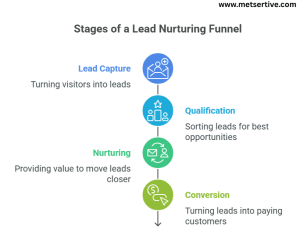
A lead nurturing funnel isn’t a one-email wonder. It’s a structured journey guiding your leads toward readiness without pressure. A nurturing funnel should be designed to convert marketing leads into sales qualified leads, ready for your sales team

stages of a lead nurturing funnel

Here’s how to break it down:

1️. Lead Capture

What it is: The moment you turn a visitor into a lead.

How:

  • Lead magnets (eBooks, checklists)
  • Webinar signups
  • Free trials
  • Newsletter opt-ins

Scenario:
A marketing consultant offers a “10-Step LinkedIn Content Checklist” in exchange for email addresses, turning visitors into warm leads.

Tip: Keep forms simple. More fields = fewer signups.

2️. Qualification

What it is: Sorting leads to focus on the best opportunities. Before nurturing leads, implementing a lead qualification process ensures you focus on the right prospects

How:

  • Use lead scoring to track behavior (opens, clicks, visits).
  • Segment based on interests or industry.

Scenario:
A SaaS company assigns +10 points when a lead visits the pricing page and +20 when they attend a webinar, indicating high interest.

Tip: Use CRM tools like HubSpot or Zoho to automate scoring

3️. Nurturing

What it is: Consistently providing value to move leads closer to a decision.

How:

  • Email drip campaigns with education and social proof.
  • Retargeting ads to re-engage website visitors.
  • Social media touchpoints.

Scenario:
An HR software sends a 5-email drip campaign post-webinar:

  1. Thank you + webinar replay
  2. Related blog/resource
  3. Customer success story
  4. Overcoming a common objection
  5. Invite to book a call

Tip: Don’t rush to sell. Educate first, then offer solutions.

4️. Conversion

What it is: Turning leads into paying customers.

How:

  • Personalized demo invites
  • Free trial upgrades
  • Consultation calls
  • Clear CTAs on emails and landing pages

Scenario:
After nurturing, a lead books a call through a personalized invite that says, “Let’s map out your HR automation plan.”

 Tip: Add a time-limited incentive (e.g., “Get your first month free if you book this week”) to encourage action.

Recap:

Your funnel stages should flow:
Lead Capture → Qualification → Nurturing → Conversion

When built intentionally, this funnel moves leads from “just curious” to “ready to buy” systematically.

Crafting Content for Each Funnel Stage

Now that you know the funnel structure, it’s time to feed it with the right content at each stage. Customer journey mapping allows you to align your funnel stages with your leads’ actual needs and questions at each step.”

1. Awareness (Top of Funnel)

Goal: Attract and educate.

Content:

  • Blog posts
  • Social media content
  • Infographics
  • Educational videos

Example:
A B2B SaaS company writes a blog, “5 Signs You Need Automated HR Processes,” to attract HR managers.

Tip: Add CTAs like “Download our HR Automation Checklist” to capture leads.

2. Interest (Mid Funnel)

Goal: Deepen engagement.

Content:

  • Lead magnets (guides, checklists)
  • Webinars
  • Quizzes

Example:
A quiz, “How Efficient Is Your Hiring Process?”, collects emails while providing value.

Tip: Use quizzes to segment leads based on their needs automatically.

3. Consideration (Lower Mid Funnel)

Goal: Build trust and address objections.

Content:

  • Case studies
  • Testimonials
  • Comparison guides
  • Email drips with social proof

Example:
A SaaS sends an email with a mini-case study: “How Company X Reduced Turnover by 32% Using Our Software.”

Tip: Use client logos and testimonials in retargeting ads for credibility.

4. Decision (Bottom of Funnel)

Goal: Prompt action.

Content:

  • Free trials
  • Demo offers
  • Consultations
  • Time-sensitive offers

Example:
An HR tool sends a “Your Personalized Demo Awaits” email with a one-click booking link.

Tip: Use urgency carefully—pair it with value, not pressure.

Crafting the best email sequences for lead nurturing involves understanding your audience’s pain points and aligning content with funnel stages.

Putting It All Together:

Scenario:
1. A lead reads your blog → downloads your HR checklist (Awareness → Interest).
2. They receive a 5-part drip sequence with case studies and resources (Consideration).
3.  They are invited to a free demo with a personalized CTA (Decision).
4.  They convert and enter your customer onboarding flow.

Next Up:

You now know how to structure your lead nurturing funnel and feed it with content that matches your buyer’s journey.

Next, we will cover the best tools to automate your funnel so you can scale without dropping the ball.

Tools to Automate and Manage Your Lead Nurturing Funnel

Building a lead nurturing funnel is one thing. Running it manually? Impossible as you scale.

That’s where automation tools come in—Automated lead nurturing workflows save you time, maintain consistency, and ensure leads don’t slip through the cracks.

Here’s what you need in your tech stack:

1. CRM Platforms

Your CRM (Customer Relationship Management) tool is the brain of your funnel. It tracks leads, segments them, scores them, and aligns your sales and marketing teams. CRM lead tracking is critical for monitoring where each lead is within your funnel and tailoring your nurturing efforts.”

Examples:

  • HubSpot: User-friendly, great for SMEs, integrates email, forms, and landing pages.
  • Zoho CRM: Affordable, customizable, solid for small businesses.
  • Salesforce: Best for advanced customization and larger teams.

Scenario:
A B2B SaaS uses HubSpot to automatically move leads who download a guide into a mid-funnel nurturing drip, while notifying sales when they visit the pricing page.

Tip: Use CRM tags to segment leads by funnel stage automatically.

2. Email Marketing Automation

Email is still your lead nurturing backbone. Use automation to send drip email sequences, segment lists, and personalize communication at scale. Well-timed drip email campaigns are the backbone of a high-converting lead nurturing funnel. Automated email follow-ups ensure your leads receive consistent value while freeing up your time.”

Examples:

  • ActiveCampaign: Powerful automation workflows with CRM and lead scoring.
  • Mailchimp: Great for simpler drips and broadcast emails.
  • ConvertKit: Ideal for creators and coaches.

Scenario:
After a lead attends a webinar, ActiveCampaign sends a 5-part email series with case studies and a CTA to book a demo.

Tip: Use personalized subject lines (“Hey Sam, ready to simplify HR?”) to boost open rates.

3. Lead Scoring & Behavioral Tracking

Assign points for actions like:
+10 for webinar signup
+20 for pricing page visit
-5 for inactivity

This helps you prioritize hot leads and trigger workflows when leads are ready.

Tools: HubSpot, ActiveCampaign, Zoho CRM.

Scenario:
When a lead hits 50 points, your system automatically notifies sales to follow up with a personalized invite.

 Tip: Review your scoring every 6 months to match current lead behavior.

4. Retargeting Platforms

Retargeting keeps your brand top-of-mind by showing ads to leads who’ve visited your site but haven’t converted.

Platforms: Google Ads, Facebook/Instagram Ads, LinkedIn Ads.

Scenario:
An e-commerce brand uses Facebook retargeting ads to offer a 10% discount to visitors who abandoned their cart.

Tip: Use testimonial or product demo video ads for warm retargeting audiences.

5. Chatbots & Conversational Tools

AI chatbots can answer FAQs, qualify leads, and book calls while you sleep.

Examples: Drift, Intercom, ManyChat.

Scenario:
A chatbot on your demo page asks, “Want to see how this works for your business?” and books a calendar slot directly.

Tip: Combine chatbots with human handoff for complex queries.

Summary:

To automate your funnel:
1. Use a CRM as your central hub.
2.  Automate email nurturing and behavioral tracking.
3.  Retarget non-converting leads.
4.  Use chatbots for real-time engagement.

Start simple—layer in tools as your funnel scales.

Measuring Funnel Performance

If you can’t measure it, you can’t improve it.

Tracking key metrics will help you see where leads drop off, what’s working, and how to refine your funnel for more conversions.

Here’s what to track:

 1. Email Metrics

  • Open Rates: Are your subject lines grabbing attention?
  • Click-Through Rates (CTR): Is your content engaging?
  • Reply Rates: Are leads interacting?

Scenario:
Your welcome email has a 55% open rate but a 2% CTR. Test a new CTA or reposition your offer to increase clicks.

Tip: A/B test subject lines with and without personalization.

 2. Conversion Metrics

  • Lead-to-customer conversion rates.
  • Time taken from lead capture to conversion (sales cycle length).
  • Funnel drop-off points.

Scenario:
You notice leads drop after email 3 in your drip. Refine that email with a customer story or clearer CTA.

Tip: Use Google Analytics or your CRM’s funnel reports to visualize where drop-offs occur.

3. Lead Score Movements

Track how leads progress through your scoring system. Are they engaging, or going cold? Using lead scoring in your lead nurturing funnel helps prioritize hot leads and improves conversion rates.

Scenario:
A lead’s score increases rapidly after a webinar and pricing page visit—automatically trigger a sales follow-up.

 Tip: Use lead decay to subtract points for inactivity, keeping your pipeline clean.

 4. Retargeting & Ad Metrics

  • CTR on retargeting ads.
  • Conversion rate from retargeting campaigns.
  • Cost per conversion.

Scenario:
Retargeting testimonial video ads have a 2.4x higher ROAS than static ads—scale what works.

How to Use These Metrics:

1. Identify which stage of your funnel needs attention.
2. Test and tweak emails, CTAs, or ad creatives.
3.  Prioritize hot leads for personalized outreach.

Recap:

  • Your funnel isn’t “set and forget.”
  • Measure consistently to optimize performance.
  • Small tweaks compound into big conversion lifts.

Integrating your lead nurturing funnel with your sales pipeline management ensures that leads transition seamlessly from interest to purchase. Regular marketing funnel optimization helps you improve conversion rates and reduce lead drop-offs.

Next:

Now that you know how to automate and measure your lead nurturing funnel, we’ll dive into:

Common Mistakes to Avoid in Your Lead Nurturing Funnel

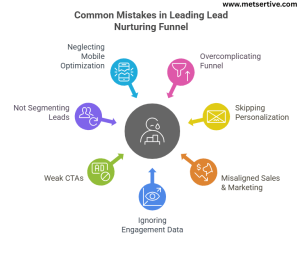
Even the best-intentioned funnels can leak leads if you’re not careful. Here are the most common pitfalls to watch for—and how to fix them.

Mistakes in Lead Nurturing Funnel

Mistake 1: Overcomplicating the Funnel

If your funnel has 15 emails, 6 retargeting stages, and 10 lead score triggers… you’re likely confusing your audience and yourself.

Scenario:
A coaching business had a 12-email drip but only 2 emails were consistently getting replies.

Fix:
Start simple: 3–5 core emails, clear CTAs, and retargeting only for warm leads.

Tip: You can always layer complexity later—simplicity scales.

Mistake 2: Skipping Personalization

Sending generic emails like “Hi there, check out our product” will get you ignored.

Scenario:
A SaaS company improved its open rates by 28% simply by adding “Hi [First Name]” and tailoring content based on lead behavior.

Fix:
Use merge tags, segmentation, and behavior-based triggers to personalize.

Mistake 3: Misaligned Sales & Marketing

If marketing is nurturing one way while sales is pitching another, you’re sending mixed signals.

Scenario:
A lead receives nurturing emails focusing on education, then a sales rep cold calls with aggressive closing lines.

Fix:
Have a shared lead scoring system and regular meetings between sales and marketing teams to align messaging.

Mistake 4: Ignoring Engagement Data

If you’re not checking open rates, CTRs, or drop-offs, you’re flying blind.

Scenario:
An e-commerce brand kept sending promo emails to leads who never opened them, damaging deliverability.

Fix:
Clean your list regularly and adjust content based on what your audience engages with.

Mistake 5: Using Weak or Vague CTAs

Saying “Learn More” everywhere won’t move leads forward.

Scenario:
A consulting firm switched from “Learn More” to “Book Your Free Strategy Session” and saw a 32% increase in conversions.

Fix:
Make CTAs specific, clear, and aligned with the funnel stage.

Mistake 6: Not Segmenting Leads

Sending the same content to cold leads and warm leads will lower engagement.

Scenario:
A SaaS was sending trial extension offers to leads who had never signed up for a trial.

Fix:
Segment based on actions (e.g., content download, demo request) to tailor messaging.

Mistake 7: Neglecting Mobile Optimization

Half of your leads open emails on mobile. If your emails aren’t mobile-friendly, you’re losing them.

Scenario:
A lead clicks your email on mobile, but the landing page is cluttered, causing them to drop off.

Fix:
Test your funnel on mobile devices and simplify designs for easy reading and CTA clicks.

Recap:

Avoid these pitfalls, and your lead nurturing funnel will work with you, not against you.

  1. Keep it simple
  2. Personalize
  3. Align sales and marketing
  4. Track and optimize
  5. Use clear CTAs
  6. Segment
  7. Optimize for mobile

Real-World Examples of Lead Nurturing Funnels That Convert

Nothing beats seeing how a lead nurturing funnel works in practice.

Here are lead nurturing funnel examples for small businesses you can model to generate conversions efficiently:

Example 1: B2B SaaS – Webinar to Demo Funnel

Business: A HR SaaS platform.
Goal: Convert webinar signups into demo bookings.

Workflow:
1. Lead attends webinar (Lead Capture).
2. Automated thank-you email with replay (Nurturing).
3. Follow-up email with customer case study (Nurturing).
4. Personalized demo invite email (Conversion).
5. Retargeting ad to warm leads with testimonial video.

Result: 47% increase in demo bookings within 2 months.

Takeaway: Combine education (webinars) with post-event nurturing and clear CTAs.

Example 2: E-commerce – Cart Abandonment Funnel

Business: An online sustainable fashion store.
Goal: Recover abandoned carts.

Workflow:
1. Cart abandonment detected (Lead Capture).
2.  SMS reminder 30 minutes later (Nurturing).
3. Email with “You left these behind” + social proof (Nurturing).
4. Retargeting ad offering 10% off for 48 hours (Conversion).

Result: 21% cart recovery rate increase.

Takeaway: Use multi-channel, time-sensitive touchpoints to reclaim lost revenue.

Example 3: Coaching Service – Free Resource to Strategy Call Funnel

Business: A business coach.
Goal: Turn freebie downloads into paid coaching calls.

Workflow:
1. Visitor downloads “10-Step LinkedIn Content Checklist” (Lead Capture).
2. Welcome email with checklist and quick tip video (Nurturing).
3. Email sharing a client success story (Nurturing).
4. Email with a CTA to book a free strategy session (Conversion).
5. Reminder SMS a day before the booked call.

Result: 37% lead-to-call conversion rate.

Takeaway: Free resources paired with storytelling and clear CTAs warm leads effectively.

Pro Tips for Implementing Your Funnel:

1.Map your funnel on a whiteboard before building it.
2. Start small—add complexity as you see results.
3. Use tools like HubSpot or ActiveCampaign to automate steps.
4. Test one funnel at a time to refine before scaling.

Conclusion:

A lead nurturing funnel is your ticket to predictable, scalable growth. By aligning your content, channels, and tools, you convert warm leads without being pushy.

Start with:

  1. Simple funnel stages
  2. Personalized, relevant content
  3. Automation tools to save time
  4. Tracking and refining consistently

Your lead nurturing funnel is a key part of your overall customer conversion funnel, ensuring prospects transition seamlessly to becoming customers. When you’re ready to deepen your nurturing strategy, explore our Nurturing Lead: The Complete Guide and related advanced cluster pieces to build a system that keeps working while you sleep.

What Is Lead Scoring and How to Use It Effectively

Let’s face it—no matter how many leads your business attracts, not all of them are ready to buy. Some are curious window shoppers, some are doing early research, and a few are hot and ready to make a decision. So, how do you know who to follow up with, and who to hold off on?

That’s where lead scoring comes in.

Lead scoring is a simple, powerful way to rank your leads based on how likely they are to become paying customers. It’s like having a compass that tells you which prospects are worth your time, and which ones need more nurturing.

For small and medium-sized businesses (SMEs), this is game-changing. When resources are limited, lead scoring helps you prioritize the leads that matter most, so your sales team isn’t wasting time chasing people who just aren’t ready.

And here’s the kicker: lead scoring is the missing link between lead generation and lead nurturing. It tells you who to nurture—and when. Without it, you’re guessing. With it, you’re strategic. Implementing an effective lead scoring system is crucial for small and medium businesses aiming to streamline their sales funnel optimization and enhance customer segmentation.

What Is Lead Scoring?

At its core, lead scoring is a system that assigns points to your leads based on certain criteria—like their behavior, engagement, and fit for your product or service. The higher the score, the more qualified the lead is.

Imagine this:

  • A lead visits your pricing page (+10 points)
  • They download an eBook (+5)
  • They open three emails in a row (+3)
  • They’re from your target industry (+7)

Total score = 25 points.
You can now compare that to your internal “sales-ready” threshold (say, 30 points) and decide what kind of follow-up makes sense.

🎯 Types of Lead Scoring Criteria

  1. Demographic data – e.g., job title, location, age
  2. Firmographic data – e.g., company size, industry, revenue
  3. Behavioral actions – e.g., email clicks, website visits, downloads
  4. Engagement history – e.g., webinar attendance, social media interaction

These signals help you paint a fuller picture of each lead’s potential.

🧠 Tip: Use both “explicit” and “implicit” data

  • Explicit data is what the lead tells you directly—like their company size or budget.
  • Implicit data is what you observe based on their behavior—like how many times they visited your case study page.

Both are essential for accurate scoring.

✅ Real-World Example:

Let’s say you’re selling CRM software. A lead who:

  • Works as a sales director at a 200-person company (explicit fit)
  • Attended your webinar and downloaded your ROI calculator (implicit behavior)

…is much more likely to convert than someone who just visited your homepage once.

That’s the power of scoring—it filters out the noise and keeps your pipeline focused.

By leveraging behavioral analytics, companies can assign scores to leads, distinguishing between marketing qualified leads (MQL) and sales qualified leads (SQL).

Why Lead Scoring Matters for SMEs

If you’re running a small or medium business, you know the struggle: not all leads are created equal, but they all demand your attention.

So how do you decide who gets a follow-up call today—and who’s better off in a long-term nurture sequence?

That’s where lead scoring earns its keep.

1. It Helps You Focus on High-Potential Leads

You probably don’t have a 20-person sales team. That means your time—and your team’s time—is precious. Lead scoring shows you who’s hot, who’s warm, and who’s just browsing.

Example:
A lead that watched your demo video, opened three emails, and requested pricing info should get your immediate attention. One that visited your homepage once? Maybe not just yet.

2. It Aligns Sales and Marketing (Finally)

Sales says, “We need better leads.”
Marketing says, “We gave you 200 this week.”

Sound familiar?

With a shared lead scoring model, everyone speaks the same language. Sales knows which leads are truly qualified. Marketing knows what it takes to move a lead from cold to warm.

✔️ Tip: Sit both teams down and define what a “sales-ready” lead actually looks like.

3. It Increases Conversion Rates

When you prioritize the right leads and engage them at the right time, you close more deals—without burning out your team or budget.

According to a study by MarketingSherpa, companies that use lead scoring see a 77% increase in lead generation ROI.

Now that’s a stat worth paying attention to.

Common Lead Scoring Models (and Which One You Should Use)

Lead scoring isn’t one-size-fits-all. In fact, there are several ways to do it—and the right model depends on your business goals, tools, and buyer journey.

Let’s break them down:

1. The Point-Based Model (Most Common)

This is the classic approach.
You assign points based on specific actions or attributes.

  • +10 for visiting your pricing page
  • +5 for opening an email
  • +15 for booking a demo
  • -10 for unsubscribing from your newsletter

You set a threshold (say, 50 points), and once a lead hits it, they’re passed to sales.

Tip: Use your CRM or marketing automation platform to auto-score leads. Tools like HubSpot, Zoho, and ActiveCampaign make this easy.

2. Fit + Interest Model

This model blends:

  • Fit = how well a lead matches your ideal customer (job title, industry, company size)
  • Interest = how engaged they are (website visits, downloads, webinar signups)

It helps you separate:

  • Good fit + high interest = hot lead
  • Good fit + low interest = nurture more
  • Bad fit + high interest = may not be worth chasing

3. Predictive Lead Scoring (Advanced)

Predictive Lead Scoring uses machine learning and AI to analyze patterns in your data and predict which leads are most likely to convert. It’s powerful—but often overkill for SMEs just starting out.

✅ Best for: companies with large lead volumes and data teams.
❌ Not ideal if you’re new to lead scoring or don’t have a CRM packed with historical data.

4. Demographic-Based Lead Scoring

Not every lead fits your ideal customer profile—and that’s okay. But the ones who do should score higher.

This model focuses purely on the attributes of the lead or company—things like industry, job title, location, or company size. It works well for businesses that sell to specific niches (e.g., SaaS companies targeting HR managers in tech firms).

✔️ Example:

  • +10 for job title = “Marketing Director”
  • +8 for company size = 50–200 employees
  • +5 for location = North America
  • -5 for job title = “Student” or “Intern”

Tip: Use this model when your product is highly tailored to specific roles, industries, or regions.

 5. Negative Scoring Model

Scoring shouldn’t just reward good signals—it should also detect when a lead is cooling off.

The negative scoring model subtracts points for behaviors that suggest disinterest or poor fit. It’s especially helpful for keeping your pipeline clean and preventing “false positives” (leads that seem active but aren’t serious buyers).

✔️ Example:

  • -10 for email bounce
  • -5 for visiting careers page (job seekers, not buyers)
  • -7 for no engagement in 30 days
  • -10 for unsubscribing from email list

Tip: Combine this with your existing scoring system to balance out the hype and bring more accuracy to lead readiness.

6. Time-Decay Lead Scoring Model

Interest fades. If your scoring system doesn’t account for time, you’re treating yesterday’s news like a breaking story.

Time-decay scoring gradually reduces a lead’s score if they haven’t engaged in a while. This model helps you focus only on active, high-intent leads and avoid wasting sales resources.

✔️ Example:

  • -5 after 14 days of inactivity
  • -10 after 30 days
  • -15 after 45+ days without engagement

Tip: Automate decay logic in your CRM so leads naturally drop in priority unless they re-engage.

How to Build a Simple Lead Scoring System

You don’t need fancy AI or a data science team to get started with lead scoring. In fact, many high-converting businesses begin with a basic, spreadsheet-based system.

Lead Scoring System Cycle

Here’s a simple, step-by-step framework to get you rolling:

🔹 Step 1: Define Your Ideal Customer Profile (ICP)

Start by identifying what a “perfect-fit” customer looks like for your business.

✔️ Example Criteria:

  • Industry: SaaS or service-based
  • Job Title: Marketing Manager or CEO
  • Company Size: 10–100 employees
  • Region: North America or EU

Tip: Interview your top customers or analyze your CRM to find patterns.

🔹 Step 2: Identify High-Intent Behaviors

What actions tell you someone is truly interested? These are the “conversion clues” you’ll score.

✔️ Examples of High-Intent Behavior:

  • Downloading a lead magnet (+5)
  • Visiting your pricing page (+10)
  • Signing up for a webinar (+7)
  • Returning to your website 3+ times in a week (+8)

Tip: Start with 5–7 behaviors and refine as you gather data.

🔹 Step 3: Assign Point Values

Now assign point values to each behavior and attribute.

Action

Points

Opened an email
+2
Clicked a CTA in an email
+3
Downloaded a guide
+5
Attended a webinar
+7
Visited pricing page
+10
Filled out contact form
+15

Tip: You can also assign negative points for low engagement (e.g., -5 for unsubscribing).

🔹 Step 4: Determine a Sales-Readiness Score

Set a score threshold that tells you when a lead is “ready for sales.” For many SMEs, this might be 30–50 points.

✔️ Example: Once a lead hits 40 points, they’re sent to a rep for a discovery call.

Tip: Adjust the threshold based on your average sales cycle and conversion rates.

🔹 Step 5: Use a CRM or Spreadsheet to Track

If you’re just starting out, a Google Sheet will do the trick. But to scale, use CRM platforms like HubSpot, Zoho, or ActiveCampaign to automate tracking and scoring.

Pro Tip: Set up email alerts or Slack notifications when leads cross your sales-readiness threshold.

🔹 Step 6: Test Your Model with Historical Data

Before going live, validate your scoring system against past leads.

✔️ Example: Look at leads who converted last quarter. Do their behaviors match your current scoring values? If top customers consistently scored lower than your “sales-ready” threshold, it may need adjusting.

Tip: This helps fine-tune point weights and ensures your model reflects real buyer behavior.

🔹 Step 7: Set Up Alerts and Automations

Scoring is most powerful when it’s automated and actionable.

✔️ Use your CRM or marketing platform to:

  • Send alerts to your sales team when a lead crosses the readiness threshold
  • Trigger tailored email sequences based on score brackets
  • Notify marketing if a lead cools off and drops below a threshold

Tip: Automations help move leads through your funnel faster—and more efficiently.

🔹 Step 8: Review and Optimize Monthly

Lead scoring isn’t “set it and forget it.” Your business—and buyer behavior—evolves.

✔️ Schedule a monthly or quarterly review to:

  • Analyze conversion rates by score range
  • Adjust point values based on new insights
  • Add new behaviors as your marketing channels grow (e.g., webinar replays, chatbot engagement)

Tip: Collaborate with both sales and marketing in this review to keep alignment sharp.

Utilizing CRM software like HubSpot or Zoho can simplify the process of setting up a predictive lead scoring model tailored to your business needs.

Tools and CRMs for Lead Scoring

Choosing the right CRM can simplify lead scoring and make it easier to scale. Here are four platforms that work well for SMEs and mid-size teams:

1. HubSpot

✅ Built-in lead scoring
✅ Drag-and-drop automation workflows
✅ Easy to integrate with email and sales pipelines

Why it’s great: HubSpot’s free CRM is user-friendly and powerful enough for growing teams. It also lets you create scoring rules based on both behavior and contact properties.

2. Zoho CRM

✅ Custom scoring rules
✅ Strong contact management features
✅ Affordable for small businesses

Why it’s great: Zoho lets you automate scoring based on specific actions like website visits or email opens—ideal for SMEs looking for customization on a budget.

3. Salesforce Pardot

✅ Advanced lead scoring and grading
✅ AI-powered insights
✅ Deep integration with Salesforce Sales Cloud

Why it’s great: Pardot is best suited for B2B companies with complex sales cycles. If you’re already using Salesforce, it’s a natural extension.

4. ActiveCampaign

✅ Easy-to-use automation builder
✅ Behavioral-based scoring
✅ Integrated email marketing & CRM

Why it’s great: ActiveCampaign is great for marketing-first teams who want email + scoring + nurturing all in one dashboard.

🧩 Tip: Look for CRM Integration

Selecting the right CRM tools for lead scoring is essential; platforms like Salesforce Pardot offer robust features for tracking and evaluating lead interactions.

Make sure your chosen tool integrates smoothly with your website forms, email platform, and sales pipeline. This ensures lead scoring happens in real-time—not manually.

Real-World Examples

Let’s bring all this theory to life. Here are few examples of how lead scoring works in practice—and how it helps businesses focus where it matters most.

Scenario 1: A B2B SaaS Company Using Webinar Engagement

Webinar attendance isn’t just a sign of interest—it’s a strong buying signal.

A B2B SaaS company hosts monthly product webinars. They assign lead scores like this:

  • +10 for registering
  • +15 for attending live
  • +5 for asking a question
  • +20 for booking a demo afterward

One attendee, Jane, signs up, attends, asks two detailed questions, and books a call—earning 50 points in total. Their CRM (HubSpot) automatically flags her as “sales-ready,” and a rep follows up within hours.

Takeaway:
Engagement-based scoring can help you identify high-intent leads faster and close warmer deals.

Scenario 2: E-commerce Store Prioritizing Cart Abandoners

Not all window shoppers are worth chasing—but some are almost at checkout.

An e-commerce brand selling eco-friendly skincare uses lead scoring to track site behavior:

  • +5 for viewing 3+ product pages
  • +10 for adding items to the cart
  • +15 for abandoning the cart
  • +10 for clicking on a retargeting email

When a lead reaches 40 points, they automatically receive a personalized SMS:
“Hey! You left something behind. Here’s 10% off your first order—just for you.”

Result: A 17% recovery rate on abandoned carts and a 20% lift in email open rates from warm leads.

Scenario 3: An Online Course Business Qualifying Signups

Not every email subscriber is ready to enroll—but some are already halfway there.

An online course creator tracks behaviors that indicate genuine learning intent:

  • +5 for signing up for a free course
  • +10 for watching 75% of a video lesson
  • +7 for joining a live Q&A session
  • +10 for visiting the checkout page

A lead who completes two free lessons and joins the live webinar gets flagged at 32 points, triggering a limited-time discount email sequence.

Tip: Educational businesses can use video completion and content depth as powerful engagement signals.

Scenario 4: A Healthcare SaaS Provider Targeting Medical Practices

Healthcare buyers are cautious—scoring helps spot the ones ready to move.

A B2B healthcare platform assigns points based on both role relevance and compliance needs:

  • +8 for job title “Operations Director” or “Practice Manager”
  • +10 for downloading a HIPAA compliance checklist
  • +12 for attending a product webinar
  • +5 for revisiting the pricing page within a week

Once a lead crosses 35 points, they’re routed to a sales specialist who offers a tailored compliance walkthrough.

Tip: Niche industries should focus on role-specific content and pain-point behaviors.

Scenario 5: A B2B Services Agency Targeting Mid-Market Clients

The right company size and the right engagement combo equals a hot lead.

A digital marketing agency uses fit + behavior scoring:

  • +10 for company size over 50 employees
  • +8 for downloading their case study
  • +6 for scheduling a free consultation
  • +5 for visiting the blog 3+ times in a week

A lead from a 75-person company books a call and reviews two service pages, reaching 29 points—just above the sales-readiness line. A custom proposal is sent within 48 hours.

Tip: For agencies, blend firmographic filters (company size, industry) with engagement signals for precision targeting.

Mistakes to Avoid

Even the best systems can go off track if you’re not careful. Here are four common lead scoring mistakes—and how to avoid them.


Lead Scoring Mistakes to Avoid

Mistake 1: Overcomplicating the Scoring Model

Trying to score every possible detail usually leads to confusion—not clarity.

When your model has 50+ scoring rules, it becomes harder to manage and trust. Focus on 5–10 core actions that best predict buying behavior.

✔️ Tip: Start simple. You can always refine your model later based on performance data.

Mistake 2: Not Aligning with the Sales Team

If marketing thinks a lead is hot, but sales disagrees—you have a misfire.

Lead scoring should be a shared framework between sales and marketing. Define what “sales-ready” means together and revisit the criteria often.

✔️ Tip: Use feedback from sales calls to improve your scoring logic (e.g., “Leads from webinars close faster”).

Mistake 3: Failing to Update the Model Regularly

What worked last quarter may not reflect your current buyer behavior.

If your content or strategy changes, so should your scoring rules. Leads that convert today may follow different paths than six months ago.

✔️ Tip: Review scoring rules quarterly and adjust based on funnel conversion trends.

Mistake 4: Ignoring Lead Decay

A lead who clicked your email three months ago isn’t “hot” anymore.

Without lead decay (subtracting points over time), your system may keep old leads looking artificially active.

✔️ Example: Subtract 5 points if a lead hasn’t visited your site or opened an email in 30 days.

Mistake 5: Using Only Marketing Data

Relying solely on website or email behavior gives you half the picture.

If your scoring model ignores sales input or offline conversations, you’re missing critical signals. For instance, a verbal confirmation during a discovery call may indicate a higher readiness than a click ever could.

✔️ Tip: Combine marketing data with sales insights to create a well-rounded scoring system.

Mistake 6: Not Testing and Validating the Model

If you’re not testing your scores against actual conversions, you’re guessing.

Lead scoring should evolve through data. What you think signals purchase intent might not reflect what’s happening in your funnel.

✔️ Tip: Review top converting leads each month—do their scores align with your expectations?

Mistake 7: Treating All Leads the Same Post-Scoring

Scoring is just the start—what you do with that score matters even more.

Some businesses score leads but still send all of them the same content or offers. That defeats the purpose.

✔️ Tip: Create different nurture paths for hot, warm, and cold leads—each with tailored messages.

Mistake 8: Setting the Sales Threshold Too High (or Low)

If your threshold is off, you’ll either miss out or overload sales with poor fits.

Some teams set unrealistic thresholds that most leads never hit, while others flood sales reps with weak leads.

✔️ Tip: Revisit the scoring threshold monthly. Track which score ranges actually convert into paying customers.

Neglecting to define clear lead qualification criteria can result in misaligned sales efforts and missed opportunities.

Conclusion

Lead scoring isn’t just for big brands with massive CRMs—it’s one of the most effective, low-cost ways for SMEs to qualify leads, prioritize follow-ups, and boost close rates without wasting time or effort.

When done right, lead scoring helps you:
✅ Focus on the right leads
✅ Align sales and marketing
✅ Build scalable, automated nurturing funnels
✅ Improve your ROI from every campaign

Understanding various lead scoring models and techniques empowers businesses to prioritize leads effectively, ultimately improving sales conversions

Now that you know who to prioritize, here’s how to nurture leads effectively


Target Marketing Strategies That Attract the Right Customers and Grow Your Business

Imagine trying to sell winter coats in the middle of summer to people living in the tropics. Sounds pointless, right? That’s exactly what happens when businesses market their products to the wrong audience. Instead of casting a wide net and hoping for the best, smart businesses use target marketing strategies to attract the right customers—people who actually want and need their products.

By understanding your ideal customer and tailoring your marketing efforts to them, you can increase conversions, reduce wasted ad spend, and build a loyal customer base. In this article, we’ll break down actionable target marketing strategies that will help your business grow, backed by expert insights and data.

What Is Target Marketing?

Target marketing is the process of identifying, understanding, and reaching a specific group of consumers who are most likely to buy your products or services. Instead of marketing to everyone, you focus on a defined audience segment based on factors like:

  • Demographics (age, gender, income, education)
  • Psychographics (values, interests, lifestyles)
  • Geographics (location-based targeting)
  • Behavioral Data (purchasing habits, product preferences)

According to HubSpot, businesses that implement targeted marketing campaigns experience up to 20% higher revenue growth than those using generic marketing approaches

 Why Target Marketing Strategies Work

The success of target marketing strategies lies in their ability to deliver personalized and relevant messages to potential customers. Research by McKinsey & Company shows that businesses using personalized marketing see 5 to 8 times the ROI on their marketing spend

Here’s why it works:

Increases Conversion Rates: Customers engage more when they feel understood.
Reduces Wasted Ad Spend: Your marketing budget is spent on high-potential leads.
Builds Customer Loyalty: Personalized interactions create stronger customer relationships.

How to Define Your Target Audience

To create an effective target marketing strategy, you need to define your ideal customer clearly. Here’s how:

Defining your target audience

Step 1: Analyze Your Current Customers

Look at your existing customers—who are they? What problems do they have? Use tools like Google Analytics and Facebook Insights to gather data on demographics and behavior.

Step 2: Conduct Market Research

Use surveys, interviews, and competitor analysis to understand market demand. Tools like SEMrush and Ahrefs can help identify trends in your industry.

Step 3: Create Buyer Personas

A buyer persona is a fictional representation of your ideal customer. Include:

  • Age, gender, location
  • Interests and buying habits
  • Pain points and goals

For example, if you’re a digital marketing agency, your buyer persona could be:

“Sarah, a 35-year-old small business owner, struggling with online advertising but eager to grow her brand using digital marketing services.”

Step 4: Identify Customer Pain Points

Understanding the biggest challenges your audience faces helps you craft marketing messages that offer solutions. Read customer reviews, participate in online forums, or use tools like AnswerThePublic to identify common concerns in your industry.

Step 5: Analyze Competitor Audiences

Look at your competitors’ customers. Who follows them on social media? Who engages with their content? Tools like SimilarWeb and BuzzSumo can help you analyze audience demographics and engagement trends.

Step 6: Use Social Media Insights

Platforms like Facebook, Instagram, and LinkedIn provide audience insights that show follower demographics, interests, and behaviors. This data helps you refine your target marketing strategy to reach the right people.

Step 7: Segment Your Audience

Not all customers are the same. Divide them into smaller segments based on:

  • Age group
  • Buying behavior
  • Location
  • Level of engagement (new visitors vs. repeat customers)

According to Epsilon, 80% of consumers are more likely to purchase from brands that offer personalized experiences (source: Epsilon).

Step 8: Test and Optimize Your Targeting

Run A/B tests on different audience segments and track performance. For example, you can:

  • Test different messaging for different age groups.
  • Compare engagement rates between email and social media campaigns.
  • Adjust targeting settings based on ad performance metrics.

Continuous testing ensures your target marketing strategies are always improving.

Effective Target Marketing Strategies

Now that you’ve defined your audience, let’s explore the best target marketing strategies to reach them.

Target Marketing Strategies

   1. Segmentation and Personalization

👉 Example: An e-commerce store selling fitness gear can target:

  • Beginners (offering easy workout plans)
  • Professional Athletes (highlighting high-performance gear)
  • Home Fitness Enthusiasts (promoting space-saving equipment)

   2. Content Marketing for Targeted Outreach

strong content marketing strategy includes:

  • Blog Posts & SEO
  • Video Marketing
  • Email Campaigns

     3. Social Media Advertising with Precise Targeting

Use Facebook’s Lookalike Audiences to find people similar to your best customers.

     4. Retargeting Campaigns to Re-engage Potential Buyers

According to AdRoll, retargeted visitors are 70% more likely to convert.

     5. Influencer & Affiliate Marketing

92% of consumers trust influencers more than brand ads.

     6.Search Engine Optimization (SEO) for Organic Reach

Optimizing your website with relevant keywords can increase organic traffic.
Example: A digital marketing agency can target “Best SEO services for small businesses.”

     7.Local Marketing Strategies

If your business serves a specific location, use:

  • Google My Business optimization
  • Local SEO and directory listings
  • Community engagement and sponsorships
  1. Interactive Marketing (Quizzes, Polls, and Chatbots)

Engagement-based strategies help businesses capture leads and improve conversions.
Example: A skincare brand could offer a “Find Your Perfect Routine” quiz to generate leads.

 Measuring and Optimizing Your Target Marketing Efforts

To ensure your target marketing strategies are working, track these key metrics:

📊 Conversion Rate – Are your efforts leading to sales?
📈 Customer Acquisition Cost (CAC) – How much does it cost to gain a customer?
🎯 Return on Ad Spend (ROAS) – Are your ads generating revenue?

How to Optimize Target Marketing Strategies

1️⃣ A/B Testing – Experiment with different headlines, ad copies, and CTAs to see which performs best.
Example: If an e-commerce store runs two versions of a Facebook ad with different images, they can analyze which one leads to more clicks.

2️⃣ Refine Audience Targeting – If your ad engagement is low, adjust your targeting criteria based on demographics and interests.
Example: A fashion brand targeting “women 25-35 interested in sustainable fashion” can narrow it down further based on buying behavior.

3️⃣ Improve Website User Experience (UX) – A slow or confusing website can lead to high bounce rates. Optimize page speed, simplify navigation, and ensure mobile-friendliness.
Example: If a landing page takes too long to load, users may leave before converting.

4️⃣ Optimize Content for SEO – Refresh old blog posts with new data, update keywords, and enhance readability to improve rankings.
Example: A marketing agency can update a 2023 blog post on “SEO trends” with 2025 insights.

5️⃣ Analyze Customer Feedback – Use surveys and reviews to understand pain points and adjust your messaging accordingly.
Example: If multiple customers say a product is “too expensive,” consider offering a limited-time discount or payment plans.

Final Thoughts: Take Action Today!

Target marketing isn’t about selling to everyone—it’s about selling to the right people. By understanding your audience, using personalized marketing strategies, and leveraging digital tools, you can increase conversions, maximize ad spend, and grow your business faster.

Ready to implement powerful target marketing strategies? Contact us today for expert digital marketing services!

Life Time Value of Customer Strategies to Boost Growth and Profits

As a small or medium enterprise (SME) owner, you’re constantly looking for ways to grow your business. But are you focusing enough on the Life Time Value of a Customer (LTV)? This metric helps you determine how much revenue a customer generates over their entire relationship with your business. Understanding LTV not only helps you make smarter marketing decisions but also maximizes profitability.

In this guide, we’ll break down LTV, explain why it matters, and give you actionable tips to increase it.

What is Life Time Value of a Customer (LTV)?

LTV, or Customer Lifetime Value, is the projected revenue a customer brings to your business from their first purchase to their last. It answers a crucial question:

➡️ How much is a customer worth to your business over time?

LTV Formula:

LTV = Average Purchase Value × Purchase Frequency × Customer Lifespan

Example:
If a customer typically spends ₹2,000 per order, buys 5 times a year, and stays with you for 3 years:
LTV = ₹2,000 × 5 × 3 = ₹30,000

Why is Life Time Value of a Customer Important?

Understanding and improving LTV can help you:

Prioritize Customer Retention: Acquiring new customers is 5-7x more expensive than retaining existing ones.

Optimize Marketing Spend: Knowing LTV allows you to spend more effectively on customer acquisition and retention.

Increase Profit Margins: By maximizing LTV, you ensure each customer relationship contributes more to your bottom line.

How to Calculate LTV in 3 Steps

1. Determine Average Purchase Value

Formula:
Average Purchase Value = Total Revenue ÷ Total Number of Purchases

2. Find Purchase Frequency

Formula:
Purchase Frequency = Total Number of Purchases ÷ Number of Unique Customers

3. Measure Customer Lifespan

Estimate how long, on average, a customer continues buying from your business. This is typically calculated in years or months.

Final LTV Formula:

LTV = Average Purchase Value × Purchase Frequency × Customer Lifespan

Key Factors That Impact Life Time Value of a Customer

1. Customer Retention Rate (CRR)

Higher retention rates lead to a longer customer lifespan, boosting LTV. According to Harvard Business Review, increasing retention rates by just 5% can increase profits by 25% to 95%.

2. Average Order Value (AOV)

Upselling and cross-selling increase the value of each transaction, which boosts LTV.

3. Purchase Frequency

Loyal customers buy more often. Implementing loyalty programs can encourage repeat purchases.

4. Customer Acquisition Cost (CAC)

If your CAC is higher than your LTV, your business may be losing money. A healthy business model ensures that LTV > 3x CAC.

5. Customer Satisfaction Score (CSAT)

Higher satisfaction levels lead to stronger loyalty and repeat business, directly increasing LTV.

6. Product/Service Quality

Consistently delivering high-quality products or services reduces churn and keeps customers engaged longer.

7. Subscription Renewal Rates

For subscription-based models, higher renewal rates ensure a prolonged revenue stream, boosting overall LTV.

8. Referral and Advocacy Potential

Happy customers refer others, creating a referral loop that reduces acquisition costs and increases LTV over time.

Proven Strategies to Boost LTV


Strategies to boost Lifetime value of customer

1. Implement a Loyalty Program

Reward repeat customers with exclusive offers, discounts, and rewards. Studies show that loyalty programs can increase purchase frequency by 20%.

2. Nurture with Email Marketing

Stay top-of-mind by sending personalized, value-driven emails. Offer exclusive content, promotions, and product recommendations.

3. Upsell and Cross-Sell Effectively

Encourage customers to explore complementary products or higher-tier services. Upselling can increase revenue by 10-30%.

4. Focus on Customer Experience

Excellent customer service encourages loyalty. A study by PwC shows that 73% of consumers say customer experience plays a role in their purchasing decisions.

5. Personalized Customer Experience

Use customer data to tailor recommendations, emails, and offers, making them feel valued and increasing retention.

6. Offer Subscription or Membership Plans

Encouraging customers to subscribe to recurring services ensures consistent revenue and longer customer relationships.

7. Strengthen Customer Support

Quick, helpful, and accessible support reduces frustration and encourages repeat business.

8. Improve Product/Service Onboarding

A smooth onboarding process enhances customer satisfaction, reducing early churn.

9. Leverage SMS & Push Notifications

Timely reminders, exclusive deals, and updates by SMS and Push notifications keep your brand top-of-mind, increasing repeat purchases.

10. Implement a Win-Back Campaign

Use targeted offers and incentives to re-engage lapsed customers, bringing them back into the buying cycle.

How to Analyze and Improve LTV

1. Track LTV Regularly

Set a quarterly review process to assess LTV and compare it with customer acquisition costs. Tools like Google Analytics, HubSpot, and Shopify can help track LTV metrics.

2. Segment Your Audience

Analyze high-value customer segments to identify behaviors and trends. Target these segments with personalized offers to increase retention.

3. Gather Feedback and Act on It

Regularly collect customer feedback to identify pain points and improve their experience.

Common Mistakes to Avoid When Analyzing LTV

Mistakes to avoid when analyzing Lifetime value of customer

Overlooking Customer Churn: High churn rates can drastically reduce LTV.

Focusing Only on Acquisition: Retention strategies are equally, if not more, important.

Ignoring Referral Value: Happy customers refer others, increasing LTV indirectly.

. Misinterpreting Segmentation Data
Failing to segment customers properly may lead to skewed LTV insights.

. Ignoring Customer Acquisition Source
Not analyzing which acquisition channels yield high-LTV customers can result in poor marketing allocation.

. Focusing Only on Revenue, Not Profitability
LTV should account for profit, not just revenue, ensuring a realistic view of business growth.

. Neglecting Customer Feedback Loops
Failing to act on customer feedback can increase churn, reducing overall LTV.

Case Study: How a SaaS Company Increased LTV by 30%

A SaaS company offering project management tools noticed that their LTV was stagnating. After implementing a targeted email nurturing campaign and improving their onboarding process, they reduced churn by 15% and increased average subscription length by 6 months—leading to a 30% boost in LTV.

Conclusion: Why Focusing on Life Time Value of a Customer is Essential

For SMEs, focusing on Life Time Value of a Customer is a game-changer. By improving retention, increasing purchase frequency, and optimizing customer experience, you can maximize profitability and ensure long-term success.

Ready to maximize your LTV? 🚀 Start by analyzing your current LTV and implement the strategies mentioned in this guide!

Have questions or need help increasing LTV? Contact us today to explore how we can help grow your business!

Lifecycle Marketing to Engage Your Customers at Every Stage

Introduction

Lifecycle marketing is a powerful approach to connecting with customers at every stage of their journey, from their first interaction with your brand to becoming loyal advocates. In today’s competitive digital landscape, where customers are bombarded with countless marketing messages daily, adopting a strategy that caters to their evolving needs is no longer optional—it’s essential. By delivering the right message to the right audience at the right time, lifecycle marketing ensures that every touch point with your brand adds value and builds trust.

Whether you’re nurturing a lead, converting a prospect, or retaining an existing customer, this approach enables businesses to craft personalized experiences that resonate deeply. Moreover, by focusing on the entire customer journey rather than isolated transactions, lifecycle marketing not only boosts customer retention but also drives sustainable growth. This guide will walk you through the fundamentals of lifecycle marketing and provide actionable tips to help you implement it successfully in your business.

What Is Lifecycle Marketing?

Lifecycle marketing is a strategy that focuses on engaging customers with targeted, relevant messages at different stages of their journey with your brand. This approach recognizes that a customer’s needs and expectations evolve over time, from the moment they discover your business to when they become loyal advocates.

For example, imagine a small business selling eco-friendly skincare products. Here’s how lifecycle marketing might look for them:

  • Awareness Stage: A potential customer sees an engaging social media post or a blog about the benefits of eco-friendly skincare, sparking interest.
  • Consideration Stage: The customer receives an email with a personalized discount code after signing up for a newsletter, encouraging them to explore products further.
  • Purchase Stage: Upon making a purchase, the customer gets a thank-you email with tips for using the product effectively.
  • Retention Stage: A follow-up email a month later offers a subscription option for regular deliveries, helping to maintain engagement.
  • Advocacy Stage: The brand encourages the customer to leave a review or share their experience on social media, potentially bringing in new customers.

This holistic approach ensures that communication and marketing efforts are not only relevant but also foster long-term relationships with customers. By addressing specific needs at each stage, lifecycle marketing maximizes the chances of customer satisfaction and loyalty.

The Stages of Lifecycle Marketing

Understanding the customer journey is essential for effective lifecycle marketing.

  1. Awareness: Potential customers become aware of your brand or product.
  2. Interest: They express interest by seeking more information.
  3. Consideration: Prospects evaluate your offerings against competitors.
  4. Purchase: The decision to buy is made.
  5. Retention: Efforts to keep customers engaged and satisfied post-purchase.
  6. Advocacy: Satisfied customers become brand advocates, promoting your business to others.

Why Is Lifecycle Marketing Important?

Implementing a lifecycle marketing strategy offers several benefits:

  1. Personalized Engagement

    Tailoring messages to specific stages of the customer journey enhances relevance and effectiveness, ensuring customers feel understood and valued.

  2. Improved Customer Retention

    Ongoing engagement fosters loyalty and increases the likelihood of repeat purchases, helping to build long-term relationships.

  3. Increased Customer Lifetime Value (CLV)

    Satisfied and loyal customers contribute more revenue over time, boosting profitability and reducing the dependency on acquiring new customers.

  4. Efficient Resource Allocation

    Understanding customer behavior allows for better allocation of marketing resources, enabling you to focus on the most impactful strategies and channels.

  5. Enhanced Customer Experience

    Delivering relevant, timely content improves the overall customer experience, making every interaction meaningful and aligned with their needs.

  6. Stronger Brand Loyalty

    Consistent engagement and personalized communication build trust and affinity, encouraging customers to stay connected with your brand over competitors.

  7. Encourages Word-of-Mouth Marketing

    Happy customers often share their positive experiences with friends and family, turning into brand advocates who organically promote your business.

  8. Facilitates Data-Driven Decision Making

    Lifecycle marketing relies on insights from customer data, empowering your team to make informed decisions and continuously improve campaign effectiveness.

Implementing an Effective Lifecycle Marketing Strategy

To harness the full potential of lifecycle marketing, consider the following steps:

Lifecycle marketing strategy

  1. Data Collection and Analysis

    Gather comprehensive data on customer interactions, preferences, and behaviors. Utilize analytics tools to gain insights into customer journeys and identify opportunities for targeted engagement.

  2. Segmentation

    Divide your customer base into distinct segments based on demographics, behaviors, purchase history, or interests. This allows for personalized and relevant marketing efforts tailored to specific needs.

  3. Personalized Communication

    Develop tailored messages and offers for each segment and stage of the customer journey. Personalization improves customer experience and increases engagement and conversion rates.

  4. Automation

    Use marketing automation tools to streamline your communications. Automated workflows ensure timely delivery of messages and reduce the manual effort required for repetitive tasks.

  5. Performance Monitoring and Optimization

    Track the effectiveness of your lifecycle marketing campaigns using key performance indicators such as conversion rates, customer retention metrics, and engagement statistics. Continuously refine your strategies based on the data.

  6. Customer Feedback Integration

    Actively gather feedback from your customers through surveys, reviews, and direct interactions. Use this feedback to improve your products, services, and messaging for a customer-focused approach.

  7. Cross-Channel Consistency

    Ensure your brand messaging is cohesive across all touchpoints, including social media, email, website, and offline channels. Consistency strengthens trust and enhances the overall customer experience.

  8. Dynamic Content Creation

    Create flexible, engaging content that evolves with your customers’ preferences and journey stages. This could include adaptive landing pages, personalized email content, and interactive tools like quizzes.

  9. Retention-Centric Strategies

    Focus on retaining existing customers by offering loyalty programs, exclusive deals, and ongoing support. Retention strategies can significantly reduce churn rates and boost lifetime value.

  10. Training and Collaboration

    Equip your team with the necessary training and tools to execute lifecycle marketing effectively. Foster collaboration across departments to align goals and strategies, ensuring a seamless customer experience.

Key Metrics to Track in Lifecycle Marketing

Monitoring the right metrics is crucial for optimizing your lifecycle marketing efforts:

Lifecycle marketing metrics

  • Customer Acquisition Cost (CAC): The total cost of acquiring a new customer.
  • Customer Lifetime Value (CLV): The total revenue a business can expect from a single customer account over time.
  • Churn Rate: The percentage of customers who stop doing business with you over a specific period.
  • Engagement Metrics: Open rates, click-through rates, and other indicators of how customers interact with your communications.
  • Conversion Rates: The percentage of recipients who take the desired action, such as making a purchase or signing up for a newsletter.

Challenges in Lifecycle Marketing

While lifecycle marketing offers numerous benefits, it also presents certain challenges:

  • Data Management: Collecting and analyzing large volumes of customer data can be complex.
  • Integration of Tools: Ensuring that various marketing tools and platforms work seamlessly together requires careful planning.
  • Content Creation: Developing personalized content for different customer segments and stages demands significant resources.
  • Maintaining Consistency: Delivering a consistent brand message across all stages of the customer journey is essential yet challenging.

Expert Insights on Lifecycle Marketing

According to Salesforce’s State of Marketing report, only around half of marketers take a lifecycle marketing approach to personalization.

Additionally, a report by Litmus highlights that many marketers are not fully utilizing email in their lifecycle marketing strategies, missing opportunities for engagement and retention.

Conclusion

Lifecycle marketing is a powerful strategy that enables businesses to engage customers effectively at every stage of their journey. By understanding and implementing personalized communication, leveraging data-driven insights, and continuously optimizing your approach, you can enhance customer satisfaction, boost retention rates, and drive sustainable business growth.