
Your Lead Nurturing Isn’t Broken—It’s Just Single-Channel (Here’s Why Multi-Channel Wins)
Lead nurturing fails for most businesses not because they don’t follow up—but because they rely on too few touchpoints. Modern buyers interact across multiple channels before making a decision, and a single-channel approach limits visibility, engagement, and trust. Multi-channel lead nurturing solves this by reaching prospects where they are, increasing conversions and improving overall marketing ROI.
Let’s be honest.
Most businesses do follow up.
They send emails.
They run ads.
They even make calls.
But still…
Leads don’t convert.
So what’s going wrong?
The Real Problem
It’s not about whether you nurture.
It’s about how many touchpoints you use.
Core Insight
Today’s buyers don’t live in one channel.
They:
- Check emails in the morning
- Scroll LinkedIn during work
- Browse Instagram at night
- Ignore unknown calls
- Click ads only when interested
If you rely on just one channel…
You’re invisible most of the time.
What Happens With Single-Channel Nurturing
Let’s say you only use email.
Scenario:
- You send 5 emails
- Open rate = 20%
- Click rate = 2%
That means most of your leads never even see your message
Now imagine:
- The same lead ignores your email
- But sees your retargeting ad
- Then reads your LinkedIn post
- Then clicks your WhatsApp reminder
That’s when conversion happens.
The Reality
Single-channel nurturing = limited visibility
Limited visibility = missed opportunities
The Shift You Need to Make
Instead of asking:
“Are we following up?”
Start asking:
“Are we present where our leads are?”
Positioning Insight
Multi-channel nurturing is no longer optional.
It’s a growth lever.
Because:
- More touchpoints = more visibility
- More visibility = more trust
- More trust = higher conversions
Simple Analogy
Think of it like this:
If you meet a prospect once, they forget you.
If they see you:
- In their inbox
- On social media
- In ads
- In conversations
You become familiar.
And familiarity builds trust.
Key Takeaway
Most lead nurturing fails not because of lack of effort…
But because of limited presence
If your leads only hear from you in one place…
You’re leaving conversions on the table.
What Is Lead Nurturing (Quick Context)
Let’s simplify this.
What is Lead Nurturing?
Lead nurturing is:
Building trust through consistent, relevant communication
The Real Goal
It’s not just about “staying in touch.”
It’s about guiding a lead from:
Interest → Trust → Decision
Why This Matters
Most leads are not ready to buy immediately.
They need:
- Information
- Clarity
- Confidence
Without nurturing:
• They forget you
• They choose competitors
• They delay decisions
Effective lead nurturing is really about customer journey nurturing—guiding your prospects with the right message at the right stage until they’re ready to buy.
Simple Scenario
A potential customer:
- Visits your website
- Downloads a guide
Then what?
No follow-up → They disappear
Proper nurturing → They convert later
What Nurturing Actually Looks Like
Good lead nurturing includes:
- Helpful emails
- Educational content
- Social media touchpoints
- Retargeting ads
- Timely follow-ups
Not random messages
Not hard selling
What Lead Nurturing Is NOT
Let’s clear this up:
Lead nurturing is NOT:
- Sending one email and hoping for the best
- Spamming offers
- Treating all leads the same
- Pushing for sale too early
Key Insight
Lead nurturing is a system, not a one-time action
It works when:
- Messages are timed well
- Content matches intent
- Channels work together
Example (Simple but Powerful)
A SaaS company nurtures a lead like this:
- Email → “Beginner guide”
- LinkedIn post → Industry insight
- Retargeting ad → Feature highlight
- Webinar invite → Deep dive
- Demo offer → Conversion
That’s a system.
Pro Tip
Don’t think:
“What should we send?”
Think:
“What does the lead need next?”
Key Takeaway
Lead nurturing is not about pushing sales.
It’s about earning trust step by step
And when done right…
Conversions become a natural outcome.
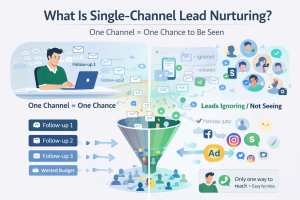
What Is Single-Channel Lead Nurturing?
Let’s start simple.
What is Single-Channel Lead Nurturing?
It means:
Using only one platform to engage and follow up with your leads
That’s it.
Common Examples
Most businesses fall into this without realizing it:
- Only sending email drip campaigns
- Only doing WhatsApp follow-ups
- Only running retargeting ads
They pick one channel…
And depend on it completely.
Real Scenario
Let’s take a SaaS company.
They:
- Capture leads through a landing page
- Set up a 5-email sequence
Looks good on paper.
But here’s what actually happens:
- The user signs up
- Doesn’t check email regularly
- Ignores all 5 emails
Result? No engagement. No conversion.
The Hidden Problem
You think:
“We followed up multiple times”
But the reality:
The lead never saw you
Core Limitation
Here’s the truth most businesses miss:
If the lead ignores that one channel, you disappear
Completely.
Why This Happens
Different people prefer different channels:
- Some respond to emails
- Some prefer WhatsApp
- Some notice ads
- Some engage on social media
If you’re only in one place…
You’re invisible everywhere else.
What This Leads To
- Low engagement rates
- Missed opportunities
- Slower conversions
- Higher CAC
And the worst part?
You assume the lead wasn’t interested
When in reality…
They just didn’t see you.
Simple Analogy
Imagine trying to reach someone…
But only calling them once a day.
If they don’t pick up…
You stop trying.
That’s single-channel nurturing.
Actionable Tip
If you’re currently using only one channel, ask:
- What % of my leads actually see this?
- What happens to the rest?
That gap is where your lost conversions are.
Key Takeaway
Single-channel nurturing is not wrong…
It’s just limited.
Because:
One channel = One chance to be seen
And in today’s attention economy…
One chance is rarely enough.
What Is Multi-Channel Lead Nurturing?
Now let’s look at the smarter approach.
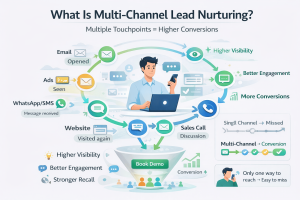
What is Multi-Channel Lead Nurturing?
It means:
Engaging leads across multiple platforms and touchpoints
Instead of relying on one channel…
You create a system of connected interactions.
Channels You Can Use
Multi-channel doesn’t mean “be everywhere blindly”
It means being strategic.
Common channels include:
- WhatsApp / SMS
- Retargeting ads
- Social media
- Sales calls
- Website personalization
Real Scenario (Same Lead, Different Outcome)
Let’s revisit the same SaaS example.
This time:
- The lead ignores your email
- Sees your retargeting ad on LinkedIn
- Gets a WhatsApp reminder
- Visits your website again
- Books a demo
Same lead
Same intent
But now…
Multiple touchpoints = conversion
What Changed?
Not your product
Not your pricing
Your presence
Core Advantage
Here’s the biggest shift:
You meet the lead where they are
Not where you want them to be.
Why This Works So Well
Because modern buyers:
- Switch between devices
- Use multiple platforms
- Engage at different times
Multi-channel nurturing adapts to this behavior.
What You Gain
- Higher visibility
- Better engagement
- Stronger brand recall
- Faster trust-building
- More conversions
Powerful Insight
Every touchpoint does one job:
- Email → Educates
- Ads → Reminds
- WhatsApp → Nudges
- Calls → Converts
Together, they create momentum
Actionable Tip
Start simple.
Don’t try to use 6 channels at once.
Instead:
Add one complementary channel to what you already use
Example:
- If you use email → add retargeting ads
- If you use WhatsApp → add email
- If you use ads → add follow-up messages
Important Reminder
Multi-channel doesn’t mean:
• Spamming everywhere
• Sending the same message everywhere
It means:
Coordinated, relevant communication across channels
Key Takeaway
Multi-channel lead nurturing works because:
• It increases your chances of being seen
• It builds familiarity through repetition
• It meets the customer in their natural behavior
And when that happens…
Conversions stop feeling forced
They start happening naturally
Single-Channel vs Multi-Channel: Key Differences
Let’s make this crystal clear.
Because this is where the real shift happens.
Comparison Breakdown
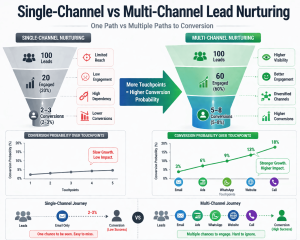
Factor |
Single-Channel |
Multi-Channel |
Reach |
Limited |
High |
Engagement |
Low–Moderate |
High |
Dependency |
High risk |
Diversified |
Conversion Rate |
Lower |
Higher |
Customer Experience |
Fragmented |
Seamless |
What This Actually Means
Let’s break it down in simple terms.
1. Reach
Single-channel:
You’re visible in only one place
Multi-channel:
You show up across multiple platforms
Example:
- Email only → seen by 20%
- Email + Ads + WhatsApp → seen by 60–80%
2. Engagement
Single-channel:
Limited interaction
Multi-channel:
Multiple chances to engage
Why this matters:
People rarely act on the first touchpoint.
They:
- See → Ignore
- See again → Consider
- See again → Act
3. Dependency
Single-channel:
Everything depends on one platform
Multi-channel:
Risk is spread across channels
Example:
- If your emails go to spam → you’re invisible
- If your ad performance drops → leads dry up
Multi-channel protects you from this.
4. Conversion Rate
Single-channel:
Lower conversions
Multi-channel:
Higher conversions
Scenario:
- Single-channel → 2% conversion
- Multi-channel → 5–8% conversion
Same leads. Better outcome.
5. Customer Experience
Single-channel:
Disconnected experience
Multi-channel:
Customer experience is Smooth, consistent journey
Example:
A lead:
- Reads your email
- Sees your ad
- Gets a reminder
- Talks to sales
Everything feels connected
The Big Insight
Most people think:
“Multi-channel = more reach”
But the real truth is:
Multi-channel = higher probability of conversion
Why This Works
Because conversion is not a single event.
It’s a process of:
- Repeated exposure
- Gradual trust-building
- Timely nudges
Multi-channel supports all three.
Actionable Tip
Audit your current system:
Ask:
- How many touchpoints does a lead experience before conversion?
- Are they all in one channel?
If yes, you’re limiting your growth.
The real difference between single-channel and multi-channel marketing is not just reach—it’s the number of opportunities you create for a lead to engage and convert.”
Key Takeaway
Single-channel gives you one path to conversion
Multi-channel gives you multiple chances to win
And in today’s market…
More chances = more customers
Why Single-Channel Nurturing Breaks Down
Now let’s address the real issue.
Single-channel doesn’t just limit growth…
It eventually stops working.
Core Problems
Here’s why:
1. Channel Fatigue
People get tired.
- Emails go unread
- Ads get ignored
- Messages feel repetitive
Example:
You send 10 emails over 2 weeks…
At first:
Open rate = 25%
Later:
Drops to 10% or less
Why?
Overexposure in one channel
2. Algorithm Dependency
If you rely on one channel…
You rely on its algorithm
Examples:
- Email → spam filters
- Social media → reach limitations
- Ads → rising costs
Insight:
You don’t control these platforms.
3. Missed Timing
Not every lead is active at the same time.
- Some check emails in the morning
- Some scroll at night
- Some respond instantly to WhatsApp
If your message hits at the wrong time…
It gets ignored
4. Lack of Reinforcement
One touchpoint is rarely enough.
People need:
- Reminders
- Repetition
- Reinforcement
Scenario:
A lead:
- Sees one email → forgets
- Sees email + ad + message → remembers
That’s the difference
The Harsh Reality (Numbers Don’t Lie)
Let’s say:
- Email open rate = 20%
That means:
80% of your leads never see your message
Now think about it:
You paid to acquire those leads…
And most of them never even hear from you
What Businesses Usually Do (Wrong Move)
They say:
“Email isn’t working”
So they:
- Change subject lines
- Increase frequency
- Send more emails
But the real fix is:
Add more channels
The Real Takeaway
Single-channel nurturing creates:
A single point of failure
If that channel underperforms…
Your entire funnel suffers
Actionable Tip
Instead of optimizing one channel endlessly:
Add one more touchpoint
Start small:
- Email + Retargeting ads
- Ads + WhatsApp
- Email + LinkedIn
Key Takeaway
Single-channel fails not because it’s bad…
But because it’s incomplete
In today’s environment:
One channel = one chance
Multiple channels = multiple opportunities
And conversions happen where:
Visibility meets timing meets trust
Why Multi-Channel Nurturing Drives Better Results
Let’s get to the real question:
Why does multi-channel actually work better?
It’s not just about “being everywhere.”
It’s about being seen, remembered, and trusted.
If you’re wondering how multi-channel lead nurturing increases conversions, it comes down to repeated visibility and timely engagement across the platforms your leads already use.
Let’s break it down.
1. Higher Visibility
This is the most obvious advantage.
More touchpoints = more chances to be seen
If you rely on one channel:
- You might reach 20–30% of your leads
But with multiple channels:
- You can reach 60–80% (or more)
Example:
- Email → 20% open rate
- Ads → additional visibility
- WhatsApp → direct attention
Suddenly, your message is everywhere your lead already is
2. Better Engagement
Not everyone behaves the same way.
Some people:
- Check emails daily
- Ignore emails but respond to WhatsApp
- Scroll social media but never click emails
Different people prefer different channels
Scenario:
You send:
- Email → ignored
- WhatsApp message → opened instantly
Same lead. Different response.
3. Reinforced Messaging
This is where things get powerful.
When a lead sees your message:
- Once → easy to forget
- Twice → starts noticing
- Three times → starts trusting
Repetition builds recall
Example:
A prospect:
- Reads your email
- Sees your ad later
- Gets a reminder message
Now your brand feels familiar
And familiarity reduces resistance.
4. Faster Conversions
When leads keep seeing you…
They decide faster
Why?
Because:
- Questions get answered sooner
- Doubts reduce quicker
- Trust builds continuously
Scenario:
Without multi-channel:
- Lead takes 30 days to convert
With multi-channel:
- Lead converts in 10–15 days
Same lead, faster decision
5. Improved Customer Experience
This is underrated.
Multi-channel, when done right, feels:
Natural, not forced
Because:
- You’re not pushing in one place
- You’re guiding across multiple touchpoints
Example:
Instead of:
10 emails in 5 days
You do:
• 3 emails
• 2 ads
• 1 WhatsApp follow-up
Feels balanced, not overwhelming
The Big Insight
Here’s what really drives results:
- Repetition across channels builds familiarity
- Familiarity builds trust
- Trust drives conversions
Using multiple channels allows you to apply different lead engagement techniques, ensuring your message connects with prospects based on how they prefer to interact.
Actionable Tip
Don’t just repeat messages blindly.
Keep the core message same
Change the format per channel
Example:
- Email → Detailed explanation
- Ad → Short reminder
- WhatsApp → Direct nudge
Key Takeaway
Multi-channel nurturing works because:
• It increases visibility
• It improves engagement
• It reinforces trust
And when all three align…
Conversions become easier, faster, and more consistent
If you’re trying to figure out how to convert more leads without increasing ad spend, improving your nurturing system is often the fastest and most cost-effective solution.
Real-World Scenarios
Let’s make this real.
Because strategy is only useful when you can see it in action.
Scenario 1: SaaS Business
Problem:
Free trial users don’t convert
Single-Channel Approach:
- Only email follow-ups
Users don’t open emails → low activation
Multi-Channel Approach:
- Email onboarding
- In-app messages
- Retargeting ads
Result:
1. Users see guidance everywhere
2. Feature adoption increases
3. Trial-to-paid conversion improves
Scenario 2: Service-Based Business
Problem:
Leads go cold after inquiry
Single-Channel Approach:
- One follow-up call
Lead forgets → no response
Multi-Channel Approach:
- Email with case study
- WhatsApp follow-up
- Reminder message
Result:
Trust builds gradually
Lead stays engaged
More deals close
Scenario 3: E-commerce
Problem:
Cart abandonment
Single-Channel Approach:
- One cart recovery email
Missed → lost sale
Multi-Channel Approach:
- Email reminder
- SMS alert
- Retargeting ad
Result:
Multiple reminders
Higher recall
More recovered revenue
Scenario 4: SME (Small & Medium Enterprise)
Problem:
Low-quality or unresponsive leads
Single-Channel Approach:
- Only social media posts
Limited reach → inconsistent leads
Multi-Channel Approach:
- Social media content
- Email nurturing
- Direct outreach
Result:
1. Better-qualified leads
2. Higher engagement
3. More consistent pipeline
Scenario 5: D2C Brand
Problem:
Low repeat purchases
Single-Channel Approach:
- Only Instagram ads
One-time buyers, low retention
Multi-Channel Approach:
- Ads for awareness
- Email for education
- SMS for offers
Result:
1. Stronger brand recall
2. More repeat purchases
3. Higher customer lifetime value
The Pattern You Should Notice
Across all scenarios:
Single-channel = missed opportunities
Multi-channel = captured intent
Final Insight
It’s not that leads aren’t interested…
They’re just not seeing enough of you in the right places
The scenarios above clearly show how multi-channel lead nurturing examples and strategies can be applied across different industries to improve engagement and conversions.
Key Takeaway
Multi-channel nurturing works across industries because:
• It matches how people actually behave
And when your strategy aligns with behavior…
• Results improve naturally
When Single-Channel Still Works
Let’s be real.
Multi-channel is powerful.
But that doesn’t mean single-channel is useless.
In some cases, it actually works well.
The key is knowing when it makes sense.
When Single-Channel Works
- Budget Is Very Limited
If you’re just starting out:
You may not have the resources for multiple channels
So it’s smarter to:
- Focus on one channel
- Do it really well
Instead of:
- Spreading yourself too thin
Example:
A small business:
- Starts with email marketing only
- Builds a strong list
- Sends valuable, consistent content
Gets steady conversions
- Early-Stage Business
At the beginning:
Complexity can slow you down
You don’t need:
- Automation tools
- Multiple platforms
- Complex systems
You need:
traction
Scenario:
A startup:
- Uses only LinkedIn outreach
- Builds conversations
- Closes initial clients
Simple. Focused. Effective.
- Audience Is Highly Concentrated
Sometimes your audience lives in one place.
That’s your advantage.
Example:
A local service business:
- Customers prefer WhatsApp
- Communication is direct and fast
Using only WhatsApp:
- Inquiries
- Follow-ups
- Closing deals
Works perfectly
Real-World Example
A local home service provider:
- Gets leads via referrals
- Uses only WhatsApp for:
- Quotes
- Follow-ups
- Booking confirmations
No email
No ads
Still:
High conversion rate
Why?
Because the audience is already there
The Limitation (Important)
Here’s where most businesses go wrong:
They start with single-channel…
And never evolve
The Insight That Matters
Single-channel is a starting point—not a strategy for scale
It works:
- In the beginning
- In specific situations
But as you grow:
It becomes a bottleneck
Actionable Tip
Ask yourself:
- Are we missing leads because they don’t engage on this channel?
- Are we dependent on one platform?
If yes:
It’s time to expand
For most growing businesses, the best lead nurturing strategy for SMEs is not complexity—it’s starting with two to three well-coordinated channels and scaling from there.
Key Takeaway
Single-channel works when:
• You’re starting small
• You’re resource-constrained
• Your audience is concentrated
But growth happens when:
You move beyond it
How to Transition from Single to Multi-Channel Nurturing
Now let’s make this practical.
You don’t need to jump into 5 channels overnight.
That’s where most businesses fail.
Instead:
Transition step-by-step
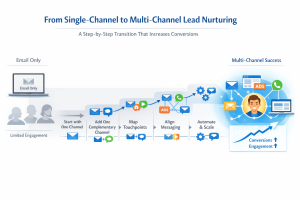
Step 1: Identify Your Current Channel
Start here.
What are you using today?
- Email?
- WhatsApp?
- Ads?
- Social media?
Insight:
You don’t need to replace it.
You need to build around it
Step 2: Add One Complementary Channel
This is the smartest move.
Add just ONE more channel
Not randomly.
Strategically.
Example:
If you use:
Add:
- Retargeting ads
Why?
Ads bring visibility to those who didn’t open emails
Another example:
- WhatsApp → Add email
- Ads → Add WhatsApp
Step 3: Map Touchpoints Across the Journey
Now think like this:
Where does your lead interact with you?
Simple Journey:
- Awareness → Ad
- Interest → Email
- Consideration → Case study
- Decision → Call / WhatsApp
Insight:
More touchpoints = higher conversion probability
But only if they are:
Structured, not random
Step 4: Align Messaging Across Channels
This is critical.
If your messaging is inconsistent:
You create confusion
Example:
Ad says:
“Affordable solution”
Email says:
“Premium offering”
Lead gets confused → no conversion
Fix:
Keep:
- Core message same
Change:
- Format per channel
Step 5: Automate Where Possible
Once your system works manually:
Start automating
Tools you can use:
- CRM (HubSpot, Zoho)
- Email automation tools
- Ad retargeting platforms
This is where smart marketing automation strategies come into play, helping you deliver consistent follow-ups across multiple channels without increasing manual effort.
Example:
- Lead downloads guide
Trigger: - Email sequence
- Retargeting ad
- Reminder message
All automated
Example Transition Path
Keep it simple.
Don’t overcomplicate
Stage 1:
Email only
Stage 2:
Email + WhatsApp
Stage 3:
Email + WhatsApp + Retargeting ads
Step-by-step growth
Common Mistake to Avoid
Most businesses:
Add channels randomly
Result:
- Inconsistent messaging
- Poor experience
- Low results
The Smarter Approach
Add channels with a purpose
Ask:
- What gap am I trying to fill?
- Which leads am I missing?
Actionable Tip
Start with this simple combo:
Email + Retargeting ads
Why?
- Email → depth
- Ads → visibility
Powerful combination
Final Insight
You don’t need:
More channels
You need:
Better-connected channels
Key Takeaway
Transitioning to multi-channel is not about complexity.
It’s about expanding your chances to convert
Start small
Stay consistent
Scale strategically
And over time:
Your nurturing system becomes a growth engine
Building a Simple Multi-Channel Nurturing Flow
Let’s simplify this.
You don’t need a complex system.
You need a structured, consistent flow
Because here’s the truth:
• It’s not about doing more
• It’s about doing it at the right time, in the right way
Example: Simple Multi-Channel Flow
Let’s walk through a practical flow you can implement immediately:
Day 1: Email (Welcome / Education)
First impression matters
- Welcome the lead
- Set expectations
- Share something valuable
Example:
“Here’s how to solve [problem] in 3 simple steps”
Day 3: Retargeting Ad (Reminder)
Stay visible
- Reinforce your message
- Keep your brand top-of-mind
Example:
Short ad:
“Still struggling with [problem]? Here’s a better way.”
Day 5: WhatsApp (Quick Nudge)
Direct and personal
- Short message
- Clear intent
Example:
“Hey, did you get a chance to check this out? Let me know if you have questions.”
Day 7: Case Study Email
Build trust
- Show real results
- Reduce doubts
Example:
“How we helped a business increase conversions by 2X”
Day 10: Demo / Offer
Drive action
- Clear CTA
- Low friction next step
Example:
“Book a quick demo” or “Get started today”
Why This Flow Works
Notice what’s happening:
- Different channels
- Different formats
- Same core message
This creates consistent reinforcement without feeling repetitive
Instead of treating follow-ups as isolated actions, think of this as sales funnel nurturing—where every touchpoint moves the lead closer to a decision.
The Real Insight
Most businesses think:
“We need to send more messages”
But the truth is:
You need better-timed, better-placed messages
Scenario
Two businesses:
Business A (Single-channel):
- Sends 5 emails
Gets ignored
Business B (Multi-channel):
- Ad
Same lead sees message multiple times
Converts faster
Actionable Tips
- Start with a 5–10 day flow (don’t overcomplicate)
- Use 2–3 channels max initially
- Keep messaging consistent but not identical
- Space out touchpoints (avoid overload)
Important Principle
Consistency beats intensity
It’s better to:
- Show up regularly across channels
Than:
- Bombard leads in one day
Key Takeaway
A simple multi-channel flow works because:
• It guides the lead step-by-step
• Across multiple touchpoints
• Without overwhelming them
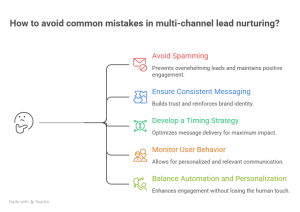
Common Mistakes in Multi-Channel Nurturing
Now let’s talk about what breaks this system.
Because multi-channel can either:
• Increase conversions
• Or completely overwhelm your leads
1. Spamming Across Channels
This is the biggest mistake.
More channels ≠ more messages
Example:
- Email in the morning
- WhatsApp in the afternoon
- SMS in the evening
- Ad everywhere
Result:
Annoyance → Unsubscribe → Block
Fix:
Space your communication
Respect attention
2. Inconsistent Messaging
If your message changes across channels:
You confuse the lead
Example:
- Email: “Affordable solution”
- Ad: “Premium service”
- WhatsApp: “Limited-time offer”
Lead thinks:
“What exactly are they offering?”
Fix:
• Keep the core message consistent
• Adjust only the format and tone
3. No Timing Strategy
Timing is everything.
If your messages are:
- Too frequent → overwhelming
- Too delayed → forgotten
You lose momentum
Example:
- 3 messages in one day → ignored
- Next message after 10 days → forgotten
Fix:
Follow a simple cadence (like 2–3 day gaps)
4. Ignoring User Behavior
Not all leads behave the same.
But many businesses treat them the same.
Example:
A lead:
- Clicks your email
- Visits pricing page
High intent
But you still send:
Generic educational content
Missed opportunity
Fix:
Use behavior triggers:
- Visited pricing → send offer
- Downloaded guide → send case study
5. Over-Automation Without Personalization
Automation is powerful.
But overdoing it makes your brand feel:
Robotic
Example:
“Dear User123,
We noticed your activity…”
Feels impersonal
Fix:
Add human touch:
- Use names
- Keep tone conversational
- Personalize based on actions
The Core Principle
Here’s what most businesses get wrong:
They treat multi-channel as a volume game
But it’s not.
The Right Approach
Coordinate, don’t bombard
Think like this:
- Each channel has a role
- Each message has a purpose
- Each touchpoint builds on the previous one
Actionable Checklist
Before sending anything, ask:
- Does this add value?
- Is the timing right?
- Is the message consistent?
- Is this necessary?
Key Takeaway
Multi-channel fails when:
It becomes noisy and unstructured
It works when:
It is coordinated, intentional, and customer-focused
Final Insight
The goal is not:
To be everywhere
The goal is:
To show up meaningfully where it matters
And when you do that:
Conversions follow naturally
Metrics That Prove Multi-Channel Works
Let’s be honest.
If you can’t measure it…
• You can’t improve it
• And you definitely can’t scale it
So how do you know your multi-channel nurturing is actually working?
You track the right metrics
1. Conversion Rate
This is your #1 indicator
Are more leads turning into customers?
Example:
Before multi-channel:
- 100 leads → 5 customers
Conversion rate = 5%
After multi-channel:
- 100 leads → 12 customers
Conversion rate = 12%
Insight:
Same leads. Same traffic.
Better system = more conversions
Multi-channel nurturing is one of the most effective conversion optimization strategies because it increases visibility, builds trust, and reduces drop-offs across the funnel.
2. Engagement Across Channels
This tells you:
Are people interacting with your content?
Track:
- Email opens & clicks
- Ad impressions & clicks
- WhatsApp replies
- Website visits
Scenario:
A lead:
- Ignores email
- Clicks your ad
- Replies on WhatsApp
That’s engagement spread across channels
Why this matters:
Engagement = interest
Interest = future conversions
3. Cost Per Acquisition (CAC)
This is where things get interesting.
CAC = Total cost ÷ customers acquired
Example:
Before:
- Spend ₹1,00,000 → 10 customers
CAC = ₹10,000
After multi-channel:
- Same spend → 20 customers
CAC = ₹5,000
What changed?
Not your budget
Your efficiency
4. Time to Conversion
How long does it take for a lead to become a customer?
Scenario:
Single-channel:
25–30 days to convert
Multi-channel:
10–15 days
Why this happens:
- More touchpoints
- Faster trust-building
- Quicker decision-making
Faster conversions = lower effort + lower cost
5. Customer Lifetime Value (LTV)
This is often overlooked.
Multi-channel doesn’t just convert better…
It retains better
Example:
With nurturing:
- Customers stay longer
- Engage more
- Buy again
LTV increases
Why this matters:
Higher LTV = more profitable business
Even if CAC stays same, margins improve
The Real Insight
Don’t look at metrics in isolation.
Look at the pattern:
Conversions ↑
Time to convert ↓
CAC ↓
LTV ↑
The One Signal That Matters Most
If conversions increase without proportional increase in spend…
Your system is working
Actionable Tip
Start simple.
Track just 3 metrics first:
- Conversion rate
- CAC
- Time to conversion
That alone will show you the impact
Key Takeaway
Multi-channel works when:
It improves efficiency, not just activity
More messages don’t matter.
Better outcomes do.
Advanced Insight: The Multi-Channel Flywheel
Now let’s connect everything.
Because this is where strategy becomes powerful.
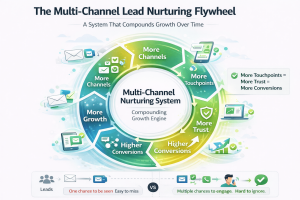
The Multi-Channel Flywheel
Think of it like a loop:
More Channels
→ More Touchpoints
→ More Trust
→ Higher Conversions
→ Lower CAC
→ More Growth
→ (Back to more channels)
Let’s Break This Down
- More Channels → More Touchpoints
When you add channels:
You increase visibility
- Ads
- Social
Leads see you more often
- More Touchpoints → More Trust
People don’t trust instantly.
They trust through:
Repeated exposure
Example:
A lead:
- Sees your ad
- Reads your email
- Gets a message
Now your brand feels familiar
- More Trust → Higher Conversions
When trust increases:
Resistance drops
Leads think:
• “I’ve seen this brand before… I trust them”
• Conversion becomes easier
- Higher Conversions → Lower CAC
This is the game changer.
Same spend
More customers
CAC automatically drops
- Lower CAC → More Budget Efficiency
Now you have options:
- Scale ads profitably
- Invest in better content
- Expand channels
Growth becomes easier
- More Growth → More Channels
As you grow:
You add more channels strategically
And the cycle repeats.
Why This Matters
Most businesses think growth is linear.
Spend more → get more customers
But that’s expensive.
The Smarter Approach
Build a system that improves itself
That’s what the flywheel does.
Scenario
Business A:
- Relies only on ads
Growth depends on spending
Business B:
- Uses multi-channel nurturing
Converts more from same leads
Business B grows faster
With less pressure on budget
Actionable Tip
Ask yourself:
- Are we increasing touchpoints?
- Are we building trust consistently?
- Are conversions improving over time?
If yes:
Your flywheel is working
Key Takeaway
Multi-channel is not just a tactic.
It’s a compounding growth system
And when it starts working:
Growth becomes predictable, scalable, and efficient
Conclusion: Don’t Rely on One Door
Let’s bring this together.
Most businesses don’t fail because they don’t follow up.
They fail because they rely on one way to do it
The Reality
Single-channel nurturing gives you:
• One path to conversion
• One chance to be seen
• One point of failure
Multi-channel nurturing gives you:
• Multiple touchpoints
• Multiple chances to engage
• A system that scales with your growth
The Shift That Changes Everything
This is the mindset shift:
Stop asking, “Are we following up?”
Start asking, “Are we showing up where it matters?”
Final Thought
“Your leads don’t live in one channel—so your nurturing shouldn’t either.”
Actionable Next Steps
Don’t overcomplicate this.
Start small. But start smart.
- Audit Your Current Nurturing Channel
Ask:
- Where are we currently engaging leads?
- Are we dependent on just one channel?
Identify your starting point
- Add One Additional Channel This Week
Not five. Just one.
Keep it simple and strategic
Examples:
- Email → Add retargeting ads
- Ads → Add WhatsApp
- Social → Add email
- Map a Simple 5-Touchpoint Journey
Create a basic flow:
- Touchpoint 1 → Awareness (Email/Ad)
- Touchpoint 2 → Reminder (Ad)
- Touchpoint 3 → Engagement (WhatsApp)
- Touchpoint 4 → Trust (Case study)
- Touchpoint 5 → Conversion (Offer/Demo)
Keep it structured, not random
- Track Engagement and Conversions
You don’t need complex dashboards.
Just track:
- Are more people engaging?
- Are more leads converting?
That’s your signal
Key Takeaway
Multi-channel lead nurturing is not about:
Being everywhere
Doing more
It’s about:
• Being present at the right moments
• Across the channels your customers already use
Final Insight
Growth doesn’t come from:
More leads alone
It comes from:
Better systems that convert those leads
And multi-channel nurturing…
Is one of the most reliable systems you can build

