Posts

Lead Nurturing Reduces Customer Acquisition Cost and Increases Conversions

Lead nurturing reduces customer acquisition cost (CAC) by improving conversion rates, building trust with prospects, and maximizing the value of existing leads instead of constantly acquiring new ones. When businesses guide leads through the buyer journey with relevant content and timely follow-ups, they convert more leads into customers—lowering CAC and increasing overall marketing ROI.

Here’s the problem most businesses face:

They invest heavily in ads, generate leads…
but only a small percentage actually convert.

The result?
High CAC, wasted budget, and inconsistent growth.

But the real issue isn’t traffic.

It’s what happens after the lead comes in.

Most leads are not ready to buy immediately.
They need:

  • Clarity
  • Trust
  • Confidence

And that’s exactly what lead nurturing provides.

Instead of pushing for a sale too early,
lead nurturing focuses on:

  • Educating prospects
  • Addressing objections
  • Building relationships over time

Think of it this way:

If 100 leads enter your funnel and only 2 convert, your CAC is high by default.
But if you can convert 5, 10, or even 15 of those same leads…

Your CAC drops—without increasing your ad spend.

Understanding how lead nurturing reduces customer acquisition cost comes down to one principle—converting more of the leads you already paid to acquire.

In this guide, you’ll learn how to use lead nurturing as a system, not just a tactic—so you can reduce CAC, increase conversions, and build a more efficient, scalable growth engine.

What Is Customer Acquisition Cost (CAC) — And Why It Matters

Let’s simplify this.

Customer Acquisition Cost (CAC) is:

The total cost you spend to acquire one customer.

Simple Formula:

CAC = Total Marketing + Sales Cost ÷ Number of Customers Acquired

What goes into CAC?

Most businesses underestimate this.

It’s not just ad spend.

Your CAC includes:

  • Ad spend (Google Ads, Meta Ads, etc.)
  • Tools (CRM, email software, analytics tools)
  • Team salaries (marketing + sales teams)
  • Content creation (blogs, videos, creatives)
  • Sales effort (calls, demos, follow-ups)

Why This Matters More Than You Think

Here’s where most businesses go wrong:

They assume:

“High CAC = expensive marketing”

But that’s not always true.

The Real Insight

High CAC often means:

Low conversion efficiency

Let’s look at a simple example:

You spend ₹1,00,000 on marketing.

Case 1:

  • You acquire 10 customers
    CAC = ₹10,000

Case 2:

  • You acquire 20 customers
    CAC = ₹5,000

What changed?

Not your budget.
Not your ads.

Your conversion rate improved.

That’s the game changer

You don’t always need to reduce spend to lower CAC.

You need to increase how many leads turn into customers.
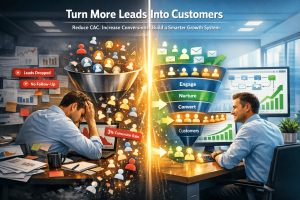
Reduce Customer Acquisition Cost and increase conversion

Real-World Scenario

A SaaS company runs ads and gets:

  • 500 sign-ups for a free trial

But only:

  • 10 people convert to paid users

CAC stays high.

Now they introduce:

  • Onboarding emails
  • Product walkthroughs
  • Feature education

Conversions go from:

  • 10 → 30 users

Same traffic. Same spend. Lower CAC.

Valuable Tip

Before increasing your marketing budget, ask:

  • Are we converting enough of the leads we already have?
  • Where are leads dropping off in our funnel?
  • Do we have a system to nurture them?

Because:

Optimizing conversion is often cheaper than acquiring new leads.

✅ Key Takeaway

Customer Acquisition Cost is not just about how much you spend.

It’s about how efficiently you turn attention into customers.

And that’s exactly where lead nurturing becomes your biggest advantage.

The Real Problem: Most Leads Don’t Convert (And Why)

Here’s something most businesses don’t realize:

The majority of your leads are not ready to buy when they first interact with you.

But many businesses treat every lead like they’re ready to purchase immediately.

And that’s where things start breaking.

Let’s look at what actually happens:

A potential customer:

  • Visits your website
  • Downloads a guide
  • Signs up for a webinar

What does that mean?

They’re interested.
But not necessarily ready to buy.

So why don’t most leads convert?

Let’s break it down.

1. Leads Are Not Ready to Buy Immediately

Every buyer goes through a journey:

  • Awareness
  • Consideration
  • Decision

Most leads are stuck in the early stages.

Scenario:

A business owner downloads your “SEO checklist.”

That doesn’t mean:
They’re ready to hire you today

It means:
They’re trying to understand the problem

If you immediately pitch your service…

You lose them.

2. Lack of Trust

People don’t buy from brands they don’t trust.

Especially in:

  • B2B
  • High-ticket services
  • SaaS

Scenario:

A lead visits your pricing page.

They’re interested.

But they still wonder:

  • “Will this actually work for me?”
  • “Can I trust this company?”

Without:

  • Case studies
  • Testimonials
  • Educational content

They hesitate… and leave.

3. No Follow-Up (or Poor Follow-Up)

This is one of the biggest revenue leaks.

Scenario:

A lead fills out your contact form.

You respond after 3 days.

By then:

  • They’ve forgotten you
  • Or chosen a competitor

Or worse…

You send:
One email
And then nothing

That lead goes cold.

4. Generic Messaging

Not all leads are the same.

But many businesses communicate like they are.

Scenario:

  • A first-time visitor gets the same email as a pricing-page visitor
  • A curious reader gets the same message as a high-intent buyer

Result?

The message doesn’t resonate
The lead disengages

Important Data Insight

Studies consistently show:

Only a small percentage of leads are sales-ready at the first touchpoint

Which means:

Most of your leads need nurturing before they convert

Common Mistakes That Kill Conversions

  • Treating all leads the same
  • Pushing for a sale too early
  • Not understanding buyer intent
  • Ignoring follow-ups

Think of it this way:

If someone just walked into a store…

Would you immediately say:

“Buy this now.”

Or would you:

  • Understand their needs
  • Answer questions
  • Guide them

That’s exactly what your funnel should do.

Key Takeaway

Without nurturing, you’re leaking money at every stage of your funnel.

You paid to acquire the lead.

But without:

  • Follow-up
  • Education
  • Trust-building

That investment goes to waste.

At its core, effective lead nurturing is a form of sales funnel optimization—it ensures that leads don’t just enter your funnel, but actually move through it and convert.

What Is Lead Nurturing (And What It’s Not)

Now that we understand the problem…

Let’s talk about the solution.

What Is Lead Nurturing?

Lead nurturing is a structured process of:

  • Educating your leads
  • Engaging them over time
  • Building trust gradually

So that when they’re ready to buy…

They choose you.

Simple Way to Understand It

Lead nurturing is not about pushing a sale.

It’s about guiding a prospect toward a decision.

Real-World Example

A SaaS company gets a new sign-up.

Instead of immediately selling…

They send:

  • Day 1: Welcome email + quick start guide
  • Day 3: Feature walkthrough
  • Day 5: Case study
  • Day 7: Invite to demo

By the time they pitch:

The user already understands the value

Conversion becomes easier.

What Lead Nurturing Looks Like in Practice

  • Helpful emails
  • Educational content
  • Timely follow-ups
  • Personalized messaging
  • Behavior-based communication

What Lead Nurturing Is NOT

Let’s clear some common misconceptions.

1. Random email blasts

Sending emails without:

  • Strategy
  • Timing
  • Relevance

That’s noise, not nurturing.

2. Hard selling in every message

If every email says:
“Buy now”

Leads will:
Ignore or unsubscribe

3. One-size-fits-all communication

Different leads need different messages.

  • New leads → education
  • Interested leads → value
  • High-intent leads → conversion

Valuable Tip

Before sending any message, ask:

“What does this lead need at this stage?”

Not:

“What do I want to sell?”

Another Practical Insight

Good nurturing feels like:

  • Guidance
  • Help
  • Clarity

Not:

  • Pressure
  • Spam
  • Noise

Core Idea

Lead nurturing = Guiding a prospect toward a decision, not forcing one.

✅ Key Takeaway

When done right, lead nurturing:

  • Builds trust
  • Reduces hesitation
  • Increases conversions

And most importantly…

It turns your existing leads into customers—without increasing your ad spend. 

How Lead Nurturing Directly Reduces CAC
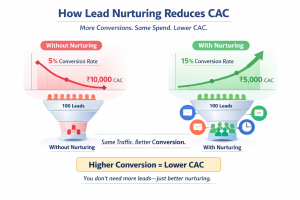
 

Lead nurturing reduces customer acquisition cost

Lead nurturing reduces customer acquisition cost


If you’re wondering how to convert more leads without increasing ad spend, the answer lies in building a structured nurturing process that guides prospects toward a decision.

Now let’s connect the dots.

You’ve seen:

  • Leads don’t convert immediately
  • Most businesses don’t nurture properly

So what happens when you do nurture?

Your Customer Acquisition Cost starts dropping—without reducing spend.

Let’s break down how.

1. Improves Lead-to-Customer Conversion Rate

This is the biggest lever.

If more leads convert into customers:

Your CAC automatically goes down.

Scenario:

You generate 100 leads.

  • Without nurturing → 5 customers
  • With nurturing → 15 customers

Same traffic. Same budget.

But your CAC drops by 3X.

Why this works:

Nurturing:

  • Builds trust
  • Answers objections
  • Keeps your brand top-of-mind

So when the lead is ready…

They choose you.

2. Maximizes ROI on Existing Traffic

Every lead you generate already costs you money.

Through:

  • Ads
  • Content
  • SEO
  • Social media

Scenario:

A user downloads your guide.

Without nurturing:
They leave and never return

With nurturing:

  • You send follow-up emails
  • Share relevant content
  • Invite them to a webinar

That same lead now converts.

Key Idea:

You don’t need more traffic.

You need to extract more value from the traffic you already have.

3. Reduces Dependency on Paid Ads

Most businesses fall into this trap:

“We need more leads → Increase ad spend”

But here’s the smarter way:

Convert more from what you already have.

Scenario:

  • Without nurturing → 2% conversion rate
  • With nurturing → 6% conversion rate

Now you get:
3X more customers from the same leads

Which means:
Less pressure to keep increasing ad budgets

Valuable Tip

Before scaling ads, fix your funnel.

Because:
Scaling a broken funnel = scaling your losses

4. Shortens the Sales Cycle

Time is money.

The longer it takes to convert a lead:

  • The more follow-ups needed
  • The more effort required
  • The higher your cost

Scenario:

Two leads:

Lead A (Not nurtured):
  • Asks basic questions
  • Needs multiple calls
  • Takes 30 days to convert
Lead B (Nurtured):
  • Already read your content
  • Understands your offering
  • Takes 10 days to convert

What changed?

Education.

Nurtured leads:

  • Come prepared
  • Ask better questions
  • Decide faster

5. Increases Customer Lifetime Value (LTV)

This is often overlooked.

Lead nurturing doesn’t stop at conversion.

Scenario:

A SaaS company:

  • Without onboarding → users drop off
  • With onboarding emails + guidance → users stay longer

Result:

  • Higher retention
  • More repeat purchases
  • Higher lifetime value

Why this matters for CAC:

When Customer Life Time Value increases:

You can afford higher CAC
Or maintain the same CAC with better profitability


Key Insight

Here’s the truth most businesses miss:

CAC doesn’t drop because you spend less
It drops because you convert more efficiently

This is where conversion rate optimization plays a critical role—because even small improvements in how leads move through your funnel can significantly reduce your overall CAC.

✅ Key Takeaway

Lead nurturing is not a cost-cutting tactic.

It’s a revenue efficiency system

That:

  • Converts more leads
  • Faster
  • With less effort

How Lead Nurturing Increases Conversions (Stage-by-Stage)

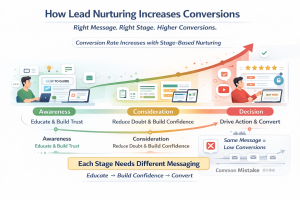
The most effective lead nurturing strategies to increase conversions focus on delivering the right message at the right stage of the buyer journey.

Now let’s make this practical.

Not all leads are the same.

And more importantly:

Not all leads are at the same stage.

Big Mistake Most Businesses Make

They send the same message to everyone.

Result?

  1. Low engagement
  2. Low conversions

The Smarter Approach

Align your messaging with the buyer’s journey

Stage 1: Awareness → Interest

This is where the journey begins.

The lead is:

  • Exploring
  • Learning
  • Trying to understand the problem

Goal: Build Trust

Not sell.

What to Share:

  • Educational emails
  • Blog content
  • Guides and checklists
  • Industry insights

Scenario:

A business owner searches:
“How to improve website traffic”

They land on your content.

If you immediately pitch:

You lose them

But if you:

  • Educate
  • Provide value
  • Simplify their problem

You earn attention and trust

Tip

Focus on:
Helping, not selling

At this stage:
Trust > Transaction
How Lead Nurturing increases conversion

Stage 2: Interest → Consideration

Now the lead is thinking:

“This looks interesting… but is it right for me?”

Goal: Reduce Doubt

What to Share:

  • Case studies
  • Product benefits
  • Comparisons
  • Use-case examples

Scenario:

A SaaS user is evaluating tools.

They’re comparing:

  • Features
  • Pricing
  • Results

If you provide:

  • Real results
  • Customer success stories

You move from “option” to “preferred choice”

Tip

Answer questions like:

  • “Will this work for me?”
  • “Is it worth it?”

Stage 3: Consideration → Decision

This is where conversion happens.

But even here…

Leads hesitate.

Goal: Drive Action

What to Share:

  • Testimonials
  • Product demos
  • Free trials
  • Limited-time offers

Scenario:

A lead:

  • Visited your pricing page
  • Opened multiple emails

They’re close.

Now is the time to:
Nudge them forward

Tip

Use:

  • Urgency
  • Clarity
  • Strong CTA

But keep it:
Helpful, not pushy

Big Insight (This Changes Everything)

Each stage needs different messaging.

If you:

  • Sell too early → you lose trust
  • Educate too late → you lose momentum

Simple Way to Remember

  • Awareness → Educate
  • Consideration → Build confidence
  • Decision → Convert

✅ Key Takeaway

Lead nurturing works because it aligns:

  1. The right message
  2. With the right person
  3. At the right time

And when that happens:

Conversions increase naturally.

Lead nurturing is a key part of customer journey optimization, ensuring that each interaction moves the prospect closer to a confident buying decision.

Types of Lead Nurturing That Drive Real Results

Now that we understand why nurturing matters…

Let’s talk about how to actually do it.

Because here’s the truth:

🔸Lead nurturing is not one tactic.
🔸It’s a system of touchpoints working together.

1. Email Drip Campaigns

This is the foundation of most nurturing systems.

A drip email campaign is a sequence of emails sent over time based on:

  • User action
  • Signup
  • Behavior

Scenario:

A user downloads your guide.

Instead of sending just one email, you send:

  • Day 1 → Welcome + resource
  • Day 3 → Educational content
  • Day 5 → Case study
  • Day 7 → Offer/demo

Why it works:

  • Keeps your brand top-of-mind
  • Builds trust gradually
  • Moves the lead step-by-step

Tip:

Each email should have one clear goal
Don’t try to educate, sell, and survey all in one email.

2. Retargeting Ads

Not every lead converts the first time.

But that doesn’t mean they’re lost.

Scenario:

A visitor:

  • Visits your pricing page
  • Leaves without taking action

You run retargeting ads showing:

  • Testimonials
  • Benefits
  • Limited-time offers

They come back and convert.

Why it works:

  • Reinforces your message
  • Reminds users of their interest
  • Targets high-intent audiences

 Tip:

Don’t show generic ads
Show stage-specific ads based on user behavior

3. WhatsApp / SMS Follow-Ups

This is where speed and visibility matter.

Emails can be ignored.

But messages?

They get opened.

Scenario:

A lead signs up for a demo.

You send:
“Hey, just confirming your demo for tomorrow. Let us know if you have any questions.”

Simple. Human. Effective.

Why it works:

  • High open rates
  • Feels personal
  • Faster response

Tip:

Use this for:

  • Reminders
  • Quick nudges
  • Important updates

Avoid overuse—it can feel intrusive.

4. Webinar Sequences

Webinars are powerful for:

  • Education
  • Trust-building
  • High-intent engagement

Scenario:

You host a webinar on:
“How to Reduce CAC for SMEs”

Your nurturing flow:

  • Before → Reminder emails
  • During → Value-packed session
  • After → Replay + offer

Why it works:

  • Builds authority
  • Engages leads deeply
  • Warms up cold audiences

Tip:

Don’t stop at the webinar
The post-webinar follow-up is where conversions happen

5. Personalized Content Journeys

This is where nurturing becomes powerful.

Instead of sending the same content to everyone…

You tailor it based on behavior.

Scenario:

  • Lead A → Reads beginner blogs → gets educational emails
  • Lead B → Visits pricing page → gets case studies + demo invites

Why it works:

  • Feels relevant
  • Matches intent
  • Increases engagement

Tip:

Even simple segmentation (beginner vs high-intent) can make a big difference

Big Insight

Multi-channel nurturing performs better than single-channel

Because your audience is not in one place.

They:

  • Check emails
  • Scroll social media
  • Use WhatsApp
  • Watch videos

Simple Rule

Be present across channels…

But stay consistent in your message

✅ Key Takeaway

The best nurturing systems are:

  • Timely
  • Relevant
  • Multi-channel
  • Behavior-driven

Real-World Scenarios 

Let’s bring everything together with real examples.

Because this is where theory becomes clear.

Scenario 1: SaaS Business

Problem:

Free trial users sign up… but don’t convert.

What’s really happening?

Users:

  • Don’t understand features
  • Don’t see value quickly
  • Get overwhelmed

Solution:

  • Onboarding email sequence
  • Feature walkthroughs
  • Use-case-based education

Result:

  • Higher activation
  • More users experience value
  • More conversions

CAC drops because more users convert from the same pool

Scenario 2: Service-Based Business

Problem:

Leads inquire… then go silent.

What’s happening?

  • Lack of follow-up
  • No trust built
  • No differentiation

Solution:

  • Follow-up emails
  • Case studies
  • Testimonials
  • Educational insights

Result:

  • Builds credibility
  • Keeps conversation alive
  • Increases conversion chances


Scenario 3: E-commerce Business

Problem:

Customers add to cart… but don’t purchase.

What’s happening?

  • Price hesitation
  • Distraction
  • Second thoughts

Solution:

  • Cart reminder emails
  • Limited-time offers
  • Customer reviews

Result:

  • Recovered revenue
  • Increased conversions


Scenario 4: SME (Small & Medium Business)

Problem:

Leads come in through ads or website… but conversion is low.

What’s happening?

  • Leads are not ready
  • No structured follow-up
  • Sales team engages too early

Solution:

  • Lead nurturing email sequence
  • Educational content
  • Lead scoring to identify high-intent leads

Scenario:

An SME offering digital services:

  • Starts sending weekly insights + case studies
  • Tracks engagement

Result:

  • Warmer leads
  • Better sales conversations
  • Higher conversion rates

Same leads → better outcomes → lower CAC


Scenario 5: D2C Brand (Direct-to-Consumer)

Problem:

High traffic but low repeat purchases.

What’s happening?

  • No post-purchase engagement
  • Weak brand connection
  • No retention strategy

Solution:

  • Post-purchase email flow
  • Product usage tips
  • Loyalty offers
  • Re-engagement campaigns

Scenario:

A skincare brand:

  • Sends tips on product usage
  • Recommends complementary products
  • Offers repeat purchase discounts

Result:

  • Higher repeat purchases
  • Increased LTV
  • Better ROI on acquisition

Key Insight

In all these scenarios, the pattern is the same:

The problem is not lack of leads
The problem is lack of nurturing

Final Takeaway

Lead nurturing turns:

  • Interest → trust
  • Trust → action
  • Action → revenue

And when that happens:

  1. Your CAC drops
  2. Your conversions rise
  3. Your growth becomes sustainable 

Common Lead Nurturing Mistakes That Increase CAC (And How to Fix Them)

Here’s the uncomfortable truth:

Most businesses don’t have a lead problem.
They have a lead handling problem.

And every mistake here?
Quietly increases your CAC.

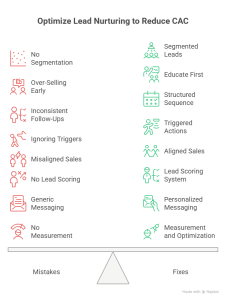
Let’s break down 8 high-impact mistakes—with fixes and real-world scenarios.

1. No Segmentation

What Happens:

All leads get the same emails, same offers, same messaging.

Why It Hurts:

A first-time visitor and a pricing-page visitor are not the same.

Fix:

Segment based on:

  • Behavior (visited pricing page, downloaded guide)
  • Source (ads, organic, referral)
  • Stage (cold, warm, hot)

Scenario:

SaaS:
A CRM tool sends the same onboarding emails to:

  • Trial users
  • Blog subscribers

Result: Low engagement.

Fix:

  • Trial users → product tutorials
  • Subscribers → educational content

Engagement improves → more conversions → lower CAC

2. Over-Selling Too Early

What Happens:

You push demos, pricing, or calls too soon.

Why It Hurts:

Trust isn’t built yet.

Fix:

Follow the rule:
Educate → Build trust → Then sell

Scenario:

Service Business:
A marketing agency sends:
“Book a paid consultation” immediately after signup.

Low response.

Fix:

  • First: Share insights/case studies
  • Then: Invite for consultation

Leads warm up → conversion increases
Common Lead Nurturing mistakes

 3. Inconsistent Follow-Ups

What Happens:

You follow up once… then disappear.

Why It Hurts:

Leads forget you.

Fix:

Create a structured follow-up sequence

  • Day 1
  • Day 3
  • Day 7
  • Day 14

Scenario:

SME (B2B):
A manufacturing supplier responds to inquiry once.

No reply → lead lost.

Fix:

  • Follow-up with:
    • Product comparison
    • Case study
    • Reminder

Lead re-engages → closes later

4. Ignoring Behavioral Triggers

What Happens:

You don’t act when leads show intent.

Why It Hurts:

High-intent signals go wasted.

Fix:

Trigger actions based on behavior:

  • Visited pricing page → send pricing breakdown
  • Abandoned cart → send reminder

Scenario:

D2C Brand:
User adds product to cart → leaves.

No follow-up.

Fix:

  • Send:
    • Reminder email
    • Offer
    • Review/testimonial

Recovery increases → CAC drops

5. Not Aligning with Sales

What Happens:

Marketing sends leads.
Sales says: “These aren’t good.”

Why It Hurts:

Wasted effort + poor conversions.

Fix:

Define together:
What is a “sales-ready” lead?

Scenario:

SaaS:
Marketing sends webinar attendees to sales.

Sales says:
“They’re not ready.”

Fix:
Only send leads who:

  • Attended webinar
  • Visited pricing page

Sales closes faster

6. No Lead Scoring System

What Happens:

You don’t prioritize leads.

Why It Hurts:

Hot leads don’t get immediate attention.

Fix:

Assign points:

  • Pricing page → +10
  • Webinar → +7
  • Email click → +3

Scenario:

Service Business:
A high-intent lead waits 3 days for response.

Lost to competitor.

Fix:
Lead scoring triggers instant sales call.

Faster response → higher close rate

7. Generic, Non-Personalized Messaging

What Happens:

Same email to everyone.

Why It Hurts:

Feels irrelevant → ignored.

Fix:

Personalize using:

  • Name
  • Industry
  • Behavior
  • Pain points

Scenario:

SME:
Sends generic “Our services” email.

Low CTR.

Fix:

  • “For manufacturing businesses struggling with X…”

Relevance increases → engagement improves

8. No Measurement or Optimization

What Happens:

You run campaigns without tracking performance.

Why It Hurts:

You don’t know what’s working.

Fix:

Track:

  • Open rates
  • CTR
  • Conversion rate
  • CAC

Scenario:

D2C:
Runs email campaigns blindly.

No improvement.

Fix:

  • Identify top-performing emails
  • Double down

Better ROI → lower CAC

Actionable Tip

Fixing just 2–3 of these mistakes can:

  1. Increase conversions by 20–40%
  2. Reduce CAC significantly without increasing ad spend

Key Takeaway

  1. You don’t reduce CAC by spending less
  2. You reduce CAC by wasting fewer leads

How to Build a Simple Lead Nurturing System (Step-by-Step)

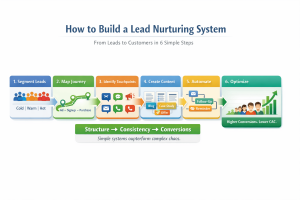
A simple lead nurturing system for small businesses doesn’t need to be complex—it just needs to be consistent, targeted, and aligned with how customers actually make decisions.

Let’s simplify this.

You don’t need complex tools.
You need a structured system.

Step 1: Segment Your Leads

Group leads into:

  • Cold (just discovered you)
  • Warm (engaged)
  • Hot (ready to buy)

Tip:

Start simple. You can refine later.

Step 2: Map Your Customer Journey

Understand:

  • Where leads enter
  • What they need at each stage

Example:

SaaS Journey:
Ad → Signup → Trial → Upgrade

Step 3: Define Key Touchpoints

Identify:

  • Email
  • WhatsApp
  • Retargeting ads
  • Calls

Insight:

More touchpoints = higher conversion probability
How to build a lead nurturing system

Step 4: Create Targeted Content

Match content to stage:

  • Awareness → Educational
  • Consideration → Case studies
  • Decision → Offers/demo

Scenario:

Service Business:

  • Blog → Awareness
  • Case study → Consideration
  • Consultation → Decision

Step 5: Set Up Automation

Use tools to automate:

  • Email sequences
  • Follow-ups
  • Alerts

Tools:

  • CRM: HubSpot, Zoho
  • Email: Mailchimp, ActiveCampaign

With the right marketing automation in place, businesses can nurture leads consistently at scale without relying on manual follow-ups.

Step 6: Track and Optimize

Measure:

  • Conversion rates
  • Engagement
  • Drop-offs

Tip:

Improve one step at a time.

Real-World System Examples

1. SME Example

Problem:

Leads come from website but don’t convert.

System:

  • Day 1: Welcome email
  • Day 3: Case study
  • Day 7: Offer/free consultation

Result: Higher conversions without more ads

2. SaaS Example

Problem:

Free trials don’t convert.

System:

  • Day 1: Setup guide
  • Day 2: Feature tutorial
  • Day 5: Case study
  • Day 7: Upgrade offer

Result: Better activation → lower CAC

3. Service Business Example

Problem:

Leads go cold.

System:

  • Follow-up email sequence
  • Testimonials
  • Problem-solving content

Result: Trust builds → more deals closed

4. D2C Example

Problem:

Cart abandonment.

System:

  • 1 hour: Reminder
  • 24 hours: Offer
  • 48 hours: Social proof

Result: Recovered revenue

Final Insight

  1. You don’t need more leads
  2. You need a better system

Key Takeaway

Lead nurturing is not about sending emails.

It’s about guiding decisions

And when done right:

✔ More conversions
✔ Lower CAC
✔ Higher ROI 

Metrics That Prove Your CAC Is Decreasing

Let’s be honest.

You can feel things are improving…
But unless you measure it, you can’t prove it.

And in business:

What you can’t prove, you can’t scale.

So instead of tracking everything, focus on a few high-impact metrics that directly show whether your lead nurturing is working.

1. Conversion Rate (Your #1 Signal)

This is the most important metric.

Formula:
Leads → Customers

Why It Matters:

If more leads convert into customers…

Your CAC automatically drops

Scenario:

You generate 100 leads.

  • Earlier → 5 customers → 5% conversion
  • Now → 10 customers → 10% conversion

Same leads. Same spend.

But CAC is cut in half.

Tip:

Track conversion at each stage:

  • Visitor → Lead
  • Lead → Qualified
  • Qualified → Customer

This shows where you’re improving.

2. Cost per Lead vs Cost per Customer

This is where many businesses get confused.

They focus only on cost per lead (CPL).

But what really matters is:

Cost per customer (CAC)

Scenario:

You spend ₹50,000 on ads.

Case A:
  • 500 leads → ₹100 per lead
  • 5 customers → CAC = ₹10,000
Case B:
  • Same 500 leads
  • 10 customers → CAC = ₹5,000

Lead cost didn’t change
Conversion improved

Insight:

Low CPL ≠ success
High conversion = success

3. Email Engagement (Early Indicator)

Before conversions improve…

Engagement improves first.

Track:

  • Open rate
  • Click-through rate (CTR)
  • Reply rate

Scenario:

SaaS Business:
  • Old emails → 12% open rate
  • New nurturing sequence → 28% open rate

More engagement → more educated leads → higher conversions

Tip:

If engagement is low:
1.Your messaging is off

2. Not your product

4. Sales Cycle Length

How long does it take to convert a lead?

Scenario:

Service Business:
  • Earlier: 30 days to close
  • After nurturing: 18 days

Why?

Because leads:

  • Already understand the value
  • Already trust you

Insight:

Shorter sales cycle = lower cost per deal

Less time → less effort → lower CAC

5. Customer Lifetime Value (LTV)

CAC is only half the story.

The real game is:

CAC vs LTV

Scenario:

D2C Brand:
  • Without nurturing → one-time buyers
  • With nurturing → repeat purchases

LTV increases

Insight:

Better nurturing doesn’t just convert…

It creates better customers

Putting It All Together

Here’s the pattern you want:

✔ Conversion rate → Up
✔ Email engagement → Up
✔ Sales cycle → Down
✔ LTV → Up
✔ CAC → Down

Core Insight

  1. If conversions increase while spend stays the same
  2. CAC will drop automatically

No hacks. No tricks.

Just better funnel efficiency.

Advanced Insight: The CAC vs Conversion Flywheel

Most businesses think like this:

“We need more leads to grow”

But high-growth businesses think differently:

“We need to convert better”

That’s where the CAC vs Conversion Flywheel comes in.

The Flywheel Explained

Here’s the loop:

Better Nurturing
Higher Conversion Rate
Lower CAC
More Budget Efficiency
More Leads / Better Investment
More Growth
→ Back to Better Nurturing

Why This Changes Everything

This is not a one-time improvement.

It’s a compounding system.

Scenario:

Month 1:
  • Conversion rate = 5%
  • CAC = ₹10,000

You improve nurturing.

Month 3:
  • Conversion rate = 8%
  • CAC = ₹6,250

Now you reinvest savings into better campaigns.

Month 6:
  • More leads
  • Better conversion
  • Even lower CAC

Growth accelerates

The Real Power

Most businesses try to scale like this:

Spend more → hope for growth

But this is risky.

Smart businesses scale like this:

Improve system → then scale

Strategic Insight

Lead nurturing is not just a marketing tactic.

It’s a growth lever

Because it impacts:

  • Conversions
  • Costs
  • Revenue
  • Retention

Actionable Tip

Start small:

  1. Improve one nurture sequence
  2. Track conversion impact
  3. Reinvest gains into better campaigns

Repeat.

Final Takeaway

  1. CAC doesn’t drop randomly
  2. It drops when your system improves

And when you build this flywheel:

✔ Growth becomes predictable
✔ Marketing becomes efficient
✔ Sales becomes easier

Conclusion: Stop Chasing Leads—Start Converting Them

Let’s bring this home.

Most businesses believe their biggest problem is:
“We need more leads”

So they spend more on ads.
Try new channels.
Push harder for traffic.

But here’s the reality:

CAC is not just a cost problem. It’s a conversion problem.

If your funnel converts poorly,
even cheap leads become expensive.

If your funnel converts well,
even expensive leads become profitable.

The Real Shift

Lead nurturing is the missing link most businesses ignore.

It’s the bridge between:

Interest → Trust → Purchase

Without it:

  • Leads stay cold
  • Sales feels forced
  • CAC keeps rising

With it:

  • Leads get educated
  • Trust builds naturally
  • Conversions happen faster

Final Thought

“The businesses that win are not the ones that generate the most leads—
but the ones that convert the most from what they already have.”

That’s the difference between:

  • Constantly chasing growth
    vs
  • Building a system that creates it

Actionable Next Steps (Start Here)

Don’t overcomplicate this.

Start simple. Start practical.

1. Audit Your Current Funnel

Ask yourself:

  • Where are leads coming from?
  • What happens after they enter?

Most businesses don’t even have clarity here.

2. Identify Where Leads Drop Off

Look for leaks:

  • After signup?
  • After first visit?
  • Before purchase?

That’s where your CAC is increasing.

3. Set Up One Simple Nurturing Sequence

Start with just one:

Example:

  • Day 1: Welcome + value
  • Day 3: Insight or case study
  • Day 5: Problem-solving content
  • Day 7: Offer or CTA

Keep it simple. Consistency beats complexity.

4. Track Conversion Improvements

Watch:

  • Conversion rate
  • Engagement
  • Sales cycle

Even small improvements = big CAC reduction

Key Takeaway

Lead nurturing is not just another marketing tactic.

It’s a revenue optimization system

Because when you get it right:

✔ You convert more without spending more
✔ You reduce CAC naturally
✔ You build predictable growth


The Ultimate Guide to Multi Channel Lead Nurturing

In today’s digital world, one touchpoint is rarely enough to win a customer. That’s why multi‑channel lead nurturing—engaging prospects across email, SMS, social media, retargeting ads, and live chat—has become essential for growing businesses.

Why does it matter for SMEs? Because it extends your reach, boosts engagement, and shortens the sales cycle. In fact, companies using 4 or more digital channels outperform single (or dual) channel users by a whopping 300% in conversions. That’s not theoretical—it’s real impact. In this guide, we’ll walk you through how to run an omnichannel lead nurturing campaign for SMEs, so you can reach prospects across email, SMS, retargeting ads, and more

This guide will unpack:

  • Why multi‑channel beats single‑channel nurturing
  • A breakdown of each core channel with proven tactics
  • How to integrate them seamlessly
  • Tech tools that tie it all together
  • And how to track performance like an analytics pro

Why Multi‑Channel Trumps Single‑Channel

Multi-channel lead nurturing is a key part of customer lifecycle marketing, ensuring you’re engaging leads not just once but at every critical stage of their buying journey

  1. Single Channels Create Gaps

Let’s face it—your audience doesn’t live in just one place. Sticking to a single channel (like email) often means missing people who simply don’t check their inboxes as often.

Example: A SaaS company sent out a free trial expiration reminder only via email—and saw minimal conversions. When they followed up with a LinkedIn DM and a retargeting ad, demo bookings jumped by 40% in just one week. One message, delivered differently, made all the difference.

  1. Avoid Message Fatigue

Hammering the same inbox over and over again doesn’t build trust—it builds friction. But spreading your outreach across multiple channels lets you stay visible without being repetitive.

Example: A small marketing agency switched from sending five email reminders about a webinar to using a mix of email, SMS, and Facebook reminders. Webinar attendance increased by 26%, and fewer people unsubscribed from their list.

Tip: Think of this like a conversation. You wouldn’t shout the same thing into someone’s ear 5 times. But if you gently mention it across different touchpoints, it feels natural.

  1. More Touchpoints = More Trust

People rarely convert after just one interaction. Multi-channel nurturing gives you more opportunities to build credibility through helpful, timely messages on the platforms your leads already use.

Example: A fitness brand used a mix of Instagram Reels, email drip series, and SMS tips to nurture leads who downloaded their free workout guide. Those exposed to all three channels were 2.3x more likely to buy a subscription than those who only got emails.

  1. Cater to Audience Preferences

Some people love LinkedIn messages. Others scroll Instagram between meetings. Multi-channel nurturing lets you respect user behavior and meet them where they’re most active.

Example: A B2B HR software company noticed Gen Z prospects were ghosting emails but responding quickly to Instagram Stories and live chat widgets. They adjusted their nurturing strategy accordingly—and reactivated 20% of “cold” leads.

  1. Better Lead Qualification

When a lead interacts across multiple touchpoints, they’re telling you something: they’re interested. Tracking this multi-channel behavior helps you identify and prioritize high-intent leads.

Example: An eCommerce tool tracked a user who opened an email, visited the pricing page via a Google ad, then chatted with support via live chat. That multi-channel engagement triggered a sales team handoff—and the lead converted within 48 hours.

Tip: Use scoring tools to assign higher value to leads engaging on more than one channel—they’re closer to buying than someone who just clicked once.

Core Channels Explained

A multi-channel strategy means meeting your audience wherever they are—email, SMS, social media, ads, or chat—and making each channel work together seamlessly.

1. Email

Still the backbone of Java nurturing.

  • Why it works: Ideal for drip sequences, longer content, drip nurturing, and education.
  • Example: Send a series explaining product features or signing up leads with educational content over 7 days.
  • Tip: Always include a clear CTA like “Start your free trial” or “Book a demo.”

Each channel plays a unique role at different lead nurturing funnel stages—email for education, retargeting for re-engagement, and chat for instant qualification.”

2. SMS

Fast, direct, and urgent.

  • Why it works: With a 98% open rate and 90% read within 3 minutes, SMS can quickly recapture attention
  • Example: “Forgot something? Your cart is waiting—here’s 10% off if you check out in the next hour.”
  • Tip: Send SMS reminders 30 minutes after cart abandonment, but cap frequency under two texts per week.

3. Social Media

Your thought leadership spotlight.

  • Why it works: Great for visibility, community building, and informal outreach.
  • Example: After a webinar, run an Instagram Stories poll about business challenges.
  • Tip: Promote key emails or offers through regular social media shares or posts.

4. Retargeting Ads

Visual reminders that stick.

  • Why it works: Ad retargeting flies with low-cost clicks—often 10x more effective than display noise
  • Example: Show a testimonial video ad to users who abandoned cart—but keep it light so it doesn’t feel creepy.
  • Tip: Allocate 10‑40% of ad spend to retargeting for better ROI

5. Chatbots & Live Chat

Real-time help, in the moment.

  • Why it works: People love instant answers. Chat shaves downtime and improves lead qualification.
  • Example: If someone visits your pricing page twice, trigger a chatbot: “Need help picking a plan?”
  • Tip: Combine a bot with human handoffs for warm leads—never leave them hanging.

How to Connect Channels Seamlessly

The real magic lies in coordinating channels, not just adding them.

 1. Use a Central CRM Hub

Platforms like HubSpot or ActiveCampaign let you orchestrate email, SMS, chat, and ads from one dashboard.

2. Trigger Smart, Not Spammy

Set up behavior-based sequences. For example:

  1. Lead opens email → then chatbot follows up
  2. If chatbot visits but doesn’t convert → send SMS 1 day later

3. Sequence Logic That Works

Create flows like:
Email → SMS Reminder → LinkedIn InMail
But avoid blasting all channels at once.

4. Avoid Channel Overlap Fatigue

  • Don’t stress leads with an email, SMS, and ad on the same day.
  • Use tone to match channel: casual in chat, professional in email.

Smart flows use behavior‑based triggers for email and SMS, like sending a cart‑recovery text when someone leaves items in their basket.”

Quick Integration Tips:

  • Email & SMS: Use both for critical reminders (trial expiration, cart recovery).
  • Ads: Target retargeting ads only after email failure.
  • Chat: Automate responses but let reps take over on complex questions.

By harnessing each channel for its strengths—and guiding communication through smart triggers—you build a nurturing engine that feels human, timely, and effective.

How to Segment Leads Effectively Across Multiple Channels

Different people prefer different ways of hearing from you. Smart segmentation ensures your messages hit the right inbox—or screen—at the right time with the right tone.

how to Segment Leads Across Channels

  1. Map Personas to Channels

Some leads respond best to one channel over another.

  • Example: Busy executives might ignore emails but pay attention to LinkedIn InMail, while younger buyers may reply through chat on your website.
  • Tip: Tag contacts with channel preference and track where they engage most.

     2. Segment by Data

Break your audience into thoughtful groups for smarter targeting:

  • Demographic: Job title, company size
  • Behavioral triggers: What they downloaded, pages viewed
  • Past interactions: Webinar attendance, demo requests

Example: Leads who clicked case studies but didn’t book a call get a special email + social ad.

  1. Use Content Readiness Markers

Gauge where people are in the funnel—who’s warming up, close to buying, or just browsing.

  • Light engagement: Opened emails or downloaded a freebie
  • Medium engagement: Watched webinars or interacted on chat
  • Heavy engagement: Asked for demo, visited pricing often

Tip: Tailor channel use to readiness:

  • Light -> Email drip
  • Medium -> Add SMS reminders or chatbot messages
  • Heavy -> Trigger a sales call or invite to join a paid webinar

     4️. Dynamic Preference Tags

What to do: Let your audience choose their preferred communication channel.

Scenario: After signing up, ask leads “How do you prefer to hear from us?” with options like Email, SMS, or LinkedIn DM.

Tip: Store this as a contact tag so future messages align with their preference—no one feels ignored or overwhelmed.

    5️. Engagement-Based Retargeting Groups

What to do: Create groups based on specific website behaviors.

Example: Leads who clicked on a pricing page belong to the “Pricing Interest” segment. These people get targeted LinkedIn InMails or retargeting ads with pricing comparisons or case studies.

Tip: Regularly update segments so new visitors get added automatically and obsolete ones don’t linger.

     6️. Recency and Frequency Filters

What to do: Segment by how recently and often someone engages with your content.

Scenario: A lead opened your email twice this week but only clicked once last quarter. Mark them as “Recently Active” and send them more timely or action-oriented messages.

Tip: Use your platform’s date-based filters to automatically segment them after defined thresholds (e.g., 3 opens in 7 days).

     7️. Predictive Behavioral Scoring

Going beyond demographics, behavioral segmentation helps you tailor messages based on actions like content viewed, emails opened, or links clicked.

What to do: Use your CRM’s built-in predictive scoring to surface high-intent leads across channels.

Example: A lead with a high intent score triggers a special multi-channel flow: a proactive SMS invite for a demo, an email detailing key benefits, and a LinkedIn follow-up from your sales team.

Tip: Combine predictive behavior scoring with manual rules (like lead source or job title) to avoid false positives.

Use lead qualification scoring to determine which channel is most effective for each segment—whether they’re hot leads ready for a demo or cold ones needing nurturing.

Tools & Tech Stack Recommendations

Here are the essential tools that enable true multi-channel nurturing—without breaking your budget or needing a tech team.

  1. CRM with Omnichannel Capabilities

Centralize communication:

  • HubSpot: Email, SMS add-on, chat, ads, CRM
  • ActiveCampaign: Powerful email, CRM, and behavior tracking
  • Sendinblue: Email, SMS, and chat in one platform

Tip: Choose a CRM that lets you view every lead’s touchpoints across channels.

     2. SMS Providers

Add quick hits of urgency or reminders:

  • Twilio: Developer-focused, highly customizable
  • SimpleTexting: User-friendly with pre-made templates

Tip: Stick to messaging frequency limits—no more than two texts per week.

     3. Paid Ads Platforms

Boost visibility with retargeting:

  • Google & Facebook/Instagram: Use dynamic ads for item reminders
  • LinkedIn Ads: Great for B2B offer dropoffs

Tip: Create a retargeting audience based on email or chat engagement—match channel signal to ad.

   4. Chat Tools

Capture leads and qualify instantly:

  • Drift: AI + live chat with account-based messaging options
  • Intercom: Great for SaaS support and conversational marketing

Tip: Program bots to ask quick qualifying questions before human handover.

   5. Integration Tools

Connect platforms seamlessly:

  • Zapier or Integromat: Automate actions (e.g., “If a lead books a demo in Calendly, send congrats SMS”)
  • Tip: Start simple—like adding leads to your email sequence when they fill a form—and build from there.

To tie everything together, you’ll need to invest in the best tools for multi‑channel marketing automation, like HubSpot or ActiveCampaign.

Platforms like ActiveCampaign and HubSpot aren’t just CRM solutions—they’re powerful marketing automation tools that allow you to build responsive, behavior-based campaigns.

Multi-Channel Lead Nurturing Campaign Examples

  1. Cart Abandonment Flow

Workflow:

  1. Email: “Looks like you left something behind…”
  2. 30-min later, SMS: “Use code SAVE10 to complete your purchase!”
  3. Next day, Retargeting Banner: Show product with offer reminder

KPIs to Track:

  • Email opens & CTR
  • SMS click-through rate
  • Banner ad impressions & purchase conversions

Example: A DTC brand used this combo and recovered 15% of abandoned carts—2× better than email-only reminders.

  1. SaaS Onboarding Sequence

Workflow:

  1. Email: “Welcome! Here’s how to get started in 5 min”
  2. 2 days later, LinkedIn InMail: Invite to connect and ask if they’d like a walkthrough
  3. Upon Visit to Feature Page, Chatbot Message: “Need help with this feature?”

KPIs to Track:

  • Email open and click rates
  • Replies to LinkedIn DM
  • Chatbot conversation starts
  • Feature activation and trial-to-paid conversions

Tip: This combo boosted their trial-to-paid rate by 27%.

  1. Re-Engagement Campaign

Workflow:

  1. Retargeting Ads: Show your latest product or offer
  2. Email Invite: Shared content or poll: “We miss you—what would help?”
  3. 2 hours after email, SMS: “Response didn’t go through? Quick check-in reply works too!”

KPIs to Track:

  • Ad click-throughs
  • Email open and reply rates
  • SMS responses or reactivations
  • Engagement uplift (opens, site visits, etc.)

Example: A small retailer reactivated 18% of dormant users with this flow—and without discounting.

  1. Webinar Reminder & Follow-Up

Workflow:

  • Email: “Join us tomorrow at 2 PM—don’t miss this session!”
  • SMS (1 hour before): “Our webinar starts in 1 hour—here’s your access link.”
  • LinkedIn Message (post-webinar): “Thanks for attending! Here’s the recording and slides.”

KPIs to Track:

  • Email opens and confirmations
  • SMS click-throughs to join link
  • LinkedIn message replies and follow-up engagement
  • Webinar attendance rate and post-event actions

Example: A B2B software provider achieved 30% higher webinar attendance using SMS reminders compared to email alone.

  1. Trial-to-Paid Conversion Sequence (SaaS)

Workflow:

  • Day 1: Welcome email with login and “Start here” video.
  • Day 3: In-app chatbot “How’s the trial going? Need help?”
  • Day 5: SMS “Your trial ends soon—get 20% off if you upgrade today!”
  • Day 7: Retargeting ad showing product features and pricing.

KPIs to Track:

  • Email and chatbot engagement rates
  • SMS click and conversion rates
  • Ad impressions and CTR
  • Trial-to-paid conversion percentage

Tip: Offering a time-sensitive discount via SMS often drives a spike in upgrades—short windows create urgency.

  1. New Feature Launch Outreach

Workflow:

  • Email: Announcement + “See it in action” video.
  • Social Post: Teaser demo with caption: “Watch how it transforms your workflow!”
  • Retargeting Ad: Retarget web visitors with a case study or tutorial.
  • Chatbot: “Want a deep-dive walkthrough? I can connect you to a specialist.”

KPIs to Track:

  • Email click-throughs to video
  • Social shares and post-engagement
  • Ad conversions to feature landing page
  • Chatbot conversations scheduled for demos

Example: A marketing tool’s retargeting campaign featuring their new dashboard resulted in a 50% increase in demo requests.

  1. Annual Plan Renewal Nudge

Workflow:

  • Email (30 days pre-renewal): “Your annual plan is set to renew—renew now and save!”
  • SMS (15 days pre-renewal): Reminder with direct payment link.
  • Email (7 days pre-renewal): Highlight added bonus or discount if renewed now.
  • Chatbot: Offer live chat to talk through plan benefits or upgrades.

KPIs to Track:

  • Renewal click-through and signup rates
  • SMS response and completion rates
  • Chatbot engagement and support tickets
  • Retention percentage vs prior year

Tip: Offer loyalty discounts via SMS—a quick personalization that often seals the deal on renewals.

Common Multi-Channel Pitfalls

Even the best automation can trip up—here’s what to watch for:


Common Pitfalls in Multi-channel lead nurturing

❌ Over-Messaging Without Coordination

Bombarding across channels feels spammy.

  • Tip: Use channel triggers, not duplicates. If you message via SMS, skip email the same day.

❌ Channel Cannibalization

Your own messages shouldn’t compete.

  • Tip: Stagger content. Social previews should amplify—not repeat—email content.

❌ Unconnected Reporting / Attribution

If tools don’t talk, you don’t know what works.

  • Tip: Tag everything with UTM codes and track in one dashboard or CRM.

❌ Missing Personalization Per Channel

Same message in chat, email, and LinkedIn can feel robotic.

  • Tip: Adapt tone and detail—quick update in SMS, helpful video link in email, story highlight on social.

Ignoring Channel-Specific Best Practices

Every platform has its own etiquette. What works on email may flop on LinkedIn.

  • Scenario: A SaaS company reused long-form email copy as a Facebook ad caption—result: poor engagement and wasted ad spend.
  • Tip: Tailor content format—SMS should be crisp, LinkedIn messages more personal, and emails value-packed.

❌ Delayed Follow-Ups That Miss the Moment

Timing is everything in nurturing. Waiting too long between touches can kill momentum.

  • Example: A B2B firm sent a demo replay email 5 days after the event—by then, most leads had lost interest.
  • Tip: Use automation to send reminders, thank-yous, or bonus content within 24 hours of key interactions.

❌ Failing to Test and Optimize

Set-it-and-forget-it doesn’t work with multi-channel flows. Without A/B testing, you risk guessing what works.

  • Tip: Test subject lines on email, image creatives in retargeting ads, or CTAs in SMS. Small tweaks can boost performance 2× or more.

Measurement & ROI

Tracking your multi-channel efforts—and proving their ROI—is critical. Here’s how to measure success across your campaigns: We’ll also show you how to measure ROI from multi‑channel marketing campaigns by tracking revenue per contact across your email, SMS, ad, and chat efforts.

  1. Attribution Models

Choose the right attribution model to credit where conversions are coming from:

  • First-touch: Credit the first channel (good for awareness campaigns)
  • Last-touch: Credit the channel that closed the deal
  • Multi-touch: Spread credit across multiple interactions—ideal for multi-channel flows

Example: A lead opens an email, views retargeted ads, and converts after an SMS reminder. All three contributed—consider using a multi-touch model.

   2. Metrics Across Channels

Here’s what to track for a complete performance picture:

  • Email: Open rate, CTR, reply/forward rates
  • Retargeting ads: Impressions, CTR, conversion rate (Cart recovered, trial started)
  • Chatbot/live chat: Messages started, questions answered, conversions from chat
  • SMS: Open and reply rates

Example: Your retargeting ads could get a strong CTR of 0.7%—10× more than display banners signaling strong resonance.

3. Uplift Tracking

Compare the performance of multi-channel vs single-channel campaigns:

  • Revenue per contact for multi-channel flows: total revenue / number of contacts
  • Single-channel revenue/cost ratio as baseline

Scenario: If you spend $2 in ad + email tools per lead and earn $50 on average, your ROI is 25–1. That’s hard to beat with just email alone.

Make sure to track campaign performance metrics like email CTR, ad impressions, chat replies, and SMS open rates to fully assess your impact.

Conclusion

Multi-channel lead nurturing gives SMEs an edge with richer connection, better engagement, and shorter sales cycles. Start smart:

  1. Pick 2–3 channels—email plus SMS and/or retargeting is a powerful combo
  2. Roll it out in stages; segment carefully and test triggers
  3. Monitor performance and refine based on opens, CTRs, ad clicks, chat replies, and revenue

Want to take it further? Check out our in-depth guides on Nurturing Lead and Drip Email Campaign Examples That Actually Convert.”


Nurturing Lead to Close More Deals With Less Effort

In a world flooded with ads, emails, and “free” offers, getting someone’s attention is tough. But keeping it—and turning that interest into revenue? That’s where nurturing leads becomes the secret sauce for success.

If you’re a small or medium-sized business owner, chances are you’re working with limited time, budget, and resources. That’s why a smart, streamlined lead nurturing strategy isn’t just nice to have—it’s a must.

Let’s walk through what lead nurturing really means today, why it matters more than ever, and how to do it right (without needing a team of 10 marketers).

What Is Lead Nurturing and Why Does It Matter?

Lead nurturing is all about building trust. Instead of pushing a sale right away, you’re guiding potential customers through their journey—answering questions, solving problems, and giving them every reason to choose you when they’re ready.

And here’s the kicker:
Nurtured leads make 47% larger purchases and convert 50% more often than non-nurtured leads (Salesmate).

So if you’re not nurturing your leads, you’re leaving serious money on the table.

The Core Building Blocks of a Nurturing Strategy

Before you dive into email campaigns or content calendars, make sure you’ve got a solid foundation. Here’s what that looks like:

1.Understand Your Ideal Buyer

Start with buyer personas—detailed profiles of your target audience based on real data and behavior. The more specific, the better.

Pro tip: Use surveys, CRM insights, and past sales data to find out:

  • What challenges your leads face
  • Where they hang out online
  • How they prefer to communicate

2. Know Your Sales Cycle

For some, it’s a week. For others, it’s months. Either way, you need to know how long it typically takes for someone to go from “just browsing” to “take my money.” This helps you time your messages and content perfectly.

Modern Lead Nurturing is not a one-size-fits-all journey—integrating the right timing with the right message transforms casual interest into high-converting engagement.

3. Build a Segmented Lead Database

Why it matters:
Grouping leads by attributes like industry, behavior, stage in the sales funnel, or engagement level enables you to send more personalized and relevant messaging.

How to do it:
Use your CRM integration to automatically assign leads to segments based on actions (e.g., downloading a guide or visiting your pricing page).

CRM Integration helps you deliver more relevant messaging and ensures your Sales Funnel stays optimized for conversion.

✔️ Pro Tip: Start with three basic segments—cold, warm, and hot leads—then refine based on engagement or persona type.

4. Create Multi-Channel Touchpoints

Why it matters:
Your leads don’t live in one place—they check email, scroll social, watch videos, and maybe even read texts. A good nurturing strategy meets them across platforms.

How to do it:
Design campaigns that integrate email drip campaigns, social media posts, SMS messages, and retargeting ads—each aligned with the buyer’s journey.

✔️ Pro Tip: Use tools like Mailchimp + Facebook Ads Manager for unified multi-channel outreach.

5. Establish a Content Delivery Timeline

Why it matters:
Even the best content won’t perform if it’s sent at the wrong time. You need a cadence that builds trust without overwhelming your leads.

How to do it:
Create a nurturing calendar that schedules touches based on activity and time gaps. Use marketing automation tools to set sequences for different stages.

✔️ Pro Tip: Trigger a new sequence if a lead hasn’t engaged in 30 days—offer fresh content or a special incentive.

By combining Email Marketing, behavioral data, and  Marketing Automation, you can build nurturing workflows that feel personal—even at scale.

Powerful Lead Nurturing Strategies That Actually Work


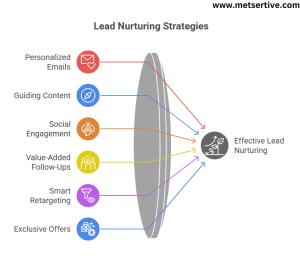
Lead Nurturing Strategies

  1. Personalized Email Campaigns

No more one-size-fits-all emails. Use segmentation and behavior data to tailor your emails to what each lead cares about most.

✔️ Try this: Use automation to send different follow-ups based on what a lead downloads or clicks.

  1. Content That Guides, Not Sells

Blog posts, whitepaper, case studies, guides, webinars and videos—these contents build authority and gently lead prospects to a decision.

✔️ Try this: Map your content to the buyer’s journey:

  • Awareness: Blogs, explainer videos
  • Consideration: Case studies, webinars
  • Decision: Free trials, testimonials
  1. Engage on Social Where They Are

Don’t just post—listen. Join conversations, answer questions, and stay relevant.

✔️ Try this: Use tools like Hootsuite or Sprout Social to monitor social media mentions and jump in with helpful info.

  1. Follow-Up Calls That Add Value

Calls don’t have to be cold. If a lead downloaded something or asked a question—call them!

✔️ Try this: Call with a specific reason like “I saw you checked out our case study. Want to dive into how we could help your team?”

  1. Smart Retargeting Ads

Remind visitors of what they left behind. Show them testimonials or free trials based on past behavior.

Retargeting leads based on their behavior and pairing it with tailored messaging is a powerful way to support your broader Inbound Marketing and Content Marketing strategy.

✔️ Try this: Retarget leads who visited your pricing page with a special offer.

  1. Prioritize with Lead Scoring

Not every lead is ready to buy. Use CRM and automation tools to assign scores based on actions like email opens, website visits, and content downloads.

✔️ Try this: Assign scores based on actions (opens, clicks, downloads) and set up alerts for high scorers.

  1. Run Educational Webinars

Position yourself as the expert. Webinars are a great way to educate and build trust. Hosting webinars and live Q&A sessions provides leads with in-depth knowledge about your products or industry while building trust and authority. These events also allow direct interaction with potential customers.

✔️ Try this: End each session with a low-pressure CTA like “Want help applying this to your business?”

  1. SMS Marketing (Yes, Really!)

People check their texts more than email. Use it wisely. Email isn’t the only channel for nurturing leads—SMS marketing allows for quick, direct, and personal communication. With high open rates, SMS can be a powerful tool for sending reminders, special offers, and follow-ups

✔️ Try this: Send a short, personalized message after a missed follow-up: “Hi Jamie, still interested in that free demo?”

  1. Use Customer Proof Like a Boss

People trust people. Show off those glowing reviews and case studies.

✔️ Try this: Add a “Real Results” or “Customer Stories” section to your site and include case studies in nurturing emails.

  1. Exclusive Offers and Discounts to Move the Needle

Providing special incentives for leads who have been engaging with your brand can push them toward making a purchase. Exclusive discounts, free trials, or early access to new features create urgency.

✔️ Try this: Segment leads based on engagement and offer tailored discounts (e.g., “As a valued subscriber, here’s 10% off your first purchase!“). Use countdown timers in emails to increase urgency.

These tactics, especially when fueled by Lead Generation and personalized nurture tracks, help push high-potential leads across the finish line.

Measure What Matters: Lead Nurturing Metrics to Track

To ensure your lead nurturing strategies are effective, it’s crucial to track and analyze key performance indicators (KPIs).

1. Conversion Rates

Monitor the percentage of nurtured leads that convert into customers. An increase indicates the effectiveness of your nurturing efforts.

2. Engagement Metrics

Assess open rates, click-through rates, and content engagement levels to gauge how well your audience is responding to your nurturing tactics.

3. Sales Cycle Length

A shorter sales cycle often results from effective lead nurturing, as prospects receive the information they need to make decisions faster.

4. Customer Lifetime Value (CLV)

Nurtured leads tend to become loyal customers. Tracking Customer Lifetime Value helps you understand the long-term value of your nurturing strategies.

Tracking and optimizing Lead Nurturing performance helps align your content, campaigns, and Customer Journey for predictable revenue growth.

Common Challenges in Lead Nurturing and How to Fix It

Even with the best intentions, lead nurturing can hit roadblocks. Here’s how to recognize them and tackle each one head-on—with practical examples and tools you can actually use.

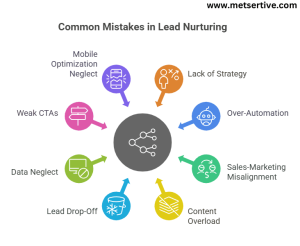
Common mistakes in Lead Nurturing

1: No Clear Strategy

What’s happening:
Without a structured plan, your messages might be inconsistent or misaligned with where the lead is in the sales funnel. This leads to confusion and lost opportunities.

How to fix it:

  • Map out the buyer’s journey: Awareness → Consideration → Decision.
  • Create a simple workflow that outlines what content or action happens at each stage.

Example:
Use a tool like HubSpot to visualize your funnel. If a lead downloads a guide (awareness), follow up with a case study (consideration), then offer a free consultation (decision).

Pro Tip: Integrate this with your CRM for a seamless experience (CRM integration).

2: Overusing Automation

What’s happening:
Yes, marketing automation is powerful—but overdoing it makes your communication feel robotic and impersonal.

How to fix it:

  • Use automated email drip campaigns, but personalize subject lines, content, and even timing.
  • Mix automation with real human interactions—especially for warm or high-value leads.

Example:
If a lead completes a webinar, don’t just send a templated follow-up. Add a personal note like, “Hey Sarah, I saw you attended our session on growing B2B pipelines. Curious if you’d like a 1:1 strategy call?”

Remember: the right balance between Email Drip Campaigns and human connection can keep your nurturing efforts feeling genuine and results-driven.

3: Sales and Marketing Aren’t Synced

What’s happening:
Misalignment leads to missed follow-ups, redundant communication, or even pitching the wrong solution to the wrong lead.

How to fix it:

  • Create a Service Level Agreement (SLA) that defines when a lead becomes “sales-ready.”
  • Sync both teams on a shared CRM to track lead stages, notes, and activity logs.

Example:
If marketing scores a lead as hot (based on lead scoring), sales should get an automated alert for immediate follow-up with a tailored pitch.

4: Content Overload

What’s happening:
Your leads are overwhelmed with content—and if it’s not relevant, they tune out.

How to fix it:

  • Focus on value-driven, stage-specific content. Don’t flood inboxes with every new blog post.
  • Use behavioral triggers (like clicks or downloads) to guide what you send next.

Example:
Instead of a general newsletter, send a targeted email: “You downloaded our eBook on lead generation—here’s a quick video that shows how it works in action.”

5: Leads Drop Off Over Time

What’s happening:
Sometimes leads just go cold. Life gets busy. Interest fades. But that doesn’t mean they’re gone forever.

How to fix it:

  • Launch re-engagement campaigns using exclusive content, surveys, or offers.
  • Use analytics to pinpoint where drop-off is happening.

Example:
Send a message like, “Still thinking about streamlining your funnel? Here’s a 20% discount just for you—expires in 3 days!”

Pro Tip: A/B test subject lines and offers to see what reactivates leads fastest.

6: Not Using Data to Personalize the Journey

What’s happening:
Many businesses send the same message to all leads, regardless of where they are in the sales funnel or what actions they’ve taken. This results in disengagement and lost trust.

How to fix it:

  • Tap into CRM data and analytics tools to personalize every touchpoint—emails, follow-ups, offers.
  • Use lead behavior (pages visited, content consumed) to tailor next steps.

Example:
If a lead has opened your emails but hasn’t clicked through, send a follow-up message with a different format—like a short video or infographic.

✔️ Tip: Combine CRM integration with tools like Hotjar or HubSpot’s tracking to create dynamic, behavior-based workflows.

Using behavioral insights from your CRM Integration and #Analytics tools lets you create dynamic nurturing flows tailored to each lead’s journey.

7: Weak or Generic Calls to Action (CTAs)

What’s happening:
Your emails or landing pages might be missing a clear next step—or worse, have CTAs that feel boring or irrelevant.

How to fix it:

  • Make CTAs ultra-specific and contextual. Every CTA should help the lead move one step closer to purchase.
  • Use action-driven phrases tied to value (“Get Your Free Funnel Audit” vs. “Learn More”).

Example:
In a lead scoring system, when a lead hits a certain threshold, trigger an email with the CTA: “Based on your recent interest, here’s your custom quote ready to review.”

✔️ Tip: A/B test CTAs in your email drip campaigns to optimize click-through rates.

Strong CTAs tied to user behavior within your Sales Funnel can dramatically improve engagement and lead velocity.

8: Ignoring Mobile Optimization

What’s happening:
A huge chunk of your audience is viewing emails and landing pages on mobile—but if the design is clunky or slow, they bounce.

How to fix it:

  • Ensure all your emails, landing pages, and lead magnets are fully responsive and optimized for mobile.
  • Compress images, shorten copy, and make CTAs easily tappable.

Example:
If you’re running an SMS campaign or email drip sequence, link to a mobile-optimized landing page with a one-click sign-up form or calendar integration.

✔️ Tip: Use tools like Google’s Mobile-Friendly Test or Mailchimp’s mobile preview to catch issues before launch.

Tech Tools That Supercharge Lead Nurturing

Using the right tools doesn’t just save time—it helps you deliver the right message to the right person at exactly the right moment. Here’s a breakdown of the best tech tools to power your lead nurturing engine:

  1. Customer Relationship Management (CRM) Integration

CRMs like HubSpot, Zoho, or Salesforce help you organize and track every interaction with your leads. They serve as the central brain of your lead nurturing efforts.

Actionable Tip:
Set up automated alerts for your sales team when a lead hits a specific lead scoring threshold.

Example:
When a lead downloads a pricing sheet and watches a demo, your CRM notifies a sales rep to follow up within 24 hours.

      2. Marketing Automation Platforms

These tools (like ActiveCampaign or Mailchimp) automate repetitive tasks such as email sends, behavior tracking, and campaign management, helping you scale your outreach.

Actionable Tip:
Use behavioral triggers to personalize your outreach—for example, send a case study if a lead viewed your services page twice in a week.

Example:
A new sign-up triggers a welcome sequence that includes three emails over five days, tailored to the user’s interests.

    3. Analytics and Tracking Tools

Tools like Google Analytics, Hotjar, or Crazy Egg show you how leads interact with your site—where they drop off, what they click, and what keeps them engaged.

Actionable Tip:
Track which blog posts or landing pages generate the most conversions and use them in your email drip campaigns.

Example:
You find that your “Free Tools” page gets the most visits. You now include it in all awareness-stage nurturing emails.

     4. AI-Powered Chatbots and Conversational Tools

Tools like Drift, ManyChat, and Intercom use AI to answer questions, qualify leads, and even book meetings—24/7, without human intervention.

Actionable Tip:
Script your chatbot to ask qualifying questions and route hot leads directly to a live rep when needed.

Example:
A chatbot asks, “What’s your biggest marketing challenge?” and based on the answer, offers a downloadable guide or books a strategy call.

   5. Interactive Content Platforms

Platforms like Outgrow, Typeform, or SurveyMonkey let you create calculators, quizzes, and surveys that collect data and drive engagement.

Actionable Tip:
Use interactive lead magnets to both capture and qualify leads based on their responses.

Combining Interactive Content with Lead Scoring and segmentation helps you not only capture more leads—but qualify and nurture them smarter.

 Final Word: Keep It Personal, Keep It Consistent

Lead nurturing isn’t about sending more emails. It’s about building relationships at scale with genuine value, smart timing, and tailored messages. For SMEs, this isn’t just effective—it’s essential.

So take a step today. Audit your current funnel, segment your list, or just send one personal check-in to a warm lead. Every small effort counts.

Effective Lead Nurturing isn’t just about communication—it’s about delivering value at every stage of the Customer Journey. With the right mix of Marketing Automation, Content Marketing, and CRM Integration, you can turn passive leads into loyal customers.

📞 Need help building a lead nurturing system that actually converts? Reach out—we’ll walk you through

What Is Sales Planning and How It Can Help SMEs Grow

What is sales planning? It’s a crucial strategy that helps small and medium-sized enterprises (SMEs) set clear sales objectives, identify target markets, and allocate resources effectively to drive business growth. In today’s competitive market, relying on guesswork is not an option—having a well-structured sales plan ensures that your business stays on track, maximizes revenue opportunities, and outperforms competitors. In this guide, we’ll explore how effective sales planning can transform your business, common pitfalls to avoid, and actionable insights to create a winning strategy.

Understanding What Is Sales Planning

Sales planning is a strategic process that involves setting sales objectives, identifying target markets, and outlining the tactics and resources necessary to achieve your business goals. It’s more than just forecasting sales figures; it’s about creating a comprehensive roadmap that aligns your sales activities with your company’s overarching objectives.

The Importance of Sales Planning for SMEs

For SMEs, a well-structured sales plan offers several benefits:

  • Clear Direction: It provides a focused path for your sales team, ensuring everyone works towards common goals.
  • Resource Optimization: By identifying key markets and strategies, you can allocate resources more efficiently.
  • Performance Measurement: Establishing benchmarks allows you to track progress and make informed adjustments.

Key Components of an Effective Sales Plan

To craft a robust sales plan, consider incorporating the following elements:

  1. Setting Clear, Achievable Sales Goals

Begin by defining what success looks like for your business. Are you aiming to increase revenue by 20% this year? Or perhaps expand into new markets? Setting Specific, Measurable, Achievable, Relevant, and Time-bound (SMART) goals provides a clear target for your team to strive towards.

  1. Analyzing Your Market Position

Understanding your current standing in the market is crucial. Conduct a SWOT analysis to identify your strengths, weaknesses, opportunities, and threats. This insight will inform your strategies and help you capitalize on your competitive advantages.


Building an Effective Sales Plan

  1. Identifying Target Customers

Who are your ideal customers? Develop detailed buyer personas that encompass demographics, preferences, and pain points. This targeted approach ensures your sales efforts resonate with those most likely to benefit from your offerings.

  1. Crafting a Unique Value Proposition

What sets your products or services apart? Clearly articulate the unique benefits you provide to differentiate yourself from competitors. A compelling value proposition is key to attracting and retaining customers.

  1. Developing Sales Strategies and Tactics

Outline the approaches your team will use to reach prospects and convert them into customers. This may include:

  1. Allocating Resources and Setting Budgets

Determine the resources—both human and financial—required to execute your sales plan. This includes setting budgets for marketing campaigns, sales tools, and training programs.

  1. Implementing Performance Metrics

Establish Key Performance Indicators (KPIs) to monitor your progress. Metrics such as conversion rates, customer acquisition costs, and sales cycle length provide actionable insights into your sales performance.

Actionable Insights for SMEs

Implementing an effective sales plan requires deliberate action. Here are eight powerful insights to help SMEs craft a sales strategy that drives growth:

1. Invest in Sales Training

Equip your team with the skills they need to succeed. Regular training sessions can enhance product knowledge, sales techniques, and customer service skills.

2. Leverage Technology

Utilize Customer Relationship Management (CRM) systems to track interactions, manage leads, and streamline your sales process. Tools like HubSpot or Salesforce can be invaluable assets.

3. Foster Cross-Department Collaboration

Encourage collaboration between your sales, marketing, and customer service teams. A unified approach ensures consistent messaging and a seamless customer experience.

4. Monitor and Adapt

Regularly review your sales performance against your KPIs. Be prepared to adapt your strategies in response to market changes or performance gaps.

5. Implement a Data-Driven Approach

Successful sales planning relies on data, not just intuition. Use analytics to track customer behavior, sales trends, and conversion rates. Google Analytics, CRM dashboards, and AI-driven insights can help fine-tune your approach.

6. Personalize the Sales Experience

Modern buyers expect personalized experiences. Leverage customer data to tailor your sales approach—whether through personalized email campaigns, targeted offers, or customized product recommendations—to increase conversions.

7. Optimize Your Sales Funnel

Map out your customer journey and identify bottlenecks in your sales funnel. Are leads dropping off at a certain stage? Are follow-ups inconsistent? Fixing these gaps will significantly improve your lead-to-customer conversion rate.

8. Set Up an Effective Follow-Up System

Many sales opportunities are lost due to poor follow-up. Implement a structured follow-up system with automated email sequences, CRM reminders, and scheduled check-ins to nurture leads effectively.

By implementing these eight actionable insights, SMEs can refine their sales planning process, maximize revenue, and build a scalable business model.

Common Pitfalls to Avoid in Sales Planning

Even the most well-intentioned sales plans can fall short due to common mistakes. Here are eight pitfalls SMEs should avoid when crafting an effective sales plan:


Pitfalls to avoid in Sales Planning

1. Not Clearly Defining What Is Sales Planning for Your Business

Many SMEs jump into sales activities without first understanding what is sales planning in the context of their specific industry. Without a clear definition and structured approach, sales efforts become scattered and ineffective.

2. Ignoring Market Research

Failing to analyze your market, competitors, and customer behavior can lead to misguided sales strategies. Invest time in thorough market research to make informed decisions.

3. Targeting the Wrong Audience

Trying to sell to everyone dilutes your efforts. Clearly define your buyer personas and tailor your messaging to address their specific needs and pain points.

4. Overlooking Customer Retention

Many businesses focus solely on acquiring new customers and neglect customer retention. Repeat customers tend to spend more and refer others, so include loyalty programs and after-sales engagement in your plan.

5. Failing to Align Sales and Marketing

Sales and marketing teams often work in silos, leading to inconsistent messaging. Ensure cross-departmental collaboration to create a seamless customer journey.

6. Not Setting a Realistic Budget

A well-crafted sales plan requires adequate financial backing. Underestimating marketing costs, training expenses, or sales tools can hinder execution. Allocate resources strategically to support your plan.

7. Neglecting Sales Team Training

Even the best sales plan will fail if your team lacks the necessary skills. Regular sales training and coaching ensure they stay updated on industry trends, negotiation techniques, and product knowledge.

8. Failure to Track and Adjust

A sales plan should not be static. Failing to track Key Performance Indicators (KPIs) and adjust your strategies based on real-time data can result in missed opportunities. Regularly analyze your performance and refine your approach as needed.

By avoiding these pitfalls, SMEs can create a robust sales plan that not only drives revenue but also fosters long-term business growth.

Conclusion

Effective sales planning is a cornerstone of success for SMEs. By setting clear goals, understanding your market, and implementing strategic actions, you can drive growth and position your business for long-term prosperity. Remember, a well-crafted sales plan is not static; it requires continuous evaluation and adaptation to stay aligned with your business objectives and market dynamics.